


 |
市場調查報告書
商品編碼
2083057
人工智慧在電網管理的應用:市場機會、成長要素、產業趨勢分析及2026-2035年預測AI in Power Grid Management Market Opportunity, Growth Drivers, Industry Trend Analysis, and Forecast 2026 - 2035 |
||||||

2025 年全球電網管理人工智慧市場價值 84 億美元,預計到 2035 年將以 17.7% 的複合年成長率成長至 467 億美元。
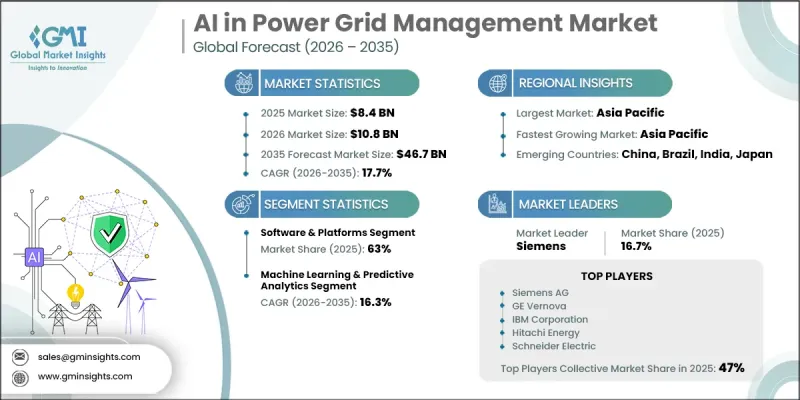
隨著電力公司擴大採用智慧技術來改善電網監控、預測性維護和即時運行決策,人工智慧在電網管理領域的市場正經歷顯著成長。再生能源來源的日益併網也使電網運作變得更加複雜,促使電力公司採用人工智慧解決方案,以更有效地平衡供需和分散式能源。人工智慧能夠幫助電力公司從被動維護轉向預測性電網管理,透過在故障發生前識別設備問題並利用進階分析最佳化運行性能來實現這一目標。這些能力有助於縮短平均修復時間 (MTTR)、降低營運成本並提高電網整體可靠性。隨著人工智慧的應用不斷從試點計畫轉向全面商業部署,全球能源產業正在進行的數位轉型有望推動電網管理領域人工智慧市場的發展。
| 市場範圍 | |
|---|---|
| 開始年份 | 2025 |
| 預測期 | 2026-2035 |
| 上市時的市場規模 | 84億美元 |
| 預測金額 | 467億美元 |
| 複合年成長率 | 17.7% |
軟體和平台領域預計在2025年將佔據63%的市場佔有率,並在2035年之前保持16.9%的複合年成長率。該領域之所以能保持其主導地位,是因為軟體解決方案透過支援進階分析、決策和人工智慧模型的部署,為更智慧的公共產業營運奠定了基礎。此領域涵蓋企業能源管理系統、配電管理平台以及旨在改善故障預測、需量反應管理、可再生能源併網和整體電網最佳化的機器學習軟體。對於尋求提高營運效率和增強電網效能的公用事業營運商而言,持續投資於智慧軟體平台仍然至關重要。
預計到2025年,機器學習和預測分析領域將佔據35%的市場佔有率,並在2035年之前以16.3%的複合年成長率成長。該領域之所以佔據市場領先地位,是因為機器學習技術被廣泛應用於眾多電網管理功能,包括電力需求預測、預測性維護和異常檢測。電力公司提供的大量歷史數據、機器學習開發工具的成熟度以及預測模型能夠提供符合營運和監管要求的透明可靠洞察,都為該領域的快速發展提供了有力支撐。這些優勢將持續鞏固機器學習在現代電網管理中的作用。
預計到2025年,北美電網管理領域的人工智慧市場佔有率將達到38.5%,並在2035年之前以17.6%的複合年成長率成長。區域市場成長的主要驅動力是電網現代化、數位化電力基礎設施以及能夠提升電網韌性和運作效率的先進技術投資的增加。該地區的電力公司持續優先考慮人工智慧技術,以增強電力系統的可靠性、支援脫碳進程並最佳化可再生能源併網,從而進一步鞏固北美在全球市場的領先地位。
目錄
第1章:調查方法和範圍
第2章執行摘要
第3章 行業洞察
- 產業生態系分析
- 影響產業的因素
- 促進因素
- 產業潛在風險與挑戰
- 成長潛力分析
- 監理情勢
- 波特的分析
- PESTLE分析
- 技術與創新展望
- 人工智慧和機器學習在電網管理的應用
- 基於物聯網的電廠狀態監測
- 在電網資產中應用數位孿生技術
- 邊緣運算和即時分析
- 價格分析
- 按組件分類的價格趨勢
- 人工智慧和生成式人工智慧對市場的影響
- 人工智慧驅動的預測性維護和故障檢測
- 生成式人工智慧在維護計畫和資產管理的應用案例
- 自主維護與決策智慧
- 風險、限制與網路安全挑戰
- 新機會和趨勢
- 投資分析及未來展望
第4章 競爭情勢
- 介紹
- 企業市佔率分析:按地區分類
- 北美洲
- 歐洲
- 亞太地區
- 中東和非洲
- 拉丁美洲
- 競爭定位矩陣
- 主要進展
- 併購
- 夥伴關係和聯盟
- 新產品發布
- 業務拓展計劃及資金籌措
第5章 市場規模及預測:依組件分類,2022-2035年
- 軟體平台
- 網格分析與情境察覺平台
- 人工智慧整合的SCADA和能源管理系統
- 需求預測與負載最佳化軟體
- 其他
- 服務
- 諮詢和顧問服務
- 系統整合和實施服務
- 其他
第6章 市場規模與預測:依人工智慧技術分類,2022-2035年
- 機器學習和預測分析
- 深度學習與神經網路
- 電腦視覺和影像處理
- 其他
第7章 市場規模及預測:依應用領域分類,2022-2035年
- 需求預測與負載管理
- 故障檢測和預測性維護
- 最佳化電網並調整能源平衡
- 可再生能源併網
- 其他
第8章 市場規模及預測:依最終用戶分類,2022-2035年
- 私營電力公司(IOU)
- 公有電力公司和合作社
- 工業和商業微電網
- 其他
第9章 市場規模及預測:依地區分類,2022-2035年
- 北美洲
- 美國
- 加拿大
- 墨西哥
- 歐洲
- 德國
- 英國
- 法國
- 丹麥
- 瑞典
- 亞太地區
- 中國
- 日本
- 印度
- 韓國
- 澳洲
- 中東和非洲
- 沙烏地阿拉伯
- UAE
- 南非
- 拉丁美洲
- 巴西
- 智利
第10章:公司簡介
- ABB
- AspenTech
- AVEVA
- Baker Hughes
- BluWave-ai
- Buzz Solutions
- C3.ai
- Cognite
- Enel Group
- Envision Digital
- GE Vernova
- GridBeyond
- Hitachi Energy
- Honeywell
- IBM
- Oracle Utilities
- Schneider Electric
- Siemens
- Toshiba Energy Systems
- Uplight
- Utilidata
The Global AI in Power Grid Management Market was valued at USD 8.4 billion in 2025 and is estimated to grow at a CAGR of 17.7% to reach USD 46.7 billion by 2035.
The AI in power grid management market is witnessing significant growth as electric utilities increasingly adopt intelligent technologies to improve grid monitoring, predictive maintenance, and real-time operational decision-making. Rising pressure to reduce unplanned power outages, improve service reliability, and modernize aging transmission and distribution infrastructure is accelerating the deployment of artificial intelligence across utility networks. At the same time, the growing integration of renewable energy sources is increasing the complexity of grid operations, encouraging utilities to implement AI-powered solutions capable of balancing supply, demand, and distributed energy resources more efficiently. Artificial intelligence is enabling utilities to shift from reactive maintenance to predictive grid management by identifying equipment issues before failures occur and optimizing operational performance through advanced analytics. These capabilities help reduce mean time to repair (MTTR), lower operating expenses, and improve overall grid reliability. As AI adoption continues to move beyond pilot initiatives toward full-scale commercial deployment, the AI in power grid management market is expected to benefit from ongoing digital transformation initiatives across the global energy sector.
| Market Scope | |
|---|---|
| Start Year | 2025 |
| Forecast Year | 2026-2035 |
| Start Value | $8.4 Billion |
| Forecast Value | $46.7 Billion |
| CAGR | 17.7% |
The software and platforms segment accounted for 63% share in 2025 and is expected to register a CAGR of 16.9% through 2035. This segment maintains its dominant position because software solutions serve as the foundation for intelligent utility operations by supporting advanced analytics, decision-making, and AI model deployment. The segment includes enterprise energy management systems, distribution management platforms, and machine learning-enabled software designed to improve fault prediction, demand response management, renewable energy integration, and overall grid optimization. Continued investment in intelligent software platforms remains essential for utilities seeking greater operational efficiency and enhanced grid performance.
The machine learning and predictive analytics segment represented 35% share in 2025 and is projected to grow at a CAGR of 16.3% during 2035. This segment leads the market because machine learning technologies are widely applied across numerous grid management functions, including electricity demand forecasting, predictive equipment maintenance, and anomaly detection. Strong adoption is supported by the availability of extensive historical utility data, the maturity of machine learning development tools, and the ability of predictive models to deliver transparent, reliable insights that align with operational and regulatory requirements. These advantages continue to strengthen the role of machine learning in modern power grid management.
North America AI in Power Grid Management Market accounted for 38.5% share in 2025 and is projected to grow at a CAGR of 17.6% throughout 2035. Regional market growth is primarily driven by increasing investments in grid modernization, digital utility infrastructure, and advanced technologies that improve grid resilience and operational efficiency. Utilities across the region continue to prioritize artificial intelligence to strengthen power system reliability, support decarbonization initiatives, and optimize renewable energy integration, reinforcing North America's leadership within the global market.
Major companies operating in the global AI in power grid management market include Siemens, ABB, Oracle Utilities, Honeywell, GridBeyond, Cognite, Baker Hughes, Toshiba Energy Systems, AVEVA, Uplight, C3.ai, IBM, Hitachi Energy, BluWave-ai, GE Vernova, AspenTech, Schneider Electric, Envision Digital, Utilidata, Buzz Solutions, and Enel Group. Companies operating in the AI in power grid management market are strengthening their competitive position by investing in advanced artificial intelligence algorithms, cloud-based grid management platforms, and predictive analytics solutions that improve utility performance and operational efficiency. Many organizations are expanding research and development activities to enhance machine learning capabilities, automate grid operations, and improve renewable energy management. Strategic collaborations with utility providers, technology companies, and energy infrastructure operators are accelerating product deployment and expanding market reach. Businesses are also focusing on scalable software platforms, cybersecurity enhancements, and real-time analytics to address evolving utility requirements.
Table of Contents
Chapter 1 Methodology & Scope
- 1.1 Research approach
- 1.2 Quality commitment
- 1.2.1 GMI AI policy & data integrity commitment
- 1.2.1.1 Source consistency protocol
- 1.2.1 GMI AI policy & data integrity commitment
- 1.3 Research Trail & Confidence Scoring
- 1.3.1 Research Trail Components
- 1.3.2 Scoring Components
- 1.4 Data Collection
- 1.4.1 Partial list of primary sources
- 1.5 Data mining sources
- 1.5.1 Paid sources
- 1.5.1.1 Sources, by region
- 1.5.1 Paid sources
- 1.6 Base estimates and calculations
- 1.6.1 Base year calculation for any one approach
- 1.7 Forecast model
- 1.8 Research transparency addendum
- 1.8.1 Source attribution framework
- 1.8.2 Quality assurance metrics
- 1.8.3 Our commitment to trust
- 1.8.3.1 Market definitions
Chapter 2 Executive Summary
- 2.1 Industry synopsis, 2022 - 2035
- 2.2 Business trends
- 2.3 Component trends
- 2.4 AI technology trends
- 2.5 Application trends
- 2.6 End User trends
- 2.7 Regional trends
Chapter 3 Industry Insights
- 3.1 Industry ecosystem analysis
- 3.2 Industry impact forces
- 3.2.1 Growth drivers
- 3.2.2 Industry pitfalls & challenges
- 3.3 Growth potential analysis
- 3.4 Regulatory landscape
- 3.5 Porter's analysis
- 3.5.1 Bargaining power of suppliers
- 3.5.2 Bargaining power of buyers
- 3.5.3 Threat of new entrants
- 3.5.4 Threat of substitutes
- 3.6 PESTEL analysis
- 3.7 Technology & Innovation Landscape
- 3.7.1 AI & machine learning in power grid management
- 3.7.2 IoT-enabled condition monitoring in power plants
- 3.7.3 Digital twin applications in power grid assets
- 3.7.4 Edge computing & real-time analytics
- 3.8 Pricing Analysis (Driven by Primary Research)
- 3.8.1 Pricing trends by Component
- 3.9 Impact of AI & generative AI on the market
- 3.9.1 AI-driven Predictive Maintenance & Fault Detection
- 3.9.2 GenAI use cases in maintenance planning & asset management
- 3.9.3 Autonomous maintenance & decision intelligence
- 3.9.4 Risks, limitations & cybersecurity challenges
- 3.10 Emerging opportunities & trends
- 3.11 Investment analysis & future outlook
Chapter 4 Competitive Landscape, 2026
- 4.1 Introduction
- 4.2 Company market share analysis, by region, 2025
- 4.2.1 North America
- 4.2.2 Europe
- 4.2.3 Asia Pacific
- 4.2.4 Middle East & Africa
- 4.2.5 Latin America
- 4.3 Competitive positioning matrix
- 4.4 Key Developments
- 4.4.1 Mergers & acquisitions
- 4.4.2 Partnerships & collaborations
- 4.4.3 New product launches
- 4.4.4 Expansion plans and funding
Chapter 5 Market Size and Forecast, By Component, 2022 - 2035 (USD Million)
- 5.1 Key trends
- 5.2 Software & platforms
- 5.2.1 Grid analytics & situational awareness platforms
- 5.2.2 AI-integrated SCADA & energy management systems
- 5.2.3 Demand forecasting & load optimization software
- 5.2.4 Others
- 5.3 Services
- 5.3.1 Consulting & advisory services
- 5.3.2 System integration & implementation services
- 5.3.3 Others
Chapter 6 Market Size and Forecast, By AI Technology, 2022 - 2035 (USD Million)
- 6.1 Key trends
- 6.2 Machine learning & predictive analytics
- 6.3 Deep learning & neural networks
- 6.4 Computer vision & image processing
- 6.5 Others
Chapter 7 Market Size and Forecast, By Application, 2022 - 2035 (USD Million)
- 7.1 Key trends
- 7.2 Demand forecasting & load management
- 7.3 Fault detection & predictive maintenance
- 7.4 Grid optimization & energy balancing
- 7.5 Renewable energy integration
- 7.6 Others
Chapter 8 Market Size and Forecast, By End User, 2022 - 2035 (USD Million)
- 8.1 Key trends
- 8.2 Investor-Owned Utilities (IOUs)
- 8.3 Public power utilities & cooperatives
- 8.4 Industrial & commercial microgrids
- 8.5 Others
Chapter 9 Market Size and Forecast, By Region, 2022 - 2035 (USD Million)
- 9.1 Key trends
- 9.2 North America
- 9.2.1 U.S.
- 9.2.2 Canada
- 9.2.3 Mexico
- 9.3 Europe
- 9.3.1 Germany
- 9.3.2 UK
- 9.3.3 France
- 9.3.4 Denmark
- 9.3.5 Sweden
- 9.4 Asia Pacific
- 9.4.1 China
- 9.4.2 Japan
- 9.4.3 India
- 9.4.4 South Korea
- 9.4.5 Australia
- 9.5 Middle East & Africa
- 9.5.1 Saudi Arabia
- 9.5.2 UAE
- 9.5.3 South Africa
- 9.6 Latin America
- 9.6.1 Brazil
- 9.6.2 Chile
Chapter 10 Company Profiles
- 10.1 ABB
- 10.2 AspenTech
- 10.3 AVEVA
- 10.4 Baker Hughes
- 10.5 BluWave-ai
- 10.6 Buzz Solutions
- 10.7 C3.ai
- 10.8 Cognite
- 10.9 Enel Group
- 10.10 Envision Digital
- 10.11 GE Vernova
- 10.12 GridBeyond
- 10.13 Hitachi Energy
- 10.14 Honeywell
- 10.15 IBM
- 10.16 Oracle Utilities
- 10.17 Schneider Electric
- 10.18 Siemens
- 10.19 Toshiba Energy Systems
- 10.20 Uplight
- 10.21 Utilidata

 2026-2034年全球人工智慧市場規模、佔有率、趨勢和成長分析報告(電力系統管理)
 2034年智慧電網人工智慧市場預測-全球分析(按組件、人工智慧技術、部署模型、電網層、應用、公用事業功能、資料來源、電網類型、企業規模、最終用戶和地區分類)
 智慧電網數據分析:市場佔有率分析、產業趨勢與統計、成長預測(2026-2031)頻率調節市場預測至2034年-按調節類型、控制機制、技術、應用、最終用戶和地區分類的全球分析
 網格最佳化解決方案市場規模、佔有率和成長分析:按解決方案、技術、最終用戶、部署類型和地區分類-2026-2033年產業預測
 智慧電網數據分析市場:按部署類型、應用、解決方案、最終用戶產業和地區分類
 2026年智慧電網巨量資料分析全球市場報告
 網格最佳化解決方案市場報告:按類型、應用和地區分類 2026-2034 年2026年全球網格分析軟體市場報告2026年全球電網邊緣相位辨識分析市場報告