


 |
市場調查報告書
商品編碼
2083051
巡航飛彈市場機會、成長要素、產業趨勢分析及2026-2035年預測。Cruise Missile Market Opportunity, Growth Drivers, Industry Trend Analysis, and Forecast 2026 - 2035 |
||||||

據估計,到 2025 年,全球巡航飛彈市場價值為 62 億美元,年複合成長率為 7.8%,到 2035 年將達到 129 億美元。
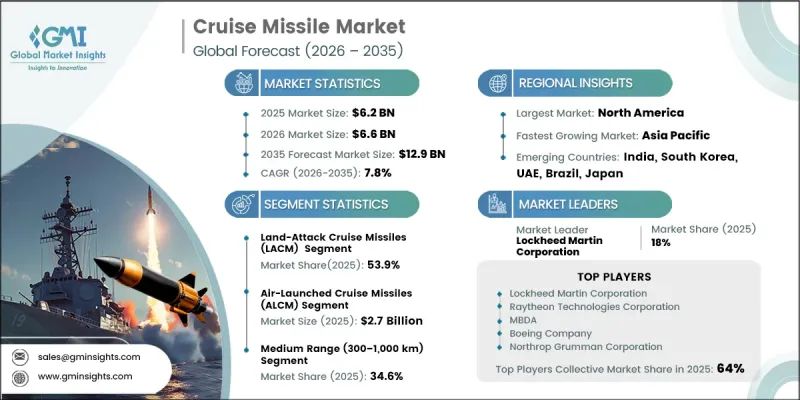
市場成長的驅動力來自對精確導引遠程打擊能力日益成長的需求、先進防禦系統部署的擴大、海軍現代化計畫的推進以及對國內導彈研發項目投資的增加。全球國防機構日益關注能夠在打擊戰略目標的同時保持作戰安全距離並最大限度降低人員和軍事平台風險的先進打擊技術。精確戰術日益重要以及不斷變化的安全挑戰正在加速採購活動,並支持對先進飛彈系統的長期投資。此外,不斷擴大的海上安全需求和海軍艦隊的現代化顯著增加了對海上打擊能力的需求。國防自主性、技術進步以及對戰略阻礙力的持續關注進一步促進了市場擴張。在全球國防費用和現代化計畫的持續支持下,隨著各國軍隊加強作戰準備並提升精確打擊能力,巡航飛彈市場預計將在未來十年保持強勁的成長勢頭。
| 市場範圍 | |
|---|---|
| 開始年份 | 2025 |
| 預測期 | 2026-2035 |
| 初始市場規模 | 62億美元 |
| 預計金額 | 129億美元 |
| 複合年成長率 | 7.8% |
到2025年,陸攻巡航飛彈市佔率將達到53.9%。此細分市場的主導地位源自於其在現代精確打擊行動和遠程交戰策略中的關鍵作用。這些飛彈系統使部隊能夠從遠距離精確打擊受保護的戰略要地,從而降低作戰過程中發射平台被擊中的風險。對跨多種軍事平台廣泛部署相容性和多功能任務能力的日益成長的需求,持續推動著該細分市場的強勁成長。
中程武器系統射程在300至1000公里之間,預計到2025年將佔全球市場佔有率的34.6%。此細分市場的優勢在於其作戰效能、部署柔軟性和成本合理性的平衡。中程武器系統廣泛應用於戰術性打擊任務、區域威懾行動和海上作戰,仍然是許多國防機構的首選。在保持成本效益的同時提供有效的遠端打擊能力,持續推動採購活動並支撐著該細分市場的成長。
預計到2025年,北美巡弋飛彈市場佔有率將達到37.6%,繼續保持其作為全球最大區域市場的地位。這一區域成長主要得益於遠程打擊能力的現代化、先進國防技術的進步以及對軍事能力提升項目的持續投入。市場需求涵蓋多種飛彈類型和軍事應用,並得到高度發展的國防工業基礎、大規模採購計畫和持續現代化建設的支持。強大的研發能力、先進的製造基礎設施以及長期的國防投資策略,將繼續鞏固北美在全球巡航飛彈產業的領先地位。
目錄
第1章:調查方法和範圍
第2章執行摘要
第3章 行業洞察
- 產業生態系分析
- 供應商情況
- 利潤率
- 成本結構
- 每個階段增加的價值
- 影響價值鏈的因素
- 中斷
- 影響產業的因素
- 促進因素
- 電動車的快速普及增加了對IGBT和SiC的需求。
- 工業自動化的發展正在推動電源模組的需求成長。
- 能源效率法規要求採用先進的電力電子設備。
- 資料中心的電源最佳化導致 MOSFET 功耗增加。
- 快速充電基礎設施的擴展正在推動對寬能隙半導體的需求。
- 產業潛在風險與挑戰
- SiC和GaN元件的製造成本高昂
- 供應鏈中對數量有限的晶圓供應商的依賴
- 市場機遇
- 在800V電動車平台中採用SiC
- 智慧電網的升級改造增加了對高功率分立元件的需求。
- 促進因素
- 成長潛力分析
- 監理情勢
- 北美洲
- 歐洲
- 亞太地區
- 拉丁美洲
- 中東和非洲
- 波特的分析
- PESTLE分析
- 技術與創新展望
- 最新科技趨勢
- 新興技術
- 價格分析
- 歷史價格分析(2022-2025)
- 依球員類型分類的定價策略(高級球員、超值球員、成本加成球員)
- 人工智慧和生成式人工智慧對市場的影響
- 利用人工智慧改造現有經營模式
- 按細分市場分類的生成式人工智慧用例和部署藍圖
- 風險、限制和監管考量
- 生產能力和生產情況
- 設備產能:按地區和主要生產商分類
- 運轉率和擴張計劃
第4章 競爭情勢
- 企業市佔率分析
- 按地區
- 北美洲
- 歐洲
- 亞太地區
- 拉丁美洲
- 中東和非洲
- 市場集中度分析
- 按地區
- 主要市場公司的競爭分析
- 競爭定位矩陣
- 主要進展
- 併購
- 夥伴關係和聯盟
- 新產品發布
- 業務拓展計劃及資金籌措
- 按公司規模進行基準測試
- 排名分類標準與遴選標準
- 按銷售額、地區和創新能力分類的層級定位矩陣。
第5章 市場估計與預測:依飛彈類型分類,2022-2035年
- 陸攻巡弋飛彈(LACM)
- 反艦巡航飛彈(ASCM)
- 陸攻反艦巡航飛彈
第6章 市場估價與預測:依彈頭類型分類,2022-2035年
- 傳統的
- 核
第7章 市場估價與預測:依發布平台分類,2022-2035年
- 空射飛彈防禦系統(ALCM)
- 海基飛彈防禦系統(SLCM)
- 地面發射(GLCM)
第8章 市場估計與預測:依範圍分類,2022-2035年
- 短距離(小於300公里)
- 中等距離(300-1000公里)
- 長途(1000-2500公里)
- 超長距離(超過2500公里)
第9章 市場估計與預測:依速度分類,2022-2035年
- 亞音速
- 超音速
- 高超音速
第10章 市場估價與預測:依地區分類,2022-2035年
- 北美洲
- 美國
- 加拿大
- 歐洲
- 德國
- 英國
- 法國
- 西班牙
- 義大利
- 俄羅斯
- 亞太地區
- 中國
- 印度
- 日本
- 澳洲
- 韓國
- 拉丁美洲
- 巴西
- 墨西哥
- 阿根廷
- 中東和非洲
- 南非
- 沙烏地阿拉伯
- UAE
第11章:公司簡介
- 全球主要公司
- Lockheed Martin Corporation
- Raytheon Technologies Corporation
- MBDA
- Boeing Company
- Northrop Grumman Corporation
- 該地區的主要公司
- 亞太地區
- BrahMos Aerospace Pvt. Ltd.
- China Aerospace Science and Industry Corporation(CASIC)
- 歐洲
- Kongsberg Defence &Aerospace AS
- Middle East &Africa
- Roketsan AS
- Rafael Advanced Defense Systems Ltd.
- Israel Aerospace Industries
- 亞太地區
- 小眾玩家/顛覆者
- Avibras Industria Aeroespacial S/A
- LIG Nex1
- Elbit Systems
The Global Cruise Missile Market was valued at USD 6.2 billion in 2025 and is estimated to grow at a CAGR of 7.8% to reach USD 12.9 billion by 2035.
Market growth is driven by rising demand for precision-guided long-range strike capabilities, increasing deployment of sophisticated defense systems, expanding naval modernization initiatives, and growing investments in domestic missile development programs. Defense organizations across the world are placing greater emphasis on advanced strike technologies that enable engagement of strategic targets while maintaining operational stand-off distances and minimizing risks to personnel and military platforms. The growing importance of precision warfare and evolving security challenges are accelerating procurement activities and supporting long-term investment in advanced missile systems. In addition, expanding maritime security requirements and the modernization of naval fleets are generating significant demand for sea-based strike capabilities. Continued focus on defense self-sufficiency, technological advancement, and strategic deterrence is further contributing to market expansion. As military forces seek to strengthen operational readiness and enhance precision engagement capabilities, the cruise missile market is expected to maintain a strong growth trajectory over the coming decade, supported by sustained defense spending and modernization programs worldwide.
| Market Scope | |
|---|---|
| Start Year | 2025 |
| Forecast Year | 2026-2035 |
| Start Value | $6.2 Billion |
| Forecast Value | $12.9 Billion |
| CAGR | 7.8% |
The land-attack cruise missiles segment accounted for 53.9% share in 2025. The segment's dominance is attributed to its critical role in modern precision-strike operations and long-range engagement strategies. These missile systems provide armed forces with the ability to accurately engage protected and strategically important targets from extended distances, reducing the exposure of launch platforms during operations. Broad deployment compatibility across multiple military platforms and increasing demand for versatile mission capabilities continue to support strong growth within this segment.
The medium-range segment, covering distances between 300 and 1,000 kilometers, held a 34.6% share in 2025. The segment benefits from its balance of operational effectiveness, deployment flexibility, and procurement affordability. Medium-range systems are widely utilized for tactical strike missions, regional deterrence operations, and maritime engagement requirements, making them a preferred choice for many defense organizations. Their ability to provide meaningful stand-off capability while maintaining cost efficiency continues to drive procurement activity and support segment growth.
North America Cruise Missile Market accounted for 37.6% share in 2025, maintaining its position as the largest regional market. Regional growth is supported by ongoing investments in long-range strike modernization, advanced defense technologies, and military capability enhancement programs. Demand spans a broad range of missile categories and military applications, supported by a highly developed defense industrial base, extensive procurement programs, and continuous modernization initiatives. Strong research and development capabilities, advanced manufacturing infrastructure, and long-term defense investment strategies continue to reinforce North America's leadership within the global cruise missile industry.
Leading companies operating in the global cruise missile market include MBDA, Raytheon Technologies Corporation, Lockheed Martin Corporation, Northrop Grumman Corporation, Boeing Company, Kongsberg Defence & Aerospace AS, Rafael Advanced Defense Systems Ltd., BrahMos Aerospace Pvt. Ltd., Roketsan A.S., Israel Aerospace Industries, China Aerospace Science and Industry Corporation (CASIC), LIG Nex1, Elbit Systems, and Avibras Industria Aeroespacial S/A. Companies participating in the cruise missile market are implementing a range of strategic initiatives to strengthen their competitive position and expand market presence. Significant investments in research and development remain a primary focus, enabling manufacturers to improve guidance systems, propulsion technologies, precision targeting capabilities, and overall operational effectiveness. Strategic partnerships, defense collaborations, and joint development programs are helping companies accelerate innovation while securing access to new procurement opportunities. Many market participants are also emphasizing indigenous production capabilities and technology localization to address growing demand for defense self-reliance. Product portfolio diversification, modernization of existing missile platforms, and integration of advanced digital technologies are further supporting competitive differentiation.
Table of Contents
Chapter 1 Methodology and Scope
- 1.1 Market scope and definition
- 1.2 Research design
- 1.2.1 Research approach
- 1.2.2 Data collection methods
- 1.3 Data mining sources
- 1.3.1 Global
- 1.3.2 Regional/Country
- 1.4 Base estimates and calculations
- 1.4.1 Base year calculation
- 1.4.2 Key trends for market estimation
- 1.5 Primary research and validation
- 1.5.1 Primary sources
- 1.6 Forecast model
- 1.7 Research assumptions and limitations
Chapter 2 Executive Summary
- 2.1 Industry 360° synopsis, 2022 - 2035
- 2.2 Key market trends
- 2.2.1 Missile type trends
- 2.2.2 Warhead type trends
- 2.2.3 Launch platform trends
- 2.2.4 Range trends
- 2.2.5 Speed trends
- 2.2.6 Regional trends
- 2.3 TAM Analysis, 2026-2035
- 2.4 CXO perspectives: Strategic imperatives
Chapter 3 Industry Insights
- 3.1 Industry ecosystem analysis
- 3.1.1 Supplier Landscape
- 3.1.2 Profit Margin
- 3.1.3 Cost structure
- 3.1.4 Value addition at each stage
- 3.1.5 Factor affecting the value chain
- 3.1.6 Disruptions
- 3.2 Industry impact forces
- 3.2.1 Growth drivers
- 3.2.1.1 Rapid EV adoption increasing IGBT and SiC demand
- 3.2.1.2 Industrial automation growth raising demand for power modules
- 3.2.1.3 Energy efficiency regulations mandating advanced power electronics
- 3.2.1.4 Data center power optimization increasing MOSFET consumption
- 3.2.1.5 Fast-charging infrastructure expansion boosting wide-bandgap semiconductors
- 3.2.2 Industry pitfalls and challenges
- 3.2.2.1 High manufacturing cost of SiC and GaN devices
- 3.2.2.2 Supply chain dependence on limited wafer suppliers
- 3.2.3 Market opportunities
- 3.2.3.1 Adoption of SiC in 800V electric vehicle platforms
- 3.2.3.2 Smart grid upgrades increasing demand for high-power discrete devices
- 3.2.1 Growth drivers
- 3.3 Growth potential analysis
- 3.4 Regulatory landscape
- 3.4.1 North America
- 3.4.2 Europe
- 3.4.3 Asia Pacific
- 3.4.4 Latin America
- 3.4.5 Middle East & Africa
- 3.5 Porter’s analysis
- 3.6 PESTEL analysis
- 3.7 Technology and Innovation landscape
- 3.7.1 Current technological trends
- 3.7.2 Emerging technologies
- 3.8 Price Analysis (Driven by Primary Research)
- 3.8.1 Historical Price Analysis (2022-2025)
- 3.8.2 Pricing Strategy by Player Type (Premium / Value / Cost-plus)
- 3.9 Impact of AI & Generative AI on the Market (Driven by Primary Research)
- 3.9.1 AI-Driven Disruption of Existing Business Models
- 3.9.2 GenAI Use Cases & Adoption Roadmap by Segment
- 3.9.3 Risks, Limitations & Regulatory Considerations
- 3.10 Capacity & Production Landscape (Driven by Primary Research)
- 3.10.1 Installed Capacity by Region & Key Producer
- 3.10.2 Capacity Utilization Rates & Expansion Pipelines
Chapter 4 Competitive Landscape, 2025
- 4.1 Company market share analysis, 2025
- 4.1.1 By Region
- 4.1.1.1 North America
- 4.1.1.2 Europe
- 4.1.1.3 Asia-Pacific
- 4.1.1.4 Latin America
- 4.1.1.5 Middle East and Africa
- 4.1.2 Market Concentration Analysis
- 4.1.1 By Region
- 4.2 Competitive analysis of major market players
- 4.3 Competitive positioning matrix
- 4.3.1 Key developments
- 4.3.2 Mergers & acquisitions
- 4.3.3 Partnerships & collaborations
- 4.3.4 New product launches
- 4.3.5 Expansion plans and funding
- 4.4 Company tier benchmarking
- 4.4.1 Tier classification criteria & qualifying thresholds
- 4.4.2 Tier positioning matrix by revenue, geography & innovation
Chapter 5 Market Estimates and Forecast, By Missile Type, 2022 - 2035 (USD Million & Units)
- 5.1 Key trends
- 5.2 Land-attack cruise missiles (LACM)
- 5.3 Anti-ship cruise missiles (ASCM)
- 5.4 Anti-surface cruise missiles (dual land/sea)
Chapter 6 Market Estimates and Forecast, By Warhead Type, 2022 - 2035 (USD Million & Units)
- 6.1 Key trends
- 6.2 Conventional
- 6.3 Nuclear
Chapter 7 Market Estimates and Forecast, By Launch Platform, 2022 - 2035 (USD Million & Units)
- 7.1 Key trends
- 7.2 Air-launched (ALCM)
- 7.3 Sea-launched (SLCM)
- 7.4 Ground-launched (GLCM)
Chapter 8 Market Estimates and Forecast, By Range, 2022 - 2035 (USD Million & Units)
- 8.1 Key trends
- 8.2 Short range (< 300 km)
- 8.3 Medium range (300-1,000 km)
- 8.4 Long-range (1,000-2,500 km)
- 8.5 Very long-range (> 2,500 km)
Chapter 9 Market Estimates and Forecast, By Speed, 2022 - 2035 (USD Million & Units)
- 9.1 Key trends
- 9.2 Subsonic
- 9.3 Supersonic
- 9.4 Hypersonic
Chapter 10 Market Estimates and Forecast, By Region, 2022 - 2035 (USD Million & Units)
- 10.1 Key trends
- 10.2 North America
- 10.2.1 U.S.
- 10.2.2 Canada
- 10.3 Europe
- 10.3.1 Germany
- 10.3.2 UK
- 10.3.3 France
- 10.3.4 Spain
- 10.3.5 Italy
- 10.3.6 Russia
- 10.4 Asia Pacific
- 10.4.1 China
- 10.4.2 India
- 10.4.3 Japan
- 10.4.4 Australia
- 10.4.5 South Korea
- 10.5 Latin America
- 10.5.1 Brazil
- 10.5.2 Mexico
- 10.5.3 Argentina
- 10.6 Middle East and Africa
- 10.6.1 South Africa
- 10.6.2 Saudi Arabia
- 10.6.3 UAE
Chapter 11 Company Profiles
- 11.1 Global Key Players
- 11.1.1 Lockheed Martin Corporation
- 11.1.2 Raytheon Technologies Corporation
- 11.1.3 MBDA
- 11.1.4 Boeing Company
- 11.1.5 Northrop Grumman Corporation
- 11.2 Regional key players
- 11.2.1 Asia Pacific
- 11.2.1.1 BrahMos Aerospace Pvt. Ltd.
- 11.2.1.2 China Aerospace Science and Industry Corporation (CASIC)
- 11.2.2 Europe
- 11.2.2.1 Kongsberg Defence & Aerospace AS
- 11.2.3 Middle East & Africa
- 11.2.3.1 Roketsan A.S.
- 11.2.3.2 Rafael Advanced Defense Systems Ltd.
- 11.2.3.3 Israel Aerospace Industries
- 11.2.1 Asia Pacific
- 11.3 Niche Players/Disruptors
- 11.3.1 Avibras Industria Aeroespacial S/A
- 11.3.2 LIG Nex1
- 11.3.3 Elbit Systems

 2026-2034年全球巡航飛彈市場規模、佔有率、趨勢和成長分析報告
 固體火箭引擎市場報告:趨勢、預測和競爭分析(至2035年)全球巡弋飛彈市場(2026-2036 年)
 2026年全球固體火箭引擎市場報告2026年雙模微波探求者全球市場報告
 巡航飛彈市場:2026-2032年全球市場預測(依推進類型、平台、射程、導引系統、速度、彈頭類型和應用分類)2026年全球導引武器系統市場報告
 巡航飛彈市場-全球產業規模、佔有率、趨勢、機會和預測:按發射平台、射程、速度、地區和競爭格局分類,2021-2031年
 巡航飛彈市場規模、佔有率和成長分析(按飛彈類型、零件、飛彈速度、發射平台、飛彈射程、導引技術和地區分類)-2026-2033年產業預測固體火箭發動機市場規模、佔有率、成長及全球產業分析:依類型、應用和地區劃分的洞察與預測(2024-2032 年)