


 |
市場調查報告書
商品編碼
2083037
2026 年至 2035 年抗蟲種子性狀的市場機會、成長要素、產業趨勢分析與預測。Insect-Resistant (Bt) Seed Traits Market Opportunity, Growth Drivers, Industry Trend Analysis, and Forecast 2026 - 2035 |
||||||

2025年全球抗蟲害(Bt)種子性狀市場價值27億美元,預計2035年將以8%的複合年成長率成長至58億美元。
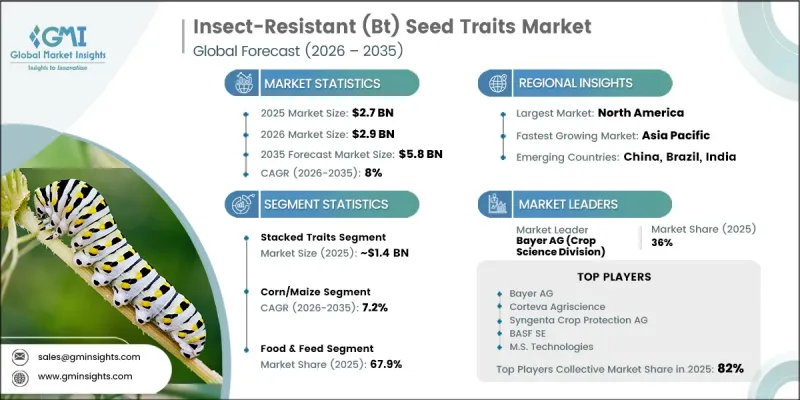
全球抗蟲(Bt)種子性狀市場的成長是由傳統殺蟲劑防治方法日益顯現的限制所驅動的。特別是,僅靠化學處理越來越難以有效控制某些破壞性極強的害蟲。 Bt種子性狀透過在植物整個生長週期中表達抗蟲蛋白,為作物提供嵌入式整個生長季的保護,從而減少對重複施用農藥的依賴,降低生產成本。這些優勢持續推動著從大規模商業農場到小規模農業經營者的應用。同時,該產業正透過持續的技術創新來應對不斷演變的抗蟲性挑戰。市場正經歷從第一代單蛋白Bt性狀向結合多種害蟲防治機制和基於RNA干擾(RNAi)解決方案的先進多態性種子技術的重大轉變。這種技術革新正在提升害蟲管理績效,延長產品有效期,並支持農業的長期生產力。因此,先進的Bt種子性狀對於永續作物保護和現代農業系統的重要性日益凸顯。
| 市場範圍 | |
|---|---|
| 開始年份 | 2025 |
| 預測期 | 2026-2035 |
| 上市時的市場規模 | 27億美元 |
| 預計金額 | 58億美元 |
| 複合年成長率 | 8% |
複合性狀種子佔50.4%的市場佔有率,預計到2025年銷售額將達到14億美元。該領域透過將多種Bt蛋白、除草劑抗性以及日益普及的RNA干擾(RNAi)技術整合到單一種子平台中,構成了現代抗蟲種子技術的基礎。與單一蛋白質性狀解決方案相比,複合性狀種子技術提供多種互補的作用機制,從而實現更廣泛的害蟲防治、更有效的抗性管理以及更持久的作物保護。
預計到2025年,食品和飼料應用領域將佔據67.9%的市場佔有率,並在2035年之前以7.9%的複合年成長率成長。該領域的持續需求受到全球蛋白質消費量成長、畜牧業規模擴大以及對提高糧食安全需求的持續推動。這些長期的農業需求將繼續促進基改作物的種植,並支撐其在商品價格波動的情況下保持穩定的需求。
預計2025年,北美抗蟲(Bt)種子性狀市場規模將達到14億美元,佔53%的市場佔有率,並將在2035年之前以3.9%的複合年成長率成長。該地區保持主導地位的原因在於基因改造作物的廣泛應用以及對先進種子性狀技術的持續投資。每英畝面積性狀價值的提高以及新一代RNAi種子技術的引入進一步推動了收入成長。這些因素正在加速產品更換,並鼓勵種植者採用更先進的病蟲害防治方案。預計區域農業市場的監管發展也將支持未來的市場擴張。
目錄
第1章:調查方法和範圍
第2章執行摘要
第3章 行業洞察
- 產業生態系分析
- 供應商情況
- 利潤率
- 每個階段增加的價值
- 影響價值鏈的因素
- 中斷
- 影響產業的因素
- 促進因素
- 產業潛在風險與挑戰
- 市場機遇
- 成長潛力分析
- 監理情勢
- 波特的分析
- PESTLE分析
- 技術與創新展望
- 最新科技趨勢
- 新興技術
- 價格趨勢
- 按地區
- 依特徵類型
- 未來市場趨勢
- 專利趨勢
- 貿易統計
- 主要進口國
- 主要出口國
- 永續性和環境方面
- 永續計劃
- 減少廢棄物策略
- 生產中的能源效率
- 具有環保意識的舉措
第4章 競爭情勢
- 介紹
- 企業市佔率分析
- 按地區
- 北美洲
- 歐洲
- 亞太地區
- LATAM
- 中東和非洲
- 按地區
- 企業矩陣分析
- 主要市場公司的競爭分析
- 競爭定位矩陣
- 主要進展
- 併購
- 夥伴關係和聯盟
- 新產品發布
- 業務拓展計劃
第5章 市場估算與預測:依性狀類型分類,2022-2035年
- 單Bt性狀
- 疊加特徵
- 基於RNAi的害蟲防治
- 其他新出現的特徵
第6章 市場估算與預測:依作物類型分類,2022-2035年
- 玉米/米茲
- 棉布
- 大豆
- 菜籽
- 其他
第7章 市場估計與預測:依最終用途分類,2022-2035年
- 食品/飼料
- 生質燃料生產
- 工業加工
- 其他(製藥/研究)
第8章 市場估計與預測:依地區分類,2022-2035年
- 北美洲
- 美國
- 加拿大
- 歐洲
- 德國
- 英國
- 法國
- 西班牙
- 義大利
- 其他歐洲國家
- 亞太地區
- 中國
- 印度
- 日本
- 澳洲
- 韓國
- 其他亞太國家
- 拉丁美洲
- 巴西
- 墨西哥
- 阿根廷
- 其他拉丁美洲國家
- 中東和非洲
- 沙烏地阿拉伯
- 南非
- UAE
- 其他中東和非洲國家
第9章:公司簡介
- Bayer AG(Crop Science Division)
- Corteva Agriscience
- Syngenta Crop Protection AG
- BASF SE
- MS Technologies, LLC
- Kaveri Seeds Company Limited
- Rasi Seeds Private Limited
- Nuziveedu Seeds Limited
- Beijing Dabeinong Biotechnology Co., Ltd.
- Nuseed
- Beck's Superior Hybrids
- Dyna-Gro Seed
- Ankur Seeds Private Limited
- Mahyco(Maharashtra Hybrid Seeds Company)
- S&W Seed Company
The Global Insect-Resistant (Bt) Seed Traits Market was valued at USD 2.7 billion in 2025 and is estimated to grow at a CAGR of 8% to reach USD 5.8 billion by 2035.
Growth in the global insect-resistant (Bt) seed traits market is driven by the increasing limitations of conventional insecticide-based pest control, particularly as several destructive insect species have become more difficult to manage through chemical treatments alone. Bt seed traits provide built-in, season-long crop protection by expressing insect-resistant proteins throughout plant development, reducing dependence on repeated pesticide applications while lowering production costs for growers. These advantages continue to encourage adoption across both large-scale commercial farms and smaller agricultural operations. At the same time, the industry is responding to evolving pest resistance challenges through continuous technological innovation. The market is witnessing a significant transition from first-generation single-protein Bt traits toward advanced multi-trait seed technologies that combine multiple insect protection mechanisms with RNA interference (RNAi)-based solutions. This technological evolution is improving pest management performance, extending product effectiveness, and supporting long-term agricultural productivity, making advanced Bt seed traits increasingly important for sustainable crop protection and modern farming systems.
| Market Scope | |
|---|---|
| Start Year | 2025 |
| Forecast Year | 2026-2035 |
| Start Value | $2.7 Billion |
| Forecast Value | $5.8 Billion |
| CAGR | 8% |
The stacked traits segment held a 50.4% share, generating USD 1.4 billion in 2025. This segment forms the foundation of modern insect-resistant seed technology by combining multiple Bt proteins with herbicide tolerance and, increasingly, RNA interference (RNAi) technologies within a single seed platform. Multi-trait seed technologies provide several complementary modes of action, offering broader insect control, improved resistance management, and enhanced long-term crop protection compared with single-protein trait solutions.
The food and feed application segment held a 67.9% share in 2025 and is forecast to grow at a CAGR of 7.9% through 2035. Continued demand within this segment is supported by rising global protein consumption, expansion of livestock production, and the ongoing need to strengthen food security. These long-term agricultural requirements continue to encourage cultivation of Bt crops, supporting stable demand regardless of fluctuations in commodity pricing.
North America Insect-Resistant (Bt) Seed Traits Market accounted for 53% share in 2025, generating USD 1.4 billion, and is projected to grow at a CAGR of 3.9% through 2035. The region maintains its leading position due to the widespread adoption of genetically modified crops and continued investment in advanced seed trait technologies. Revenue growth is further supported by increasing trait value per cultivated acre and the introduction of next-generation RNAi-enabled seed technologies, which are driving product replacement cycles and encouraging growers to adopt more advanced insect protection solutions. Continued regulatory progress across regional agricultural markets is also expected to support future market expansion.
Major companies operating in the global insect-resistant (Bt) seed traits market include Corteva Agriscience, Bayer AG (Crop Science Division), BASF SE, Syngenta Crop Protection AG, M.S. Technologies, L.L.C., Beck's Superior Hybrids, Dyna-Gro Seed, Nuseed, Kaveri Seeds Company Limited, Rasi Seeds Private Limited, Nuziveedu Seeds Limited, Mahyco (Maharashtra Hybrid Seeds Company), Ankur Seeds Private Limited, Beijing Dabeinong Biotechnology Co., Ltd., and S&W Seed Company. Companies operating in the insect-resistant (Bt) seed traits market are strengthening their competitive position by investing heavily in biotechnology research, advanced trait development, and next-generation seed innovation. Industry participants are expanding multi-trait product portfolios that combine insect resistance, herbicide tolerance, and emerging biological technologies to improve crop performance and long-term pest management. Strategic collaborations with research institutions, seed producers, and agricultural distributors are helping companies accelerate product commercialization and expand market reach.
Table of Contents
Chapter 1 Methodology & Scope
- 1.1 Market scope and definition
- 1.2 Research design
- 1.2.1 Research approach
- 1.2.2 Data collection methods
- 1.3 Data mining sources
- 1.3.1 Global
- 1.3.2 Regional/Country
- 1.4 Base estimates and calculations
- 1.4.1 Base year calculation
- 1.4.2 Key trends for market estimation
- 1.5 Primary research and validation
- 1.5.1 Primary sources
- 1.6 Forecast model
- 1.7 Research assumptions and limitations
Chapter 2 Executive Summary
- 2.1 Industry 360° synopsis
- 2.2 Key market trends
- 2.2.1 Trait type
- 2.2.2 Crop type
- 2.2.3 Application
- 2.2.4 Regional
- 2.3 TAM Analysis, 2026-2035
- 2.4 CXO perspectives: Strategic imperatives
- 2.5 Future outlook and strategic recommendations
Chapter 3 Industry Insights
- 3.1 Industry ecosystem analysis
- 3.1.1 Supplier landscape
- 3.1.2 Profit margin
- 3.1.3 Value addition at each stage
- 3.1.4 Factor affecting the value chain
- 3.1.5 Disruptions
- 3.2 Industry impact forces
- 3.2.1 Growth drivers
- 3.2.2 Industry pitfalls and challenges
- 3.2.3 Market opportunities
- 3.3 Growth potential analysis
- 3.4 Regulatory landscape
- 3.4.1 North America
- 3.4.2 Europe
- 3.4.3 Asia Pacific
- 3.4.4 Latin America
- 3.4.5 Middle East & Africa
- 3.5 Porter's analysis
- 3.6 PESTEL analysis
- 3.7 Technology and innovation landscape
- 3.7.1 Current technological trends
- 3.7.2 Emerging technologies
- 3.8 Price trends
- 3.8.1 By region
- 3.8.2 By Trait type
- 3.9 Future market trends
- 3.10 Patent landscape
- 3.11 Trade statistics (HS code)
- 3.11.1 Major importing countries
- 3.11.2 Major exporting countries
- 3.12 Sustainability and environmental aspects
- 3.12.1 Sustainable practices
- 3.12.2 Waste reduction strategies
- 3.12.3 Energy efficiency in production
- 3.12.4 Eco-friendly initiatives
Chapter 4 Competitive Landscape, 2025
- 4.1 Introduction
- 4.2 Company market share analysis
- 4.2.1 By region
- 4.2.1.1 North America
- 4.2.1.2 Europe
- 4.2.1.3 Asia Pacific
- 4.2.1.4 LATAM
- 4.2.1.5 MEA
- 4.2.1 By region
- 4.3 Company matrix analysis
- 4.4 Competitive analysis of major market players
- 4.5 Competitive positioning matrix
- 4.6 Key developments
- 4.6.1 Mergers & acquisitions
- 4.6.2 Partnerships & collaborations
- 4.6.3 New product launches
- 4.6.4 Expansion plans
Chapter 5 Market Estimates and Forecast, By Trait Type, 2022-2035 (USD Million) (Kilo Tons)
- 5.1 Key trends
- 5.2 Single Bt Traits
- 5.3 Stacked Traits
- 5.4 RNAi-Based Insect Protection
- 5.5 Other Emerging Trait Technologies
Chapter 6 Market Estimates and Forecast, By Crop Type, 2022-2035 (USD Million) (Kilo Tons)
- 6.1 Key trends
- 6.2 Corn/Maize
- 6.3 Cotton
- 6.4 Soybean
- 6.5 Canola
- 6.6 Others
Chapter 7 Market Estimates and Forecast, By End-Use Application, 2022-2035 (USD Million) (Kilo Tons)
- 7.1 Key trends
- 7.2 Food & Feed
- 7.3 Biofuel Production
- 7.4 Industrial Processing
- 7.5 Others (Pharmaceutical & Research)
Chapter 8 Market Estimates and Forecast, By Region, 2022-2035 (USD Million) (Kilo Tons)
- 8.1 Key trends
- 8.2 North America
- 8.2.1 U.S.
- 8.2.2 Canada
- 8.3 Europe
- 8.3.1 Germany
- 8.3.2 UK
- 8.3.3 France
- 8.3.4 Spain
- 8.3.5 Italy
- 8.3.6 Rest of Europe
- 8.4 Asia Pacific
- 8.4.1 China
- 8.4.2 India
- 8.4.3 Japan
- 8.4.4 Australia
- 8.4.5 South Korea
- 8.4.6 Rest of Asia Pacific
- 8.5 Latin America
- 8.5.1 Brazil
- 8.5.2 Mexico
- 8.5.3 Argentina
- 8.5.4 Rest of Latin America
- 8.6 Middle East and Africa
- 8.6.1 Saudi Arabia
- 8.6.2 South Africa
- 8.6.3 UAE
- 8.6.4 Rest of Middle East and Africa
Chapter 9 Company Profiles
- 9.1 Bayer AG (Crop Science Division)
- 9.2 Corteva Agriscience
- 9.3 Syngenta Crop Protection AG
- 9.4 BASF SE
- 9.5 M.S. Technologies, L.L.C.
- 9.6 Kaveri Seeds Company Limited
- 9.7 Rasi Seeds Private Limited
- 9.8 Nuziveedu Seeds Limited
- 9.9 Beijing Dabeinong Biotechnology Co., Ltd.
- 9.10 Nuseed
- 9.11 Beck's Superior Hybrids
- 9.12 Dyna-Gro Seed
- 9.13 Ankur Seeds Private Limited
- 9.14 Mahyco (Maharashtra Hybrid Seeds Company)
- 9.15 S&W Seed Company

 生物防治市場-全球市場預測(2026-2032年)
 生物防治市場:依類型、作物、原料、應用、國家及地區分類-全球產業分析、市場規模、市場佔有率及2026年至2033年預測
 生物防治:市場佔有率分析、產業趨勢與統計、成長預測(2026-2031)
 2026年全球生物防治市場報告
 生物防治市場-全球產業規模、佔有率、趨勢、機會及預測(依產品類型、功能、處理方法、作物類型、地區和競爭格局分類,2021-2031年)磁珠以微珠為基礎市場按產品類型、技術、應用和最終用戶分類,全球預測(2026-2032年)
 生物防治市場規模、佔有率及成長分析(依產品類型、作物類型、目標害蟲、配方、應用方法、通路及地區分類)-2026-2033年產業預測
 全球生物防治市場(2024-2028)