

 |
市場調查報告書
商品編碼
2071394
住宅維修市場機會、成長促進因素、產業趨勢分析及2026-2035年預測。Home Improvement Market Opportunity, Growth Drivers, Industry Trend Analysis, and Forecast 2026 - 2035 |
||||||

全球住宅維修市場預計到 2025 年將達到 1.2 兆美元,年複合成長率為 3.8%,到 2035 年將達到 1.8 兆美元。
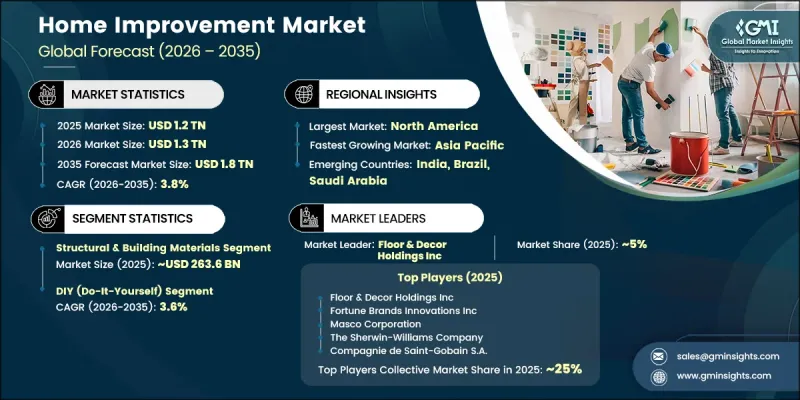
已開發地區老舊住宅存量是市場成長的主要驅動力,持續產生對房屋維修、更換和節能維修的穩定需求。這種潛在的結構性需求確保了房屋改造活動的持續進行,不受消費者支出模式短期波動的影響。同時,智慧家庭技術的日益普及顯著提升了房屋改造的價值,因為住宅安裝的先進系統能夠改善便利性、能源管理和安全性。永續性也正成為一個重要的影響因素,在日益嚴格的能源法規、政府激勵措施和消費者環保意識不斷增強的背景下,環保維修越來越受到關注。雖然住宅維修支出通常與更廣泛的經濟指標相關,但對老舊房屋的持續維護和維修需求為市場的長期成長提供了穩定的基礎。
| 市場範圍 | |
|---|---|
| 開始年份 | 2025 |
| 預測期 | 2026-2035 |
| 起始金額 | 1.2兆美元 |
| 預測金額 | 1.8兆美元 |
| 複合年成長率 | 3.8% |
預計到2025年,結構和建材市場規模將達到2,636億美元,並在2026年至2035年間以3.5%的複合年成長率成長。該市場涵蓋了維修和維修項目中使用的各種基本建材。現有建築的狀況和使用壽命對其需求影響巨大,因此其受短期經濟波動的影響較小,且越來越依賴長期維護需求。
預計到2025年,DIY市場將佔據54.5%的市場佔有率,並在2035年之前以3.6%的複合年成長率成長。消費者對自行進行住宅維修專案的強烈偏好持續推動著這一市場的發展,零售商在提供便利的工具、材料和指導方面發揮著至關重要的作用。數位化解決方案和方便用戶使用型資源的普及進一步簡化了專案實施,使住宅能夠更有效率地自訂生活空間。
美國住宅維修市場預計到2025年將達到4,946億美元,並在2035年之前以3.5%的複合年成長率成長。由於住宅存量龐大,以及持續不斷的維修和升級需求,市場需求仍然強勁。住宅擴大利用替代資金籌措來支持維修項目,從而確保即使在住宅市場波動的情況下,市場活動也能持續進行。
目錄
第1章:調查方法
第2章執行摘要
第3章 行業洞察
- 產業生態系分析
- 原物料供應商
- 產品製造商
- 銷售代理商和批發商
- 零售通路
- 最終消費者
- 利潤率分析
- 每個階段增加的價值
- 影響價值鏈的因素
- 影響產業的因素
- 成長促進因素
- 住宅存量老化加速了維修和重建需求的成長。
- 數位教程和平台正在推動DIY文化的擴張。
- 智慧家庭的快速普及正在引發高級產品的更換。
- 產業潛在風險與挑戰
- 不斷上漲的房屋抵押貸款利率和住宅的「鎖定效應」正在阻礙專案推進。
- 原料成本波動
- 成長促進因素
- 成長潛力分析
- 未來市場趨勢
- 技術與創新展望
- 最新科技趨勢
- 新興技術
- 價格分析
- 按產品類型分析歷史價格趨勢
- 依球員類型分類的定價策略(高級球員、超值球員、成本加成球員)
- 貿易數據分析(基於付費數據來源)
- 進出口量及進口額趨勢
- 主要貿易路線及關稅的影響
- 監理情勢
- 標準和合規要求
- 區域監理框架
- 認證標準
- 波特的分析
- PESTLE分析
- 人工智慧和生成式人工智慧對市場的影響
- 利用人工智慧改造現有經營模式
- 按細分市場分類的生成式人工智慧用例和部署藍圖
- 風險、限制和監管考量
- 消費行為分析
- 人口趨勢
- 影響購買決策的因素
- 消費者產品採納
- 首選分銷管道
第4章 競爭情勢
- 介紹
- 企業市佔率分析
- 按地區
- 企業矩陣分析
- 主要市場公司的競爭分析
- 競爭定位矩陣
- 主要進展
- 併購
- 夥伴關係和聯盟
- 新產品發布
- 業務拓展計劃
第5章 市場估算與預測:依產品類型分類,2022-2035年
- 結構和建材
- 設備、配件、櫃體
- 機械系統和設備
- 照明和電氣配件
- 地板材料和表面處理
- 油漆、塗料、壁材
- 工具和五金
- 戶外及園藝用品
- 室內織品產品
第6章 市場估計與預測:依項目類型分類,2022-2035年
- DIY(Do-It-Yourself)
- 專業的
第7章 市場估計與預測:依技術分類,2022-2035年
- 傳統的
- 智慧/互聯
第8章 市場估計與預測:依應用領域分類,2022-2035年
- 外部的
- 內部的
- 系統升級
- 戶外和景觀美化
- 其他
第9章 市場估價與預測:依物業類型分類,2022-2035年
- 獨立式住宅
- 多用戶住宅
- 模組化住宅
- 其他
第10章 市場估價與預測:依通路分類,2022-2035年
- 線上
- 離線
第11章 市場估價與預測:按地區分類,2022-2035年
- 北美洲
- 美國
- 加拿大
- 歐洲
- 德國
- 英國
- 法國
- 義大利
- 西班牙
- 瑞典
- 荷蘭
- 亞太地區
- 中國
- 印度
- 日本
- 韓國
- 澳洲
- 印尼
- 拉丁美洲
- 巴西
- 墨西哥
- 阿根廷
- 中東和非洲
- 沙烏地阿拉伯
- UAE
- 南非
第12章:公司簡介
- 世界公司
- The Home Depot Inc
- Lowe's Companies Inc
- Compagnie de Saint-Gobain SA
- Masco Corporation
- The Sherwin-Williams Company
- Stanley Black & Decker Inc
- Mohawk Industries
- 當地公司
- Floor & Decor Holdings, Inc.
- Kingfisher plc
- Groupe Adeo SA
- HORNBACH Holding AG & Co. KGaA
- PPG Industries Inc
- KGC Group
- Lindner Group
- Gebruder Schneider
- 新興企業和創新者
- Tostem
- Fortune Brands Innovations, Inc.
- James Hardie Industries plc
- Silvadec
- JAF Group
- Trex
The Global Home Improvement Market was valued at USD 1.2 trillion in 2025 and is estimated to grow at a CAGR of 3.8% to reach USD 1.8 trillion by 2035.
Market growth is strongly supported by the aging housing stock across developed regions, which continues to generate steady demand for repair, replacement, and efficiency upgrades. This underlying structural demand ensures consistent renovation activity regardless of short-term fluctuations in consumer spending patterns. At the same time, the increasing adoption of smart home technologies has significantly elevated renovation value, as homeowners integrate advanced systems that enhance convenience, energy management, and security. Sustainability is also becoming a major influencing factor, with eco-friendly upgrades gaining traction due to stricter energy regulations, government incentives, and rising environmental awareness among consumers. While home improvement expenditure often aligns with broader economic indicators, the ongoing need to maintain and upgrade aging properties provides a stable foundation for long-term market growth.
| Market Scope | |
|---|---|
| Start Year | 2025 |
| Forecast Year | 2026-2035 |
| Start Value | $1.2 Trillion |
| Forecast Value | $1.8 Trillion |
| CAGR | 3.8% |
The structural and building materials segment generated USD 263.6 billion in 2025 and is expected to grow at a CAGR of 3.5% from 2026 to 2035. This segment includes a wide range of essential construction components used in repair and renovation activities. Demand remains largely driven by the condition and lifecycle of existing properties, making it less sensitive to short-term economic variations and more dependent on long-term maintenance requirements.
The DIY segment accounted for 54.5% share in 2025 and is projected to grow at a CAGR of 3.6% throughout 2035. Strong consumer preference for self-managed home projects continues to support this segment, with retailers playing a key role by providing accessible tools, materials, and guidance. The availability of digital solutions and user-friendly resources has further simplified project execution, enabling homeowners to customize their living spaces more efficiently.
United States Home Improvement Market reached USD 494.6 billion in 2025 and is expected to grow at a CAGR of 3.5% through 2035. Demand remains resilient due to the prevalence of older housing stock and the ongoing need for renovation and upgrades. Homeowners are increasingly utilizing alternative financing methods to support improvement projects, ensuring continued activity even amid fluctuations in the housing market.
Key players in the global home improvement market include The Home Depot Inc, Lowe's Companies Inc, Compagnie de Saint-Gobain S.A., Masco Corporation, The Sherwin-Williams Company, Stanley Black & Decker Inc, Mohawk Industries, Floor & Decor Holdings Inc, Kingfisher plc, Groupe Adeo SA, HORNBACH Holding AG & Co. KGaA, PPG Industries Inc, KGC Group, Lindner Group, Gebruder Schneider, Tostem, Fortune Brands Innovations Inc, James Hardie Industries plc, Silvadec, JAF Group, and Trex. Companies operating in the home improvement industry are focusing on expanding product portfolios, strengthening retail networks, and enhancing customer engagement strategies to reinforce their market position. Significant investments are being made in digital platforms to improve omnichannel experiences and streamline purchasing processes. Firms are also prioritizing innovation in sustainable and energy-efficient products to align with evolving regulatory standards and consumer preferences. Strategic partnerships, mergers, and acquisitions are helping companies expand their geographic footprint and diversify offerings.
Table of Contents
Chapter 1 Research Methodology
- 1.1 Research approach
- 1.2 Quality Commitments
- 1.2.1 GMI AI policy & data integrity commitment
- 1.2.1.1 Source consistency protocol
- 1.2.1 GMI AI policy & data integrity commitment
- 1.3 Research trail & confidence scoring
- 1.3.1 Research trail components
- 1.3.2 Scoring components
- 1.4 Data Collection
- 1.4.1 Partial list of primary sources
- 1.5 Data mining sources
- 1.5.1 Paid sources
- 1.5.1.1 Sources, by region
- 1.5.1 Paid sources
- 1.6 Base estimates and calculations
- 1.6.1 Base year calculation
- 1.7 Forecast model
- 1.7.1 Quantified market impact analysis
- 1.7.1.1 Mathematical impact of growth parameters on forecast
- 1.7.1 Quantified market impact analysis
- 1.8 Research transparency addendum
- 1.8.1 Source attribution framework
- 1.8.2 Quality assurance metrics
- 1.8.3 Our commitment to trust
Chapter 2 Executive Summary
- 2.1 Industry 360° synopsis
- 2.2 Business trends
- 2.3 Regional
- 2.4 Product type
- 2.5 Project mode
- 2.6 Technology
- 2.7 Application
- 2.8 Property type
- 2.9 Distribution channel
Chapter 3 Industry Insights
- 3.1 Industry ecosystem analysis
- 3.1.1 Raw material suppliers
- 3.1.2 Product manufacturers
- 3.1.3 Distributors & wholesalers
- 3.1.4 Retail channels
- 3.1.5 End consumers
- 3.1.6 Profit margin analysis
- 3.1.7 Value addition at each stage
- 3.1.8 Factor affecting the value chain
- 3.2 Industry impact forces
- 3.2.1 Growth drivers
- 3.2.1.1 Aging housing stock driving accelerated repair & replacement demand
- 3.2.1.2 Expanding DIY culture amplified by digital tutorials & platform
- 3.2.1.3 Surging smart home adoption creating premium product upgrade cycles
- 3.2.2 Industry pitfalls & challenges
- 3.2.2.1 Elevated mortgage rates & housing lock-in effect suppressing project pipeline
- 3.2.2.2 Raw material cost volatility
- 3.2.1 Growth drivers
- 3.3 Growth potential analysis
- 3.4 Future market trends
- 3.5 Technology and innovation landscape
- 3.5.1 Current technological trends
- 3.5.2 Emerging technologies
- 3.6 Pricing analysis (driven by primary research)
- 3.6.1 Historical price trend analysis by product category
- 3.6.2 Pricing strategy by player type (premium / value / cost-plus)
- 3.7 Trade data analysis (based on paid data sources)
- 3.7.1 Import/export volume & value trends
- 3.7.2 Key trade corridors & tariff impact
- 3.8 Regulatory landscape
- 3.8.1 Standards and compliance requirements
- 3.8.2 Regional regulatory frameworks
- 3.8.3 Certification standards
- 3.9 Porter's analysis
- 3.10 PESTEL analysis
- 3.11 Impact of AI & generative AI on the market
- 3.11.1 AI-driven disruption of existing business models
- 3.11.2 GenAI use cases & adoption roadmap by segment
- 3.11.3 Risks, limitations & regulatory considerations
- 3.12 Consumer behavior analysis
- 3.12.1 Demographic trends
- 3.12.2 Factors affecting buying decision
- 3.12.3 Consumer product adoption
- 3.12.4 Preferred distribution channel
Chapter 4 Competitive Landscape, 2025
- 4.1 Introduction
- 4.2 Company market share analysis
- 4.2.1 By Region
- 4.2.1.1 North America
- 4.2.1.2 Europe
- 4.2.1.3 Asia Pacific
- 4.2.1.4 Latin America
- 4.2.1.5 Middle East & Africa
- 4.2.1 By Region
- 4.3 Company matrix analysis
- 4.4 Competitive analysis of major market players
- 4.5 Competitive positioning matrix
- 4.6 Key developments
- 4.6.1 Mergers & acquisitions
- 4.6.2 Partnerships & collaborations
- 4.6.3 New product launches
- 4.6.4 Expansion plans
Chapter 5 Market Estimates & Forecast, By Product Type, 2022 - 2035, (USD Billion) (Units)
- 5.1 Key trends
- 5.2 Structural & building materials
- 5.3 Fixtures, fittings & cabinetry
- 5.4 Mechanical systems & equipment
- 5.5 Lighting & electrical accessories
- 5.6 Flooring & surface finishing materials
- 5.7 Paints, coatings & wallcoverings
- 5.8 Tools & hardware
- 5.9 Outdoor & landscaping products
- 5.10 Home decor & soft furnishings
Chapter 6 Market Estimates & Forecast, By Project Mode, 2022 - 2035, (USD Billion) (Units)
- 6.1 Key trends
- 6.2 Do-It-Yourself (DIY)
- 6.3 Professional
Chapter 7 Market Estimates & Forecast, By Technology, 2022 - 2035, (USD Billion) (Units)
- 7.1 Key trends
- 7.2 Conventional
- 7.3 Smart/connected
Chapter 8 Market Estimates & Forecast, By Application, 2022 - 2035, (USD Billion) (Units)
- 8.1 Key trends
- 8.2 Exterior
- 8.3 Interior
- 8.4 System upgrades
- 8.5 Outdoor & landscaping
- 8.6 Others
Chapter 9 Market Estimates & Forecast, By Property Type, 2022 - 2035, (USD Billion) (Units)
- 9.1 Key trends
- 9.2 Single-family homes
- 9.3 Multi-family residential
- 9.4 Modular homes
- 9.5 Others
Chapter 10 Market Estimates & Forecast, By Distribution Channel, 2022 - 2035, (USD Billion) (Units)
- 10.1 Key trends
- 10.2 Online
- 10.3 Offline
Chapter 11 Market Estimates & Forecast, By Region, 2022 - 2035, (USD Billion) (Units)
- 11.1 Key trends
- 11.2 North America
- 11.2.1 U.S
- 11.2.2 Canada
- 11.3 Europe
- 11.3.1 Germany
- 11.3.2 UK
- 11.3.3 France
- 11.3.4 Italy
- 11.3.5 Spain
- 11.3.6 Sweden
- 11.3.7 Netherlands
- 11.4 Asia Pacific
- 11.4.1 China
- 11.4.2 India
- 11.4.3 Japan
- 11.4.4 South Korea
- 11.4.5 Australia
- 11.4.6 Indonesia
- 11.5 Latin America
- 11.5.1 Brazil
- 11.5.2 Mexico
- 11.5.3 Argentina
- 11.6 MEA
- 11.6.1 Saudi Arabia
- 11.6.2 UAE
- 11.6.3 South Africa
Chapter 12 Company Profiles
- 12.1 Global Players
- 12.1.1 The Home Depot Inc
- 12.1.2 Lowe's Companies Inc
- 12.1.3 Compagnie de Saint-Gobain S.A.
- 12.1.4 Masco Corporation
- 12.1.5 The Sherwin-Williams Company
- 12.1.6 Stanley Black & Decker Inc
- 12.1.7 Mohawk Industries
- 12.2 Regional Players
- 12.2.1 Floor & Decor Holdings, Inc.
- 12.2.2 Kingfisher plc
- 12.2.3 Groupe Adeo SA
- 12.2.4 HORNBACH Holding AG & Co. KGaA
- 12.2.5 PPG Industries Inc
- 12.2.6 KGC Group
- 12.2.7 Lindner Group
- 12.2.8 Gebruder Schneider
- 12.3 Emerging Players & Innovators
- 12.3.1 Tostem
- 12.3.2 Fortune Brands Innovations, Inc.
- 12.3.3 James Hardie Industries plc
- 12.3.4 Silvadec
- 12.3.5 JAF Group
- 12.3.6 Trex

 家居裝修市場-全球產業規模、佔有率、趨勢、競爭格局、機會及預測:依產品、專案、採購通路、地區及競爭格局分類,2021-2031年
 住宅裝修服務市場預測-全球分析(按服務類型、專案規模、服務提供者、價格範圍、分銷管道、最終用戶和地區分類)——2034年
 全球住宅維修市場規模、佔有率、趨勢及成長分析報告(2026-2034)
 DIY住宅維修零售市場:按產品類型、應用、銷售管道和最終用戶分類-2026-2032年全球市場預測玻璃安裝服務市場:按安裝類型、玻璃類型、應用和最終用途分類-全球預測,2026-2032年住宅裝修市場規模、佔有率、成長及全球產業分析:按類型、應用和地區分類的洞察,2026-2034 年預測
 住宅維修服務市場報告:按類型、買家年齡層、城市類型和地區分類(2026-2034 年)日本住宅維修服務市場規模、佔有率、趨勢及預測(按類型、購買者年齡層、城市類型和地區分類,2026-2034年)
 住宅維修市場規模、佔有率及成長分析(按產品類型、分銷管道、最終用途和地區分類)-2026-2033年產業預測
 2025-2029年全球住宅裝修市場