

 |
市場調查報告書
商品編碼
2071358
人體發光劑市場機會、成長促進因素、產業趨勢分析及2026-2035年預測Body Luminizer Market Opportunity, Growth Drivers, Industry Trend Analysis, and Forecast 2026 - 2035 |
||||||

全球人體發光劑市場預計到 2025 年將價值 6.791 億美元,並將以 6.6% 的複合年成長率成長,到 2035 年達到 12.9 億美元。
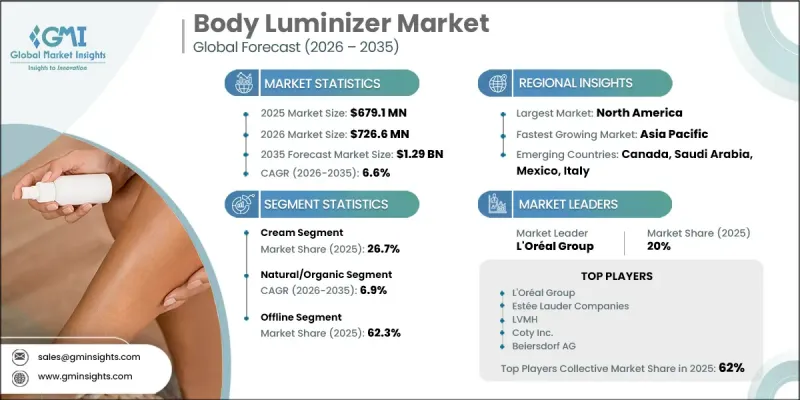
市場擴張的驅動力在於消費者對均勻膚色和提升妝效產品的需求不斷成長,無論是在高階市場還是大眾市場。新興市場健康生活方式的興起、可支配收入的增加以及光澤配方的持續創新,都在推動這一品類的長期成長。消費者越來越重視外表、肌膚健康和自我護理習慣,因此兼具彩妝和護膚功效的產品需求日益成長。身體提亮產品如今遊走於彩妝與護膚之間,既可作為妝前定妝品,又可作為肌膚調理保養品。富含抗氧化劑、維生素和保濕成分的配方進一步提升了其吸引力,使其超越傳統美容用戶的範疇,吸引了更廣泛的受眾。產業分析表明,均勻膚色產品是全球個人護理市場成長最快的類別之一。化妝品配方科學的進步,包括先進的光反射技術、親膚調理劑和改良的成膜系統,提升了產品性能,並拓展了其應用範圍,從日常護理到專業美容程序,均可適用。
| 市場範圍 | |
|---|---|
| 開始年份 | 2025 |
| 預測期 | 2026-2035 |
| 上市時的市場規模 | 6.791億美元 |
| 預計金額 | 12.9億美元 |
| 複合年成長率 | 6.6% |
預計到2025年,膏狀產品市佔率將達到26.7%,並在整個預測期內維持6.2%的複合年成長率。此細分市場的主導地位得益於消費者的高度認知、零售通路的廣泛覆蓋以及穩定的配方結構所帶來的高光澤度提亮效果。此外,專賣店和百貨公司美妝通路的持續優質化趨勢也推動了該細分市場的成長,膏狀提亮產品在這些通路中仍然是核心產品。 Charlotte Tilbury Beauty和歐萊雅集團等高階美妝品牌不斷推出高性能配方,將閃光技術與護膚成分相結合,從而強化了該細分市場。這使得此類產品能夠定位為日常使用,並支援每個超過45美元的高階定價策略。
預計到2025年,天然和有機配方產品將佔據37.8%的市場佔有率,並在2035年之前以6.9%的複合年成長率成長。這一成長動能反映了北美和歐洲對某些合成化妝品成分日益嚴格的監管,以及消費者對潔淨標示、環保美容產品的需求不斷成長。此外,消費者對透明度的更高期望以及對成分安全性的日益關注,也推動了消費者向天然配方產品的轉變。
預計2025年,北美身體高光產品市佔率將達到34.8%,複合年成長率(CAGR)為6.4%。這反映出該市場已發展成為一個成熟且高價值的美容市場。美國仍然是主要的收入來源,這得益於其廣泛的專業零售分銷網路,該網路為高階品牌和大眾市場提供了充足的高光產品管道。在加拿大,由於高階美容零售商和電子商務市場的滲透率不斷提高,預計該市場將保持穩定成長,這改善了都市區和非都市區消費者獲取產品的途徑。
目錄
第1章:調查方法和範圍
第2章執行摘要
第3章 行業洞察
- 產業生態系分析
- 供應商情況
- 利潤率
- 每個階段增加的價值
- 影響價值鏈的因素
- 影響產業的因素
- 促進因素
- 消費者對提亮膚色和美膚產品的需求日益成長。
- 高階奢侈美容領域的擴張
- 產品創新
- 產業潛在風險與挑戰
- 皮膚敏感及對成分的擔憂
- 價格敏感度
- 機會
- 清潔、天然、永續的高光產品
- 個性化和簾子技術
- 促進因素
- 成長潛力分析
- 監理框架
- 美國監管情勢(FDA/MoCRA 2022)
- 歐盟監管情況(微塑膠禁令、REACH法規)
- 亞太地區的監管考量
- 符合道德規範的雲母採購標準與認證
- 價格分析
- 2022-2025年歷史價格趨勢分析
- 依球員類型分類的定價策略(高級球員、超值球員、成本加成球員)
- 貿易數據分析
- 進出口量及進口額趨勢
- 主要貿易路線及關稅的影響
- 人工智慧和生成式人工智慧對市場的影響
- 利用人工智慧改造現有經營模式
- 針對特定細分市場的生成式人工智慧(個人化色彩匹配、虛擬試穿)用例和實作藍圖
- 風險、限制和監管考量
- 目前分銷基礎設施和通路滲透情況
- 按地區與業態(現代零售與傳統零售)分類的通路覆蓋率
- 缺乏最後一公里基礎設施和不斷變化的管道
第4章 競爭情勢
- 介紹
- 企業市佔率分析
- 按地區
- 企業矩陣分析
- 主要市場公司的競爭分析
- 競爭定位矩陣
- 主要進展
- 併購
- 夥伴關係和聯盟
- 新產品發布
- 業務拓展計劃
第5章 市場估算與預測:依產品類型分類,2022-2035年
- 奶油
- 血清
- 洗劑
- 噴
- 凝膠
- 油
- 棒狀/固態
- 其他類型(粉末型、混合型等)
第6章 市場估計與預測:依成分分類,2022-2035年
- 天然/有機
- 合成
第7章 市場估算與預測:依表面處理類型分類,2022-2035年
- 墊
- 光滑
- 閃光
- 其他
第8章 市場估計與預測:依範圍分類,2022-2035年
- 光
- 中型的
- 滿的
第9章 市場估價與預測:依膚質分類,2022-2035年
- 油
- 乾燥
- 普通的
- 敏感的
- 組合
第10章 市場估價與預測:依價格區間分類,2022-2035年
- 低的
- 中等的
- 高的
第11章 市場估價與預測:依最終用戶分類,2022-2035年
- 女士
- 男性
- 男女通用的
第12章 市場估計與預測:依通路分類,2022-2035年
- 線上
- 電子商務
- 企業網站
- 離線
- 大賣場和超級市場
- 專賣店
- 其他零售店
第13章 市場估計與預測:依地區分類,2022-2035年
- 北美洲
- 美國
- 加拿大
- 歐洲
- 德國
- 英國
- 法國
- 義大利
- 西班牙
- 亞太地區
- 中國
- 日本
- 印度
- 澳洲
- 韓國
- 拉丁美洲
- 巴西
- 墨西哥
- 阿根廷
- 中東和非洲
- 南非
- 沙烏地阿拉伯
- UAE
第14章:公司簡介
- 世界公司
- L'Oreal Group
- Estee Lauder Companies
- LVMH
- Beiersdorf AG
- Shiseido Company
- Coty Inc.
- Unilever PLC
- 當地公司
- Bondi Sands
- Vita Liberata
- Paese Cosmetics
- Affect Cosmetics
- Inglot Cosmetics
- Revolution Beauty Group
- W7 Cosmetics
- 新興企業
- Charlotte Tilbury Beauty
- Iconic London
- Patrick Ta Beauty
- Saie Beauty
- Milk Makeup
- Danessa Myricks Beauty
- Ere Perez
The Global Body Luminizer Market was valued at USD 679.1 million in 2025 and is estimated to grow at a CAGR of 6.6% to reach USD 1.29 billion by 2035.
Market expansion is shaped by rising consumer demand for complexion-enhancing and skin-finishing products across both premium and mass beauty segments. Increasing wellness orientation, higher disposable incomes in emerging economies, and continuous innovation in luminizing formulations are reinforcing long-term category growth. Consumers are increasingly prioritizing personal appearance, skin health, and self-care routines, which has strengthened demand for products that deliver both aesthetic enhancement and skincare benefits. Body luminizers now sit at the intersection of cosmetics and skincare, functioning as both finishing products and skin-conditioning treatments. Enriched formulations containing antioxidants, vitamins, and moisturizing agents are further broadening appeal beyond traditional beauty users. Industry assessments indicate that complexion-enhancing products are among the fastest-expanding personal care categories across global markets. Progress in cosmetic formulation science, including advanced light-reflecting technologies, skin-adaptive conditioning agents, and improved film-forming systems, is enhancing product performance and widening application potential across daily-use and professional beauty routines.
| Market Scope | |
|---|---|
| Start Year | 2025 |
| Forecast Year | 2026-2035 |
| Start Value | $679.1 Million |
| Forecast Value | $1.29 Billion |
| CAGR | 6.6% |
The cream-based formats segment held a 26.7% share in 2025 and is maintaining steady expansion through the forecast period at a CAGR of 6.2%. Their dominance is supported by strong consumer familiarity, widespread availability across retail channels, and their ability to deliver high-intensity glow effects through stable formulation structures. Growth in this segment is also supported by ongoing premiumization trends within specialty and department store beauty channels, where cream-based luminizers remain a core offering. Prestige beauty brands such as Charlotte Tilbury Beauty and L'Oreal S.A. continue to strengthen this segment with high-performance formulations that blend shimmer technology with skincare-focused ingredients, enabling daily wear positioning and supporting premium pricing strategies exceeding USD 45 per unit.
The natural and organic formulations segment held a 37.8% share in 2025 and is projected to grow at a CAGR of 6.9% through 2035. This performance gap reflects growing regulatory scrutiny on select synthetic cosmetic ingredients and increasing consumer demand for clean-label, environmentally conscious beauty products across North America and Europe. The shift toward natural formulations is also supported by rising transparency expectations and ingredient safety awareness among beauty consumers.
North America Body Luminizer Market holds 34.8% share in 2025 and is projected to grow at a CAGR of 6.4%, reflecting its status as a mature but high-value beauty market. The United States remains the core revenue contributor, supported by extensive specialty retail distribution networks that provide broad access to prestige and mass-market luminizer products. Canada contributes steady growth through premium beauty retail and expanding e-commerce penetration, which is improving product accessibility across urban and non-urban consumer segments.
Key players operating in the global body luminizer market include LVMH, Estee Lauder Companies Inc., L'Oreal S.A., Shiseido Company, Unilever PLC, Coty Inc., Beiersdorf AG, Charlotte Tilbury Beauty Ltd., Milk Makeup, Saie Beauty, Danessa Myricks Beauty, Patrick Ta Beauty, Iconic London, Revolution Beauty Group PLC, Inglot Cosmetics, Paese Cosmetics, W7 Cosmetics, Affect Cosmetics, Bondi Sands, Vita Liberata, and Ere Perez. Companies in the body luminizer market are strengthening their position through continuous product innovation focused on hybrid skincare-makeup formulations that deliver both aesthetic enhancement and skin benefits. Many brands are investing heavily in R&D to develop advanced light-reflecting pigments, long-wear polymers, and dermatologically tested clean-label ingredients. Digital-first marketing strategies, including influencer collaborations and social media-led product launches, are being widely used to accelerate brand visibility and consumer engagement. Firms are also expanding omnichannel distribution networks by integrating direct-to-consumer platforms with premium retail partnerships to improve accessibility. Sustainable packaging adoption and vegan or cruelty-free product positioning are becoming central to brand differentiation strategies.
Table of Contents
Chapter 1 Methodology and Scope
- 1.1 Market scope and definition
- 1.2 Research design
- 1.2.1 Research approach
- 1.2.2 Data collection methods
- 1.3 Data mining sources
- 1.3.1 Global
- 1.3.2 Regional/Country
- 1.4 Base estimates and calculations
- 1.4.1 Base year calculation
- 1.4.2 Key trends for market estimation
- 1.5 Primary research and validation
- 1.5.1 Primary sources
- 1.6 Forecast model
- 1.7 Research assumptions and limitations
Chapter 2 Executive Summary
- 2.1 Industry 360° synopsis
- 2.2 Key market trends
- 2.2.1 Regional
- 2.2.2 Product type
- 2.2.3 Ingredient
- 2.2.4 Finish type
- 2.2.5 Coverage
- 2.2.6 Skin type
- 2.2.7 Price range
- 2.2.8 End user
- 2.2.9 Distribution channel
Chapter 3 Industry Insights
- 3.1 Industry ecosystem analysis
- 3.1.1 Supplier landscape
- 3.1.2 Profit margin
- 3.1.3 Value addition at each stage
- 3.1.4 Factor affecting the value chain
- 3.2 Industry impact forces
- 3.2.1 Growth drivers
- 3.2.1.1 Rising demand for glow & skin-enhancement products
- 3.2.1.2 Expansion of premium & luxury beauty segment
- 3.2.1.3 Product innovation
- 3.2.2 Industry pitfalls & challenges
- 3.2.2.1 Skin sensitivity & ingredient concerns
- 3.2.2.2 Price sensitivity
- 3.2.3 Opportunities
- 3.2.3.1 Clean, natural & sustainable luminizers
- 3.2.3.2 Personalization & shade technology
- 3.2.1 Growth drivers
- 3.3 Growth potential analysis
- 3.4 Regulatory framework
- 3.4.1 U.S. regulatory landscape (FDA / MoCRA 2022)
- 3.4.2 EU regulatory landscape (Microplastics Ban, REACH)
- 3.4.3 APAC regulatory considerations
- 3.4.4 Ethical mica sourcing standards & certifications
- 3.5 Pricing analysis (driven by primary research)
- 3.5.1 Historical price trend analysis (2022-2025)
- 3.5.2 Pricing strategy by player type (premium / value / cost-plus)
- 3.6 Trade data analysis (driven by paid database)
- 3.6.1 Import/export volume & value trends
- 3.6.2 Key trade corridors & tariff impact
- 3.7 Impact of AI & generative AI on the market
- 3.7.1 AI-driven disruption of existing business models
- 3.7.2 GenAI use cases & adoption roadmap by segment (personalized shade matching, virtual try-on)
- 3.7.3 Risks, limitations & regulatory considerations
- 3.8 Distribution infrastructure & channel penetration landscape (driven by primary research)
- 3.8.1 Channel coverage by region & format (modern vs. Traditional trade)
- 3.8.2 Last-mile infrastructure gaps & emerging channel shifts
Chapter 4 Competitive Landscape, 2025
- 4.1 Introduction
- 4.2 Company market share analysis
- 4.2.1 By region
- 4.2.1.1 North America
- 4.2.1.2 Europe
- 4.2.1.3 Asia Pacific
- 4.2.1.4 Latin America
- 4.2.1.5 Middle East and Africa
- 4.2.1 By region
- 4.3 Company matrix analysis
- 4.4 Competitive analysis of major market players
- 4.5 Competitive positioning matrix
- 4.6 Key developments
- 4.6.1 Mergers & acquisitions
- 4.6.2 Partnerships & collaborations
- 4.6.3 New product launches
- 4.6.4 Expansion plans
Chapter 5 Market Estimates and Forecast, By Product Type, 2022 - 2035 (USD Million) (Thousand Units)
- 5.1 Key trends
- 5.2 Cream
- 5.3 Serum
- 5.4 Lotion
- 5.5 Spray
- 5.6 Gel
- 5.7 Oil
- 5.8 Stick/solid
- 5.9 Others (Powder-based, hybrid formats, etc.)
Chapter 6 Market Estimates and Forecast, By Ingredient, 2022 - 2035 (USD Million) (Thousand Units)
- 6.1 Key trends
- 6.2 Natural/Organic
- 6.3 Synthetic
Chapter 7 Market Estimates and Forecast, By Finish Type, 2022 - 2035 (USD Million) (Thousand Units)
- 7.1 Key trends
- 7.2 Matte
- 7.3 Glossy
- 7.4 Shimmery
- 7.5 Others
Chapter 8 Market Estimates and Forecast, By Coverage, 2022 - 2035 (USD Million) (Thousand Units)
- 8.1 Key trends
- 8.2 Light
- 8.3 Medium
- 8.4 Full
Chapter 9 Market Estimates and Forecast, By Skin Type, 2022 - 2035 (USD Million) (Thousand Units)
- 9.1 Key trends
- 9.2 Oil
- 9.3 Dry
- 9.4 Normal
- 9.5 Sensitive
- 9.6 Combination
Chapter 10 Market Estimates and Forecast, By Price Range, 2022 - 2035 (USD Million) (Thousand Units)
- 10.1 Key trends
- 10.2 Low
- 10.3 Medium
- 10.4 High
Chapter 11 Market Estimates and Forecast, By End User, 2022 - 2035 (USD Million) (Thousand Units)
- 11.1 Key trends
- 11.2 Women
- 11.3 Men
- 11.4 Unisex
Chapter 12 Market Estimates and Forecast, By Distribution Channel, 2022 - 2035 (USD Million) (Thousand Units)
- 12.1 Key trends
- 12.2 Online
- 12.2.1 E-commerce
- 12.2.2 Company website
- 12.3 Offline
- 12.3.1 Hypermarket/supermarkets
- 12.3.2 Specialty stores
- 12.3.3 Other retail stores
Chapter 13 Market Estimates and Forecast, By Region, 2022 - 2035 (USD Million) (Thousand Units)
- 13.1 Key trends
- 13.2 North America
- 13.2.1 U.S.
- 13.2.2 Canada
- 13.3 Europe
- 13.3.1 Germany
- 13.3.2 UK
- 13.3.3 France
- 13.3.4 Italy
- 13.3.5 Spain
- 13.4 Asia Pacific
- 13.4.1 China
- 13.4.2 Japan
- 13.4.3 India
- 13.4.4 Australia
- 13.4.5 South Korea
- 13.5 Latin America
- 13.5.1 Brazil
- 13.5.2 Mexico
- 13.5.3 Argentina
- 13.6 Middle East and Africa
- 13.6.1 South Africa
- 13.6.2 Saudi Arabia
- 13.6.3 UAE
Chapter 14 Company Profiles
- 14.1 Global players
- 14.1.1 L'Oreal Group
- 14.1.2 Estee Lauder Companies
- 14.1.3 LVMH
- 14.1.4 Beiersdorf AG
- 14.1.5 Shiseido Company
- 14.1.6 Coty Inc.
- 14.1.7 Unilever PLC
- 14.2 Regional players
- 14.2.1 Bondi Sands
- 14.2.2 Vita Liberata
- 14.2.3 Paese Cosmetics
- 14.2.4 Affect Cosmetics
- 14.2.5 Inglot Cosmetics
- 14.2.6 Revolution Beauty Group
- 14.2.7 W7 Cosmetics
- 14.3 Emerging players
- 14.3.1 Charlotte Tilbury Beauty
- 14.3.2 Iconic London
- 14.3.3 Patrick Ta Beauty
- 14.3.4 Saie Beauty
- 14.3.5 Milk Makeup
- 14.3.6 Danessa Myricks Beauty
- 14.3.7 Ere Perez

 2026 年至 2034 年摩擦預防產品的市場規模、佔有率、成長、全球產業分析、區域趨勢和預測。
 身體潤膚霜市場規模、佔有率和成長分析:按類型、通路、消費者、配方、包裝和地區分類-2026-2033年產業預測全球潤膚露市場規模、佔有率、趨勢和成長分析報告(2026-2034年)
 身體保養產品市場報告:趨勢、預測和競爭分析(至2035年)
 身體保養市場:2026-2032年全球市場預測(按產品類型、配方類型、成分類型、應用、分銷管道、年齡層和最終用戶分類)潤膚露市場:2026-2032年全球市場預測(按產品類型、膚質、價格範圍、配方、分銷管道、最終用戶和應用領域分類)全球乳房膠帶市場規模、佔有率、趨勢和成長分析報告:2026-2034年
 擦拭巾市場 - 全球產業規模、佔有率、趨勢、機會及預測(依產品類型、銷售管道、地區及競爭格局分類,2021-2031年)乾性皮膚乳霜和乳液市場按產品類型、配方、價格範圍、包裝、分銷管道、應用領域和最終用戶分類-2026-2032年全球預測塑身按摩器市場:按產品類型、應用、最終用戶和分銷管道分類 - 全球預測(2026-2032年)