


 |
市場調查報告書
商品編碼
2071351
一次性內視鏡市場:商業機會、成長要素、產業趨勢分析及2026-2035年預測Disposable Endoscopes Market Opportunity, Growth Drivers, Industry Trend Analysis, and Forecast 2026 - 2035 |
||||||

全球一次性內視鏡市場預計到 2025 年將價值 22 億美元,預計到 2035 年將以 15.7% 的複合年成長率成長至 92 億美元。
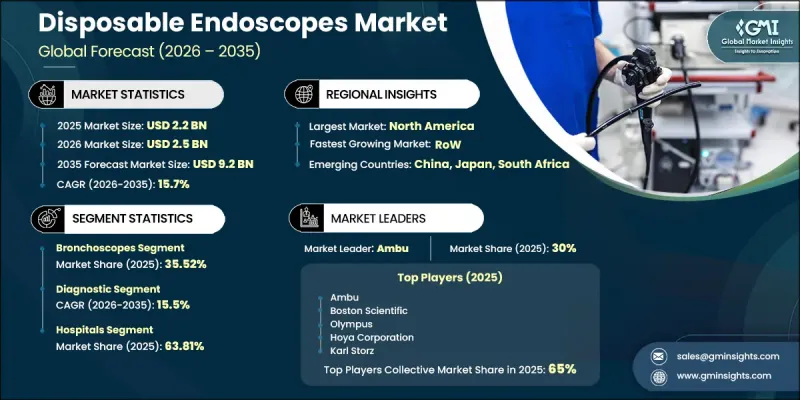
全球醫院、門診手術中心和重症監護室對一次性內視鏡設備的日益普及,推動了市場強勁成長。胃腸道和呼吸系統疾病以及其他需要微創診斷和治療的疾病的盛行率不斷上升,持續支撐著市場需求的成長。同時,醫療專業人員也越來越重視感染預防和病患安全,因此越來越傾向於選擇一次性設備,以避免重複使用設備處理帶來的風險。成像系統、設備耐用性和小型化方面的技術進步顯著提高了一次性內視鏡的性能,使其達到與可重複使用設備相媲美的水平。因此,採購決策越來越受到營運效率、感染控制和成本最佳化等因素的驅動,而非技術限制。醫療程序從住院轉向門診和護理機構的趨勢,進一步加速了這一趨勢的普及。此外,醫療保健報銷框架內對微創手術的支持力度不斷加大,鼓勵醫療機構投資一次性內視鏡解決方案,從而提高工作流程效率,縮短處理時間,並最大限度地降低消毒相關成本。
| 市場範圍 | |
|---|---|
| 開始年份 | 2025 |
| 預測期 | 2026-2035 |
| 初始市場規模 | 22億美元 |
| 預測金額 | 92億美元 |
| 複合年成長率 | 15.7% |
支氣管鏡檢查領域目前佔35.52%的市場佔有率,預計到2025年銷售額將達到7.81億美元。這一成長主要受以下因素驅動:呼吸系統疾病負擔日益加重、支氣管鏡檢查在重症監護環境中的應用不斷擴展,以及感染控制在臨床實踐中的重要性日益凸顯。一次性支氣管鏡性能的不斷提升,也進一步鞏固了其在全球醫療機構的市場滲透率。
醫院領域佔據63.81%的市場佔有率,預計到2025年市場規模將達到14億美元。醫院採用率的提升主要得益於微創診斷和治療程序在多個臨床專科的廣泛應用。一次性內視鏡的優勢——降低污染風險、簡化工作流程、無需重複處理——持續推動其在大型醫療機構中的普及。
北美一次性內視鏡市場佔49.93%的市場佔有率,預計到2025年市場規模將達到11億美元。這一成長主要得益於先進的醫療基礎設施、對創新醫療技術的積極應用、有利的保險報銷政策以及對感染預防日益重視。此外,該地區完善的採購體系和廣泛已通過核准的商用一次性內視鏡產品也為市場擴張提供了有力支撐。
目錄
第1章:調查方法和範圍
第2章執行摘要
第3章 行業洞察
- 產業生態系分析
- 影響產業的因素
- 促進因素
- 消化系統疾病、癌症和慢性疾病的發生率增加。
- 一次內視鏡的技術進步
- 人們越來越重視污染和感染控制
- 產業潛在風險與挑戰
- 熟練的醫師和內視鏡醫師短缺
- 與可重複使用的平台相比,每次治療的成本更高。
- 對環境和廢棄物管理的擔憂
- 市場機遇
- 開發可生物分解且環境友善的一次性內視鏡
- 促進因素
- 成長潛力分析
- 監理情勢
- 北美洲
- 歐洲
- 技術展望
- 最新科技趨勢
- 新興技術
- 價格趨勢分析
- 未來市場趨勢
- 專利分析
- 波特的分析
- PESTLE分析
- 人工智慧和生成式人工智慧對市場的影響
- 價值鏈分析
- 投資與資金籌措分析
第4章 競爭情勢
- 介紹
- 企業市佔率分析:按地區分類
- 北美洲
- 歐洲
- 主要進展
- 重要合作夥伴關係和合作
- 主要併購活動
- 產品創新和新產品發布
- 市場擴大策略
- 競爭定位矩陣
第5章 市場規模及預測:依產品類型分類,2022-2035年
- 支氣管鏡檢查
- 膀胱鏡
- 十二指腸內視鏡檢查
- 子宮鏡
- 喉鏡
- 輸尿管鏡
- 其他產品類型
第6章 市場規模及預測:依臨床應用分類,2022-2035年
- 診斷
- 外科
第7章 市場規模及預測:依最終用途分類,2022-2035年
- 醫院
- 門診手術中心
- 其他最終用戶
第8章 市場規模及預測:依地區分類,2022-2035年
- 北美洲
- 美國
- 加拿大
- 歐洲
- 德國
- 法國
- 英國
- 荷蘭
- 西班牙
- 義大利
- RoW
第9章:公司簡介
- Ambu
- Boston Scientific
- Coloplast
- CooperSurgical
- Flexicare
- Hoya Corporation
- HugeMed
- Karl Storz
- OLYMPUS
- RICHARD WOLF
- TSC
- UE MEDICAL
- Vathin Medical
- Verathon
The Global Disposable Endoscopes Market was valued at USD 2.2 billion in 2025 and is estimated to grow at a CAGR of 15.7% to reach USD 9.2 billion by 2035.
Strong market momentum is fueled by increasing adoption of single-use endoscopic devices across hospitals, ambulatory surgical centers, and critical care facilities worldwide. Rising prevalence of gastrointestinal disorders, respiratory diseases, and other conditions requiring minimally invasive diagnostic and therapeutic procedures continues to support demand growth. At the same time, healthcare providers are placing greater emphasis on infection prevention and patient safety, leading to a growing preference for disposable devices that eliminate risks associated with reprocessing reusable equipment. Technological advancements in imaging systems, device durability, and miniaturization have significantly enhanced the performance of disposable endoscopes, making them increasingly comparable to reusable alternatives. As a result, purchasing decisions are increasingly centered on operational efficiency, infection control, and cost optimization rather than technological limitations. The ongoing shift of medical procedures from inpatient settings to outpatient and ambulatory care environments is further accelerating adoption. In addition, healthcare reimbursement frameworks are increasingly supporting minimally invasive procedures, encouraging healthcare facilities to invest in single-use endoscopic solutions that improve workflow efficiency, reduce turnaround times, and minimize sterilization-related costs.
| Market Scope | |
|---|---|
| Start Year | 2025 |
| Forecast Year | 2026-2035 |
| Start Value | $2.2 Billion |
| Forecast Value | $9.2 Billion |
| CAGR | 15.7% |
The bronchoscope segment held a 35.52% share, generating USD 781 million in 2025. Growth is being driven by the increasing burden of respiratory diseases, rising utilization of bronchoscopic procedures in critical care environments, and the growing importance of infection prevention in clinical settings. Continued improvements in single-use bronchoscope performance have further strengthened market penetration across healthcare facilities globally.
The hospitals segment held a 63.81% share, generating USD 1.40 billion in 2025. Adoption within hospital settings is supported by extensive use across multiple clinical specialties where minimally invasive diagnostic and treatment procedures are routinely performed. The ability of disposable endoscopes to reduce contamination risks, streamline workflow processes, and eliminate reprocessing requirements continues to drive utilization across major healthcare institutions.
North America Disposable Endoscopes Market accounted for 49.93% share, generating USD 1.10 billion in 2025. Growth is supported by advanced healthcare infrastructure, strong adoption of innovative medical technologies, favorable reimbursement policies, and increasing emphasis on infection prevention. The region also benefits from a well-established procurement ecosystem and broad availability of commercially approved single-use endoscopic devices, which continue to support market expansion.
Major companies operating in the disposable endoscopes market include Verathon, Coloplast, Ambu A/S, Boston Scientific Corporation, Karl Storz SE & Co. KG, Olympus Corporation, CooperSurgical, Hoya Corporation (PENTAX Medical), Flexicare, RICHARD WOLF, HugeMed, Vathin Medical, UE Medical, and TSC (Tiansong Medical). Companies operating in the disposable endoscopes market are pursuing a range of strategic initiatives to strengthen their market presence and enhance competitive positioning. A primary focus is on continuous product innovation, including the development of advanced imaging capabilities, improved maneuverability, and enhanced device durability to increase clinical acceptance. Manufacturers are expanding their product portfolios across multiple procedural applications to address a broader range of healthcare requirements. Strategic partnerships with hospitals, healthcare systems, and distribution networks are helping companies accelerate market penetration and strengthen customer relationships. Investments in research and development remain a priority to improve device performance while reducing production costs.
Table of Contents
Chapter 1 Methodology & Scope
- 1.1 Research approach
- 1.2 Quality commitments
- 1.2.1 GMI AI policy & data integrity commitment
- 1.2.1.1 Source consistency protocol
- 1.2.1 GMI AI policy & data integrity commitment
- 1.3 Research trail & confidence scoring
- 1.3.1 Research trail components
- 1.3.2 Scoring components
- 1.4 Data collection
- 1.4.1 Partial list of primary sources
- 1.5 Data mining sources
- 1.5.1 Paid sources
- 1.5.1.1 Sources, by region
- 1.5.1 Paid sources
- 1.6 Base estimates and calculations
- 1.6.1 Base year calculation for any one approach
- 1.7 Market estimates & forecasts parameters
- 1.8 Forecast model
- 1.8.1 Quantified market impact analysis
- 1.8.1.1 Mathematical impact of growth parameters on forecast
- 1.8.1 Quantified market impact analysis
- 1.9 Research transparency addendum
- 1.9.1 Source attribution framework
- 1.9.2 Quality assurance metrics
- 1.9.3 Our commitment to trust
- 1.10 Market definitions
Chapter 2 Executive Summary
- 2.1 Industry synopsis, 2022 - 2035
- 2.1.1 Business trends
- 2.1.2 Product type trends
- 2.1.3 Clinical use trends
- 2.1.4 End use trends
- 2.1.5 Regional trends
Chapter 3 Industry Insights
- 3.1 Industry ecosystem analysis
- 3.2 Industry impact forces
- 3.2.1 Growth drivers
- 3.2.1.1 Rising incidence of gastrointestinal disorders, cancer, and chronic conditions.
- 3.2.1.2 Technological advancements in disposable endoscopes
- 3.2.1.3 Increased focus on contamination and infection control
- 3.2.2 Industry pitfalls and challenges
- 3.2.2.1 Shortage of skilled physicians and endoscopists
- 3.2.2.2 Higher per-procedure cost relative to reusable platforms
- 3.2.2.3 Environmental and waste management concerns
- 3.2.3 Market opportunities
- 3.2.3.1 Biodegradable and eco-compatible single-use scope development
- 3.2.1 Growth drivers
- 3.3 Growth potential analysis
- 3.4 Regulatory landscape (Driven by primary research)
- 3.4.1 North America
- 3.4.2 Europe
- 3.5 Technology landscape
- 3.5.1 Current technological trends
- 3.5.2 Emerging technologies
- 3.6 Pricing trend analysis (Driven by primary research)
- 3.7 Future market trends
- 3.8 Patent analysis
- 3.9 Porter's analysis
- 3.10 PESTEL analysis
- 3.11 Impact of AI and Generative AI on the market (Driven by primary research)
- 3.12 Value chain analysis (Driven by primary research)
- 3.13 Investment & funding analysis (Driven by primary research)
Chapter 4 Competitive Landscape, 2025
- 4.1 Introduction
- 4.2 Company market share analysis, by region, 2025
- 4.2.1 North America
- 4.2.2 Europe
- 4.3 Key developments
- 4.3.1 Key partnerships & collaborations
- 4.3.2 Major M&A activities
- 4.3.3 Product innovations & launches
- 4.3.4 Market expansion strategies
- 4.4 Competitive positioning matrix
Chapter 5 Market Size and Forecast, By Product Type, 2022 - 2035 (USD Million)
- 5.1 Key trends
- 5.2 Bronchoscopes
- 5.3 Cystoscopes
- 5.4 Duodenoscopes
- 5.5 Hysteroscopes
- 5.6 Laryngoscopes
- 5.7 Ureteroscopes
- 5.8 Other product types
Chapter 6 Market Size and Forecast, By Clinical Use, 2022 - 2035 (USD Million)
- 6.1 Key trends
- 6.2 Diagnostic
- 6.3 Surgical
Chapter 7 Market Size and Forecast, By End Use, 2022 - 2035 (USD Million)
- 7.1 Key trends
- 7.2 Hospital
- 7.3 Ambulatory surgical centers
- 7.4 Other end users
Chapter 8 Market Size and Forecast, By Region, 2022 - 2035 (USD Million)
- 8.1 Key trends
- 8.2 North America
- 8.2.1 U.S.
- 8.2.2 Canada
- 8.3 Europe
- 8.3.1 Germany
- 8.3.2 France
- 8.3.3 UK
- 8.3.4 Netherlands
- 8.3.5 Spain
- 8.3.6 Italy
- 8.4 RoW
Chapter 9 Company Profiles
- 9.1 Ambu
- 9.2 Boston Scientific
- 9.3 Coloplast
- 9.4 CooperSurgical
- 9.5 Flexicare
- 9.6 Hoya Corporation
- 9.7 HugeMed
- 9.8 Karl Storz
- 9.9 OLYMPUS
- 9.10 RICHARD WOLF
- 9.11 TSC
- 9.12 UE MEDICAL
- 9.13 Vathin Medical
- 9.14 Verathon

 一次性內視鏡市場:按產品類型、技術類型、患者類型、應用、最終用戶和分銷管道分類-2026-2032年全球市場預測
 全球一次性內視鏡市場:機會與策略展望(至2035年)
 拋棄式內視鏡市場規模、佔有率、成長、全球產業分析、區域洞察及2026-2034年預測
 一次性內視鏡市場-全球產業規模、佔有率、趨勢、機會、預測:按類型、最終用戶、地區和競爭格局分類,2021-2031年
 一次性內視鏡市場:按類型、應用程式、最終用戶和地區分類全球一次性內視鏡市場規模、佔有率、趨勢和成長分析報告(2026-2034年)
 一次性內視鏡市場規模、佔有率和趨勢分析報告:按產品、最終用途、地區和細分市場預測(2026-2033 年)
 一次性內視鏡市場規模、佔有率及成長分析(按產品類型、應用、患者、最終用途和地區分類)-2026-2033年產業預測
 全球一次性內視鏡市場按類型、臨床用途、應用、最終用戶和地區分類-預測至2030年
 拋棄式內視鏡的全球市場 - 市場考察,競爭情形,市場預測(2032年)