


 |
市場調查報告書
商品編碼
2071349
2026 年至 2035 年外牆系統的市場機會、成長要素、產業趨勢分析與預測。Cladding Systems Market Opportunity, Growth Drivers, Industry Trend Analysis, and Forecast 2026 - 2035 |
||||||

全球外牆系統市場預計到 2025 年將達到 2,496 億美元,年複合成長率為 5.2%,到 2035 年將達到 4,167 億美元。
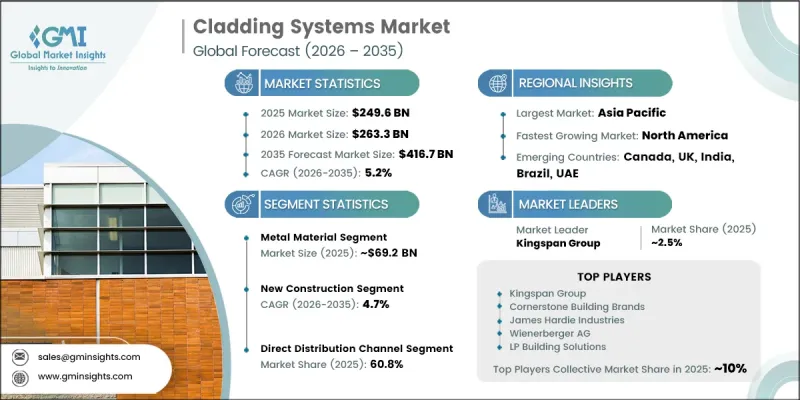
新興經濟體快速的都市化和大規模基礎設施建設推動了市場擴張,對先進建築外牆解決方案的需求強勁。開發商擴大選擇高性能覆材,以滿足不斷成長的城市人口的需求,這些材料兼具安裝快捷、結構防護性能更佳和耐久性強等優點。同時,節能建築圍護結構的日益普及也顯著影響著市場趨勢,相關人員優先考慮那些能夠增強隔熱性能、降低能耗並支持永續性目標的材料。成熟市場的維修和整修項目也推動了市場需求,老舊建築透過採用先進的外牆系統進行維修,以提高性能、安全性和使用壽命。全球對永續建築實踐和美觀建築設計的關注進一步促進了兼具功能性和美學價值的先進外牆技術的應用。
| 市場範圍 | |
|---|---|
| 開始年份 | 2025 |
| 預測期 | 2026-2035 |
| 上市時的市場規模 | 2496億美元 |
| 預計金額 | 4167億美元 |
| 複合年成長率 | 5.2% |
預計到2025年,金屬覆材市場規模將達到692億美元,並在2035年之前以5.5%的複合年成長率成長。由於金屬帷幕牆具有優異的耐候性、耐用性和長使用壽命,因此被廣泛用於新建和維修項目。此外,對永續建築解決方案日益成長的需求也推動了這一領域的發展,因為金屬覆材可回收利用,並且與旨在提高隔熱和能源效率的先進幕牆系統相容。
預計到2025年,新建建築市場將佔據67.6%的市場佔有率,並在預測期內以4.7%的複合年成長率成長。人口成長、城市擴張和現代基礎設施的進步正在推動對在設計階段就融入外牆系統的新建建築的強勁需求。建築師和開發商擴大採用先進材料,這些材料能夠增強隔熱性能、提高建築性能並降低長期營運成本,同時滿足不斷變化的監管和永續性要求。
美國外牆系統市場預計到2025年將達到517億美元,並在2035年之前以4.6%的複合年成長率成長。美國擁有成熟的建設產業,住宅、商業和公共部門的需求穩定,這為市場成長提供了有力支撐。對節能建築方法和監管標準的重視,正在加速採用旨在降低能耗和環境影響的現代外牆解決方案。此外,嚴格的建築安全要求也推動了高性能防火材料在建築專案中的應用。
目錄
第1章:調查方法和範圍
第2章執行摘要
第3章 行業洞察
- 產業生態系分析
- 供應商情況
- 利潤率
- 每個階段增加的價值
- 影響價值鏈的因素
- 影響產業的因素
- 促進因素
- 快速的都市化和基礎建設
- 人們對節能型建築圍護結構的興趣日益濃厚。
- 已開發國家市場的維修整修活動
- 美學偏好與建築潮流
- 產業潛在風險與挑戰
- 高檔覆材的初始成本較高
- 格倫費爾大火後,人們對消防安全問題日益關注,相關法規也加強。
- 防火性能測試標準不足
- 機會
- 輕型模組化外飾系統
- 先進材料(自清潔材料、光催化劑、智慧塗層)
- 促進因素
- 成長潛力分析
- 未來市場趨勢
- 技術與創新展望
- 最新科技趨勢
- 新興技術
- 監理情勢
- 標準和合規要求
- 區域監理框架
- 認證標準
- 貿易數據分析
- 進出口量及進口額趨勢
- 主要貿易路線及關稅的影響
- 價格分析
- 對過去價格趨勢的分析
- 按業務類型(高階/低階/大眾市場)分類的定價策略
- 人工智慧和生成式人工智慧對市場的影響
- 利用人工智慧改造現有經營模式
- 按細分市場分類的生成式人工智慧用例和部署藍圖
- 風險、限制和監管考量
- 波特的分析
- PESTLE分析
- 消費者購買行為分析
- 人口趨勢
- 影響購買決策的因素
- 消費者產品採納
- 首選分銷管道
第4章 競爭情勢
- 介紹
- 企業市佔率分析
- 按地區
- 企業矩陣分析
- 主要市場公司的競爭分析
- 競爭定位矩陣
- 主要進展
- 併購
- 夥伴關係和聯盟
- 新產品發布
- 業務拓展計劃
第5章 市場估算與預測:依材料類型分類,2022-2035年
- 金屬
- 陶瓷製品
- 石材
- 樹
- 乙烯基(塑膠)
- 石灰外牆及外牆外保溫系統
- 纖維水泥
- 其他
第6章 市場估計與預測:依系統類型分類,2022-2035年
- 外牆材料
- 屋頂覆蓋材料
- 門窗
- 其他
第7章 市場估計與預測:依安裝類型分類,2022-2035年
- 新建工程
- 維修和整修
第8章 市場估計與預測:依應用領域分類,2022-2035年
- 住宅
- 獨立式住宅
- 多用戶住宅
- 公寓和住宅
- 非住宅
- 商業
- 產業
- 對機構而言
第9章 市場估價與預測:依通路分類,2022-2035年
- 直銷
- 間接銷售
第10章 市場估價與預測:依地區分類,2022-2035年
- 北美洲
- 美國
- 加拿大
- 歐洲
- 德國
- 英國
- 法國
- 義大利
- 西班牙
- 亞太地區
- 中國
- 印度
- 日本
- 韓國
- 澳洲
- 印尼
- 馬來西亞
- 拉丁美洲
- 巴西
- 墨西哥
- 阿根廷
- 中東和非洲
- 沙烏地阿拉伯
- UAE
- 南非
第11章:公司簡介
- 世界頂尖公司
- Kingspan Group
- Compagnie de Saint-Gobain SA
- Tata Steel Limited
- Arconic Corporation
- Etex Group
- Rockwool International
- James Hardie Industries PLC
- 當地公司
- 日葉株式會社(亞太)
- 路易斯安那太平洋公司(北美)
- Swisspearl Group AG
- Trespa International BV
- FunderMax
- Reynaers Aluminium
- Everest Industries Ltd
- 新興企業
- Avenere Cladding LLC
- Aludecor
- 3A Composites
- Alpolic(Mitsubishi Chemical)
- Sto Corporation
- Centria
- NBK Terracotta
The Global Cladding Systems Market was valued at USD 249.6 billion in 2025 and is estimated to grow at a CAGR of 5.2% to reach USD 416.7 billion by 2035.
Market expansion is fueled by rapid urbanization and large-scale infrastructure development across emerging economies, which are driving strong demand for advanced exterior building solutions. Developers are increasingly selecting high-performance cladding materials that support faster installation, improved structural protection, and long-term durability to accommodate growing urban populations. At the same time, rising emphasis on energy-efficient building envelopes is significantly influencing market trends, as stakeholders prioritize materials that enhance insulation, reduce energy consumption, and support sustainability goals. Renovation and retrofit activities across mature markets are also contributing to demand, as aging structures are upgraded with modern cladding systems to improve performance, safety, and longevity. The global focus on sustainable construction practices and visually appealing architectural designs is further encouraging the adoption of advanced cladding technologies that deliver both functionality and aesthetic value.
| Market Scope | |
|---|---|
| Start Year | 2025 |
| Forecast Year | 2026-2035 |
| Start Value | $249.6 Billion |
| Forecast Value | $416.7 Billion |
| CAGR | 5.2% |
The metal cladding materials generated USD 69.2 billion in 2025 and is expected to grow at a CAGR of 5.5% through 2035. These materials are widely utilized due to their strong resistance to environmental conditions, durability, and long lifecycle performance, making them suitable for both new construction and refurbishment projects. Growing demand for sustainable construction solutions is also supporting this segment, as metal cladding is recyclable and compatible with advanced facade systems designed to improve thermal performance and energy efficiency.
The new construction segment accounted for 67.6% share in 2025 and is projected to grow at a CAGR of 4.7% over the forecast period. Increasing population growth, urban expansion, and the development of modern infrastructure are driving strong demand for newly built structures where cladding systems are incorporated during the design phase. Architects and developers are increasingly adopting advanced materials that enhance insulation, improve building performance, and deliver long-term operational savings while meeting evolving regulatory and sustainability requirements.
United States Cladding Systems Market accounted for USD 51.7 billion in 2025 and is expected to grow at a CAGR of 4.6% through 2035. The country benefits from a well-established construction industry supported by consistent demand across residential, commercial, and institutional sectors. Strong focus on energy-efficient building practices and regulatory standards is accelerating the adoption of modern cladding solutions designed to reduce energy consumption and environmental impact. Additionally, strict building safety requirements encourage the use of high-performance, non-combustible materials in construction projects.
Major players operating in the global cladding systems industry include Kingspan Group, Compagnie de Saint-Gobain SA, Tata Steel Limited, Arconic Corporation, Etex Group, Rockwool International, James Hardie Industries PLC, Nichiha Corporation, Louisiana Pacific Corporation, Swisspearl Group AG, Trespa International B.V., FunderMax, Reynaers Aluminium, Everest Industries Ltd, Avenere Cladding LLC, Aludecor, 3A Composites, Alpolic (Mitsubishi Chemical), Sto Corporation, Centria, and NBK Terracotta. Companies in the cladding systems market are focusing on innovation and sustainability to strengthen their competitive position. Leading players are investing in advanced materials that improve energy efficiency, durability, and fire resistance. Strategic partnerships with construction firms and architects are enabling the development of customized facade solutions tailored to modern building requirements. Manufacturers are also expanding their product portfolios to include eco-friendly and recyclable materials that align with global sustainability goals. Increasing emphasis on automation and efficient installation techniques is helping reduce project timelines and costs.
Table of Contents
Chapter 1 Methodology & Scope
- 1.1 Market scope and definition
- 1.2 Research design
- 1.2.1 Research approach
- 1.2.2 Data collection methods
- 1.3 Data mining sources
- 1.3.1 Global
- 1.3.2 Regional/Country
- 1.4 Base estimates and calculations
- 1.4.1 Base year calculation
- 1.4.2 Key trends for market estimation
- 1.5 Primary research and validation
- 1.5.1 Primary sources
- 1.6 Forecast model
- 1.7 Research assumptions and limitations
Chapter 2 Executive Summary
- 2.1 Industry 360° synopsis
- 2.2 Key market trends
- 2.2.1 Regional
- 2.2.2 Material type
- 2.2.3 System type
- 2.2.4 Installation type
- 2.2.5 Application
- 2.2.6 Distribution channel
Chapter 3 Industry Insights
- 3.1 Industry ecosystem analysis
- 3.1.1 Supplier landscape
- 3.1.2 Profit margin
- 3.1.3 Value addition at each stage
- 3.1.4 Factor affecting the value chain
- 3.2 Industry impact forces
- 3.2.1 Growth drivers
- 3.2.1.1 Rapid urbanization & infrastructure development
- 3.2.1.2 Growing emphasis on energy-efficient building envelopes
- 3.2.1.3 Renovation & retrofit activities in developed markets
- 3.2.1.4 Aesthetic preferences & architectural trends
- 3.2.2 Industry pitfalls & challenges
- 3.2.2.1 High initial costs of premium cladding materials
- 3.2.2.2 Fire safety concerns & regulatory tightening post-Grenfell
- 3.2.2.3 Inadequate fire performance testing standards
- 3.2.3 Opportunities
- 3.2.3.1 Lightweight & modular cladding systems
- 3.2.3.2 Advanced materials (self-cleaning, photocatalytic, smart coatings)
- 3.2.1 Growth drivers
- 3.3 Growth potential analysis
- 3.4 Future market trends
- 3.5 Technology and innovation landscape
- 3.5.1 Current technological trends
- 3.5.2 Emerging technologies
- 3.6 Regulatory landscape
- 3.6.1 Standards and compliance requirements
- 3.6.2 Regional regulatory frameworks
- 3.6.3 Certification standards
- 3.7 Trade data analysis (HS Code 7308)
- 3.7.1 Import/export volume & value trends
- 3.7.2 Key trade corridors & tariff impact
- 3.8 Pricing analysis
- 3.8.1 Historical price trend analysis (driven by primary research)
- 3.8.2 Pricing strategy by player type (premium / value / mass market)
- 3.9 Impact of AI & generative AI on the market
- 3.9.1 AI-driven disruption of existing business models
- 3.9.2 GenAI use cases & adoption roadmap by segment
- 3.9.3 Risks, limitations & regulatory considerations
- 3.10 Porter's analysis
- 3.11 PESTEL analysis
- 3.12 Consumer buying behavior analysis
- 3.12.1 Demographic trends
- 3.12.2 Factors affecting buying decisions
- 3.12.3 Consumer product adoption
- 3.12.4 Preferred distribution channel
Chapter 4 Competitive Landscape, 2025
- 4.1 Introduction
- 4.2 Company market share analysis
- 4.2.1 By Region
- 4.2.1.1 North America
- 4.2.1.2 Europe
- 4.2.1.3 Asia Pacific
- 4.2.1.4 Latin America
- 4.2.1.5 Middle East & Africa
- 4.2.1 By Region
- 4.3 Company matrix analysis
- 4.4 Competitive analysis of major market players
- 4.5 Competitive positioning matrix
- 4.6 Key developments
- 4.6.1 Mergers & acquisitions
- 4.6.2 Partnerships & collaborations
- 4.6.3 New product launches
- 4.6.4 Expansion plans
Chapter 5 Market Estimates & Forecast, By Material Type, 2022 - 2035, (USD Billion) (Million Units)
- 5.1 Key trends
- 5.2 Metal
- 5.3 Ceramic
- 5.4 Brick & stone
- 5.5 Wood
- 5.6 Vinyl (Plastics)
- 5.7 Stucco & EIFS
- 5.8 Fiber cement
- 5.9 Other
Chapter 6 Market Estimates & Forecast, By System type, 2022 - 2035, (USD Billion) (Million Units)
- 6.1 Key trends
- 6.2 Wall cladding
- 6.3 Roof cladding
- 6.4 Windows & doors
- 6.5 Others
Chapter 7 Market Estimates & Forecast, By Installation Type, 2022 - 2035, (USD Billion) (Million Units)
- 7.1 Key trends
- 7.2 New construction
- 7.3 Renovation & retrofit
Chapter 8 Market Estimates & Forecast, By Application, 2022 - 2035, (USD Billion) (Million Units)
- 8.1 Key trends
- 8.2 Residential
- 8.2.1 Single-family homes
- 8.2.2 Multi-family housing
- 8.2.3 Apartments & condominiums
- 8.3 Non-residential
- 8.3.1 Commercial
- 8.3.2 Industrial
- 8.3.3 Institutional
Chapter 9 Market Estimates & Forecast, By Distribution Channel, 2022 - 2035, (USD Billion) (Million Units)
- 9.1 Key trends
- 9.2 Direct sales
- 9.3 Indirect sales
Chapter 10 Market Estimates & Forecast, By Region, 2022 - 2035, (USD Billion) (Million Units)
- 10.1 Key trends
- 10.2 North America
- 10.2.1 U.S.
- 10.2.2 Canada
- 10.3 Europe
- 10.3.1 Germany
- 10.3.2 UK
- 10.3.3 France
- 10.3.4 Italy
- 10.3.5 Spain
- 10.4 Asia Pacific
- 10.4.1 China
- 10.4.2 India
- 10.4.3 Japan
- 10.4.4 South Korea
- 10.4.5 Australia
- 10.4.6 Indonesia
- 10.4.7 Malaysia
- 10.5 Latin America
- 10.5.1 Brazil
- 10.5.2 Mexico
- 10.5.3 Argentina
- 10.6 MEA
- 10.6.1 Saudi Arabia
- 10.6.2 UAE
- 10.6.3 South Africa
Chapter 11 Company Profiles
- 11.1 Top Global Players
- 11.1.1 Kingspan Group
- 11.1.2 Compagnie de Saint-Gobain SA
- 11.1.3 Tata Steel Limited
- 11.1.4 Arconic Corporation
- 11.1.5 Etex Group
- 11.1.6 Rockwool International
- 11.1.7 James Hardie Industries PLC
- 11.2 Regional Players
- 11.2.1 Nichiha Corporation (Asia Pacific)
- 11.2.2 Louisiana Pacific Corporation (North America)
- 11.2.3 Swisspearl Group AG
- 11.2.4 Trespa International B.V.
- 11.2.5 FunderMax
- 11.2.6 Reynaers Aluminium
- 11.2.7 Everest Industries Ltd
- 11.3 Emerging Players
- 11.3.1 Avenere Cladding LLC
- 11.3.2 Aludecor
- 11.3.3 3A Composites
- 11.3.4 Alpolic (Mitsubishi Chemical)
- 11.3.5 Sto Corporation
- 11.3.6 Centria
- 11.3.7 NBK Terracotta

 覆材市場-2026-2032年全球市場預測
 防火覆層市場:按類型、應用、最終用途行業和地區分類。覆層系統市場:按材料、類型、應用和地區分類
 覆材市場報告:按材料、組件、最終用戶和地區分類(2026-2034 年)
 2026年全球覆層系統市場報告
 覆材市場規模、佔有率及趨勢分析報告:依產品、應用、地區及細分市場預測(2026-2033 年)
 覆層:市佔率分析、產業趨勢與統計、成長預測(2026-2031)
 全球覆層系統市場規模、佔有率、趨勢和成長分析報告(2026-2034年)2026年全球衛浴覆層市場報告
 覆層系統市場 - 全球產業規模、佔有率、趨勢、機會及預測(按材料、應用、組件類型、地區和競爭格局分類,2021-2031年)