


 |
市場調查報告書
商品編碼
2071342
餐桌布藝及廚房用紡織品市場機會、成長要素、產業趨勢分析及 2026-2035 年預測。Table and Kitchen Linen Market Opportunity, Growth Drivers, Industry Trend Analysis, and Forecast 2026 - 2035 |
||||||

全球餐桌和廚房用紡織品市場預計到 2025 年將達到 262 億美元,年複合成長率為 5.7%,到 2035 年將達到 458 億美元。
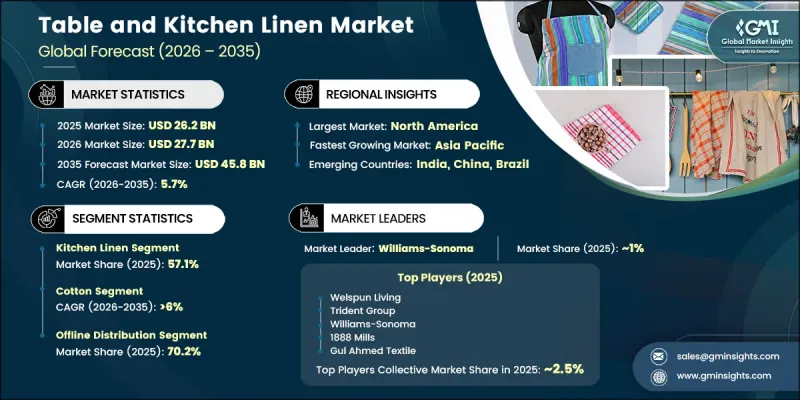
市場擴張主要得益於歐洲和北美等成熟經濟體消費的穩定成長,以及亞太和中東等快速發展地區需求的不斷擴大。可支配所得水準的提高、全球旅館業的持續擴張,以及消費者偏好向高階、生活方式導向型家用紡織品的明顯轉變,都為長期需求奠定了堅實的基礎。有組織的零售模式和電子商務平台的日益普及進一步提升了產品的可及性,使品牌能夠透過整合的線上管道同時服務於成本績效和追求高階的客戶群。同時,飯店和餐飲服務供應商的採購慣例也日趨規範化,長期供應合約在機構買家中日益普遍,取代了以往零散的採購行為。飯店和餐飲服務業仍然是商用餐桌布和廚房用紡織品需求的核心驅動力。亞太地區、中東和北美地區飯店客房的擴張、餐廳的蓬勃發展以及對整體餐飲服務基礎設施的持續投資,都維持了對桌布、廚房毛巾、餐巾和圍裙等基本布藝產品的穩定需求。
| 市場範圍 | |
|---|---|
| 開始年份 | 2025 |
| 預測期 | 2026-2035 |
| 上市時的市場規模 | 262億美元 |
| 預測金額 | 458億美元 |
| 複合年成長率 | 5.7% |
廚房用紡織品市場佔據57.1%的市場佔有率,預計到2035年將以5.3%的複合年成長率成長。該行業的領先地位得益於其豐富的產品系列,包括餐巾、廚房用巾、隔熱手套、圍裙和廚房防護用品,這些產品面向家庭和商用終端用戶。此類別的需求主要受功能性更換週期的驅動,確保了住宅廚房和商業餐飲服務業的穩定補貨需求。與裝飾性桌布不同,廚房用紡織品使用頻繁,更換更高,從而在全球市場保持穩定且持續的需求。
預計到2035年,棉織品市場將以6%的複合年成長率成長。其優勢源自於消費者對天然材料獨特性能的強烈偏好,例如高吸水性、透氣性、耐用性和易護理性。此外,棉織物適用於住宅和商用用途,因為它與家用和工業洗滌工藝均相容。近年來,全球棉纖維產量一直穩定在每年約2500萬至2600萬噸,這為紡織品製造商提供了穩定的原料供應,並有助於整個價值鏈的供應穩定。
預計到2025年,北美餐桌和廚房紡織品市場佔有率將達到26.9%,並在2035年之前以6%的複合年成長率成長。市場擴張的驅動力主要來自消費者對高階家用紡織品日益成長的興趣以及商業酒店業的復甦。飯店建築活動的活性化和餐飲服務基礎設施的擴張,推動了機構對餐桌和廚房紡織品的強勁需求,從而保障了商業終端用戶採購週期的穩定。
目錄
第1章:調查方法和範圍
第2章執行摘要
第3章 行業洞察
- 產業生態系分析
- 原物料供應商
- 製造商和紡織廠
- 銷售代理商、批發商和進口商
- 零售通路
- 最終用戶
- 利潤率
- 每個階段增加的價值
- 影響價值鏈的因素
- 影響產業的因素
- 促進因素
- 全球酒店餐飲業的擴張正在推動商用紡織品的採購。
- 消費者在室內設計和廚房美學方面的支出增加,正在推動住宅需求。
- 社群媒體對餐飲和廚房風格的影響
- 潛在風險和挑戰
- 由於原物料價格波動,生產成本不斷增加。
- 來自低成本合成替代品和一次性餐具的競爭日益激烈。
- 機會
- 優質化和客製化的趨勢正在創造高利潤的成長領域。
- 對永續、有機和經 OEKO-TEX 認證的亞麻產品的需求不斷成長。
- 促進因素
- 成長潛力分析
- 技術與創新展望
- 先進織物技術
- 數位紡織印花和客製化設計領域的創新
- 智慧紡織品和功能性布料的發展趨勢
- 監管和授權框架
- 全球關於紡織品安全性和化學性能的法規
- 永續性和生態標籤合規要求
- 價格分析
- 按產品類型分析歷史價格趨勢
- 依球員類型分類的定價策略(高級球員、超值球員、成本加成球員)
- 供應鏈分析
- 全球採購中心
- 供應鏈中斷風險及緩解措施
- 紡織品採購中近岸外包和回岸外包的趨勢
- 貿易數據分析
- 按產品類別分類的進出口量和進口額趨勢
- 主要貿易路線及關稅的影響
- 人工智慧和生成式人工智慧對市場的影響
- 利用人工智慧改造現有經營模式
- 按細分市場分類的生成式人工智慧用例和部署藍圖
- 風險、限制和監管考量
- 目前分銷基礎設施和通路滲透情況
- 按地區與業態(現代零售與傳統零售)分類的通路覆蓋率
- 缺乏最後一公里基礎設施和不斷變化的管道
第4章 競爭情勢
- 介紹
- 企業市佔率分析
- 按地區
- 企業矩陣分析
- 主要市場公司的競爭分析
- 競爭定位矩陣
- 主要進展
- 併購
- 夥伴關係和聯盟
- 新產品發布
- 業務拓展計劃
第5章 市場估算與預測:依產品類型分類,2022-2035年
- 桌布
- 桌布
- 桌布
- 餐墊和桌墊
- 餐巾
- 其他物品(桌裙、桌布等)
- 廚房用紡織品
- 廚房用巾/洗碗巾
- 圍裙
- 隔熱手套/烤箱手套/隔熱手套
- 其他物品(抹布、水槽墊等)
第6章 市場估計與預測:依材料分類,2022-2035年
- 棉布
- 普通棉花
- 有機且永續採購的棉花
- 亞麻布
- 人造纖維(聚酯纖維、超細纖維及其混紡織物)
- 聚酯纖維
- 超細纖維
- 混紡織物(棉、聚酯纖維等)
- 其他材質(絲綢、羊毛、竹纖維、毛巾布)
第7章 市場估計與預測:依價格區間分類,2022-2035年
- 低的
- 中等的
- 高的
第8章 市場估算與預測:依最終用途分類,2022-2035年
- 住宅
- 商業
- 飯店業
- 食品服務業
- 對機構而言
第9章 市場估價與預測:依通路分類,2022-2035年
- 線上
- 企業網站
- 電子商務網站
- 離線
- 大賣場和超級市場
- 百貨公司及家居用品專賣店
- 批發和機構供應管道
- 其他(室內設計商店、快閃店)
第10章 市場估價與預測:依地區分類,2022-2035年
- 北美洲
- 美國
- 加拿大
- 歐洲
- 德國
- 英國
- 法國
- 義大利
- 西班牙
- 亞太地區
- 中國
- 日本
- 印度
- 澳洲
- 韓國
- 拉丁美洲
- 巴西
- 墨西哥
- 阿根廷
- 中東和非洲
- 南非
- 沙烏地阿拉伯
- UAE
第11章:公司簡介
- 世界公司
- Welspun Living
- Trident Group
- Garnier-Thiebaut
- Libeco
- Ralph Lauren Home
- 1888 Mills
- 當地公司
- Alok Industries
- Gul Ahmed Textile Mills
- Milliken &Company(Table Linens)
- Williams-Sonoma
- Zorluteks Tekstil
- Beauville(MIE)
- Tessitura Carlo Lamperti
- SFERRA Fine Linens
- American Dawn(ADI)
- AB Siulas(Linen Fashion)
- LinenMe
- 新興企業
- Coyuchi
- Cultiver
- Rough Linen
- NJU Linen
The Global Table and Kitchen Linen Market was valued at USD 26.2 billion in 2025 and is estimated to grow at a CAGR of 5.7% to reach USD 45.8 billion by 2035.
Market expansion is supported by steady consumption growth across established Western economies as well as rapidly developing regions such as Asia Pacific and the Middle East. Rising disposable income levels, continuous expansion of the global hospitality sector, and a clear shift in consumer preference toward premium and lifestyle-focused home textiles are strengthening long-term demand fundamentals. Increased penetration of organized retail formats and e-commerce platforms is further improving product accessibility, enabling brands to serve both value-oriented and premium customer segments through integrated online channels. In parallel, procurement practices within hotels and food service operators are becoming more structured, with long-term supply agreements increasingly replacing irregular purchasing behavior across institutional buyers. The hospitality and food service industry continues to represent the core demand driver for commercial-grade table and kitchen linen products. Ongoing investments in hotel capacity expansion, restaurant development, and broader food service infrastructure across Asia Pacific, the Middle East, and North America are sustaining stable demand for essential linen products, including table coverings, kitchen towels, napkins, and aprons.
| Market Scope | |
|---|---|
| Start Year | 2025 |
| Forecast Year | 2026-2035 |
| Start Value | $26.2 Billion |
| Forecast Value | $45.8 Billion |
| CAGR | 5.7% |
The kitchen linen segment held a 57.1% share and is projected to grow at a CAGR of 5.3% through 2035. The segment's dominance is supported by its wide product portfolio, which includes dish towels, kitchen towels, oven mitts, aprons, and protective kitchen accessories, serving both household and institutional end users. Demand in this category is largely driven by functional replacement cycles, ensuring consistent replenishment across residential kitchens and commercial food service operations. Unlike decorative table linen, kitchen linen benefits from frequent usage and higher replacement frequency, which sustains stable and recurring demand across global markets.
The cotton segment is projected to grow at a CAGR of 6% through 2035. Its dominance is attributed to strong consumer preference for its natural properties, including high absorbency, breathability, durability, and ease of maintenance. Cotton is also widely compatible with both household washing and industrial laundering processes, making it suitable for residential and commercial applications. Stable global cotton fiber production levels, maintained at approximately 25-26 million metric tonnes annually in recent years, have supported consistent raw material availability for textile manufacturers, contributing to supply stability across the value chain.
North America Table and Kitchen Linen Market accounted for 26.9% share in 2025 and is expected to grow at a CAGR of 6% through 2035. Market expansion is driven by rising consumer interest in premium home textiles and a recovering commercial hospitality sector. Increasing hotel construction activity and expanding food service infrastructure are generating strong institutional demand for table and kitchen linen products, supporting consistent procurement cycles across commercial end users.
Major companies operating in the global table and kitchen linen market include Welspun Living, Trident Group, Garnier-Thiebaut, Libeco, Ralph Lauren Home, and 1888 Mills. Companies in the table and kitchen linen market are adopting diversified growth strategies to strengthen their market presence and enhance long-term competitiveness. Product innovation is a key focus area, with manufacturers introducing premium, durable, and design-oriented linen products tailored to evolving consumer lifestyles. Sustainability initiatives are gaining importance, with increased adoption of eco-friendly fibers, responsible sourcing practices, and low-impact dyeing processes. Expansion of e-commerce and direct-to-consumer channels is enabling brands to improve market reach while building stronger customer relationships and improving margin structures. Strategic partnerships with hospitality and food service operators support long-term supply contracts and ensuring consistent demand visibility.
Table of Contents
Chapter 1 Methodology and Scope
- 1.1 Market scope and definition
- 1.2 Research design
- 1.2.1 Research approach
- 1.2.2 Data collection methods
- 1.3 Data mining sources
- 1.3.1 Global
- 1.3.2 Regional/Country
- 1.4 Base estimates and calculations
- 1.4.1 Base year calculation
- 1.4.2 Key trends for market estimation
- 1.5 Primary research and validation
- 1.5.1 Primary sources
- 1.6 Forecast model
- 1.7 Research assumptions and limitations
Chapter 2 Executive Summary
- 2.1 Industry 360° synopsis
- 2.2 Key market trends
- 2.2.1 Regional
- 2.2.2 Product type
- 2.2.3 Material
- 2.2.4 Price
- 2.2.5 End user
- 2.2.6 Distribution channel
Chapter 3 Industry Insights
- 3.1 Industry ecosystem analysis
- 3.1.1 Raw material suppliers
- 3.1.2 Manufacturers & textile mills
- 3.1.3 Distributors, wholesalers & importers
- 3.1.4 Retail channels
- 3.1.5 End users
- 3.1.6 Profit margin
- 3.1.7 Value addition at each stage
- 3.1.8 Factor affecting the value chain
- 3.2 Industry impact forces
- 3.2.1 Growth drivers
- 3.2.1.1 Rising global hospitality & food service industry expansion driving commercial linen procurement
- 3.2.1.2 Growing consumer spending on home decor & kitchen aesthetics fueling residential demand
- 3.2.1.3 Social media influence on dining & kitchen styling
- 3.2.2 Pitfalls & challenges
- 3.2.2.1 Volatility in raw material prices increasing production costs
- 3.2.2.2 Increasing competition from low-cost synthetic substitutes & disposable tableware alternatives
- 3.2.3 Opportunities
- 3.2.3.1 Premiumization & customization trend creating high-margin growth segments
- 3.2.3.2 Growing demand for sustainable, organic & OEKO-TEX certified linen products
- 3.2.1 Growth drivers
- 3.3 Growth potential analysis
- 3.4 Technology and innovation landscape
- 3.4.1 Advanced fabric technologies
- 3.4.2 Digital textile printing & custom design innovation
- 3.4.3 Smart textiles & functional fabric developments
- 3.5 Regulatory & licensing framework
- 3.5.1 Global textile safety & chemical regulations
- 3.5.2 Sustainability & eco-label compliance requirements
- 3.6 Pricing analysis (driven by primary research)
- 3.6.1 Historical price trend analysis by product category
- 3.6.2 Pricing strategy by player type (premium / value / cost-plus)
- 3.7 Supply chain analysis
- 3.7.1 Global sourcing hubs
- 3.7.2 Supply chain disruption risks & mitigation strategies
- 3.7.3 Nearshoring & reshoring trends in textile procurement
- 3.8 Trade data analysis (driven by paid database) (HS code- 6302)
- 3.8.1 Import/export volume & value trends by product category
- 3.8.2 Key trade corridors & tariff impact
- 3.9 Impact of AI & generative AI on the market
- 3.9.1 AI-driven disruption of existing business models
- 3.9.2 GenAI use cases & adoption roadmap by segment
- 3.9.3 Risks, limitations & regulatory considerations
- 3.10 Distribution infrastructure & channel penetration landscape (driven by primary research)
- 3.10.1 Channel coverage by region & format (modern vs. traditional trade)
- 3.10.2 Last-mile infrastructure gaps & emerging channel shifts
Chapter 4 Competitive Landscape, 2025
- 4.1 Introduction
- 4.2 Company market share analysis
- 4.2.1 By region
- 4.2.1.1 North America
- 4.2.1.2 Europe
- 4.2.1.3 Asia Pacific
- 4.2.1.4 Latin America
- 4.2.1.5 Middle East and Africa
- 4.2.1 By region
- 4.3 Company matrix analysis
- 4.4 Competitive analysis of major market players
- 4.5 Competitive positioning matrix
- 4.6 Key developments
- 4.6.1 Mergers & acquisitions
- 4.6.2 Partnerships & collaborations
- 4.6.3 New product launches
- 4.6.4 Expansion plans
Chapter 5 Market Estimates and Forecast, By Product Type, 2022 - 2035 (USD Billion) (Million Units)
- 5.1 Key trends
- 5.2 Table linen
- 5.2.1 Tablecloths
- 5.2.2 Table runners
- 5.2.3 Placemats & table mat
- 5.2.4 Napkins
- 5.2.5 Others (table skirting, table overlays, etc.)
- 5.3 Kitchen linen
- 5.3.1 Kitchen towels & dish towels
- 5.3.2 Aprons
- 5.3.3 Pot holders & oven mitts/gloves
- 5.3.4 Others (dishcloths, sink mats, etc.)
Chapter 6 Market Estimates and Forecast, By Material, 2022 - 2035 (USD Billion) (Million Units)
- 6.1 Key trends
- 6.2 Cotton
- 6.2.1 Conventional cotton
- 6.2.2 Organic & sustainably sourced cotton
- 6.3 Linen
- 6.4 Artificial fibers (polyester, microfiber & blends)
- 6.4.1 Polyester
- 6.4.2 Microfiber
- 6.4.3 Blended fabrics (cotton-polyester, etc.)
- 6.5 Others (silk, wool, bamboo, terrycloth)
Chapter 7 Market Estimates and Forecast, By Price Range, 2022 - 2035 (USD Billion) (Million Units)
- 7.1 Key trends
- 7.2 Low
- 7.3 Medium
- 7.4 High
Chapter 8 Market Estimates and Forecast, By End Use, 2022 - 2035 (USD Billion) (Million Units)
- 8.1 Key trends
- 8.2 Residential
- 8.3 Commercial
- 8.3.1 Hospitality
- 8.3.2 Food service
- 8.3.3 Institutional
Chapter 9 Market Estimates and Forecast, By Distribution Channel, 2022 - 2035 (USD Billion) (Million Units)
- 9.1 Key trends
- 9.2 Online
- 9.2.1 Company website
- 9.2.2 E-commerce website
- 9.3 Offline
- 9.3.1 Hypermarkets & supermarkets
- 9.3.2 Departmental & specialty home stores
- 9.3.3 Wholesale & institutional supply channels
- 9.3.4 Others (home decor boutiques, pop-up stores)
Chapter 10 Market Estimates and Forecast, By Region, 2022 - 2035 (USD Billion) (Million Units)
- 10.1 Key trends
- 10.2 North America
- 10.2.1 U.S.
- 10.2.2 Canada
- 10.3 Europe
- 10.3.1 Germany
- 10.3.2 UK
- 10.3.3 France
- 10.3.4 Italy
- 10.3.5 Spain
- 10.4 Asia Pacific
- 10.4.1 China
- 10.4.2 Japan
- 10.4.3 India
- 10.4.4 Australia
- 10.4.5 South Korea
- 10.5 Latin America
- 10.5.1 Brazil
- 10.5.2 Mexico
- 10.5.3 Argentina
- 10.6 Middle East and Africa
- 10.6.1 South Africa
- 10.6.2 Saudi Arabia
- 10.6.3 UAE
Chapter 11 Company Profiles
- 11.1 Global players
- 11.1.1 Welspun Living
- 11.1.2 Trident Group
- 11.1.3 Garnier-Thiebaut
- 11.1.4 Libeco
- 11.1.5 Ralph Lauren Home
- 11.1.6 1888 Mills
- 11.2 Regional players
- 11.2.1 Alok Industries
- 11.2.2 Gul Ahmed Textile Mills
- 11.2.3 Milliken & Company (Table Linens)
- 11.2.4 Williams-Sonoma
- 11.2.5 Zorluteks Tekstil
- 11.2.6 Beauville (MIE)
- 11.2.7 Tessitura Carlo Lamperti
- 11.2.8 SFERRA Fine Linens
- 11.2.9 American Dawn (ADI)
- 11.2.10 AB Siulas (Linen Fashion)
- 11.2.11 LinenMe
- 11.3 Emerging players
- 11.3.1 Coyuchi
- 11.3.2 Cultiver
- 11.3.3 Rough Linen
- 11.3.4 NJU Linen

 精紡布料市場規模、佔有率和成長分析:按材料、應用、布料克重、最終用戶、分銷通路和地區分類-2026-2033年產業預測
 乙烯基織物市場規模、佔有率和成長分析:按產品類型、襯裡材料、應用、最終用戶、分銷管道和地區分類-2026-2033年產業預測
 全球MLCC用網版印刷網布市場展望、詳細分析及至2032年預測
 套件布料市場規模、佔有率和成長分析(按類型、材料、應用和地區分類):產業預測(2026-2033 年)
 服飾襯布市場規模、佔有率和成長分析:按類型、材料、應用和地區分類 - 產業預測(2026-2033 年)
 2026年全球兒童防水圍裙市場報告
 網狀織物市場規模、佔有率和成長分析:按材料、網眼尺寸、應用、通路和地區分類-2026年至2033年產業預測
 多軸紡織品市場預測至2034年-按類型、纖維類型、加工方法、最終用戶和地區分類的全球分析
 針織內衣市場-全球產業規模、佔有率、趨勢、機會和預測:按產品類型、材料、年齡層、地區和競爭格局分類,2021-2031年針織布料市場-全球產業規模、佔有率、趨勢、機會、預測:按產品、應用、區域和競爭對手分類,2021-2031年