


 |
市場調查報告書
商品編碼
2071336
清潔機器人市場商機、成長要素、產業趨勢分析及2026-2035年預測。Cleaning Robot Market Opportunity, Growth Drivers, Industry Trend Analysis, and Forecast 2026 - 2035 |
||||||

全球機器人吸塵器市場預計到 2025 年將達到 126 億美元,年複合成長率為 7.8%,到 2035 年將達到 269 億美元。
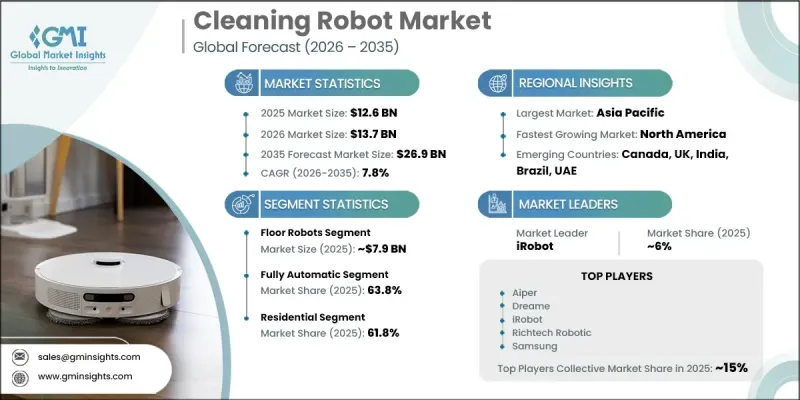
都市區密度不斷增加以及消費者對高效節能的家居技術的追求,是推動這一成長的主要因素。現代生活方式,尤其是雙薪家庭,顯著提升了對能夠減輕人工清潔負擔並維持衛生標準的設備的需求。全球對衛生日益成長的關注,以及疫情後行為模式的改變,進一步推動了住宅和商用清潔機器人的普及。配備先進過濾系統和紫外線消毒功能的清潔機器人正被廣泛接受,尤其是在對衛生標準要求極高的環境中。隨著消費者越來越傾向於使用可透過數位平台遠端控制和定時的連網型設備,智慧家庭生態系統的整合也加速了市場需求。導航、感測和自動化技術的持續創新,不斷提升了清潔機器人的性能和價格競爭力,進一步擴大了其在已開發市場和新興市場的目標消費群體。
| 市場範圍 | |
|---|---|
| 開始年份 | 2025 |
| 預測期 | 2026-2035 |
| 上市時的市場規模 | 126億美元 |
| 預測金額 | 269億美元 |
| 複合年成長率 | 7.8% |
預計到2025年,地面清潔機器人市場規模將達到79億美元,並在2035年之前以8%的複合年成長率成長。該品類包括掃地機器人和拖地機器人,由於能夠滿足頻繁重複清潔的需求,因此在智慧家庭領域仍佔據核心地位。智慧地圖繪製、即時障礙物偵測和自動定時等功能的改進,使得機器人操作更加便捷,並被廣泛應用於各種不同的住宅佈局中。
預計到2025年,住宅應用領域將佔據61.8%的市場佔有率,並在2035年之前維持8%的複合年成長率。都市化加快、生活空間日益縮小以及勞動參與率不斷提高,正推動家庭自動化清潔解決方案的普及。緊湊的設計、智慧導航和應用程式控制等功能與現代住宅生活方式相契合,使這些設備成為日常維護的實用之選。
預計到2025年,北美機器人吸塵器市場規模將達到30億美元,並在2035年之前以8.1%的複合年成長率成長。消費者強勁的購買力、較高的數位素養以及對智慧家庭技術的早期應用,持續推動市場需求。繁忙的都市生活和人們對衛生狀況的日益重視,也促進了機器人吸塵器在住宅和商業環境中的應用。
目錄
第1章:調查方法和範圍
第2章執行摘要
第3章 行業洞察
- 產業生態系分析
- 供應商情況
- 利潤率
- 每個階段增加的價值
- 影響價值鏈的因素
- 影響產業的因素
- 促進因素
- 對便捷省時解決方案的需求日益成長
- 人們衛生和清潔意識的提高
- 智慧家庭和連網型設備的廣泛應用
- 產業潛在風險與挑戰
- 電池壽命限制
- 特定表面上的性能問題
- 機會
- 商用清潔機器人需求日益成長
- 基於訂閱的服務和機器人即服務 (RaaS) 模型
- 促進因素
- 成長潛力分析
- 未來市場趨勢
- 技術與創新展望
- 最新科技趨勢
- 新興技術
- 監理情勢
- 標準和合規要求
- 區域監理框架
- 認證標準
- 貿易數據分析
- 進出口量及進口額趨勢
- 主要貿易路線及關稅的影響
- 價格分析
- 對過去價格趨勢的分析
- 按業務類型(高階/低階/大眾市場)分類的定價策略
- 人工智慧和生成式人工智慧對市場的影響
- 利用人工智慧改造現有經營模式
- 按細分市場分類的生成式人工智慧用例和部署藍圖
- 風險、限制和監管考量
- 波特的分析
- PESTLE分析
- 消費者購買行為分析
- 人口趨勢
- 影響購買決策的因素
- 消費者產品採納
- 首選分銷管道
第4章 競爭情勢
- 介紹
- 企業市佔率分析
- 按地區
- 企業矩陣分析
- 主要市場公司的競爭分析
- 競爭定位矩陣
- 主要進展
- 併購
- 夥伴關係和聯盟
- 新產品發布
- 業務拓展計劃
第5章 市場估計與預測:依類型分類,2022-2035年
- 地板機器人
- 視窗機器人
- 割草機器人
- 泳池機器人
- 其他(例如管道機器人)
第6章 市場估計與預測:依營運模式分類,2022-2035年
- 半自動
- 全自動
第7章 市場估計與預測:依價格分類,2022-2035年
- 低的
- 中等的
- 高的
第8章 市場估算與預測:依最終使用者分類,2022-2035年
- 住宅
- 商業
- 運輸
- 零售
- 辦公室
- 飯店業
- 其他(學校、大學等)
- 產業
第9章 市場估價與預測:依通路分類,2022-2035年
- 線上
- 電子商務
- 公司網站
- 離線
- 超級市場/大賣場
- 專業零售店
- 其他(例如獨立經營零售商店)
第10章 市場估價與預測:依地區分類,2022-2035年
- 北美洲
- 美國
- 加拿大
- 歐洲
- 德國
- 英國
- 法國
- 義大利
- 西班牙
- 亞太地區
- 中國
- 印度
- 日本
- 韓國
- 澳洲
- 印尼
- 馬來西亞
- 拉丁美洲
- 巴西
- 墨西哥
- 阿根廷
- 中東和非洲
- 沙烏地阿拉伯
- UAE
- 南非
第11章:公司簡介
- 世界頂尖公司
- iRobot Corporation
- Ecovacs Robotics Co., Ltd.
- Xiaomi Corporation/Roborock
- LG Electronics
- Samsung Electronics
- Panasonic Corporation
- Dyson Ltd.
- 該地區的領先企業
- Haier Group
- Miele & Cie. KG
- HOBOT Technology Inc.
- Cecotec Innovaciones SL
- ILIFE(Zhiyi Technology Co., Ltd.)
- Karcher(Alfred Karcher SE & Co. KG)
- Nilfisk Group
- 新興企業
- Narwal Robotics
- Dreame Technology
- Proscenic
- 360 Smart Life(Qihoo 360)
- SharkNinja(Shark Robotics division)
- Tineco Intelligent Technology Co., Ltd.
- Makita Corporation
The Global Cleaning Robot Market was valued at USD 12.6 billion in 2025 and is estimated to grow at a CAGR of 7.8% to reach USD 26.9 billion by 2035.
Growth is supported by increasing urban population density and the shift toward time-efficient household technologies. Modern lifestyles, particularly in dual-income households, have significantly raised demand for devices that reduce manual cleaning effort while maintaining consistent hygiene standards. Heightened global attention to sanitation, reinforced by post-pandemic behavioral changes, has further strengthened adoption across both residential and commercial settings. Cleaning robots equipped with advanced filtration systems and ultraviolet-based disinfection capabilities are gaining broader acceptance, especially in environments where hygiene compliance is critical. Their integration into smart home ecosystems is also accelerating demand, as consumers increasingly prefer connected devices that can be controlled remotely and scheduled through digital platforms. Continuous innovation in navigation, sensing, and automation technologies is improving performance and affordability, further widening the addressable consumer base across developed and emerging economies.
| Market Scope | |
|---|---|
| Start Year | 2025 |
| Forecast Year | 2026-2035 |
| Start Value | $12.6 Billion |
| Forecast Value | $26.9 Billion |
| CAGR | 7.8% |
Floor cleaning robots accounted for USD 7.9 billion in 2025 and is projected to grow at a CAGR of 8% through 2035. This category, which includes robotic vacuum and mop systems, remains central to household automation because it addresses frequent and repetitive cleaning needs. Enhanced functionality, such as intelligent mapping, real-time obstacle detection, and automated scheduling, continues to improve usability and adoption across diverse home layouts.
The residential applications segment held a 61.8% share in 2025 and is expected to maintain a CAGR of 8% through 2035. Growing urbanization, smaller living spaces, and increasing workforce participation have encouraged households to adopt automated cleaning solutions. Features such as compact design, smart navigation, and app-based control align well with modern residential lifestyles, making these devices a practical choice for daily maintenance.
North America Cleaning Robot Market captured USD 3 billion in 2025 and is projected to grow at a CAGR of 8.1% through 2035. Strong consumer purchasing power, high digital literacy, and early adoption of smart home technologies continue to drive demand. Busy urban lifestyles and sustained emphasis on hygiene have reinforced adoption across both households and commercial environments.
Major players operating in the global cleaning robot industry include Ecovacs Robotics Co., Ltd., iRobot Corporation, Samsung Electronics, Xiaomi Corporation / Roborock, LG Electronics, Panasonic Corporation, Dyson Ltd., Haier Group, Miele & Cie. KG, Karcher (Alfred Karcher SE & Co. KG), Nilfisk Group, HOBOT Technology Inc., Cecotec Innovaciones S.L., ILIFE (Zhiyi Technology Co., Ltd.), Narwal Robotics, Dreame Technology, Proscenic, 360 Smart Life (Qihoo 360), SharkNinja (Shark Robotics division), Tineco Intelligent Technology Co., Ltd., and Makita Corporation. Companies in the cleaning robot market are strengthening their position by investing heavily in artificial intelligence, machine vision, and sensor fusion technologies to improve navigation accuracy and cleaning efficiency. They are also expanding product portfolios to cover multiple price segments, ensuring accessibility for both premium and budget-conscious consumers. Strategic emphasis on smart home integration allows seamless connectivity with voice assistants and IoT ecosystems, improving user convenience. Firms are increasingly adopting subscription-based service models and extended warranty programs to generate recurring revenue. Partnerships with e-commerce platforms and retail chains are improving distribution reach globally.
Table of Contents
Chapter 1 Methodology & Scope
- 1.1 Market scope and definition
- 1.2 Research design
- 1.2.1 Research approach
- 1.2.2 Data collection methods
- 1.3 Data mining sources
- 1.3.1 Global
- 1.3.2 Regional/Country
- 1.4 Base estimates and calculations
- 1.4.1 Base year calculation
- 1.4.2 Key trends for market estimation
- 1.5 Primary research and validation
- 1.5.1 Primary sources
- 1.6 Forecast model
- 1.7 Research assumptions and limitations
Chapter 2 Executive Summary
- 2.1 Industry 360° synopsis
- 2.2 Key market trends
- 2.2.1 Regional
- 2.2.2 Type
- 2.2.3 Mode of operation
- 2.2.4 Price
- 2.2.5 End user
- 2.2.6 Distribution channel
Chapter 3 Industry Insights
- 3.1 Industry ecosystem analysis
- 3.1.1 Supplier landscape
- 3.1.2 Profit margin
- 3.1.3 Value addition at each stage
- 3.1.4 Factor affecting the value chain
- 3.2 Industry impact forces
- 3.2.1 Growth drivers
- 3.2.1.1 Growing demand for convenience and time-saving solutions
- 3.2.1.2 Increasing awareness of hygiene and cleanliness
- 3.2.1.3 Rising adoption of smart homes and connected devices
- 3.2.2 Industry pitfalls & challenges
- 3.2.2.1 Battery life constraints
- 3.2.2.2 Performance issues on certain surfaces
- 3.2.3 Opportunities
- 3.2.3.1 Rising demand for commercial cleaning robots
- 3.2.3.2 Subscription-based services and Robot-as-a-Service (RaaS) models
- 3.2.1 Growth drivers
- 3.3 Growth potential analysis
- 3.4 Future market trends
- 3.5 Technology and innovation landscape
- 3.5.1 Current technological trends
- 3.5.2 Emerging technologies
- 3.6 Regulatory landscape
- 3.6.1 Standards and compliance requirements
- 3.6.2 Regional regulatory frameworks
- 3.6.3 Certification standards
- 3.7 Trade data analysis (HS Code 8508)
- 3.7.1 Import/export volume & value trends
- 3.7.2 Key trade corridors & tariff impact
- 3.8 Pricing analysis
- 3.8.1 Historical price trend analysis (driven by primary research)
- 3.8.2 Pricing strategy by player type (premium / value / mass market)
- 3.9 Impact of AI & generative AI on the market
- 3.9.1 AI-driven disruption of existing business models
- 3.9.2 GenAI use cases & adoption roadmap by segment
- 3.9.3 Risks, limitations & regulatory considerations
- 3.10 Porter's analysis
- 3.11 PESTEL analysis
- 3.12 Consumer buying behavior analysis
- 3.12.1 Demographic trends
- 3.12.2 Factors affecting buying decisions
- 3.12.3 Consumer product adoption
- 3.12.4 Preferred distribution channel
Chapter 4 Competitive Landscape, 2025
- 4.1 Introduction
- 4.2 Company market share analysis
- 4.2.1 By Region
- 4.2.1.1 North America
- 4.2.1.2 Europe
- 4.2.1.3 Asia Pacific
- 4.2.1.4 Latin America
- 4.2.1.5 Middle East & Africa
- 4.2.1 By Region
- 4.3 Company matrix analysis
- 4.4 Competitive analysis of major market players
- 4.5 Competitive positioning matrix
- 4.6 Key developments
- 4.6.1 Mergers & acquisitions
- 4.6.2 Partnerships & collaborations
- 4.6.3 New product launches
- 4.6.4 Expansion plans
Chapter 5 Market Estimates & Forecast, By Type, 2022 - 2035, (USD Billion) (Million Units)
- 5.1 Key trends
- 5.2 Floor robots
- 5.3 Window robots
- 5.4 Lawn robots
- 5.5 Pool robots
- 5.6 Others (duct robots etc.)
Chapter 6 Market Estimates & Forecast, By Mode of Operation, 2022 - 2035, (USD Billion) (Million Units)
- 6.1 Key trends
- 6.2 Semi-automatic
- 6.3 Fully automatic
Chapter 7 Market Estimates & Forecast, By Price, 2022 - 2035, (USD Billion) (Million Units)
- 7.1 Key trends
- 7.2 Low
- 7.3 Medium
- 7.4 High
Chapter 8 Market Estimates & Forecast, By End User, 2022 - 2035, (USD Billion) (Million Units)
- 8.1 Key trends
- 8.2 Residential
- 8.3 Commercial
- 8.3.1 Transportation
- 8.3.2 Retail
- 8.3.3 Offices
- 8.3.4 Hospitality
- 8.3.5 Others (schools, universities etc.)
- 8.4 Industrial
Chapter 9 Market Estimates & Forecast, By Distribution Channel, 2022 - 2035, (USD Billion) (Million Units)
- 9.1 Key trends
- 9.2 Online
- 9.2.1 E-commerce
- 9.2.2 Company websites
- 9.3 Offline
- 9.3.1 Supermarkets/hypermarket
- 9.3.2 Specialty retail stores
- 9.3.3 Others (independent retailer etc.)
Chapter 10 Market Estimates & Forecast, By Region, 2022 - 2035, (USD Billion) (Million Units)
- 10.1 Key trends
- 10.2 North America
- 10.2.1 U.S.
- 10.2.2 Canada
- 10.3 Europe
- 10.3.1 Germany
- 10.3.2 UK
- 10.3.3 France
- 10.3.4 Italy
- 10.3.5 Spain
- 10.4 Asia Pacific
- 10.4.1 China
- 10.4.2 India
- 10.4.3 Japan
- 10.4.4 South Korea
- 10.4.5 Australia
- 10.4.6 Indonesia
- 10.4.7 Malaysia
- 10.5 Latin America
- 10.5.1 Brazil
- 10.5.2 Mexico
- 10.5.3 Argentina
- 10.6 MEA
- 10.6.1 Saudi Arabia
- 10.6.2 UAE
- 10.6.3 South Africa
Chapter 11 Company Profiles
- 11.1 Top Global Players
- 11.1.1 iRobot Corporation
- 11.1.2 Ecovacs Robotics Co., Ltd.
- 11.1.3 Xiaomi Corporation / Roborock
- 11.1.4 LG Electronics
- 11.1.5 Samsung Electronics
- 11.1.6 Panasonic Corporation
- 11.1.7 Dyson Ltd.
- 11.2 Regional Champions
- 11.2.1 Haier Group
- 11.2.2 Miele & Cie. KG
- 11.2.3 HOBOT Technology Inc.
- 11.2.4 Cecotec Innovaciones S.L.
- 11.2.5 ILIFE (Zhiyi Technology Co., Ltd.)
- 11.2.6 Karcher (Alfred Karcher SE & Co. KG)
- 11.2.7 Nilfisk Group
- 11.3 Emerging Players
- 11.3.1 Narwal Robotics
- 11.3.2 Dreame Technology
- 11.3.3 Proscenic
- 11.3.4 360 Smart Life (Qihoo 360)
- 11.3.5 SharkNinja (Shark Robotics division)
- 11.3.6 Tineco Intelligent Technology Co., Ltd.
- 11.3.7 Makita Corporation

 全球機器人吸塵器市場規模、佔有率、趨勢和成長分析報告(2026-2034)
 機器人吸塵器市場-2026-2032年全球市場預測
 水下清潔機器人市場分析及預測(至2035年):類型、產品、技術、組件、應用、最終用戶、功能、安裝配置、設備
 智慧清潔與衛生市場規模、佔有率、趨勢及預測:按產品、應用和地區分類,2026-2034年
 2026-2030年全球機器人擦窗機市場
 泳池清潔機器人市場預測至2034年:全球分析(按泳池類型、動力來源、清潔類型、驅動機制、分銷管道、最終用戶和地區分類)清潔設備及用品市場:2026-2032年全球市場預測(依產品類型、材料類型、應用、最終用戶及通路分類)智慧家庭清潔機器人市場:按機器人類型、連接方式、技術、應用和銷售管道-2026-2032年全球預測游泳池清潔機器人市場按產品類型、最終用戶、泳池類型、分銷管道、驅動機制和電源分類,全球預測(2026-2032年)
 商用清潔用品市場機會、成長要素、產業趨勢分析及2026年至2035年預測