


 |
市場調查報告書
商品編碼
2071314
耐用醫療設備市場:商業機會、成長要素、產業趨勢分析及2026-2035年預測Durable Medical Equipment Market Opportunity, Growth Drivers, Industry Trend Analysis, and Forecast 2026 - 2035 |
||||||

全球耐用醫療設備市場預計到 2025 年價值 2,652 億美元,並將以 6.1% 的複合年成長率成長,到 2035 年達到 4,781 億美元。
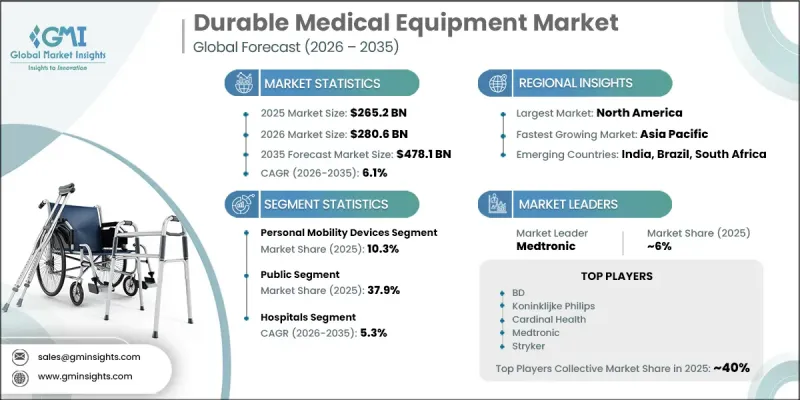
這一成長是由多種因素共同推動的:全球人口老化、慢性病盛行率上升,以及對分散式、以患者為中心的醫療服務模式的持續投資。隨著醫療系統日益從傳統的機構治療轉向在社區和家庭環境中提供的持續護理,市場正在經歷重大變革。這種轉變擴大了依賴耐用醫療設備的患者群體,同時也增加了包括行動輔助設備、患者輔助設備、監測解決方案和基本醫療耗材在內的產品類型的需求。遠距遠端醫療基礎設施的進步、醫療設備取得途徑的改善以及更多醫療設備的保險覆蓋範圍擴大,都為居家照護日益成長的需求提供了支持。除了為病人帶來便利之外,醫療服務提供者和保險公司也越來越認知到,居家照護是一種經濟高效的方法,它既能改善治療效果,又能減輕醫院和其他急診機構的負擔。預計這些長期結構性趨勢將在整個預測期內繼續成為市場擴張的關鍵促進因素。
| 市場範圍 | |
|---|---|
| 開始年份 | 2025 |
| 預測期 | 2026-2035 |
| 初始市場規模 | 2652億美元 |
| 預測金額 | 4781億美元 |
| 複合年成長率 | 6.1% |
預計到2025年,個人行動輔助設備市佔率將達到10.3%,並在2035年之前以6.3%的複合年成長率成長。老年人和因慢性疾病、受傷或老齡化相關身體機能衰退而行動不便的患者的需求不斷成長,持續推動著這一細分市場的發展。全球預期壽命的延長和老年人口的成長,為該類別產品的持續需求創造了有利環境。隨著醫療保健機構越來越重視患者的獨立性、行動能力的提升和生活品質的提高,預計在已開發市場和新興市場,個人行動輔助設備的普及率都將穩定成長。
到2025年,醫院領域將佔據34%的市場。由於病患治療、監測、行動輔助和臨床護理等各個環節都需要種類繁多的產品,醫院仍然是耐用醫療設備的主要採購者。醫療機構的採購活動越來越注重平衡臨床療效、營運效率和長期價值。對醫療基礎設施、病人安全措施和先進治療能力的持續投入,將繼續支撐全球公立和私立醫院系統的設備採購。
北美耐用醫療設備市場佔31.2%的市場佔有率,預計到2035年將以4%的複合年成長率成長。憑藉著高度發展的醫療保健生態系統、完善的醫保報銷系統和居家醫療服務,美國繼續成為區域成長的主要驅動力。該地區持續受益於高額的醫療保健支出、醫療技術的廣泛普及以及對支持慢性病管理和老齡化社會的醫療器材日益成長的需求。此外,不斷完善的醫療保險報銷機制和基於價值的醫療模式的推行,正在推動家庭醫療保健解決方案、遠端患者監護技術和專用醫療設備的使用,從而進一步促進北美市場的成長。
目錄
第1章:調查方法
第2章執行摘要
第3章 行業洞察
- 產業生態系分析
- 影響產業的因素
- 促進因素
- 患者越來越傾向於選擇居家照護
- 全球慢性病盛行率不斷上升
- 老年人口增加
- 產品技術進步
- 產業潛在風險與挑戰
- 設備價格上漲帶來的挑戰以及如何提供價格合理的選擇。
- 為兒童開發產品的複雜性
- 機會
- 人工智慧/機器學習整合和預測分析
- 進入新興市場和發展基礎設施
- 促進因素
- 成長潛力分析
- 監理情勢
- 2025年價格分析
- 技術與創新展望
- 最新科技趨勢
- 新興技術
- 投資情勢
- 救贖方案
- 轉變醫療服務模式
- 個人化醫療和精準醫療的應用
- 軟體作為醫療設備(SaMD)的綜合分析
- 未來市場趨勢
- 人工智慧和生成式人工智慧對市場的影響
- 波特的分析
- PESTLE分析
第4章 競爭情勢
- 介紹
- 企業矩陣分析
- 企業市佔率分析
- 世界
- 北美洲
- 歐洲
- 亞太地區
- LAMEA
- 主要市場公司的競爭分析
- 競爭定位矩陣
- 主要進展
- 併購
- 夥伴關係和聯盟
- 新產品發布
- 業務拓展計劃
第5章 市場估價與預測:依產品分類,2022-2035年
- 個人行動裝置
- 輪椅和電動代步車
- 拐杖和手杖
- 沃克
- 其他個人行動裝置
- 監測和治療設備
- 氧氣設備
- 血糖值儀
- 生命徵象監測
- 點滴幫浦
- 持續性陽壓呼吸器(CPAP)裝置
- 噴霧器
- 其他監測和治療設備
- 浴室安全裝置
- 醫療家具
- 尿失禁墊
- 吸乳器
- 導管
- 耗材和配件
- 其他產品
第6章 市場估計與預測:依支付方分類,2022-2035年
- 民眾
- 私人的
- 自付費用
第7章 市場估計與預測:依最終用途分類,2022-2035年
- 醫院
- 家庭醫療保健
- 門診手術中心
- 其他最終用戶
第8章 市場估計與預測:依地區分類,2022-2035年
- 北美洲
- 美國
- 加拿大
- 歐洲
- 德國
- 英國
- 法國
- 西班牙
- 義大利
- 荷蘭
- 亞太地區
- 中國
- 日本
- 印度
- 澳洲
- 韓國
- 拉丁美洲
- 巴西
- 墨西哥
- 阿根廷
- 中東和非洲
- 南非
- 沙烏地阿拉伯
- UAE
第9章:公司簡介
- B. Braun
- Baxter
- BD
- Cardinal Health
- CAREX
- Coloplast
- COMPASS HEALTH
- convaTec
- drive DeVilbiss Healthcare
- Getinge
- graham-field
- INTCO MEDICAL
- INVACARE
- Koninklijke Philips
- MEDLINE
- Medtronic
- ResMed
- Stryker
- SUNRISE MEDICAL
The Global Durable Medical Equipment Market was valued at USD 265.2 billion in 2025 and is estimated to grow at a CAGR of 6.1% to reach USD 478.1 billion by 2035.
Growth is driven by the combined impact of an aging global population, the increasing prevalence of chronic diseases, and sustained investments in healthcare delivery models that emphasize decentralized and patient-centered care. The market is undergoing a significant transformation as healthcare systems increasingly shift from traditional facility-based treatment toward continuous care delivered within community and home settings. This transition is expanding the patient base that relies on durable medical equipment while increasing demand across a broad range of product categories, including mobility aids, patient support equipment, monitoring solutions, and essential medical consumables. The growing preference for home-based care is supported by advances in telehealth infrastructure, improved device accessibility, and expanding reimbursement coverage for a wider range of medical equipment. Beyond patient convenience, healthcare providers and payers are increasingly recognizing home care as a cost-effective approach that improves outcomes while reducing the burden on hospitals and other acute care facilities. These long-term structural trends are expected to remain key contributors to market expansion throughout the forecast period.
| Market Scope | |
|---|---|
| Start Year | 2025 |
| Forecast Year | 2026-2035 |
| Start Value | $265.2 Billion |
| Forecast Value | $478.1 Billion |
| CAGR | 6.1% |
The personal mobility devices segment accounted for 10.3% share in 2025 and is projected to grow at a CAGR of 6.3% through 2035. The segment continues to benefit from rising demand among elderly individuals and patients experiencing mobility limitations caused by chronic health conditions, injuries, or age-related physical decline. Increasing life expectancy and the expanding global senior population are creating favorable conditions for sustained demand within this category. As healthcare providers place greater emphasis on patient independence, mobility enhancement, and quality-of-life improvements, the adoption of personal mobility equipment is expected to increase steadily across both developed and emerging healthcare markets.
The hospitals segment held a 34% share in 2025. Hospitals remain major purchasers of durable medical equipment due to the broad range of products required for patient treatment, monitoring, mobility assistance, and clinical care delivery. Procurement activities within healthcare institutions are increasingly focused on balancing clinical effectiveness, operational efficiency, and long-term value. Ongoing investments in healthcare infrastructure, patient safety initiatives, and advanced treatment capabilities continue to support equipment purchases across public and private hospital systems worldwide.
North America Durable Medical Equipment Market held a 31.2% share, growing at a CAGR of 4% through 2035. The United States remains the primary contributor to regional growth, supported by a highly developed healthcare ecosystem, extensive reimbursement programs, and strong adoption of home healthcare services. The region continues to benefit from significant healthcare spending, widespread access to medical technologies, and growing demand for equipment that supports chronic disease management and aging populations. In addition, evolving reimbursement structures and value-based care initiatives are encouraging the use of home-based treatment solutions, remote patient monitoring technologies, and specialized medical equipment, further strengthening market growth across North America.
Major companies operating in the global durable medical equipment market include CAREX Health Brands, INVACARE Corporation, Drive DeVilbiss Healthcare, Baxter International, Graham-Field, Cardinal Health, Coloplast, COMPASS HEALTH Brands, MEDLINE Industries, Koninklijke Philips, INTCO MEDICAL, B. Braun, Getinge, BD (Becton, Dickinson and Company), and ConvaTec. Companies operating in the durable medical equipment market are implementing a range of strategic initiatives to strengthen their market position and expand their customer base. Leading manufacturers are investing heavily in product innovation, digital health integration, and connected medical technologies that support remote patient monitoring and home-based care. Organizations are also focusing on expanding their distribution networks, strengthening partnerships with healthcare providers, and enhancing direct-to-consumer sales channels to improve market reach. Strategic acquisitions, portfolio diversification, and investments in advanced manufacturing capabilities are helping companies improve operational efficiency and address evolving patient needs.
Table of Contents
Chapter 1 Research Methodology
- 1.1 Research approach
- 1.2 Quality commitments
- 1.2.1 GMI AI policy & data integrity commitment
- 1.2.1.1 Source consistency protocol
- 1.2.1 GMI AI policy & data integrity commitment
- 1.3 Research trail & confidence scoring
- 1.3.1 Research trail components
- 1.3.2 Scoring components
- 1.4 Data collection
- 1.4.1 Partial list of primary sources
- 1.5 Data mining sources
- 1.5.1 Paid sources
- 1.5.1.1 Sources, by region
- 1.5.1 Paid sources
- 1.6 Base estimates and calculations
- 1.6.1 Base year calculation
- 1.7 Forecast model
- 1.7.1 Quantified market impact analysis
- 1.7.1.1 Mathematical impact of growth parameters on forecast
- 1.7.1 Quantified market impact analysis
- 1.8 Research transparency addendum
- 1.8.1 Source attribution framework
- 1.8.2 Quality assurance metrics
- 1.8.3 Our commitment to trust
Chapter 2 Executive Summary
- 2.1 Industry 360° synopsis
- 2.2 Key market trends
- 2.2.1 Regional trends
- 2.2.2 Product trends
- 2.2.3 Payer trends
- 2.2.4 End use trends
- 2.3 CXO perspectives: Strategic imperatives
Chapter 3 Industry Insights
- 3.1 Industry ecosystem analysis
- 3.2 Industry impact forces
- 3.2.1 Growth drivers
- 3.2.1.1 Rising patient preference for home-based care
- 3.2.1.2 Increasing prevalence of chronic diseases globally
- 3.2.1.3 Growing geriatric population
- 3.2.1.4 Technological advancements in products
- 3.2.2 Industry pitfalls and challenges
- 3.2.2.1 High device costs and affordability challenges
- 3.2.2.2 Complexity of Pediatric-Focused Product Development
- 3.2.3 Opportunities
- 3.2.3.1 AI/ML integration and predictive analytics
- 3.2.3.2 Emerging markets expansion and infrastructure development
- 3.2.1 Growth drivers
- 3.3 Growth potential analysis
- 3.4 Regulatory landscape
- 3.5 Pricing analysis, 2025
- 3.6 Technology and innovation landscape (Driven by Primary Research)
- 3.6.1 Current technological trends
- 3.6.2 Emerging technologies
- 3.7 Investment landscape
- 3.8 Reimbursement scenario
- 3.9 Healthcare delivery model transformation
- 3.10 Personalized medicine and precision healthcare applications
- 3.11 Software as medical device (SaMD) integrated analysis
- 3.12 Future market trends (Driven by Primary Research)
- 3.13 Impact of AI & Generative AI on the Market (Driven by Primary Research)
- 3.14 Porter's analysis
- 3.15 PESTEL analysis
Chapter 4 Competitive Landscape, 2025
- 4.1 Introduction
- 4.2 Company matrix analysis
- 4.3 Company market share analysis (Driven by Primary Research)
- 4.3.1 Global
- 4.3.2 North America
- 4.3.3 Europe
- 4.3.4 Asia Pacific
- 4.3.5 LAMEA
- 4.4 Competitive analysis of major market players
- 4.5 Competitive positioning matrix
- 4.6 Key developments
- 4.6.1 Mergers & acquisitions
- 4.6.2 Partnerships & collaborations
- 4.6.3 New product launches
- 4.6.4 Expansion plans
Chapter 5 Market Estimates and Forecast, By Product, 2022 - 2035 ($ Mn)
- 5.1 Key trends
- 5.2 Personal mobility devices
- 5.2.1 Wheelchair and scooter
- 5.2.2 Crutches and canes
- 5.2.3 Walkers
- 5.2.4 Other personal mobility devices
- 5.3 Monitoring and therapeutic devices
- 5.3.1 Oxygen equipment
- 5.3.2 Blood glucose analyzers
- 5.3.3 Vital sign monitors
- 5.3.4 Infusion pumps
- 5.3.5 Continuous positive airway pressure (CPAP) devices
- 5.3.6 Nebulizers
- 5.3.7 Other monitoring and therapeutic devices
- 5.4 Bathroom safety devices
- 5.5 Medical furniture
- 5.6 Incontinence pads
- 5.7 Breast pumps
- 5.8 Catheters
- 5.9 Consumables and accessories
- 5.10 Other products
Chapter 6 Market Estimates and Forecast, By Payer, 2022 - 2035 ($ Mn)
- 6.1 Key trends
- 6.2 Public
- 6.3 Private
- 6.4 Out-of-pocket
Chapter 7 Market Estimates and Forecast, By End Use, 2022 - 2035 ($ Mn)
- 7.1 Key trends
- 7.2 Hospitals
- 7.3 Home healthcare
- 7.4 Ambulatory surgical centers
- 7.5 Other end users
Chapter 8 Market Estimates and Forecast, By Region, 2022 - 2035 ($ Mn)
- 8.1 Key trends
- 8.2 North America
- 8.2.1 U.S.
- 8.2.2 Canada
- 8.3 Europe
- 8.3.1 Germany
- 8.3.2 UK
- 8.3.3 France
- 8.3.4 Spain
- 8.3.5 Italy
- 8.3.6 Netherlands
- 8.4 Asia Pacific
- 8.4.1 China
- 8.4.2 Japan
- 8.4.3 India
- 8.4.4 Australia
- 8.4.5 South Korea
- 8.5 Latin America
- 8.5.1 Brazil
- 8.5.2 Mexico
- 8.5.3 Argentina
- 8.6 MEA
- 8.6.1 South Africa
- 8.6.2 Saudi Arabia
- 8.6.3 UAE
Chapter 9 Company Profiles
- 9.1 B. Braun
- 9.2 Baxter
- 9.3 BD
- 9.4 Cardinal Health
- 9.5 CAREX
- 9.6 Coloplast
- 9.7 COMPASS HEALTH
- 9.8 convaTec
- 9.9 drive DeVilbiss Healthcare
- 9.10 Getinge
- 9.11 graham-field
- 9.12 INTCO MEDICAL
- 9.13 INVACARE
- 9.14 Koninklijke Philips
- 9.15 MEDLINE
- 9.16 Medtronic
- 9.17 ResMed
- 9.18 Stryker
- 9.19 SUNRISE MEDICAL

 呼吸系統耐用醫療設備市場規模、佔有率和趨勢分析報告:按產品、地區和細分市場預測(2026-2033 年)
 耐用醫療設備市場:依產品類型、便攜性、病患類型、最終用戶和分銷管道分類-2026-2032年全球市場預測
 耐用醫療設備市場規模、佔有率、成長、全球產業分析、區域趨勢及2026-2034年預測
 耐用醫療設備市場:依產品類型、最終用戶、分銷管道和地區分類
 耐用醫療設備:市場佔有率分析、產業趨勢與統計、成長預測(2026-2031)
 耐用醫療設備(DME)市場規模、佔有率、趨勢和預測:按產品、最終用途和地區分類,2026-2034年
 2026年全球耐用醫療設備市場報告2026-2034年全球耐用醫療設備市場規模、佔有率、趨勢和成長分析報告全球耐用醫療設備市場:市場規模、佔有率和趨勢分析(按產品、最終用途和地區分類),細分市場預測(2026-2033 年)美國呼吸系統耐用醫療設備市場規模、佔有率和趨勢分析報告:按產品供應、分銷/服務管道、主要州和細分市場預測,2026-2033年