

 |
市場調查報告書
商品編碼
2071244
2026 年至 2035 年電動車動力模組的市場機會、成長要素、產業趨勢分析與預測。EV Power Module Market Opportunity, Growth Drivers, Industry Trend Analysis, and Forecast 2026 - 2035 |
||||||

預計到 2025 年,全球電動車動力模組市場規模將達到 30 億美元,到 2035 年將達到 259 億美元,年複合成長率為 23.6%。
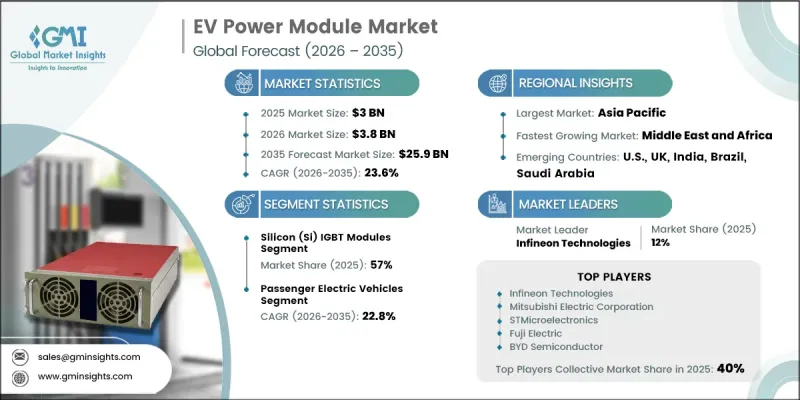
電動車功率模組產業的快速成長主要得益於全部區域電池式電動車(BEV)產量的同步成長,這些地區佔據了全球電動車產量的大部分。除了汽車產量的成長外,推動市場擴張的關鍵因素之一是傳統矽基絕緣柵雙極電晶體(IGBT)技術向先進寬能隙半導體解決方案的持續轉型。碳化矽(SiC)MOSFET和氮化鎵(GaN)元件等技術正蓬勃發展,因為它們能夠實現更高的功率密度、更佳的溫度控管和更高的能源效率。此外,促進汽車電氣化的監管措施和排放氣體目標也推動了先進動力傳動系統技術的廣泛應用。對半導體製造能力和供應鏈發展的巨額投資正在加速下一代汽車電力電子產品的商業化和部署,進一步鞏固了電動車功率模組市場。
| 市場範圍 | |
|---|---|
| 開始年份 | 2025 |
| 預測期 | 2026-2035 |
| 初始市場規模 | 30億美元 |
| 預測金額 | 259億美元 |
| 複合年成長率 | 23.6% |
預計到2025年,矽基IGBT模組將佔據57%的市場佔有率,繼續保持其在主流400V電動車平台中的關鍵技術地位。儘管該細分市場持續保持強勁的銷售成長,但由於碳化矽和氮化鎵等替代技術的日益普及,其成長速度低於整體市場平均水平。 IGBT模組的持續應用主要得益於其在400V車輛架構中的成本優勢。
預計到2035年,商用電動車(EV)市場將以26.7%的複合年成長率成長。這一市場成長主要得益於商務傳輸平台電氣化的加速發展。商用車輛所需的功率遠高於乘用車。商用電動車應用中使用的功率模組通常輸出功率在250千瓦到500千瓦甚至更高,導致每輛車所需的半導體數量大幅增加。從以金額為準來看,商用電動車所需的功率模組數量估計是搭乘用電動車的四到七倍。如此高的零件價值為製造商創造了巨大的商機,儘管產量相對較低,但商用車輛的電氣化仍然是推動成長要素。
預計到2025年,北美電動車功率模組市佔率將達到21.1%,並在2026年至2035年間以21.4%的複合年成長率成長。該地區市場的發展得益於政府旨在加強國內電動車供應鏈和促進先進汽車零件本地化的各項措施。對半導體製造設施和電力電子產品產能的投資增加,有助於建構更具韌性的區域電動車動力傳動系統技術生態系統。對國內採購、供應鏈安全以及下一代半導體研發的日益重視,持續為在北美營運的電動車功率模組製造商創造有利的市場環境。
目錄
第1章:調查方法和範圍
第2章執行摘要
第3章 行業洞察
- 產業生態系分析
- 原物料供應及採購分析
- 供應鏈韌性與風險因素
- 中斷
- 監理情勢
- 影響產業的因素
- 促進因素
- 加速全球電動車的普及
- 主要市場將推出更嚴格的排放氣體法規和強制性電動車推廣計劃
- 動力傳動系統架構從400V到800V的結構過渡
- 產業潛在風險與挑戰
- SiC基板供應集中度及晶圓良率限制
- 促進因素
- 成長潛力分析
- 波特的分析
- PESTLE分析
- 人工智慧和生成式人工智慧對市場的影響
- 利用人工智慧革新模組化設計與模擬工作流程
- GenAI實施藍圖
- 風險、限制和監管考量
- 新機會和趨勢
- 投資與資金籌措分析
- 永續發展措施與工業4.0的融合
第4章 競爭情勢
- 介紹
- 企業市佔率分析:按地區分類
- 北美洲
- 歐洲
- 亞太地區
- 中東和非洲
- 拉丁美洲
- 主要進展
- 重要合作夥伴關係和合作
- 併購主要趨勢
- 產品創新和新產品發布
- 市場擴大策略
- 競爭定位矩陣
第5章 市場規模及預測:依半導體材料分類,2022-2035年
- 矽(Si)IGBT模組
- 碳化矽 (SiC) MOSFET 模組
- 氮化鎵(GaN)模組
第6章 市場規模及預測:依車輛類型分類,2022-2035年
- 搭乘用電動車
- 商用電動車
- 工業用電動車
- 其他
第7章 市場規模及預測:以冷卻方式分類,2022-2035年
- 空冷式
- 液冷
- 混合冷卻系統
第8章 市場規模及預測:依地區分類,2022-2035年
- 北美洲
- 美國
- 加拿大
- 墨西哥
- 歐洲
- 德國
- 英國
- 法國
- 荷蘭
- 義大利
- 亞太地區
- 中國
- 印度
- 日本
- 韓國
- 澳洲
- 中東和非洲
- 沙烏地阿拉伯
- UAE
- 南非
- 拉丁美洲
- 巴西
- 阿根廷
第9章:公司簡介
- Allegro MicroSystems, Inc.
- Alpha &Omega Semiconductor
- BYD Semiconductor
- Denso Corporation
- Fuji Electric
- Hitachi Energy
- Infineon Technologies AG
- Microchip Technology Inc.
- Mitsubishi Electric Corporation
- Navitas Semiconductor
- NXP Semiconductors
- Robert Bosch
- ROHM
- Semiconductor Components Industries, LLC
- Semikron Danfoss
- StarPower Semiconductor
- STMicroelectronics
- Toshiba Corporation
- Vishay Intertechnology
- Wolfspeed
The Global EV Power Module Market was valued at USD 3 billion in 2025 and is estimated to grow at a CAGR of 23.6% to reach USD 25.9 billion by 2035.
The rapid growth of the EV power module industry is driven by the simultaneous increase in battery electric vehicle production across major automotive manufacturing regions, which collectively account for the vast majority of global EV output. Beyond the rise in vehicle volumes, a key factor supporting market expansion is the ongoing transition from traditional silicon-based insulated gate bipolar transistor (IGBT) technologies toward advanced wide-bandgap semiconductor solutions. Technologies such as silicon carbide (SiC) MOSFETs and gallium nitride (GaN) devices are gaining momentum due to their ability to deliver higher power density, improved thermal management, and enhanced energy efficiency. In addition, regulatory initiatives promoting vehicle electrification and emission reduction targets are encouraging broader adoption of advanced powertrain technologies. Significant investments in semiconductor manufacturing capacity and supply chain development are further strengthening the EV power module market by accelerating the commercialization and deployment of next-generation automotive power electronics.
| Market Scope | |
|---|---|
| Start Year | 2025 |
| Forecast Year | 2026-2035 |
| Start Value | $3 Billion |
| Forecast Value | $25.9 Billion |
| CAGR | 23.6% |
Silicon IGBT modules accounted for 57% share in 2025, maintaining their position as the dominant technology for mainstream 400V electric vehicle platforms. Although the segment continues to generate strong revenue growth, its expansion rate remains below the overall market average due to the increasing adoption of silicon carbide and gallium nitride alternatives. The continued use of IGBT modules is largely supported by their cost advantages in 400V vehicle architectures.
The commercial electric vehicle segment is expected to grow at a CAGR of 26.7% through 2035. Market growth is being fueled by the accelerating electrification of commercial transportation platforms, which require substantially higher power levels than passenger vehicles. Power modules used in commercial EV applications typically operate within the 250 kW to 500 kW range or higher, resulting in significantly greater semiconductor content per vehicle. On a value basis, the power module requirement for a commercial electric vehicle is estimated to be four to seven times greater than that of a passenger EV. This higher content value creates substantial revenue opportunities for manufacturers, making commercial vehicle electrification a major growth driver despite comparatively lower production volumes.
North America EV Power Module Market held a 21.1% share in 2025 and is forecast to grow at a CAGR of 21.4% during 2026-2035. Market development in the region is being supported by government initiatives designed to strengthen domestic electric vehicle supply chains and encourage localized production of advanced automotive components. Growing investments in semiconductor manufacturing facilities and power electronics production capabilities are helping establish a more resilient regional ecosystem for EV powertrain technologies. Increased focus on domestic sourcing, supply chain security, and next-generation semiconductor development continues to create favorable conditions for EV power module manufacturers operating throughout North America.
Major companies operating in the global EV power module market include Infineon Technologies, STMicroelectronics, ROHM, Semiconductor Components Industries (onsemi), Mitsubishi Electric, Navitas Semiconductor, and Allegro MicroSystems. Companies active in the EV power module market are adopting a variety of strategic initiatives to strengthen their competitive position and expand market share. Leading manufacturers are investing heavily in research and development to advance silicon carbide and gallium nitride technologies that offer superior efficiency and performance. Capacity expansion remains a key priority as companies work to meet rising demand from electric vehicle manufacturers. Strategic partnerships across the automotive, semiconductor, and power electronics value chains are also helping companies accelerate product development and improve market penetration.
Table of Contents
Chapter 1 Methodology & Scope
- 1.1 Research approach
- 1.2 Quality commitments
- 1.2.1 GMI AI policy & data integrity commitment
- 1.2.1.1 Source consistency protocol
- 1.2.1 GMI AI policy & data integrity commitment
- 1.3 Research trail & confidence scoring
- 1.3.1 Research trail components
- 1.3.2 Scoring components
- 1.4 Data collection
- 1.4.1 Partial list of primary sources
- 1.5 Data mining sources
- 1.5.1 Paid sources
- 1.5.1.1 Sources, by region
- 1.5.1 Paid sources
- 1.6 Base estimates and calculations
- 1.6.1 Base year calculation for any one approach
- 1.7 Market estimates & forecasts parameters
- 1.8 Forecast model
- 1.8.1 Quantified market impact analysis
- 1.8.1.1 Mathematical impact of growth parameters on forecast
- 1.8.1 Quantified market impact analysis
- 1.9 Research transparency addendum
- 1.9.1 Source attribution framework
- 1.9.2 Quality assurance metrics
- 1.9.3 Our commitment to trust
- 1.10 Market definitions
Chapter 2 Executive Summary
- 2.1 Industry synopsis, 2022 - 2035
- 2.1.1 Business trends
- 2.1.2 Semiconductor material trends
- 2.1.3 Vehicle trends
- 2.1.4 Cooling method trends
- 2.1.5 Regional trends
Chapter 3 Industry Insights
- 3.1 Industry ecosystem analysis
- 3.1.1 Raw material availability & sourcing analysis
- 3.1.2 Supply chain resilience & risk factors
- 3.1.3 Disruptions
- 3.2 Regulatory landscape
- 3.3 Industry impact forces
- 3.3.1 Growth drivers
- 3.3.1.1 Accelerating global EV adoption
- 3.3.1.2 Tightening emission regulations & EV mandates across key markets
- 3.3.1.3 Structural transition from 400V to 800V powertrain architecture
- 3.3.2 Industry pitfalls & challenges
- 3.3.2.1 SiC substrate supply concentration & wafer yield constraints
- 3.3.1 Growth drivers
- 3.4 Growth potential analysis
- 3.5 Porter's analysis
- 3.5.1 Bargaining power of suppliers
- 3.5.2 Bargaining power of buyers
- 3.5.3 Threat of new entrants
- 3.5.4 Threat of substitutes
- 3.6 PESTEL analysis
- 3.6.1 Political factors
- 3.6.2 Economic factors
- 3.6.3 Social factors
- 3.6.4 Technological factors
- 3.6.5 Legal factors
- 3.6.6 Environmental factors
- 3.7 Impact of AI & Generative AI on the market
- 3.7.1 AI-Driven disruption of module design & simulation workflows
- 3.7.2 GenAI adoption roadmap
- 3.7.3 Risks, limitations & regulatory considerations
- 3.8 Emerging opportunities & trends
- 3.9 Investment & Funding Analysis
- 3.10 Sustainability initiatives & industry 4.0 integration
Chapter 4 Competitive Landscape, 2026
- 4.1 Introduction
- 4.2 Company market share analysis, by region, 2025
- 4.2.1 North America
- 4.2.2 Europe
- 4.2.3 Asia Pacific
- 4.2.4 Middle East & Africa
- 4.2.5 Latin America
- 4.3 Key developments
- 4.3.1 Key partnerships & collaborations
- 4.3.2 Major M&A activities
- 4.3.3 Product innovations & launches
- 4.3.4 Market expansion strategies
- 4.4 Competitive positioning matrix
Chapter 5 Market Size and Forecast, By Semiconductor material, 2022 - 2035 (USD Million)
- 5.1 Key trends
- 5.2 Silicon (Si) IGBT modules
- 5.3 Silicon carbide (SiC) MOSFET modules
- 5.4 Gallium nitride (GaN) modules
Chapter 6 Market Size and Forecast, By Vehicle, 2022 - 2035 (USD Million)
- 6.1 Key trends
- 6.2 Passenger electric vehicles
- 6.3 Commercial electric vehicles
- 6.4 Industrial electric vehicles
- 6.5 Others
Chapter 7 Market Size and Forecast, By Cooling method, 2022 - 2035 (USD Million)
- 7.1 Key trends
- 7.2 Air cooled
- 7.3 Liquid cooled
- 7.4 Hybrid cooled
Chapter 8 Market Size and Forecast, By Region, 2022 - 2035 (USD Million)
- 8.1 Key trends
- 8.2 North America
- 8.2.1 U.S.
- 8.2.2 Canada
- 8.2.3 Mexico
- 8.3 Europe
- 8.3.1 Germany
- 8.3.2 UK
- 8.3.3 France
- 8.3.4 Netherlands
- 8.3.5 Italy
- 8.4 Asia Pacific
- 8.4.1 China
- 8.4.2 India
- 8.4.3 Japan
- 8.4.4 South Korea
- 8.4.5 Australia
- 8.5 Middle East & Africa
- 8.5.1 Saudi Arabia
- 8.5.2 UAE
- 8.5.3 South Africa
- 8.6 Latin America
- 8.6.1 Brazil
- 8.6.2 Argentina
Chapter 9 Company Profiles
- 9.1 Allegro MicroSystems, Inc.
- 9.2 Alpha & Omega Semiconductor
- 9.3 BYD Semiconductor
- 9.4 Denso Corporation
- 9.5 Fuji Electric
- 9.6 Hitachi Energy
- 9.7 Infineon Technologies AG
- 9.8 Microchip Technology Inc.
- 9.9 Mitsubishi Electric Corporation
- 9.10 Navitas Semiconductor
- 9.11 NXP Semiconductors
- 9.12 Robert Bosch
- 9.13 ROHM
- 9.14 Semiconductor Components Industries, LLC
- 9.15 Semikron Danfoss
- 9.16 StarPower Semiconductor
- 9.17 STMicroelectronics
- 9.18 Toshiba Corporation
- 9.19 Vishay Intertechnology
- 9.20 Wolfspeed

 功率模組市場-全球及區域分析:按應用、產品和國家分類-分析與預測(2026-2036)
 全球功率分離式元件和模組市場規模、佔有率、趨勢和成長分析報告(2026-2034)SiC功率元件和模組專利監測
 功率分離式元件模組市場機會、成長促進因素、產業趨勢分析及2026-2035年預測
 GPU 和 AI 伺服器電源管理模組 (VRM):市場佔有率分析、行業趨勢與統計數據以及成長預測 (2026-2031)
 汽車電源模組市場:2026-2032年全球市場預測(按模組類型、驅動系統、額定電壓、冷卻方式、應用和銷售管道)碳化矽功率模組市場:按產品類型、冷卻技術、額定電壓、應用和最終用戶分類-2026-2032年全球預測小型高壓功率模組市場:按拓撲結構、額定功率、輸出電壓、安裝方式和應用分類-全球預測,2026-2032年IGBT 和 SiC 模組市場按技術、類型、額定電壓、材料、應用、終端用戶產業和最終用戶分類,全球預測,2026-2032 年
 功率分離式元件和模組市場分析及預測(至2035年):按類型、產品、服務、技術、應用、最終用戶、功能、安裝類型和設備分類