


 |
市場調查報告書
商品編碼
2071226
潔淨標示防腐劑市場機會、成長要素、產業趨勢分析及2026-2035年預測Clean-Label Preservatives Market Opportunity, Growth Drivers, Industry Trend Analysis, and Forecast 2026 - 2035 |
||||||

全球潔淨標示防腐劑市場預計到 2025 年將達到 14 億美元,年複合成長率為 6.8%,到 2035 年將達到 27 億美元。
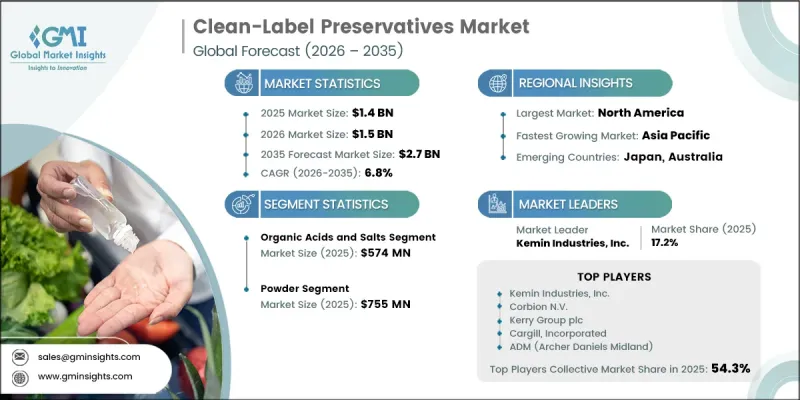
食品飲料製造商不斷調整產品配方,以滿足消費者對透明度和更清晰成分資訊的偏好,天然防腐劑解決方案的日益普及推動了市場成長。隨著高階食品領域對潔淨標示產品的需求不斷成長,製造商正被促使以天然來源的替代品取代合成添加劑,以提升產品品質並延長保存期限。此外,全球對傳統食品添加劑的監管日益嚴格,也迫使食品製造商加快向天然防腐技術的轉型。發酵和植物來源解決方案生產效率的提高進一步促進了市場擴張。加工食品領域的強勁需求持續為市場成長奠定堅實基礎,而清潔標籤防腐劑在多個食品飲料領域的應用拓展,也為潔淨標示防腐劑供應商創造了新的機會。監管支持、不斷變化的消費者期望以及原料技術的持續創新,共同為潔淨標示防腐劑行業帶來了強勁的長期發展前景。
| 市場範圍 | |
|---|---|
| 開始年份 | 2025 |
| 預測期 | 2026-2035 |
| 上市時的市場規模 | 14億美元 |
| 預計金額 | 27億美元 |
| 複合年成長率 | 6.8% |
對合成食品添加劑日益嚴格的監管仍然是推動全球潔淨標示防腐劑市場成長的關鍵因素。監管機構正在對傳統食品添加劑實施更嚴格的評估程序和上市後監測要求,這給依賴合成防腐系統的生產商帶來了更大的合規挑戰。同時,天然成分的有利法規環境正在推動潔淨標示解決方案的廣泛應用。對已通過核准添加劑的持續審查和不斷發展的食品安全標準促使食品生產商重新思考其產品配方,並採用替代防腐技術。因此,在各種食品加工應用領域,對天然防腐劑的需求持續成長。
在防腐劑領域,有機酸和鹽類產品預計到2025年市場規模將達到5.74億美元。有機酸和鹽類產品憑藉其增強產品穩定性、抑制微生物生長並同時與潔淨標示產品配方相容的特性,佔據了穩固的市場地位。配方技術的不斷進步進一步提升了其性能、加工柔軟性以及在各種食品生產環境中的應用效率。
預計2025年,粉狀防腐劑市場規模將達7.55億美元。該市場持續受益於許多優勢,例如更高的儲存穩定性、更精準的劑量控制、更易於操作以及與多種食品飲料生產流程的兼容性。粉狀配方的不斷創新使製造商能夠增強原料保護、最佳化性能,並在整個加工和儲存過程中保持產品品質。這些優勢持續推動粉狀防腐劑在眾多食品飲料應用中的廣泛應用。
至2025年,北美潔淨標示防腐劑市場規模將達到4.35億美元。該地區市場成長的驅動力包括完善的食品安全法規、消費者對潔淨標示產品日益成長的需求,以及業界對原料透明度的高度重視。全部區域的食品生產商正積極採用天然防腐技術,以滿足消費者期望,同時維持產品品質和保存期限。法律規範和零售商主導的潔淨標示計劃持續影響產品開發策略,從而支撐著北美食品飲料產業對創新防腐解決方案的持續需求。
目錄
第1章:調查方法和範圍
第2章執行摘要
第3章 行業洞察
- 產業生態系分析
- 供應商情況
- 利潤率
- 每個階段增加的價值
- 影響價值鏈的因素
- 中斷
- 影響產業的因素
- 促進因素
- 產業潛在風險與挑戰
- 市場機遇
- 成長潛力分析
- 監理情勢
- 波特的分析
- PESTLE分析
- 價格趨勢
- 按地區
- 按防腐劑類型
- 未來市場趨勢
- 技術與創新展望
- 最新科技趨勢
- 新興技術
- 專利趨勢
- 貿易統計
- 主要進口國
- 主要出口國
- 永續性和環境方面
- 永續計劃
- 減少廢棄物策略
- 生產中的能源效率
- 具有環保意識的舉措
- 考慮碳足跡
第4章 競爭情勢
- 介紹
- 企業市佔率分析
- 按地區
- 北美洲
- 歐洲
- 亞太地區
- LATAM
- 中東和非洲
- 按地區
- 企業矩陣分析
- 主要市場公司的競爭分析
- 競爭定位矩陣
- 主要進展
- 併購
- 夥伴關係和聯盟
- 新產品發布
- 業務拓展計劃
第5章 市場估價與預測:依防腐劑類型分類,2022-2035年
- 有機酸和鹽
- 檸檬酸
- 醋酸(醋)
- 乳酸
- 苯甲酸鈉
- 山梨酸鉀
- 其他
- 發酵衍生的防腐劑
- 培養葡萄糖
- 培養糖
- 發酵小麥
- 益生菌衍生的防腐劑
- 其他
- 植物來源抗菌劑
- 迷迭香萃取物
- 綠茶萃取物
- 柑橘萃取物
- 精油
- 天然抗氧化劑
- 其他
第6章 市場估計與預測:依形式分類,2022-2035年
- 粉末
- 液體
- 其他
第7章 市場估計與預測:依應用領域分類,2022-2035年
- 麵包糖果甜點
- 麵包捲
- 蛋糕和糕點
- 餅乾和曲奇
- 巧克力糖果
- 飲料
- 果汁花蜜
- 軟性飲料和碳酸飲料
- 機能飲料和運動飲料
- 酒精飲料(啤酒、葡萄酒)
- 已調理食品和加工食品
- 冷凍食品
- 冷藏已調理食品
- 罐裝和包裝食品
- 乳製品和乳製品替代品
- 牛奶和鮮奶油
- 起司
- 優格
- 植物來源乳製品替代品
- 肉類/家禽
- 生肉
- 加工肉品(香腸、熟食肉類)
- 家禽產品
- 其他
第8章 市場估計與預測:依地區分類,2022-2035年
- 北美洲
- 美國
- 加拿大
- 歐洲
- 德國
- 英國
- 法國
- 西班牙
- 義大利
- 其他歐洲國家
- 亞太地區
- 中國
- 印度
- 日本
- 澳洲
- 韓國
- 其他亞太國家
- 拉丁美洲
- 巴西
- 墨西哥
- 阿根廷
- 其他拉丁美洲國家
- 中東和非洲
- 沙烏地阿拉伯
- 南非
- UAE
- 其他中東和非洲國家
第9章:公司簡介
- Kemin Industries, Inc.
- Corbion NV
- Kerry Group plc
- Cargill, Incorporated
- ADM(Archer Daniels Midland)
- Galactic SA
- Jungbunzlauer Suisse AG
- Tate & Lyle PLC
- IFF(International Flavors & Fragrances)
- Koninklijke DSM NV
- Chinova Bioworks
- Handary SA
- Kalsec Inc.
- Lallemand Inc.
- Chr. Hansen Holding A/S
The Global Clean-Label Preservatives Market was valued at USD 1.4 billion in 2025 and is estimated to grow at a CAGR of 6.8% to reach USD 2.7 billion by 2035.
Market growth is driven by the increasing adoption of naturally sourced preservation solutions as food and beverage manufacturers continue to reformulate products to meet evolving consumer preferences for transparency and recognizable ingredients. Rising demand for clean-label products across premium food categories is encouraging manufacturers to replace synthetic additives with natural alternatives that support product quality and shelf-life extension. In addition, regulatory scrutiny surrounding conventional food additives has intensified globally, prompting food producers to accelerate the transition toward naturally derived preservation technologies. Improvements in production economics for fermentation-based and plant-derived solutions are further supporting market expansion. Strong demand from processed food categories continues to provide a solid foundation for market growth, while emerging applications across multiple food and beverage segments are creating new opportunities for clean-label preservative suppliers. The combination of regulatory support, changing consumer expectations, and ongoing innovation in ingredient technologies continues to strengthen the long-term outlook for the clean-label preservatives industry.
| Market Scope | |
|---|---|
| Start Year | 2025 |
| Forecast Year | 2026-2035 |
| Start Value | $1.4 Billion |
| Forecast Value | $2.7 Billion |
| CAGR | 6.8% |
Increasing regulatory oversight of synthetic food ingredients remains a significant factor supporting the growth of the clean-label preservatives market worldwide. Regulatory authorities are implementing stricter evaluation procedures and post-approval monitoring requirements for conventional food additives, creating additional compliance challenges for manufacturers that rely on synthetic preservation systems. At the same time, favorable regulatory environments for naturally derived ingredients are facilitating broader adoption of clean-label solutions. Ongoing reviews of approved additives and evolving food safety standards are encouraging food manufacturers to reformulate products using alternative preservation technologies. As a result, demand for naturally sourced preservatives continues to increase across a wide range of food processing applications.
Among preservative categories, the organic acids and salts segment generated USD 574 million in 2025. The strong market position of organic acids and salts is supported by their ability to enhance product stability and inhibit microbial growth while maintaining compatibility with clean-label product formulations. Continuous advancements in formulation technologies are further improving performance, processing flexibility, and application efficiency across multiple food manufacturing environments.
The powder-based preservatives segment reached USD 755 million in 2025. The segment continues to benefit from advantages such as extended storage stability, precise application control, ease of handling, and compatibility with a broad range of food production processes. Ongoing product innovation within powder formulations is enabling manufacturers to improve ingredient protection, optimize performance, and maintain product integrity throughout processing and storage. These benefits continue to support widespread adoption across numerous food and beverage applications.
North America Clean-Label Preservatives Market accounted for USD 435 million in 2025. The region's market growth is supported by well-established food safety regulations, increasing demand for clean-label products, and strong industry focus on ingredient transparency. Food manufacturers throughout the region are actively incorporating naturally derived preservation technologies to meet consumer expectations while maintaining product quality and shelf stability. Regulatory frameworks and retailer-driven clean-label initiatives continue to influence formulation strategies, supporting sustained demand for innovative preservation solutions across the North American food and beverage sector.
Major companies operating in the global clean-label preservatives market include Kemin Industries, Inc.; Corbion N.V.; Kerry Group plc; Cargill, Incorporated; ADM (Archer Daniels Midland); Galactic S.A.; Jungbunzlauer Suisse AG; Tate & Lyle PLC; IFF (International Flavors & Fragrances); Koninklijke DSM N.V.; Chinova Bioworks; Handary S.A.; Kalsec Inc.; Lallemand Inc.; and Chr. Hansen Holding A/S. Companies operating in the clean-label preservatives market are pursuing a variety of strategies to strengthen their competitive position and expand their global presence. Investment in research and development remains a primary focus, enabling manufacturers to create innovative natural preservation technologies that deliver enhanced functionality and longer shelf life. Product portfolio expansion through fermentation-based, botanical, and naturally sourced ingredient solutions is helping companies address changing customer requirements. Strategic partnerships, acquisitions, and collaborations are also being used to strengthen distribution capabilities and accelerate market penetration. Many companies are investing in advanced production technologies to improve scalability, cost efficiency, and ingredient performance.
Table of Contents
Chapter 1 Methodology & Scope
- 1.1 Research approach
- 1.2 Quality Commitments
- 1.2.1 GMI AI policy & data integrity commitment
- 1.2.1.1 Source consistency protocol
- 1.2.1 GMI AI policy & data integrity commitment
- 1.3 Research Trail & Confidence Scoring
- 1.3.1 Research Trail Components
- 1.3.2 Scoring Components
- 1.4 Data Collection
- 1.4.1 Partial list of primary sources
- 1.5 Data mining sources
- 1.5.1 Paid sources
- 1.5.1.1 Sources, by region
- 1.5.1 Paid sources
- 1.6 Base estimates and calculations
- 1.6.1 Base year calculation for any one approach
- 1.7 Forecast model
- 1.7.1 Quantified market impact analysis
- 1.7.1.1 Mathematical impact of growth parameters on forecast
- 1.7.1 Quantified market impact analysis
- 1.8 Research transparency addendum
- 1.8.1 Source attribution framework
- 1.8.2 Quality assurance metrics
- 1.8.3 Our commitment to trust
Chapter 2 Executive Summary
- 2.1 Industry 360° synopsis
- 2.2 Key market trends
- 2.2.1 Regional
- 2.2.2 Preservative type
- 2.2.3 Form
- 2.2.4 Application
- 2.3 TAM Analysis, 2026-2035
- 2.4 CXO perspectives: Strategic imperatives
Chapter 3 Industry Insights
- 3.1 Industry ecosystem analysis
- 3.1.1 Supplier landscape
- 3.1.2 Profit margin
- 3.1.3 Value addition at each stage
- 3.1.4 Factor affecting the value chain
- 3.1.5 Disruptions
- 3.2 Industry impact forces
- 3.2.1 Growth drivers
- 3.2.2 Industry pitfalls and challenges
- 3.2.3 Market opportunities
- 3.3 Growth potential analysis
- 3.4 Regulatory landscape
- 3.4.1 North America
- 3.4.2 Europe
- 3.4.3 Asia Pacific
- 3.4.4 Latin America
- 3.4.5 Middle East & Africa
- 3.5 Porter's analysis
- 3.6 PESTEL analysis
- 3.7 Price trends
- 3.7.1 By region
- 3.7.2 By preservative type
- 3.8 Future market trends
- 3.9 Technology and Innovation landscape
- 3.9.1 Current technological trends
- 3.9.2 Emerging technologies
- 3.10 Patent Landscape
- 3.11 Trade statistics (HS code)
- 3.11.1 Major importing countries
- 3.11.2 Major exporting countries
- 3.12 Sustainability and environmental aspects
- 3.12.1 Sustainable practices
- 3.12.2 Waste reduction strategies
- 3.12.3 Energy efficiency in production
- 3.12.4 Eco-friendly initiatives
- 3.13 Carbon footprint consideration
Chapter 4 Competitive Landscape, 2025
- 4.1 Introduction
- 4.2 Company market share analysis
- 4.2.1 By region
- 4.2.1.1 North America
- 4.2.1.2 Europe
- 4.2.1.3 Asia Pacific
- 4.2.1.4 LATAM
- 4.2.1.5 MEA
- 4.2.1 By region
- 4.3 Company matrix analysis
- 4.4 Competitive analysis of major market players
- 4.5 Competitive positioning matrix
- 4.6 Key developments
- 4.6.1 Mergers & acquisitions
- 4.6.2 Partnerships & collaborations
- 4.6.3 New Product Launches
- 4.6.4 Expansion Plans
Chapter 5 Market Estimates and Forecast, By Preservative Type, 2022-2035 (USD Billion) (Kilo Tons)
- 5.1 Key trends
- 5.2 Organic acids & salts
- 5.2.1 Citric acid
- 5.2.2 Acetic acid (Vinegar)
- 5.2.3 Lactic acid
- 5.2.4 Sodium benzoate
- 5.2.5 Potassium sorbate
- 5.2.6 Others
- 5.3 Fermentation-derived preservatives
- 5.3.1 Cultured dextrose
- 5.3.2 Cultured sugar
- 5.3.3 Fermented wheat
- 5.3.4 Probiotic-based preservatives
- 5.3.5 Others
- 5.4 Botanical antimicrobials
- 5.4.1 Rosemary extract
- 5.4.2 Green tea extract
- 5.4.3 Citrus extract
- 5.4.4 Essential oil
- 5.5 Natural antioxidants
- 5.6 Others
Chapter 6 Market Estimates and Forecast, By Form, 2022-2035 (USD Billion) (Kilo Tons)
- 6.1 Key trends
- 6.2 Powder
- 6.3 Liquid
- 6.4 Others
Chapter 7 Market Estimates and Forecast, By Application, 2022-2035 (USD Billion) (Kilo Tons)
- 7.1 Key trends
- 7.2 Bakery & confectionery
- 7.2.1 Bread & rolls
- 7.2.2 Cakes & pastries
- 7.2.3 Cookies & biscuits
- 7.2.4 Chocolates & candies
- 7.3 Beverages
- 7.3.1 Juices & nectars
- 7.3.2 Soft drinks & carbonated beverages
- 7.3.3 Functional & sports drinks
- 7.3.4 Alcoholic beverages (beer, wine)
- 7.4 Ready meals & processed foods
- 7.4.1 Frozen foods
- 7.4.2 Refrigerated meals
- 7.4.3 Canned & packaged foods
- 7.5 Dairy & dairy alternatives
- 7.5.1 Milk & cream
- 7.5.2 Cheese
- 7.5.3 Yogurt
- 7.5.4 Plant-based dairy alternatives
- 7.6 Meat & poultry
- 7.6.1 Fresh meat
- 7.6.2 Processed meat products (sausages, deli meats)
- 7.6.3 Poultry products
- 7.7 Others
Chapter 8 Market Estimates and Forecast, By Region, 2022-2035 (USD Billion) (Kilo Tons)
- 8.1 Key trends
- 8.2 North America
- 8.2.1 U.S.
- 8.2.2 Canada
- 8.3 Europe
- 8.3.1 Germany
- 8.3.2 UK
- 8.3.3 France
- 8.3.4 Spain
- 8.3.5 Italy
- 8.3.6 Rest of Europe
- 8.4 Asia Pacific
- 8.4.1 China
- 8.4.2 India
- 8.4.3 Japan
- 8.4.4 Australia
- 8.4.5 South Korea
- 8.4.6 Rest of Asia Pacific
- 8.5 Latin America
- 8.5.1 Brazil
- 8.5.2 Mexico
- 8.5.3 Argentina
- 8.5.4 Rest of Latin America
- 8.6 Middle East and Africa
- 8.6.1 Saudi Arabia
- 8.6.2 South Africa
- 8.6.3 UAE
- 8.6.4 Rest of Middle East and Africa
Chapter 9 Company Profiles
- 9.1 Kemin Industries, Inc.
- 9.2 Corbion N.V.
- 9.3 Kerry Group plc
- 9.4 Cargill, Incorporated
- 9.5 ADM (Archer Daniels Midland)
- 9.6 Galactic S.A.
- 9.7 Jungbunzlauer Suisse AG
- 9.8 Tate & Lyle PLC
- 9.9 IFF (International Flavors & Fragrances)
- 9.10 Koninklijke DSM N.V.
- 9.11 Chinova Bioworks
- 9.12 Handary S.A.
- 9.13 Kalsec Inc.
- 9.14 Lallemand Inc.
- 9.15 Chr. Hansen Holding A/S

 潔淨標示零食市場預測至2034年—按產品類型、原料、標籤、分銷管道、包裝和地區分類的全球分析潔淨標示食品市場預測至2034年-按產品類型、原料類型、通路、消費者群體和地區分類的全球分析
 潔淨標示材料市場報告:趨勢、預測和競爭分析(至2035年)潔淨標示家用清潔產品市場:預測至2034年-按產品類型、成分類型、包裝類型、分銷管道、最終用戶和地區分類的全球分析潔淨標示即食食品市場預測至2034年-按產品類型、菜系類型、營養標示、包裝、分銷管道、最終用戶和地區分類的全球分析海藻衍生鹿角菜膠替代品市場報告:趨勢、預測和競爭分析(至2035年)
 全球潔淨標示香精市場規模、佔有率、趨勢和成長分析報告(2026-2034年)全球潔淨標示、天然和無添加快速消費品市場預測至2032年:按產品、成分類型、無添加聲明、配銷通路和地區分類
 潔淨標示原料市場-全球產業規模、佔有率、趨勢、機會及預測(按類型、應用、形式、地區及競爭格局分類,2021-2031年)潔淨標示香精市場-全球產業規模、佔有率、趨勢、機會、預測:按類型、形式、分銷管道、地區和競爭格局分類,2021-2031年