


 |
市場調查報告書
商品編碼
2061476
薄膜電池市場機會、成長要素、產業趨勢分析及2026-2035年預測。Thin Film Battery Market Opportunity, Growth Drivers, Industry Trend Analysis, and Forecast 2026 - 2035 |
||||||

預計到 2025 年,全球薄膜電池市場規模將達到 5.676 億美元,年複合成長率為 31.6%,到 2035 年將達到 107 億美元。
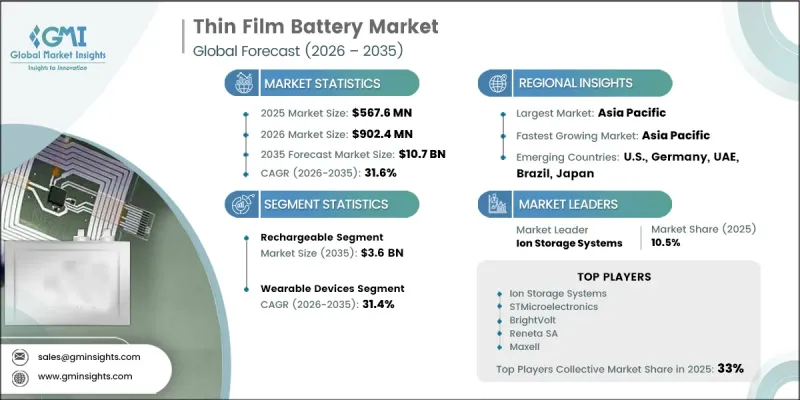
隨著製造商加大力度提升能量密度、整體效率和成本效益,電池產業正經歷快速變革。薄膜電池因其超輕量結構、柔軟性、緊湊尺寸以及適用於非常規裝置結構等優勢,正日益受到青睞。固態電池結構和軟性電池設計的重大技術進步,正推動其在先進電子生態系統中廣泛應用。互聯技術的日益普及,進一步加速了小型化解決方案的轉變。
| 市場範圍 | |
|---|---|
| 開始年份 | 2025 |
| 預測期 | 2026-2035 |
| 上市時的市場規模 | 5.676億美元 |
| 預測市場規模 | 107億美元 |
| 複合年成長率 | 31.6% |
穿戴式科技和物聯網生態系統的廣泛應用是市場擴張的主要驅動力。這些應用需要極其緊湊且耐用的能源儲存系統,以便在小型、曲面和空間受限的設備中運作。薄膜電池憑藉其高能量密度和高度可適應的結構,是智慧穿戴裝置和小型醫療監測設備的理想選擇。隨著互聯設備在全球範圍內的持續成長,對先進儲能技術的需求正在加速成長,為消費性電子產品和整個智慧設備生態系統開闢了新的成長途徑。
預計到2035年,可充電電池市場規模將達到36億美元,這主要得益於穿戴式裝置、連網型設備和醫療保健技術整體緊湊型、高效能和長續航儲能解決方案日益成長的需求。與傳統電池系統相比,可充電薄膜電池重量更輕、柔軟性更高、能量密度更大,因此在多個終端應用領域正獲得廣泛認可。固態電池化學和軟性儲能設計的持續進步,將進一步推動該領域的創新和應用。
預計到2035年,穿戴式裝置產業將以31.4%的複合年成長率成長。對輕巧、柔軟性且持久耐用的能源來源的強勁需求正在加速這一領域的成長。智慧型手錶、健身追蹤器和健康監測系統等設備需要能夠在小型或曲面設備中提供穩定性能的緊湊型電池。薄膜電池兼具所需的柔軟性、耐用性和能源效率,使其成為下一代穿戴式裝置應用的理想選擇。
預計2035年,美國薄膜電池市場規模將達31億美元。這一成長主要得益於家用電子電器、醫療保健技術和工業應用整體緊湊高效電源解決方案日益成長的需求。固態電池和軟性電池技術的廣泛應用,也推動了其在穿戴式電子設備和醫療感測器等小型設備中的應用。此外,連網型設備和物聯網系統的日益普及,也進一步促進了美國市場對先進薄膜儲能解決方案的需求成長。
目錄
第1章:調查方法和範圍
第2章執行摘要
第3章 行業洞察
- 產業生態系分析
- 原物料供應及採購分析
- 生產能力評估
- 供應鏈韌性與風險因素
- 配電網路分析
- 監理情勢
- 影響產業的因素
- 促進因素
- 產業潛在風險與挑戰
- 成長潛力分析
- 波特的分析
- PESTLE分析
- 生產能力和生產情況
- 主要製造商的生產能力
- 運轉率和擴張計劃
- 人工智慧和生成式人工智慧對市場(核心解決方案)的影響
- 人工智慧驅動的生產最佳化(核心解決方案)
- 預測性維護和故障檢測(核心解決方案)
- 新機會和趨勢
- 投資分析及未來展望
- 永續發展措施與工業4.0的融合
第4章 競爭情勢
- 介紹
- 企業市佔率分析:按地區分類
- 北美洲
- 歐洲
- 亞太地區
- 主要進展
- 主要夥伴關係和聯盟
- 主要併購活動
- 產品創新和新產品發布
- 市場擴大策略
- 競爭定位矩陣
第5章 市場規模及預測:依產品分類,2022-2035年
- 可充電的
- 不可充電
第6章 市場規模與預測:依應用領域分類,2022-2035年
- 穿戴式裝置
- 醫學領域
- 智慧卡
- 消費品
- 其他
第7章 市場規模及預測:依地區分類,2022-2035年
- 北美洲
- 美國
- 加拿大
- 墨西哥
- 歐洲
- 德國
- 英國
- 法國
- 義大利
- 西班牙
- 奧地利
- 瑞典
- 亞太地區
- 中國
- 日本
- 韓國
- 印度
- 澳洲
- 世界其他地區
- 巴西
- UAE
- 沙烏地阿拉伯
第8章:公司簡介
- BrightVolt
- Cymbet
- Enfucell
- Excellatron Solid State LLC
- Ilika
- Imprint Energy
- Ion Storage Systems
- ITEN
- Jenax
- Johnson Energy Storage
- Maxell, Ltd.
- Molex
- NEC Corporation
- Prieto Battery
- Renata SA
- STMicroelectronics
- VARTA AG
The Global Thin Film Battery Market was valued at USD 567.6 million in 2025 and is estimated to grow at a CAGR of 31.6% to reach USD 10.7 billion by 2035.
The industry is advancing rapidly as manufacturers intensify efforts to enhance energy density, overall efficiency, and cost-effectiveness. Thin film batteries are increasingly being adopted due to their ultra-lightweight structure, flexibility, and ability to fit into compact and unconventional device architectures. Key technological progress in solid-state configurations and flexible battery designs is enabling broader application across advanced electronics ecosystems. Growing deployment in connected technologies is further reinforcing the shift toward miniaturized power solutions.
| Market Scope | |
|---|---|
| Start Year | 2025 |
| Forecast Year | 2026-2035 |
| Start Value | $567.6 Million |
| Forecast Value | $10.7 Billion |
| CAGR | 31.6% |
Rising penetration of wearable technology and Internet of Things ecosystems is a major catalyst shaping market expansion. These applications require highly compact yet durable energy storage systems capable of functioning within small, curved, and space-constrained device formats. Thin film batteries are well-suited for use in smart wearable electronics and compact healthcare monitoring devices due to their high energy density and adaptable structure. As interconnected devices continue to expand globally, demand for advanced power storage technologies is accelerating, opening new growth avenues across consumer electronics and smart device ecosystems.
The rechargeable segment is projected to reach USD 3.6 billion by 2035, driven by increasing demand for compact, high-performance, and long-duration energy storage solutions across wearables, connected devices, and healthcare technologies. Rechargeable thin film batteries are gaining traction across multiple end-use sectors due to their lightweight architecture, enhanced flexibility, and improved energy density compared to conventional battery systems. Ongoing advancements in solid-state chemistry and flexible energy storage design are further supporting innovation and adoption across the segment.
The wearable devices segment is anticipated to grow at a CAGR of 31.4% through 2035. Strong demand for lightweight, flexible, and long-lasting energy sources is accelerating growth in this category. Devices such as smartwatches, fitness trackers, and health monitoring systems require compact batteries capable of delivering consistent performance within small or curved device structures. Thin film batteries offer the required flexibility, durability, and energy efficiency, making them highly suitable for next-generation wearable applications.
U.S. Thin Film Battery Market is expected to reach USD 3.1 billion by 2035. Growth in the country is driven by rising demand for compact and efficient power solutions across consumer electronics, healthcare technologies, and industrial applications. Increasing adoption of solid-state and flexible battery technologies is strengthening their use in small-format devices such as wearable electronics and medical sensors. Expanding deployment of connected devices and IoT-enabled systems is further contributing to rising demand for advanced thin film energy storage solutions in the U.S. market landscape.
Key companies operating in the Global Thin Film Battery Industry include BrightVolt, Cymbet, Enfucell, Excellatron Solid State LLC, Ilika, Imprint Energy, Ion Storage Systems, ITEN, Jenax, Johnson Energy Storage, Maxell, Ltd., Molex, NEC Corporation, Prieto Battery, Renata SA, STMicroelectronics, and VARTA AG. Companies in the thin film battery market are strengthening their position through aggressive investment in R&D focused on next-generation solid-state chemistries and ultra-thin flexible architectures. They are prioritizing improvements in energy density, cycle life, and miniaturization to align with evolving requirements in wearables and IoT devices. Strategic partnerships with electronics manufacturers and OEMs help accelerate integration into commercial products. Firms are also expanding pilot production lines to scale manufacturing efficiency while reducing unit costs. In parallel, many players are securing intellectual property portfolios to protect innovation in materials science and battery design. Another key approach involves targeting high-growth application areas such as healthcare monitoring and connected devices, where demand for compact power solutions is rising.
Table of Contents
Chapter 1 Methodology & Scope
- 1.1 Research approach
- 1.2 Quality commitments
- 1.2.1 GMI AI policy & data integrity commitment
- 1.2.1.1 Source consistency protocol
- 1.2.1 GMI AI policy & data integrity commitment
- 1.3 Research trail & confidence scoring
- 1.3.1 Research trail components
- 1.3.2 Scoring components
- 1.4 Data collection
- 1.4.1 Partial list of primary sources
- 1.5 Data mining sources
- 1.5.1 Paid sources
- 1.5.1.1 Sources, by region
- 1.5.1 Paid sources
- 1.6 Base estimates and calculations
- 1.6.1 Base year calculation for any one approach
- 1.7 Market estimates & forecasts parameters
- 1.8 Forecast model
- 1.8.1 Quantified market impact analysis
- 1.8.1.1 Mathematical impact of growth parameters on forecast
- 1.8.1 Quantified market impact analysis
- 1.9 Research transparency addendum
- 1.9.1 Source attribution framework
- 1.9.2 Quality assurance metrics
- 1.9.3 Our commitment to trust
- 1.10 Market definitions
Chapter 2 Executive Summary
- 2.1 Industry synopsis, 2022 - 2035
- 2.1.1 Business trends
- 2.1.2 Product trends
- 2.1.3 Application trends
- 2.1.4 Regional trends
Chapter 3 Industry Insights
- 3.1 Industry ecosystem analysis
- 3.1.1 Raw material availability & sourcing analysis
- 3.1.2 Manufacturing capacity assessment
- 3.1.3 Supply chain resilience & risk factors
- 3.1.4 Distribution network analysis
- 3.2 Regulatory landscape
- 3.3 Industry impact forces
- 3.3.1 Growth drivers
- 3.3.2 Industry pitfalls & challenges
- 3.4 Growth potential analysis
- 3.5 Porter's analysis
- 3.5.1 Bargaining power of suppliers
- 3.5.2 Bargaining power of buyers
- 3.5.3 Threat of new entrants
- 3.5.4 Threat of substitutes
- 3.6 PESTEL analysis
- 3.6.1 Political factors
- 3.6.2 Economic factors
- 3.6.3 Social factors
- 3.6.4 Technological factors
- 3.6.5 Legal factors
- 3.6.6 Environmental factors
- 3.7 Capacity & production landscape (Driven by Primary Research)
- 3.7.1 Capacity by key producer (Driven by Primary Research)
- 3.7.2 Capacity utilization rates & expansion pipelines (Driven by Primary Research)
- 3.8 Impact of AI & Generative AI on the market (Core Solution)
- 3.8.1 AI-Driven production optimization (Core Solution)
- 3.8.2 Predictive maintenance & fault detection (Core Solution)
- 3.9 Emerging opportunities & trends
- 3.10 Investment analysis & future prospects
- 3.11 Sustainability initiatives & industry 4.0 integration
Chapter 4 Competitive Landscape, 2026
- 4.1 Introduction
- 4.2 Company market share analysis, by region, 2025
- 4.2.1 North America
- 4.2.2 Europe
- 4.2.3 Asia Pacific
- 4.3 Key developments
- 4.3.1 Key partnerships & collaborations
- 4.3.2 Major M&A activities
- 4.3.3 Product innovations & launches
- 4.3.4 Market expansion strategies
- 4.4 Competitive positioning matrix
Chapter 5 Market Size and Forecast, By Product, 2022 - 2035 (USD Million)
- 5.1 Key trends
- 5.2 Rechargeable
- 5.3 Non rechargeable
Chapter 6 Market Size and Forecast, By Application, 2022 - 2035 (USD Million)
- 6.1 Key trends
- 6.2 Wearable devices
- 6.3 Medical
- 6.4 Smart cards
- 6.5 Consumer products
- 6.6 Others
Chapter 7 Market Size and Forecast, By Region, 2022 - 2035 (USD Million)
- 7.1 Key trends
- 7.2 North America
- 7.2.1 U.S.
- 7.2.2 Canada
- 7.2.3 Mexico
- 7.3 Europe
- 7.3.1 Germany
- 7.3.2 UK
- 7.3.3 France
- 7.3.4 Italy
- 7.3.5 Spain
- 7.3.6 Austria
- 7.3.7 Sweden
- 7.4 Asia Pacific
- 7.4.1 China
- 7.4.2 Japan
- 7.4.3 South Korea
- 7.4.4 India
- 7.4.5 Australia
- 7.5 Rest of World
- 7.5.1 Brazil
- 7.5.2 UAE
- 7.5.3 Saudi Arabia
Chapter 8 Company Profiles
- 8.1 BrightVolt
- 8.2 Cymbet
- 8.3 Enfucell
- 8.4 Excellatron Solid State LLC
- 8.5 Ilika
- 8.6 Imprint Energy
- 8.7 Ion Storage Systems
- 8.8 ITEN
- 8.9 Jenax
- 8.10 Johnson Energy Storage
- 8.11 Maxell, Ltd.
- 8.12 Molex
- 8.13 NEC Corporation
- 8.14 Prieto Battery
- 8.15 Renata SA
- 8.16 STMicroelectronics
- 8.17 VARTA AG

 全球薄膜電池市場規模、佔有率、趨勢和成長分析報告(2026-2034)
 薄膜電池:市場佔有率分析、行業趨勢和統計數據、成長預測(2026-2031 年)
 可充電薄膜電池市場機會、成長要素、產業趨勢分析及2026-2035年預測
 薄膜電池市場規模、佔有率、趨勢和預測:按技術、電池類型、電壓類型、應用和地區分類,2026-2034年薄膜電池市場:市場規模、佔有率、成長率、全球產業分析、按類型、應用和地區分類的分析以及未來預測(2026-2034 年)
 軟性、印刷和薄膜電池市場分析及預測(至2035年):按類型、產品類型、技術、應用、材料類型、裝置、製程、最終用戶、功能和安裝類型分類
 2026年全球印刷薄膜電池市場報告
 薄膜電池市場-全球產業規模、佔有率、趨勢、機會和預測,按電池類型、電壓、應用、地區和競爭格局分類,2021-2031年預測軟性印刷薄膜電池市場-全球產業規模、佔有率、趨勢、機會及預測(按電池類型、應用、地區和競爭格局分類,2021-2031年預測)
 可充電薄膜電池市場規模、佔有率及成長分析(按技術、電解液類型、應用和地區分類)-2026-2033年產業預測