

 |
市場調查報告書
商品編碼
2061464
布藝玩具市場機會、成長要素、產業趨勢分析及2026-2035年預測Fabric Toys Market Opportunity, Growth Drivers, Industry Trend Analysis, and Forecast 2026 - 2035 |
||||||

預計到 2025 年,全球布藝玩具市場價值將達到 153 億美元,並預計以 5.1% 的複合年成長率成長,到 2035 年達到 251 億美元。
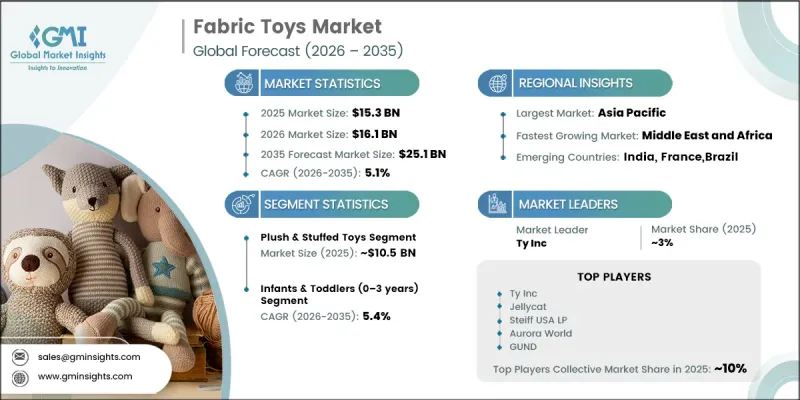
市場成長主要得益於「童心未泯」的消費者群體(包括青少年和成年人)參與度的不斷提高。他們購買布藝玩具,追求舒適感、收藏價值、裝飾效果以及與生活方式相關的用途。隨著布藝益智玩具在系統化的幼兒教育課程和發展支援活動中廣泛應用,市場需求也不斷成長。亞太、拉丁美洲以及中東和非洲等新興經濟體的市場正穩步擴張,這主要得益於中產階級家庭可支配收入的增加以及在兒童發展產品上的消費支出成長。成年人參與玩具產業正成為重要的收入來源,尤其是在高階布藝玩具領域。消費者對具有懷舊、舒適、美觀和收藏價值的產品的偏好日益成長,進一步推動了市場需求。數位商務平台的快速發展以及社群媒體主導的購買行為也加速了全球布藝玩具產業的銷售成長。
| 市場範圍 | |
|---|---|
| 開始年份 | 2025 |
| 預測期 | 2026-2035 |
| 上市時的市場規模 | 153億美元 |
| 預測金額 | 251億美元 |
| 複合年成長率 | 5.1% |
預計到2025年,毛絨玩具和布製玩具市場規模將達到105億美元,並在2026年至2035年間以4.8%的複合年成長率成長。該市場成長的主要促進因素包括不斷成長的禮品需求、全球玩具行業的穩步發展以及消費者對高階收藏日益成長的興趣。在許多地區,兒童傳統玩具的購買量仍然佔據市場總收入的很大一部分。同時,面向年長消費者的高階收藏品市場正以驚人的速度擴張,推動了整個市場產品價值和價格趨勢的提升。製造商不斷推出設計更精良、品牌策略更具差異化的高品質毛絨玩具,以吸引更廣泛的客戶群。
針對0-3歲兒童的嬰幼兒市場預計在2025年將佔據34.4%的市場佔有率,並在2035年之前以5.4%的複合年成長率成長。家長、照顧者和機構採購者越來越傾向於購買經認證的布藝玩具,這些玩具旨在促進幼兒早期發展和感官刺激。此細分市場的購買決策很大程度上受到發展階段適用性和嚴格安全標準的影響。以柔軟布料製成的發展支援產品旨在促進幼兒早期階段的感官參與和認知發展,同時滿足國際公認的安全和品質要求。人們對益智遊戲和兒童安全材料日益成長的興趣進一步推動了該年齡層的需求。
美國布藝玩具市場預計到2025年將達到29億美元,2026年至2035年的複合年成長率(CAGR)為4.4%,繼續維持在主導地位。該地區市場受到出生率下降導致兒童人口逐漸減少的影響,而成年人購買玩具的比例則持續穩定成長。嚴格的兒童產品監管標準促使製造商和進口商精簡產品系列併最佳化認證流程,以控制合規成本並應對供應鏈挑戰。現有毛絨玩具製造商之間的市場整合也有助於提升品牌定位、拓展產品系列,並增強整個美國布藝玩具產業的競爭力。
目錄
第1章:調查方法
第2章執行摘要
第3章 行業洞察
- 產業生態系分析
- 供應商情況
- 製造商
- 中斷
- 零售商
- 利潤率分析
- 每個階段增加的價值
- 影響價值鏈的因素
- 影響產業的因素
- 促進因素
- 來自「童心未泯」的成年人群體的需求日益成長。
- 幼兒教育的擴展和機構需求
- 知識產權許可和娛樂特許經營合作關係
- 產業潛在風險與挑戰
- 原料成本波動與供應鏈集中度
- 玩具安全法規的全球趨勢
- 促進因素
- 成長潛力分析
- 未來市場趨勢
- 技術與創新展望
- 最新科技趨勢
- 新興技術
- 價格趨勢
- 按地區
- 依產品類型
- 貿易數據分析
- 監理情勢
- 標準和合規要求
- 區域監理框架
- 認證標準
- 波特的分析
- PESTLE分析
- 人工智慧和生成式人工智慧對市場的影響
- 利用人工智慧改造現有經營模式
- 按細分市場分類的生成式人工智慧用例和部署藍圖
- 風險、限制和監管考量
- 消費行為分析
- 人口趨勢
- 影響購買決策的因素
- 消費者產品採納
- 首選分銷管道
- 理想價格範圍
第4章 競爭情勢
- 介紹
- 企業市佔率分析
- 按地區
- 企業矩陣分析
- 主要市場公司的競爭分析
- 競爭定位矩陣
- 主要進展
- 併購
- 夥伴關係和聯盟
- 新產品發布
- 業務拓展計劃
第5章 市場估算與預測:依產品類型分類,2022-2035年
- 絨毛玩具
- 軟體娃娃和布娃娃
- 布藝益智玩具
- 手偶和指偶
- 柔軟的音樂玩具
- 其他
第6章 市場估計與預測:依年齡層別分類,2022-2035年
- 嬰幼兒(0-3歲)
- 學齡前兒童(3-6歲)
- 學齡兒童(6-12歲)
- 青少年及成年人(12歲以上)
第7章 市場估計與預測:依價格分類,2022-2035年
- 高的
- 中等的
- 低的
第8章 市場估算與預測:依材料類型分類,2022-2035年
- 棉布
- 聚酯纖維
- 羊毛
- 麻
- 混紡布料
- 其他
第9章 市場估價與預測:依通路分類,2022-2035年
- 線上
- 企業網站
- 電子商務網站
- 離線
- 超級市場和大賣場
- 專賣店
- 其他
第10章 市場估價與預測:依地區分類,2022-2035年
- 北美洲
- 美國
- 加拿大
- 歐洲
- 德國
- 英國
- 法國
- 義大利
- 西班牙
- 瑞典
- 荷蘭
- 亞太地區
- 中國
- 印度
- 日本
- 韓國
- 澳洲
- 印尼
- 拉丁美洲
- 巴西
- 墨西哥
- 阿根廷
- 中東和非洲
- 沙烏地阿拉伯
- UAE
- 南非
第11章:公司簡介
- 世界公司
- Aurora World Inc.
- GUND Inc.
- Jellycat
- Manhattan Toy Company
- Squishmallows
- Steiff USA LP
- Ty Inc.
- 當地公司
- Beverly Hills Teddy Bear Company
- Corolle SAS
- Doshin Co Ltd
- DOUGLAS Company Inc.
- Maileg
- Trudi SpA
- Vermont Teddy Bear Company
-
- Animal Adventure
- Cuddle Barn
- FourBears
- Goffa International Corp.
- Hazel Village
- Squishable
- Teddy Mountain LLC
The Global Fabric Toys Market was estimated at USD 15.3 billion in 2025 and is estimated to grow at a CAGR of 5.1% to reach USD 25.1 billion by 2035.
Market growth is significantly influenced by the increasing participation of "kidult" consumers, including teenagers and adults, who are purchasing fabric toys for emotional comfort, collectible purposes, decorative appeal, and lifestyle-oriented use. Demand for fabric-based educational toys is also increasing as these products continue to gain wider adoption in structured early childhood learning programs and developmental activities. Emerging economies across the Asia Pacific, Latin America, the Middle East & Africa are witnessing steady market expansion due to rising disposable income levels and growing consumer spending on children's developmental products among middle-class households. Adult engagement in the toy industry is becoming a major source of revenue generation, particularly across premium fabric toy categories. Growing consumer preference for products associated with nostalgia, emotional well-being, aesthetic value, and collectability is further supporting market demand. The rapid influence of digital commerce platforms and social media-driven purchasing behavior is also accelerating sales growth across the global fabric toys industry.
| Market Scope | |
|---|---|
| Start Year | 2025 |
| Forecast Year | 2026-2035 |
| Start Value | $15.3 Billion |
| Forecast Value | $25.1 Billion |
| CAGR | 5.1% |
The plush and stuffed toys segment generated USD 10.5 billion in 2025 and is expected to grow at a CAGR of 4.8% from 2026 to 2035. Market growth within this category is supported by rising gifting demand, consistent growth in the global toy industry, and increasing consumer interest in premium collectible products. Traditional toy purchases for children continue to contribute a substantial portion of total market revenue across multiple regions. At the same time, the premium collectible segment aimed at older consumers is expanding at a significantly faster pace, contributing to higher product value and improved pricing dynamics across the market. Manufacturers are increasingly introducing premium-quality plush products with enhanced design aesthetics and differentiated branding strategies to attract a broader customer base.
The infants and toddlers segment, covering the 0-3 years age group, accounted for 34.4% share in 2025 and is forecast to grow at a CAGR of 5.4% through 2035. Parents, caregivers, and institutional buyers are increasingly investing in certified fabric toys designed to support early childhood development and sensory stimulation. Product purchasing decisions within this segment are strongly influenced by developmental suitability and compliance with strict safety standards. Soft fabric-based developmental products are designed to support sensory engagement and cognitive growth during early-stage childhood development while meeting recognized international safety and quality requirements. The increasing focus on educational play and child-safe materials is further strengthening demand within this age category.
U.S. Fabric Toys Market accounted for USD 2.9 billion in 2025 and is anticipated to register a CAGR of 4.4% between 2026 and 2035, maintaining its leading position within North America. The regional market is being shaped by a gradual decline in the child population resulting from lower birth rates, while adult participation in toy purchases continues to rise steadily. Strict regulatory standards governing children's products are encouraging manufacturers and importers to streamline product portfolios and optimize certification processes to manage compliance costs and supply chain challenges. Market consolidation activities among established plush toy companies are also contributing to stronger brand positioning, broader product portfolios, and increased competitiveness across the U.S. fabric toys industry.
Major companies operating in the Global Fabric Toys Market include Aurora World Inc., GUND Inc., Jellycat, Manhattan Toy Company, Squishmallows, Steiff USA LP, Ty Inc., Beverly Hills Teddy Bear Company, Corolle SAS, Doshin Co., Ltd., DOUGLAS Company Inc., Maileg, Trudi S.p.A., Vermont Teddy Bear Company, Animal Adventure, Cuddle Barn, FourBears, Goffa International Corp., Hazel Village, Squishable, and Teddy Mountain LLC. Companies participating in the fabric toys market are implementing multiple strategic initiatives to strengthen their market position and expand customer engagement globally. Leading manufacturers are focusing on premium product innovation, collectible toy launches, and emotionally driven branding strategies to attract both children and adult consumers. Businesses are also increasing investments in sustainable materials, eco-friendly production methods, and child-safe certifications to align with evolving consumer preferences and regulatory requirements. In addition, companies are expanding digital marketing activities and leveraging social commerce platforms to improve brand visibility and strengthen direct-to-consumer sales channels. Strategic partnerships, acquisitions, and portfolio diversification initiatives are further helping market participants increase global reach and enhance competitive positioning.
Table of Contents
Chapter 1 Research methodology
- 1.1 Research approach
- 1.2 Quality Commitments
- 1.2.1 GMI AI policy & data integrity commitment
- 1.2.1.1 Source consistency protocol
- 1.2.1 GMI AI policy & data integrity commitment
- 1.3 Research trail & confidence scoring
- 1.3.1 Research trail components
- 1.3.2 Scoring components
- 1.4 Data Collection
- 1.4.1 Partial list of primary sources
- 1.5 Data mining sources
- 1.5.1 Paid sources
- 1.5.1.1 Sources, by region
- 1.5.1 Paid sources
- 1.6 Base estimates and calculations
- 1.6.1 Base year calculation
- 1.7 Forecast model
- 1.7.1 Quantified market impact analysis
- 1.7.1.1 Mathematical impact of growth parameters on forecast
- 1.7.1 Quantified market impact analysis
- 1.8 Research transparency addendum
- 1.8.1 Source attribution framework
- 1.8.2 Quality assurance metrics
- 1.8.3 Our commitment to trust
Chapter 2 Executive Summary
- 2.1 Industry 360° synopsis
- 2.2 Business trends
- 2.3 Regional
- 2.4 Product type
- 2.5 Age group
- 2.6 Price
- 2.7 Material type
- 2.8 Distribution channel
Chapter 3 Industry Insights
- 3.1 Industry ecosystem analysis
- 3.1.1 Supplier landscape
- 3.1.2 Manufacturers
- 3.1.3 Distributors
- 3.1.4 Retailers
- 3.1.5 Profit margin analysis
- 3.1.6 Value addition at each stage
- 3.1.7 Factor affecting the value chain
- 3.2 Industry impact forces
- 3.2.1 Growth drivers
- 3.2.1.1 Rising Demand from the "Kidult" Consumer Segment
- 3.2.1.2 Expanding Early Childhood Education and Institutional Demand
- 3.2.1.3 IP Licensing and Entertainment Franchise Collaborations
- 3.2.2 Industry pitfalls & challenges
- 3.2.2.1 Raw Material Cost Volatility and Supply Chain Concentration
- 3.2.2.2 Evolving Global Toy Safety Regulations
- 3.2.1 Growth drivers
- 3.3 Growth potential analysis
- 3.4 Future market trends
- 3.5 Technology and innovation landscape
- 3.5.1 Current technological trends
- 3.5.2 Emerging technologies
- 3.6 Price trends
- 3.6.1 By region
- 3.6.2 By product type
- 3.7 Trade data analysis
- 3.8 Regulatory landscape
- 3.8.1 Standards and compliance requirements
- 3.8.2 Regional regulatory frameworks
- 3.8.3 Certification standards
- 3.9 Porter's analysis
- 3.10 PESTEL analysis
- 3.11 Impact of AI & generative AI on the market
- 3.11.1 AI-driven disruption of existing business models
- 3.11.2 GenAI use cases & adoption roadmap by segment
- 3.11.3 Risks, limitations & regulatory considerations
- 3.12 Consumer behavior analysis
- 3.12.1 Demographic trends
- 3.12.2 Factors affecting buying decision
- 3.12.3 Consumer product adoption
- 3.12.4 Preferred distribution channel
- 3.12.5 Preferred price range
Chapter 4 Competitive Landscape, 2025
- 4.1 Introduction
- 4.2 Company market share analysis
- 4.2.1 By Region
- 4.2.1.1 North America
- 4.2.1.2 Europe
- 4.2.1.3 Asia Pacific
- 4.2.1.4 Latin America
- 4.2.1.5 Middle East & Africa
- 4.2.1 By Region
- 4.3 Company matrix analysis
- 4.4 Competitive analysis of major market players
- 4.5 Competitive positioning matrix
- 4.6 Key developments
- 4.6.1 Mergers & acquisitions
- 4.6.2 Partnerships & collaborations
- 4.6.3 New product launches
- 4.6.4 Expansion plans
Chapter 5 Market Estimates & Forecast, By Product Type, 2022 - 2035, (USD Billion) (Units)
- 5.1 Key trends
- 5.2 Plush & Stuffed Toys
- 5.3 Soft Dolls & Rag Dolls
- 5.4 Fabric Educational Toys
- 5.5 Hand Puppets & Finger Puppets
- 5.6 Soft Musical Toys
- 5.7 Others
Chapter 6 Market Estimates & Forecast, By Age Group, 2022 - 2035, (USD Billion) (Units)
- 6.1 Key trends
- 6.2 Infants & Toddlers (0-3 years)
- 6.3 Preschool (3-6 years)
- 6.4 School Age (6-12 years)
- 6.5 Teens & Adults (12+ years)
Chapter 7 Market Estimates & Forecast, By Price, 2022 - 2035, (USD Billion) (Units)
- 7.1 Key trends
- 7.2 High
- 7.3 Medium
- 7.4 Low
Chapter 8 Market Estimates & Forecast, By Material Type, 2022 - 2035, (USD Billion) (Units)
- 8.1 Key trends
- 8.2 Cotton
- 8.3 Polyester
- 8.4 Wool
- 8.5 Hemp
- 8.6 Blended Fabric
- 8.7 Others
Chapter 9 Market Estimates & Forecast, By Distribution Channel, 2022 - 2035, (USD Billion) (Units)
- 9.1 Key trends
- 9.2 Online
- 9.2.1 Company Websites
- 9.2.2 E-commerce Websites
- 9.3 Offline
- 9.3.1 Supermarkets and Hypermarkets
- 9.3.2 Specialty Stores
- 9.3.3 Others
Chapter 10 Market Estimates & Forecast, By Region, 2022 - 2035, (USD Billion) (Units)
- 10.1 Key trends
- 10.2 North America
- 10.2.1 U.S
- 10.2.2 Canada
- 10.3 Europe
- 10.3.1 Germany
- 10.3.2 UK
- 10.3.3 France
- 10.3.4 Italy
- 10.3.5 Spain
- 10.3.6 Sweden
- 10.3.7 Netherlands
- 10.4 Asia Pacific
- 10.4.1 China
- 10.4.2 India
- 10.4.3 Japan
- 10.4.4 South Korea
- 10.4.5 Australia
- 10.4.6 Indonesia
- 10.5 Latin America
- 10.5.1 Brazil
- 10.5.2 Mexico
- 10.5.3 Argentina
- 10.6 MEA
- 10.6.1 Saudi Arabia
- 10.6.2 UAE
- 10.6.3 South Africa
Chapter 11 Company Profiles
- 11.1 Global Players
- 11.1.1 Aurora World Inc.
- 11.1.2 GUND Inc.
- 11.1.3 Jellycat
- 11.1.4 Manhattan Toy Company
- 11.1.5 Squishmallows
- 11.1.6 Steiff USA LP
- 11.1.7 Ty Inc.
- 11.2 Regional Players
- 11.2.1 Beverly Hills Teddy Bear Company
- 11.2.2 Corolle SAS
- 11.2.3 Doshin Co Ltd
- 11.2.4 DOUGLAS Company Inc.
- 11.2.5 Maileg
- 11.2.6 Trudi S.p.A.
- 11.2.7 Vermont Teddy Bear Company
- 11.3 Emerging Players & Innovators
- 11.3.1 Animal Adventure
- 11.3.2 Cuddle Barn
- 11.3.3 FourBears
- 11.3.4 Goffa International Corp.
- 11.3.5 Hazel Village
- 11.3.6 Squishable
- 11.3.7 Teddy Mountain LLC

 玩具市場:全球市場預測,2026-2032年
 指尖玩具市場規模、佔有率和成長分析:按類型、最終用戶、通路、材料、認證和地區分類-2026-2033年產業預測
 2026年全球玩具市場報告
 2026-2030年全球嬰幼兒自行車和搭乘用玩具市場
 可水洗手指畫市場:依年齡層、銷售管道、產品類型、最終用戶、包裝規格、價格範圍和地區分類
 玩具和遊戲市場報告:趨勢、預測和競爭分析(至2035年)
 玩具市場機會、成長要素、產業趨勢分析及2026-2035年預測。
 2026-2030年全球玩具市場搭乘用玩具市場:2026-2032年全球市場預測(依產品類型、材料、設計、年齡層、應用、銷售管道及用途分類)泡棉武器玩具市場:2026-2032年全球市場預測(依產品類型、年齡層、材料種類及銷售管道)