


 |
市場調查報告書
商品編碼
2061396
貨運無人機市場機會、成長要素、產業趨勢分析及2026-2035年預測。Cargo Drones Market Opportunity, Growth Drivers, Industry Trend Analysis, and Forecast 2026 - 2035 |
||||||

全球貨運無人機市場預計到 2025 年價值 21 億美元,並將以 40.1% 的複合年成長率成長,到 2035 年達到 588 億美元。
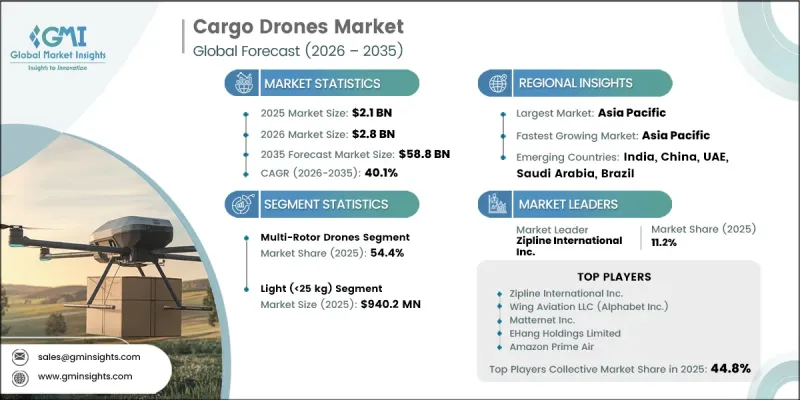
由於支援遠端無人機作業的法規結構不斷完善,以及無人機(UAV)配送系統在各行各業的廣泛應用,市場正經歷快速成長。尤其值得一提的是,隨著快速且有效率地運輸必需品變得日益重要,醫療物流領域對貨運無人機的應用也呈現出強勁的成長動能。此外,國防機構正在擴大貨運無人機在惡劣環境和偏遠地區運輸物資和設備的使用,進一步推動了市場需求。向自動化物流生態系統的持續轉型,以及有效載荷能力和飛行效率的不斷提升,進一步提高了貨運無人機部署的商業性可行性。對先進空中運輸基礎設施和自主運輸技術的持續投入,也為此大規模市場的發展提供了支持。此外,智慧導航系統、人工智慧驅動的路線最佳化以及電池技術的進步正在無縫融合,從而提高了營運效率和可靠性,使貨運無人機成為全球現代物流和運輸網路中越來越有吸引力的解決方案。
| 市場範圍 | |
|---|---|
| 開始年份 | 2025 |
| 預測期 | 2026-2035 |
| 上市時的市場規模 | 21億美元 |
| 預計金額 | 588億美元 |
| 複合年成長率 | 40.1% |
超視距(BVLOS)飛行技術的進步進一步推動了貨運無人機市場的發展。這項技術使無人機能夠在無需直接目視監控的情況下執行遠端任務,顯著提升了無人機物流網路的擴充性和效率。此外,都市區專用無人機基礎設施(包括航線和無人機起降設施)的建設,正在改善營運協調,以緩解城市空域的擁擠狀況。預計未來十年,各國政府和私人機構對綜合空中運輸系統的持續投入將加速無人機在大都會圈和區域物流網路中的商業部署。
預計2026年至2035年間,混合型垂直起降無人機市場將以41.3%的複合年成長率成長。這一成長主要得益於混合型垂直起降平台的卓越性能,該平台融合了垂直起降(VTOL)能力、遠程飛行能力和高有效載荷能力。這些系統正日益廣泛應用於城際運輸和遠端物流運營,在這些領域,遠端配送的效率至關重要。對營運柔軟性和經濟高效物流解決方案日益成長的需求,也持續推動混合型垂直起降無人機在商業領域的應用。
重量低於25公斤的輕型有效載荷無人機市場預計到2025年將達到9.402億美元。該細分市場憑藉其適用於短途配送應用以及較低的營運和監管複雜性,保持著強勁的市場主導地位。這些無人機製造、部署和維護相對簡便,因此對末端配送和商業物流運作極具吸引力。其經濟實惠的價格和易於整合到都市區配送系統中的特性,也持續推動其在市場上的廣泛應用。
預計到2025年,北美貨運無人機市佔率將達到43.4%。由於相關法規的製定和空域整合計畫的實施,促進了商用無人機的運營,該地區市場正迅速擴張。政府機構正加大對先進空中運輸(AAM)計畫和超視距(BVLOS)部署計畫的支援力度,加速了貨運無人機在物流和公共服務領域的應用。該地區航太製造商和無人機技術供應商的強大實力也進一步推動了商業化和大規模部署活動。
目錄
第1章:調查方法和範圍
第2章執行摘要
第3章 行業洞察
- 產業生態系分析
- 供應商情況
- 利潤率
- 成本結構
- 每個階段增加的價值
- 影響價值鏈的因素
- 中斷
- 影響產業的因素
- 促進因素
- 拓展超視距(BVLOS)作業將實現長途貨運。
- 融入醫療供應鏈,用於運送關鍵醫療用品。
- 在國防和戰術性後勤行動中擴大應用。
- 向自主、數位化和互聯的物流網路轉型
- 開發高負載容量、遠端貨運無人機平台
- 產業潛在風險與挑戰
- 法規的區域差異
- 大規模無人機物流部署營運成本高昂
- 市場機遇
- 開發無人機物流專用樞紐和基礎設施
- 業務拓展至中程及城際商業物流領域。
- 促進因素
- 成長潛力分析
- 監理情勢
- 波特的分析
- PESTLE分析
- 技術與創新展望
- 最新科技趨勢
- 新興技術
- 價格趨勢
- 按地區
- 依產品
- 定價策略
- 新興經營模式
- 合規要求
- 專利和智慧財產權分析
第4章 競爭情勢
- 介紹
- 企業市佔率分析
- 按地區
- 市場集中度分析
- 主要公司的競爭標竿分析
- 財務績效比較
- 收入
- 利潤率
- R&D
- 產品系列比較
- 產品線寬度
- 科技
- 創新
- 區域擴張比較
- 全球擴張分析
- 服務網路覆蓋
- 按地區分類的市場滲透率
- 競爭定位矩陣
- 領導者
- 挑戰者
- 追蹤者
- 小眾玩家
- 戰略展望矩陣
- 財務績效比較
- 主要進展
- 併購
- 夥伴關係和聯盟
- 技術進步
- 擴張和投資策略
- 數位轉型計劃
- 新興企業競爭公司和新創企業的發展趨勢
第5章 市場估算與預測:依平台類型分類,2022-2035年
- 多旋翼無人機
- 固定翼無人機
- 混合動力垂直起降無人機
第6章 市場估算與預測:依酬載能力分類,2022-2035年
- 輕型(小於25公斤)
- 中等體重(25-100公斤)
- 體重(超過100公斤)
第7章 市場估計與預測:依範圍分類,2022-2035年
- 近距離(小於50公里)
- 短程(50-149公里)
- 中等距離(150-650公里)
- 長途(超過650公里)
第8章 市場估算與預測:依驅動類型分類,2022-2035年
- 電池供電
- 氫燃料電池
- 混合
第9章 市場估價與預測:依自動駕駛等級分類,2022-2035年
- 完全自主
- 半自動
- 遙控
第10章 市場估價與預測:依最終用途產業分類,2022-2035年
- 醫療和緊急服務
- 醫療用品配送
- 血液和器官運輸
- 緊急應變和災害救援
- 其他
- 零售與電子商務
- 最後一公里配送
- 樞紐貨運
- 倉儲運輸服務
- 其他
- 國防與安全
- 戰場補給
- 邊防安全物流
- 災難疏散支援
- 其他
- 農業
- 基礎設施和建築
- 其他
第11章 市場估價與預測:按地區分類,2022-2035年
- 北美洲
- 美國
- 加拿大
- 歐洲
- 德國
- 英國
- 法國
- 西班牙
- 義大利
- 俄羅斯
- 亞太地區
- 中國
- 印度
- 日本
- 澳洲
- 韓國
- 拉丁美洲
- 巴西
- 墨西哥
- 阿根廷
- 中東和非洲
- 南非
- 沙烏地阿拉伯
- UAE
第12章:公司簡介
- 全球主要公司
- Zipline International Inc.
- Wing Aviation LLC(Alphabet Inc.)
- Matternet Inc.
- EHang Holdings Limited
- Amazon Prime Air
- 該地區的主要公司
- 北美洲
- Elroy Air Inc.
- Natilus Inc.
- Valqari
- Airspace Link
- Skyward(Verizon)
- Flyte Systems
- 亞太地區
- VastArrive
- 歐洲
- Volocopter GmbH
- Dronamics Ltd.
- Wingcopter GmbH
- Skyports Infrastructure
- Pipistrel VTOL
- Manna Aero
- Middle East & Africa
- Swoop Aero
- 北美洲
- 小眾玩家/顛覆者
- Volans-i.
The Global Cargo Drones Market was valued at USD 2.1 billion in 2025 and is estimated to grow at a CAGR of 40.1% to reach USD 58.8 billion by 2035.
The market is witnessing rapid growth due to the increasing development of regulatory frameworks supporting long-distance drone operations and the rising adoption of unmanned aerial delivery systems across multiple industries. Cargo drones are gaining strong momentum in healthcare logistics, where fast and efficient transportation of essential supplies is becoming increasingly important. In addition, defense organizations are expanding the use of cargo drones for transporting materials and equipment in difficult and remote environments, strengthening market demand. The growing transition toward automated logistics ecosystems, combined with continuous improvements in payload capabilities and flight efficiency, is further increasing the commercial viability of cargo drone deployment. Expanding investments in advanced air mobility infrastructure and autonomous transportation technologies are also supporting large-scale market development. Furthermore, the integration of intelligent navigation systems, AI-driven route optimization, and enhanced battery technologies is improving operational efficiency and reliability, making cargo drones an increasingly attractive solution for modern logistics and transportation networks worldwide.
| Market Scope | |
|---|---|
| Start Year | 2025 |
| Forecast Year | 2026-2035 |
| Start Value | $2.1 Billion |
| Forecast Value | $58.8 Billion |
| CAGR | 40.1% |
The cargo drones market is further supported by the increasing advancement of Beyond Visual Line of Sight (BVLOS) operations, which enable drones to perform long-distance missions without direct visual supervision. These capabilities significantly improve the scalability and efficiency of drone-based logistics networks. In addition, the development of dedicated urban drone infrastructure, including air corridors and drone landing facilities, is improving operational coordination and reducing congestion within urban airspaces. Growing investments by governments and private organizations in integrated air mobility systems are expected to accelerate commercial deployment across metropolitan and regional logistics networks through the coming decade.
The hybrid VTOL drones segment is expected to grow at a CAGR of 41.3% during 2026-2035. This growth is attributed to the capability of hybrid VTOL platforms to combine vertical takeoff functionality with extended flight range and higher payload performance. These systems are increasingly being adopted for intercity transportation and remote-area logistics operations where long-distance delivery efficiency is critical. Rising demand for operational flexibility and cost-efficient logistics solutions continues to strengthen adoption across commercial sectors.
The light payload segment, consisting of drones carrying less than 25 kg reached USD 940.2 million in 2025. The segment maintains strong market leadership due to its suitability for short-range delivery applications and lower operational and regulatory complexities. These drones are comparatively easier to manufacture, deploy, and maintain, making them highly attractive for last-mile delivery and commercial logistics operations. Their affordability and ease of integration into urban delivery systems continue to support widespread market adoption.
North America Cargo Drones Market accounted for 43.4% share in 2025. The regional market is expanding rapidly due to supportive regulatory developments and the implementation of structured airspace integration programs that facilitate commercial drone operations. Government agencies are increasingly supporting advanced air mobility initiatives and BVLOS deployment programs, which are accelerating cargo drone adoption across logistics and public service sectors. The strong presence of aerospace manufacturers and drone technology providers in the region further supports commercialization and large-scale deployment activities.
Major companies operating in the Global Cargo Drones Market include Zipline International Inc., Wing Aviation LLC (Alphabet Inc.), Matternet Inc., Volocopter GmbH, EHang Holdings Limited, Dronamics Ltd., Amazon Prime Air, Elroy Air Inc., VastArrive, Skyports Infrastructure, Swoop Aero, Wingcopter GmbH, Natilus Inc., Pipistrel VTOL, Valqari, Manna Aero, Volans-i, Airspace Link, Skyward (Verizon), and Flyte Systems. Companies operating in the cargo drones market are focusing on expanding their technological capabilities through continuous investments in autonomous flight systems, advanced navigation technologies, and AI-powered fleet management platforms. Strategic collaborations with logistics providers, healthcare organizations, and government agencies are helping companies accelerate commercial deployment and strengthen operational networks. Manufacturers are also prioritizing the development of hybrid VTOL systems and long-range drones to improve payload efficiency and operational flexibility. Investments in urban air mobility infrastructure, including drone ports and air traffic integration systems, are further supporting scalability. In addition, companies are working on enhancing battery performance, flight safety systems, and real-time communication technologies to improve reliability and reduce operational risks.
Table of Contents
Chapter 1 Methodology and Scope
- 1.1 Market scope and definition
- 1.2 Research design
- 1.2.1 Research approach
- 1.2.2 Data collection methods
- 1.3 Data mining sources
- 1.3.1 Global
- 1.3.2 Regional/Country
- 1.4 Base estimates and calculations
- 1.4.1 Base year calculation
- 1.4.2 Key trends for market estimation
- 1.5 Primary research and validation
- 1.5.1 Primary sources
- 1.6 Forecast model
- 1.7 Research assumptions and limitations
Chapter 2 Executive Summary
- 2.1 Industry 360° synopsis, 2022 - 2035
- 2.2 Key market trends
- 2.2.1 Platform type trends
- 2.2.2 Payload capacity trends
- 2.2.3 Range trends
- 2.2.4 Propulsion type trends
- 2.2.5 Autonomy level trends
- 2.2.6 End-use industry trends
- 2.2.7 Regional trends
- 2.3 TAM Analysis, 2026-2035
- 2.4 CXO perspectives: Strategic imperatives
Chapter 3 Industry Insights
- 3.1 Industry ecosystem analysis
- 3.1.1 Supplier Landscape
- 3.1.2 Profit Margin
- 3.1.3 Cost structure
- 3.1.4 Value addition at each stage
- 3.1.5 Factor affecting the value chain
- 3.1.6 Disruptions
- 3.2 Industry impact forces
- 3.2.1 Growth drivers
- 3.2.1.1 Expansion of beyond visual line of sight (BVLOS) operations enabling long range cargo delivery
- 3.2.1.2 Integration into healthcare supply chains for critical medical deliveries
- 3.2.1.3 Growing deployment in defense and tactical logistics operations
- 3.2.1.4 Shift toward autonomous and digitized connected logistics networks
- 3.2.1.5 Development of high-payload and long-endurance cargo drone platforms
- 3.2.2 Industry pitfalls and challenges
- 3.2.2.1 Regulatory fragmentation across regions
- 3.2.2.2 High operational cost of large-scale drone logistics deployment
- 3.2.3 Market opportunities
- 3.2.3.1 Development of dedicated drone logistics hubs and infrastructure
- 3.2.3.2 Expansion into commercial middle-mile and intercity logistics
- 3.2.1 Growth drivers
- 3.3 Growth potential analysis
- 3.4 Regulatory landscape
- 3.4.1 North America
- 3.4.2 Europe
- 3.4.3 Asia Pacific
- 3.4.4 Latin America
- 3.4.5 Middle East & Africa
- 3.5 Porter's analysis
- 3.6 PESTEL analysis
- 3.7 Technology and Innovation landscape
- 3.7.1 Current technological trends
- 3.7.2 Emerging technologies
- 3.8 Price trends
- 3.8.1 By region
- 3.8.2 By product
- 3.9 Pricing Strategies
- 3.10 Emerging Business Models
- 3.11 Compliance Requirements
- 3.12 Patent and IP analysis
Chapter 4 Competitive Landscape, 2025
- 4.1 Introduction
- 4.2 Company market share analysis
- 4.2.1 By region
- 4.2.1.1 North America
- 4.2.1.2 Europe
- 4.2.1.3 Asia Pacific
- 4.2.1.4 Latin America
- 4.2.1.5 Middle East & Africa
- 4.2.2 Market concentration analysis
- 4.2.1 By region
- 4.3 Competitive benchmarking of key players
- 4.3.1 Financial performance comparison
- 4.3.1.1 Revenue
- 4.3.1.2 Profit margin
- 4.3.1.3 R&D
- 4.3.2 Product portfolio comparison
- 4.3.2.1 Product range breadth
- 4.3.2.2 Technology
- 4.3.2.3 Innovation
- 4.3.3 Geographic presence comparison
- 4.3.3.1 Global footprint analysis
- 4.3.3.2 Service network coverage
- 4.3.3.3 Market penetration by region
- 4.3.4 Competitive positioning matrix
- 4.3.4.1 Leaders
- 4.3.4.2 Challengers
- 4.3.4.3 Followers
- 4.3.4.4 Niche players
- 4.3.5 Strategic outlook matrix
- 4.3.1 Financial performance comparison
- 4.4 Key developments
- 4.4.1 Mergers and acquisitions
- 4.4.2 Partnerships and collaborations
- 4.4.3 Technological advancements
- 4.4.4 Expansion and investment strategies
- 4.4.5 Digital transformation initiatives
- 4.5 Emerging/ startup competitors landscape
Chapter 5 Market Estimates and Forecast, By Platform Type, 2022 - 2035 (USD Million)
- 5.1 Key trends
- 5.2 Multi-rotor drones
- 5.3 Fixed-wing drones
- 5.4 Hybrid VTOL drones
Chapter 6 Market Estimates and Forecast, By Payload Capacity, 2022 - 2035 (USD Million & Units)
- 6.1 Key trends
- 6.2 Light (<25 kg)
- 6.3 Medium (25-100 kg)
- 6.4 Heavy (>100 kg)
Chapter 7 Market Estimates and Forecast, By Range, 2022 - 2035 (USD Million & Units)
- 7.1 Key trends
- 7.2 Close-range (<50 km)
- 7.3 Short-range (50-149 km)
- 7.4 Mid-range (150-650 km)
- 7.5 Long-range (>650 km)
Chapter 8 Market Estimates and Forecast, By Propulsion Type, 2022 - 2035 (USD Million & Units)
- 8.1 Key trends
- 8.2 Battery-electric
- 8.3 Hydrogen/fuel cell
- 8.4 Hybrid
Chapter 9 Market Estimates and Forecast, By Autonomy Level, 2022 - 2035 (USD Million & Units)
- 9.1 Key trends
- 9.2 Fully autonomous
- 9.3 Semi-autonomous
- 9.4 Remotely piloted
Chapter 10 Market Estimates and Forecast, By End-Use Industry, 2022 - 2035 (USD Million & Units)
- 10.1 Key trends
- 10.2 Healthcare and emergency services
- 10.2.1 Medical supply delivery
- 10.2.2 Blood and organ transport
- 10.2.3 Emergency response and disaster relief
- 10.2.4 Others
- 10.3 Retail and e-commerce
- 10.3.1 Last-mile delivery
- 10.3.2 Inter-hub cargo transport
- 10.3.3 Warehouse transfer operations
- 10.3.4 Others
- 10.4 Defense and security
- 10.4.1 Field resupply
- 10.4.2 Border patrol logistics
- 10.4.3 Disaster evacuation support
- 10.4.4 Others
- 10.5 Agriculture
- 10.6 Infrastructure and construction
- 10.7 Others
Chapter 11 Market Estimates and Forecast, By Region, 2022 - 2035 (USD Million & Units)
- 11.1 Key trends
- 11.2 North America
- 11.2.1 U.S.
- 11.2.2 Canada
- 11.3 Europe
- 11.3.1 Germany
- 11.3.2 UK
- 11.3.3 France
- 11.3.4 Spain
- 11.3.5 Italy
- 11.3.6 Russia
- 11.4 Asia Pacific
- 11.4.1 China
- 11.4.2 India
- 11.4.3 Japan
- 11.4.4 Australia
- 11.4.5 South Korea
- 11.5 Latin America
- 11.5.1 Brazil
- 11.5.2 Mexico
- 11.5.3 Argentina
- 11.6 Middle East and Africa
- 11.6.1 South Africa
- 11.6.2 Saudi Arabia
- 11.6.3 UAE
Chapter 12 Company Profiles
- 12.1 Global Key Players
- 12.1.1 Zipline International Inc.
- 12.1.2 Wing Aviation LLC (Alphabet Inc.)
- 12.1.3 Matternet Inc.
- 12.1.4 EHang Holdings Limited
- 12.1.5 Amazon Prime Air
- 12.2 Regional key players
- 12.2.1 North America
- 12.2.1.1 Elroy Air Inc.
- 12.2.1.2 Natilus Inc.
- 12.2.1.3 Valqari
- 12.2.1.4 Airspace Link
- 12.2.1.5 Skyward (Verizon)
- 12.2.1.6 Flyte Systems
- 12.2.2 Asia Pacific
- 12.2.2.1 VastArrive
- 12.2.3 Europe
- 12.2.3.1 Volocopter GmbH
- 12.2.3.2 Dronamics Ltd.
- 12.2.3.3 Wingcopter GmbH
- 12.2.3.4 Skyports Infrastructure
- 12.2.3.5 Pipistrel VTOL
- 12.2.3.6 Manna Aero
- 12.2.4 Middle East & Africa
- 12.2.4.1 Swoop Aero
- 12.2.1 North America
- 12.3 Niche Players/Disruptors
- 12.3.1 Volans-i.

 2026年全球無人機配送服務市場報告2026年全球貨運無人機市場報告
 軍用貨運無人機市場報告:趨勢、預測和競爭分析(至2035年)
 貨運無人機市場:全球市場預測,2026-2032年
 全球貨運無人機市場規模、佔有率、趨勢和成長分析報告(2026-2034)
 氫能送貨無人機市場分析及預測(至2035年):類型、產品、服務、技術、組件、應用、最終用戶、功能、安裝配置
 全球貨運無人機市場-產業規模、佔有率、趨勢、機會、預測:按類型、運能、產業、地區和競爭格局分類,2021-2031年
 配送無人機市場:依無人機類型、組件、最終用途產業及地區分類2026年全球無人機終端配送市場報告2026年全球無人機配送市場報告