

 |
市場調查報告書
商品編碼
2061389
B2B旅遊市場機會、成長要素、產業趨勢分析及2026-2035年預測B2B Travel Market Opportunity, Growth Drivers, Industry Trend Analysis, and Forecast 2026 - 2035 |
||||||

2025年全球B2B旅遊市場價值為353億美元,預計到2035年將以10.8%的複合年成長率成長至961億美元。
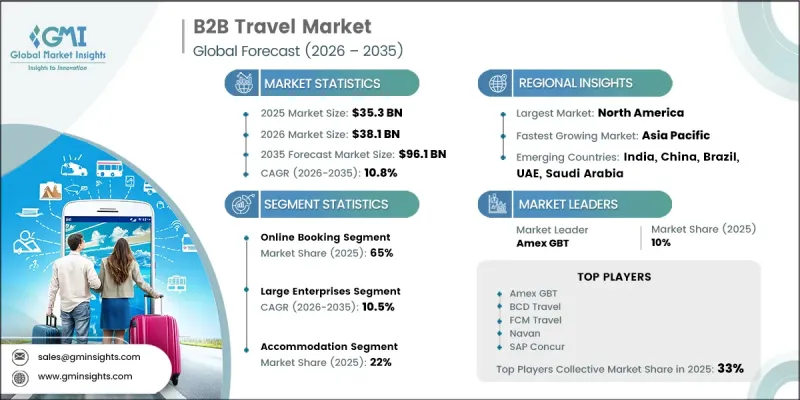
由於企業對更有效率的差旅營運需求日益成長,以及對簡化預訂、管理和合規流程的整合式數位平台的依賴性不斷提高,差旅管理市場正在不斷擴張。差旅管理公司、技術供應商和銷售平台之間的合作日益密切,旨在加強服務整合,並擴大企業客戶獲取差旅內容的管道。這些夥伴關係正在提升價格透明度,增強自動化預訂系統,並豐富整個商務旅行生態系統中的旅客支援服務。差旅管理技術的不斷進步提高了預訂效率,同時確保了企業差旅政策的合規性,並最佳化了整體差旅支出。企業越來越注重透過集中式和自動化解決方案來降低差旅相關的行政複雜性。商務旅客也要求在整個行程中獲得無縫的數位體驗、個人化提案和即時支援服務。因此,企業正在採用整合式差旅平台,將多種服務整合到一個易於存取的單一解決方案中。永續性考量在企業差旅政策中變得越來越重要,各組織積極追蹤碳排放,並鼓勵對環境負責的選擇,例如選擇低排放交通途徑和環保住宿設施。
| 市場範圍 | |
|---|---|
| 開始年份 | 2025 |
| 預測期 | 2026-2035 |
| 上市時的市場規模 | 353億美元 |
| 預測金額 | 961億美元 |
| 複合年成長率 | 10.8% |
預計到2025年,線上預訂市場佔有率將佔據65%的主導地位,並在2026年至2035年間以11.2%的複合年成長率成長。企業差旅負責人正在加速數位化預訂生態系統轉型,以提供即時存取差旅庫存、價格和行程選項的途徑。人工智慧(AI)和自動化政策合規系統的整合正在簡化預訂流程,同時減少對傳統中介機構的依賴。隨著商務旅客越來越傾向於使用提供即時核准、行程管理和個人化旅遊協助的應用程式解決方案,行動端預訂平台正成為企業差旅預訂的核心管道。對行動優先旅行技術的持續投入,進一步加速了企業對數位化預訂平台的採用。
預計到2025年,大型企業市佔率將達到65.3%,並在2035年之前以10.5%的複合年成長率成長。大型企業正日益採用先進的數位化差旅管理系統,這些系統支援預測性預訂、票價最佳化和自動化政策執行。這些解決方案有助於企業最大限度地減少差旅成本漏洞,提高成本效益,並加強各業務部門的策略決策。此外,借助先進的分析工具,企業可以按地區和部門追蹤差旅費用趨勢,從而支援更精準的預算編制和更完善的財務管理。
美國B2B差旅市場預計到2025年將達到117億美元,並在2026年至2035年間以10%的複合年成長率成長。美國企業正主導集中式差旅管理系統的普及,這些系統能夠實現集中採購、更嚴格的政策合規以及全球供應商合約的使用。這種對差旅管理平台日益成長的依賴正在提升跨國公司的成本效益和合規性。在主要大都會圈,商務旅行需求仍然強勁,這主要得益於金融服務公司、顧問公司和科技公司對頻繁的國內和國際差旅解決方案的需求,以及商務活動和公司會議需求的不斷成長。
目錄
第1章:調查方法
第2章執行摘要
第3章 行業洞察
- 產業生態系分析
- 供應商情況
- 利潤率
- 成本結構
- 每個階段增加的價值
- 影響價值鏈的因素
- 中斷
- 影響產業的因素
- 促進因素
- 旅行社與其他相關人員之間的策略夥伴關係
- 擴大企業差旅預算
- 旅遊科技的進步與創新
- 對個人化、便利旅行的需求
- 產業潛在風險與挑戰
- 分散的市場
- 資料安全和隱私問題
- 市場機遇
- 人工智慧驅動的旅行個性化和自動化
- 拓展中小企業的企業差旅解決方案
- 永續和碳中和的商務旅行計劃
- 整合式差旅、費用和風險管理平台
- 促進因素
- 成長潛力分析
- 技術與創新展望
- 最新科技趨勢
- 新興技術
- 價格分析
- 對過去價格趨勢的分析
- 定價策略:按業務類型分類
- 監理情勢
- 北美洲
- 世界商務旅遊協會
- 美國旅遊協會
- 歐洲
- GBTA Europe
- 歐洲旅遊協會
- 亞太地區
- 亞太旅遊協會
- 亞洲旅遊及科技產業協會
- LATAM
- GBTA拉丁美洲
- 中美洲旅遊協會聯合會
- 中東和非洲
- GBTA中東
- 東非旅遊協會聯合會
- 北美洲
- 波特的分析
- PESTLE分析
- 專利分析
- 人工智慧和生成式人工智慧對市場的影響
- 利用人工智慧改造現有經營模式
- 按細分市場分類的生成式人工智慧用例和部署藍圖
- 風險、限制和監管考量
- 永續性和環境方面
- 永續計劃
- 減少廢棄物策略
- 生產中的能源效率
- 具有環保意識的舉措
- 考慮碳足跡
- 預測假設和情境分析
- 基本案例:驅動複合年成長率的關鍵宏觀經濟與產業變量
- 樂觀情境:宏觀經濟與產業的順風
- 悲觀情景:宏觀經濟放緩或產業逆風
第4章 競爭情勢
- 介紹
- 企業市佔率分析
- 北美洲
- 歐洲
- 亞太地區
- LATAM
- 中東和非洲
- 主要市場公司的競爭分析
- 競爭定位矩陣
- 主要進展
- 併購
- 夥伴關係和聯盟
- 新產品發布
- 業務拓展計劃及資金籌措
第5章 市場估計與預測:依服務業分類,2022-2035年
- 運輸
- 住宿設施
- 會議、獎勵旅遊、大會和展覽(MICE)
- 旅遊保險
- 其他
- 簽證服務
- 門房服務
- 旅遊諮詢
第6章 市場估算與預測:預約方式,2022-2035年
- 線上預訂
- 線下預訂
第7章 市場估計與預測:依公司規模分類,2022-2035年
- 大公司
- 小型企業
第8章 市場估算與預測:依最終用途分類,2022-2035年
- 金融服務與諮詢
- 技術/製造
- 醫療和藥品
- 政府/教育
- 其他
第9章 市場估計與預測:依地區分類,2022-2035年
- 北美洲
- 美國
- 加拿大
- 歐洲
- 德國
- 英國
- 法國
- 義大利
- 西班牙
- 俄羅斯
- 荷蘭
- 亞太地區
- 中國
- 印度
- 日本
- 韓國
- 澳洲
- 越南
- 印尼
- 拉丁美洲
- 巴西
- 墨西哥
- 阿根廷
- 中東和非洲
- 南非
- 沙烏地阿拉伯
- UAE
第10章:公司簡介
- 世界公司
- Amadeus IT
- Amex(GBT)
- BCD Travel
- Direct Travel+ATPI
- FCM Travel
- Hotelbeds
- Sabre
- SAP Concur
- 當地公司
- Christopherson Business Travel
- CTM(Corporate Travel Management)
- Infiniti Travel
- JTB Business Travel
- Maritz Global Events
- Travelport+Deem
- Trip.Biz
- WebBeds
- 新興企業
- Chase Travel
- Navan
- Spotnana
- TravelPerk
The Global B2B Travel Market was valued at USD 35.3 billion in 2025 and is estimated to grow at a CAGR of 10.8% to reach USD 96.1 billion by 2035.
The market is expanding due to the rising need for streamlined corporate travel operations and the increasing reliance on integrated digital platforms that simplify booking, management, and compliance processes. Travel management companies, technology providers, and distribution platforms are increasingly collaborating to enhance service integration and broaden access to travel content for corporate clients. These partnerships are improving pricing transparency, strengthening automated booking systems, and enhancing traveler support services across business travel ecosystems. Continuous advancements in travel management technologies are improving booking efficiency while ensuring better compliance with corporate travel policies and optimizing overall travel expenditure. Organizations are increasingly focused on reducing the administrative complexity associated with business travel through centralized and automated solutions. Corporate travelers are also demanding seamless digital experiences, personalized recommendations, and real-time support services throughout their journeys. As a result, enterprises are adopting integrated travel platforms that unify multiple services into a single accessible solution. Sustainability considerations are becoming increasingly important in corporate travel policies, with organizations actively tracking carbon emissions and encouraging environmentally responsible choices such as low-emission transportation and eco-conscious accommodation options.
| Market Scope | |
|---|---|
| Start Year | 2025 |
| Forecast Year | 2026-2035 |
| Start Value | $35.3 Billion |
| Forecast Value | $96.1 Billion |
| CAGR | 10.8% |
The online booking segment held a dominant 65% share in 2025 and is expected to grow at a CAGR of 11.2% from 2026 to 2035. Corporate travel planners are increasingly shifting toward digital booking ecosystems that provide real-time access to travel inventory, pricing, and itinerary options. The integration of artificial intelligence and automated policy compliance systems is streamlining booking workflows while reducing reliance on traditional intermediary services. Mobile-based booking platforms are becoming a central channel for corporate travel reservations, as business travelers increasingly prefer app-based solutions that offer instant approvals, itinerary management, and personalized travel assistance. The rising investment in mobile-first travel technologies is further accelerating the adoption of digital booking platforms across enterprises.
The large enterprises segment accounted for 65.3% share in 2025 and is projected to grow at a CAGR of 10.5% through 2035. Large organizations are increasingly deploying advanced digital travel management systems that support predictive booking, fare optimization, and automated policy enforcement. These solutions are helping enterprises minimize travel leakage, improve cost efficiency, and enhance strategic decision-making across business units. The use of advanced analytics tools is also enabling organizations to track travel spending patterns across regions and departments, supporting more accurate budgeting and improved financial control.
U.S. B2B Travel Market reached USD 11.7 billion in 2025 and is expected to grow at a CAGR of 10% from 2026 to 2035. U.S. enterprises are leading the adoption of centralized travel management systems that consolidate procurement, enforce policy compliance, and leverage global supplier agreements. Increased reliance on travel management platforms is improving cost efficiency and regulatory adherence across multinational corporations. Major metropolitan hubs continue to generate strong business travel demand, driven by financial services firms, consulting organizations, and technology companies that require frequent domestic and international travel solutions, along with growing demand for business events and corporate meetings.
Leading companies operating in the Global B2B Travel Market include Amex GBT, BCD Travel, Christopherson Business Travel, CTM (Corporate Travel Management), Direct Travel, FCM Travel, JTB Business Travel, Maritz Global Events, Navan, SAP Concur, and TravelPerk. Companies operating in the B2B travel industry are focusing on multiple strategic initiatives to strengthen their market position and expand global competitiveness. Major players are increasing investment in AI-driven travel management platforms, predictive analytics tools, and automated booking systems to enhance operational efficiency and improve user experience. Strategic partnerships between travel management companies, technology providers, and distribution platforms are helping organizations expand service capabilities and integrate richer travel content. Businesses are also prioritizing mobile-first solutions, real-time itinerary management, and personalized travel experiences to meet evolving corporate traveler expectations. In addition, companies are strengthening sustainability-focused travel solutions by incorporating carbon tracking tools and eco-friendly travel options into corporate travel programs. Continuous innovation in automation, data-driven insights, and integrated travel ecosystems is further supporting long-term growth and competitive differentiation in the B2B travel market.
Table of Contents
Chapter 1 Methodology
- 1.1 Research approach
- 1.2 Quality Commitments
- 1.2.1 GMI AI policy & data integrity commitment
- 1.2.1.1 Source consistency protocol
- 1.2.1 GMI AI policy & data integrity commitment
- 1.3 Research Trail & Confidence Scoring
- 1.3.1 Research Trail Components
- 1.3.2 Scoring Components
- 1.4 Data Collection
- 1.4.1 Partial list of primary sources
- 1.5 Data mining sources
- 1.5.1 Paid sources
- 1.5.1.1 Sources, by region
- 1.5.1 Paid sources
- 1.6 Base estimates and calculations
- 1.6.1 Base year calculation
- 1.7 Forecast model
- 1.7.1 Quantified market impact analysis
- 1.7.1.1 Mathematical impact of growth parameters on forecast
- 1.7.1 Quantified market impact analysis
- 1.8 Research transparency addendum
- 1.8.1 Source attribution framework
- 1.8.2 Quality assurance metrics
- 1.8.3 Our commitment to trust
Chapter 2 Executive Summary
- 2.1 Industry 360° synopsis
- 2.2 Key market trends
- 2.2.1 Regional
- 2.2.2 Service
- 2.2.3 Booking mode
- 2.2.4 Enterprise size
- 2.2.5 End use
- 2.3 TAM analysis, 2026-2035
- 2.4 CXO perspectives: Strategic imperatives
Chapter 3 Industry Insights
- 3.1 Industry ecosystem analysis
- 3.1.1 Supplier landscape
- 3.1.2 Profit margin
- 3.1.3 Cost structure
- 3.1.4 Value addition at each stage
- 3.1.5 Factor affecting the value chain
- 3.1.6 Disruptions
- 3.2 Industry impact forces
- 3.2.1 Growth drivers
- 3.2.1.1 Strategic partnerships between travel companies and other stakeholders
- 3.2.1.2 Expanding corporate travel budget
- 3.2.1.3 Advancements and innovations in travel technology
- 3.2.1.4 Demand for personalized and hassle-free travel
- 3.2.2 Industry pitfalls and challenges
- 3.2.2.1 Fragmented marketplace
- 3.2.2.2 Data security and privacy concerns
- 3.2.3 Market opportunities
- 3.2.3.1 AI-powered travel personalization and automation
- 3.2.3.2 Expansion of SME-focused corporate travel solutions
- 3.2.3.3 Sustainable and carbon-conscious business travel programs
- 3.2.3.4 Integrated travel, expense, and risk management platforms
- 3.2.1 Growth drivers
- 3.3 Growth potential analysis
- 3.4 Technology and innovation landscape
- 3.4.1 Current technological trends
- 3.4.2 Emerging technologies
- 3.5 Pricing Analysis (Driven by Primary Research)
- 3.5.1 Historical Price Trend Analysis
- 3.5.2 Pricing Strategy by Player Type
- 3.6 Regulatory landscape
- 3.6.1 North America
- 3.6.1.1 Global Business Travel Association
- 3.6.1.2 U.S. Travel Association
- 3.6.2 Europe
- 3.6.2.1 GBTA Europe
- 3.6.2.2 European Tourism Association
- 3.6.3 Asia Pacific
- 3.6.3.1 Pacific Asia Travel Association
- 3.6.3.2 Asia Travel and Technology Industry Association
- 3.6.4 LATAM
- 3.6.4.1 GBTA Latin America
- 3.6.4.2 Federacion de Camaras de Turismo de Centroamerica
- 3.6.5 MEA
- 3.6.5.1 GBTA Middle East
- 3.6.5.2 Federation of East African Tourism Associations
- 3.6.1 North America
- 3.7 Porter's analysis
- 3.8 PESTEL analysis
- 3.9 Patent analysis (Driven by Primary Research)
- 3.10 Impact of AI & Generative AI on the Market
- 3.10.1 AI-driven disruption of existing business models
- 3.10.2 Gen AI use cases & adoption roadmap by segment
- 3.10.3 Risks, limitations & regulatory considerations
- 3.11 Sustainability and environmental aspects
- 3.11.1 Sustainable practices
- 3.11.2 Waste reduction strategies
- 3.11.3 Energy efficiency in production
- 3.11.4 Eco-friendly initiatives
- 3.11.5 Carbon footprint considerations
- 3.12 Forecast assumptions & scenario analysis (Driven by primary research)
- 3.12.1 Base Case - key macro & industry variables driving CAGR
- 3.12.2 Optimistic Scenarios - Favorable macro and industry tailwinds
- 3.12.3 Pessimistic Scenario - Macroeconomic slowdown or industry headwinds
Chapter 4 Competitive Landscape, 2025
- 4.1 Introduction
- 4.2 Company market share analysis
- 4.2.1 North America
- 4.2.2 Europe
- 4.2.3 Asia Pacific
- 4.2.4 LATAM
- 4.2.5 MEA
- 4.3 Competitive analysis of major market players
- 4.4 Competitive positioning matrix
- 4.5 Key developments
- 4.5.1 Mergers & acquisitions
- 4.5.2 Partnerships & collaborations
- 4.5.3 New product launches
- 4.5.4 Expansion plans and funding
Chapter 5 Market Estimates & Forecast, By Service, 2022 - 2035 ($Mn)
- 5.1 Key trends
- 5.2 Transportation
- 5.3 Accommodation
- 5.4 Meetings, Incentives, Conferences, and Exhibitions (MICE)
- 5.5 Travel insurance
- 5.6 Other
- 5.6.1 Visa services
- 5.6.2 Concierge services
- 5.6.3 Travel consulting
Chapter 6 Market Estimates & Forecast, By Booking mode, 2022 - 2035 ($Mn)
- 6.1 Key trends
- 6.2 Online booking
- 6.3 Offline booking
Chapter 7 Market Estimates & Forecast, By Enterprise size, 2022 - 2035 ($Mn)
- 7.1 Key trends
- 7.2 Large enterprises
- 7.3 SMEs
Chapter 8 Market Estimates & Forecast, By End use, 2022 - 2035 ($Mn)
- 8.1 Key trends
- 8.2 Financial services & consulting
- 8.3 Technology & manufacturing
- 8.4 Healthcare & pharmaceuticals
- 8.5 Government & education
- 8.6 Others
Chapter 9 Market Estimates & Forecast, By Region, 2022 - 2035 ($Mn)
- 9.1 Key trends
- 9.2 North America
- 9.2.1 U.S.
- 9.2.2 Canada
- 9.3 Europe
- 9.3.1 Germany
- 9.3.2 UK
- 9.3.3 France
- 9.3.4 Italy
- 9.3.5 Spain
- 9.3.6 Russia
- 9.3.7 Netherlands
- 9.4 Asia Pacific
- 9.4.1 China
- 9.4.2 India
- 9.4.3 Japan
- 9.4.4 South Korea
- 9.4.5 Australia
- 9.4.6 Vietnam
- 9.4.7 Indonesia
- 9.5 Latin America
- 9.5.1 Brazil
- 9.5.2 Mexico
- 9.5.3 Argentina
- 9.6 MEA
- 9.6.1 South Africa
- 9.6.2 Saudi Arabia
- 9.6.3 UAE
Chapter 10 Company Profiles
- 10.1 Global players
- 10.1.1 Amadeus IT
- 10.1.2 Amex (GBT)
- 10.1.3 BCD Travel
- 10.1.4 Direct Travel + ATPI
- 10.1.5 FCM Travel
- 10.1.6 Hotelbeds
- 10.1.7 Sabre
- 10.1.8 SAP Concur
- 10.2 Regional players
- 10.2.1 Christopherson Business Travel
- 10.2.2 CTM (Corporate Travel Management)
- 10.2.3 Infiniti Travel
- 10.2.4 JTB Business Travel
- 10.2.5 Maritz Global Events
- 10.2.6 Travelport + Deem
- 10.2.7 Trip.Biz
- 10.2.8 WebBeds
- 10.3 Emerging players
- 10.3.1 Chase Travel
- 10.3.2 Navan
- 10.3.3 Spotnana
- 10.3.4 TravelPerk

 個人化旅遊與體驗全球市場規模、佔有率、趨勢及成長分析報告(2026-2034)
 B2B旅遊市場:2026-2032年全球市場預測(依服務類型、旅遊類型、旅行時長、公司規模及預訂管道分類)
 獎勵旅遊市場規模、佔有率和成長分析:按服務類型、產業、目的地、通路和地區分類-2026-2033年產業預測
 2026-2030年全球旅遊市場
 獎勵旅遊市場-全球產業規模、佔有率、趨勢、機會和預測:按類型、旅行時長、旅行目的、地區和競爭格局分類,2021-2031年
 浪漫旅遊市場規模、佔有率和成長分析:按旅遊類型、目的地類別、住宿設施類型、旅客年齡層、預訂管道和地區分類-2026年至2033年產業預測
 個人安全應用市場:按應用和地區分類旅遊忠誠度計畫市場 - 全球產業規模、佔有率、趨勢、機會及預測(按類型、客戶群、收入群體、產業類型、地區和競爭格局分類,2021-2031年)旅行安全應用市場:按平台類型、部署類型、設備類型、應用程式類型和最終用戶分類,全球預測,2026-2032年
 浪漫旅遊:全球市場佔有率和排名、總收入和需求預測(2025-2031 年)