

 |
市場調查報告書
商品編碼
2061366
戶外服飾市場機會、成長要素、產業趨勢分析及2026-2035年預測Outdoor Apparel Market Opportunity, Growth Drivers, Industry Trend Analysis, and Forecast 2026 - 2035 |
||||||

預計到 2025 年,全球戶外服裝市場價值將達到 267 億美元,並以 7.9% 的複合年成長率成長,到 2035 年將達到 573 億美元。
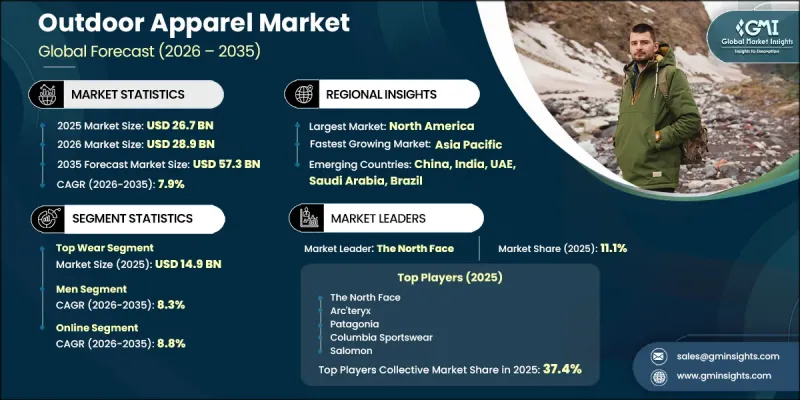
市場擴張的驅動力在於消費者對戶外休閒活動的參與度不斷提高,以及對健康、健身和整體福祉日益重視。健行、遠足、露營和其他探險活動正變得越來越主流,從而推動了對耐用、高性能戶外服裝的需求。布料技術的不斷進步也發揮著至關重要的作用,防水、防風和透氣方面的創新顯著提升了產品的功能性,滿足了消費者對高性能服裝的期望。此外,都市化和生活方式的改變促使更多人參與戶外活動,進一步推動了市場成長。社群媒體平台等數位媒體的影響力也在塑造消費者的行為,人們更多地接觸戶外生活方式和探險內容,從而提高了對戶外服裝的興趣。可支配收入的成長,尤其是在新興市場,擴大了高階戶外服裝的供應管道。永續發展趨勢正在進一步改變這個產業,消費者對環保產品的偏好日益增強,促使製造商使用回收材料和環境影響更小的生產方法,從而強化了長期差異化策略。
| 市場範圍 | |
|---|---|
| 開始年份 | 2025 |
| 預測期 | 2026-2035 |
| 上市時的市場規模 | 267億美元 |
| 預計金額 | 573億美元 |
| 複合年成長率 | 7.9% |
預計到2025年,戶外上裝市場規模將達到149億美元,並在2026年至2035年間以7.7%的複合年成長率成長。此細分市場的成長主要得益於消費者對功能多樣、經久耐用且能適應各種天氣條件的戶外上裝的需求不斷成長。健行、健行和露營等戶外活動的日益普及,持續推動著對具有防護性和功能性的上裝的需求。此外,吸濕排汗和速乾等紡織技術的進步顯著提升了服裝的舒適度和性能,進一步促進了該細分市場的擴張。
男裝市場佔50.5%的市場佔有率,預計2026年至2035年將以8.3%的複合年成長率成長。該市場的成長主要得益於男性消費者可支配收入的增加以及戶外休閒活動參與度的提高。對健行、遠足和露營等戶外活動日益成長的興趣持續推動著男性對功能性戶外服裝的穩定需求。此外,消費者對個人風格的日益關注以及對時尚戶外服裝的選擇也進一步促進了該市場的擴張。
美國戶外服飾市場佔據83%的市場佔有率,預計2025年市場規模將達到96億美元。美國市場需求受多種氣候條件的影響,這些條件塑造了不同地區戶外服裝的購買行為。戶外文化蓬勃發展的地區,例如健行、滑雪和露營參與度高的地區,戶外服飾的銷售尤其強勁。此外,隨著消費者環保意識的增強,他們越來越偏好環境永續且來源可靠的服裝。
目錄
第1章:調查方法和範圍
第2章執行摘要
第3章 行業洞察
- 產業生態系分析
- 供應商情況
- 利潤率
- 每個階段增加的價值
- 影響價值鏈的因素
- 中斷
- 影響產業的因素
- 促進因素
- 產業潛在風險與挑戰
- 機會
- 成長潛力分析
- 價格趨勢
- 對過去價格趨勢的分析
- 定價策略:按業務類型分類
- 監理框架
- PFAS法規:一項全面的區域分析
- 美國:聯邦和州級 PFAS法規結構
- 歐盟:擬議的關於REACH規則和PFAS的綜合法規
- 英國:脫歐後的化學品法規(英國 REACH)
- 日本、韓國、中國:PFAS政策的演變
- DWR(持久防水劑)化學品法規
- 歐盟綠色新政與紡織品生產者延伸責任制(EPR)
- 關於微塑膠和纖維排放的規定
- 波特五力分析
- PESTLE分析
- 貿易數據分析
- 進出口量及進口額趨勢
- 主要貿易路線及關稅的影響
- 人工智慧和生成式人工智慧對市場的影響
- 人工智慧正在改變傳統的經營模式。
- 按客戶群分類的生成式人工智慧用例和部署藍圖
- 風險、限制和監管考量
- 未來市場趨勢
- 技術與創新展望
- 最新科技趨勢
- 新興技術
- 消費行為分析
- 購買模式
- 偏好分析
- 不同地區的消費行為差異
- 電子商務對購買決策的影響
第4章 競爭情勢
- 介紹
- 企業市佔率分析
- 企業矩陣分析
- 主要市場公司的競爭分析
- 競爭定位矩陣
- 主要進展
- 併購
- 夥伴關係和聯盟
- 新產品發布
- 業務拓展計劃
第5章 市場估算與預測:依產品類型分類,2022-2035年
- 上衣
- T恤
- 夾克
- 最好的
- 其他物品(脖套、巴拉克拉法帽等)
- 下裝
- 褲子
- 短褲
- 褲子
- 貼身褲
- 其他物品(例如滑雪背帶褲)
- 其他配件
第6章 市場估計與預測:依材料分類,2022-2035年
- 合成纖維
- 聚酯纖維
- 尼龍
- 天然纖維
- 棉布
- 麻
- 竹子
- 羊毛
第7章 市場估計與預測:依消費者區隔市場分類,2022-2035年
- 男性
- 女士
- 孩子們
第8章 市場估計與預測:依價格分類,2022-2035年
- 價格低廉(200 美元以下)
- 中價位(200-500美元)
- 高價位(超過500美元)
第9章 市場估價與預測:依通路分類,2022-2035年
- 線上
- 電子商務
- 企業網站
- 離線
- 超級市場和大賣場
- 專業零售店
- 其他(例如,個體零售商)
第10章 市場估價與預測:依地區分類,2022-2035年
- 北美洲
- 美國
- 加拿大
- 歐洲
- 德國
- 英國
- 法國
- 西班牙
- 義大利
- 荷蘭
- 亞太地區
- 中國
- 日本
- 印度
- 澳洲
- 韓國
- 拉丁美洲
- 巴西
- 墨西哥
- 阿根廷
- 中東和非洲
- 南非
- 沙烏地阿拉伯
- UAE
第11章:公司簡介
- 全球主要公司
- Arc'teryx
- Black Diamond
- Columbia Sportswear
- Mammut
- Patagonia
- Salomon
- The North Face
- 當地公司
- Bergans
- Descente
- Haglofs
- Montbell
- 諾羅納
- Schoffel
- Vaude
- 新興企業和專業公司
- Cotopaxi
- Kuhl
- Mountain Hardwear
- Outdoor Research
- Picture Organic Clothing
- Rab
- Westcomb
The Global Outdoor Apparel Market was valued at USD 26.7 billion in 2025 and is estimated to grow at a CAGR of 7.9% to reach USD 57.3 billion by 2035.
Market expansion is driven by rising consumer engagement in outdoor recreation activities and a growing emphasis on health, fitness, and overall well-being. Activities such as hiking, trekking, camping, and other adventure-based pursuits are becoming increasingly mainstream, which is strengthening demand for durable, high-performance outdoor clothing. Continuous advancements in fabric technologies are also playing a crucial role, with innovations in waterproofing, wind resistance, and breathability significantly enhancing product functionality and aligning with consumer expectations for performance-oriented apparel. In addition, urbanization and evolving lifestyle patterns are encouraging more individuals to participate in outdoor activities, further supporting market growth. Digital influence through social media platforms is also shaping consumer behavior, as exposure to outdoor lifestyles and adventure content is increasing interest in outdoor apparel. Rising disposable incomes, particularly in developing economies, are expanding access to premium outdoor clothing. Sustainability trends are further reshaping the industry, with increasing consumer preference for environmentally responsible products pushing manufacturers toward recycled materials and low-impact production methods, strengthening long-term differentiation strategies.
| Market Scope | |
|---|---|
| Start Year | 2025 |
| Forecast Year | 2026-2035 |
| Start Value | $26.7 Billion |
| Forecast Value | $57.3 Billion |
| CAGR | 7.9% |
The top wear segment generated USD 14.9 billion in 2025 and is projected to grow at a CAGR of 7.7% during 2026-2035. Growth in this segment is strongly supported by rising consumer demand for versatile and durable upper-body outdoor clothing designed to perform under diverse weather conditions. Increasing participation in outdoor activities such as hiking, trekking, and camping continues to drive demand for protective and functional top wear. Additionally, advancements in textile engineering, including moisture management and rapid-drying capabilities, have significantly improved comfort and performance, further supporting segment expansion.
The men's segment held a 50.5% share and is expected to grow at a CAGR of 8.3% from 2026 to 2035. The segment's growth is supported by rising disposable income levels and increasing participation of male consumers in outdoor recreational activities. Expanding interest in hiking, trekking, and camping continues to drive consistent demand for functional outdoor apparel among men. Additionally, growing attention to personal style and fashion-oriented outdoor clothing choices is further contributing to segment expansion.
United States Outdoor Apparel Market held an 83% share, generating USD 9.6 billion in 2025. Market demand in the country is influenced by varied climatic conditions that shape regional purchasing behavior for outdoor clothing. Strong sales are observed in regions with active outdoor cultures, where participation in hiking, skiing, and camping remains high. In addition, increasing consumer preference for environmentally sustainable and responsibly sourced apparel is becoming more prominent, reflecting rising awareness of ecological impact among American consumers.
Key companies operating in the Global Outdoor Apparel Industry include Patagonia, Columbia Sportswear, The North Face, Arc'teryx, Salomon, Black Diamond, Mammut, Mountain Hardwear, Outdoor Research, Rab, KUHL, Cotopaxi, Picture Organic Clothing, Westcomb, Bergans, Descente, Haglofs, Montbell, Norrona, Schoffel, and Vaude. Companies in the outdoor apparel market are increasingly focusing on product innovation centered on high-performance and weather-adaptive fabrics that enhance durability, comfort, and protection. A major strategy involves investing in advanced textile technologies such as moisture control, thermal regulation, and lightweight insulation to improve user experience. Brands are also expanding their sustainability initiatives by incorporating recycled fibers, reducing carbon emissions, and adopting circular production models to meet rising environmental expectations. Another key approach includes strengthening direct-to-consumer distribution channels and digital retail platforms to improve brand reach and customer engagement. Companies are further leveraging lifestyle branding and outdoor community marketing to build stronger emotional connections with consumers. Strategic collaborations with athletes, influencers, and outdoor organizations are also being used to enhance brand visibility.
Table of Contents
Chapter 1 Methodology and scope
- 1.1 Research approach
- 1.2 Quality Commitments
- 1.2.1 GMI AI policy & data integrity commitment
- 1.2.1.1 Source consistency protocol
- 1.2.1 GMI AI policy & data integrity commitment
- 1.3 Research Trail & Confidence Scoring
- 1.3.1 Research Trail Components
- 1.3.2 Scoring Components
- 1.4 Data Collection
- 1.4.1 Partial list of primary sources
- 1.5 Data mining sources
- 1.5.1 Paid sources
- 1.5.1.1 Sources, by region
- 1.5.1 Paid sources
- 1.6 Base estimates and calculations
- 1.6.1 Base year calculation for any one approach
- 1.7 Forecast model
- 1.7.1 Quantified market impact analysis
- 1.7.1.1 Mathematical impact of growth parameters on forecast
- 1.7.1 Quantified market impact analysis
- 1.8 Research transparency addendum
- 1.8.1 Source attribution framework
- 1.8.2 Quality assurance metrics
- 1.8.3 Our commitment to trust
Chapter 2 Executive summary
- 2.1 Industry 360° synopsis
- 2.2 Key market trends
- 2.2.1 Regional
- 2.2.2 Product type
- 2.2.3 Material
- 2.2.4 Consumer group
- 2.2.5 Price
- 2.2.6 Distribution channel
Chapter 3 Industry insights
- 3.1 Industry ecosystem analysis
- 3.1.1 Supplier landscape
- 3.1.2 Profit margin
- 3.1.3 Value addition at each stage
- 3.1.4 Factor affecting the value chain
- 3.1.5 Disruptions
- 3.2 Industry impact forces
- 3.2.1 Growth drivers
- 3.2.2 Industry pitfalls & challenges
- 3.2.3 Opportunities
- 3.3 Growth potential analysis
- 3.4 Price trends
- 3.4.1 Historical price trend analysis
- 3.4.2 Pricing strategy by player type
- 3.5 Regulatory framework
- 3.5.1 PFAS regulation: comprehensive geographic analysis
- 3.5.2 United States: federal and state-level PFAS framework
- 3.5.3 European Union: REACH regulation and PFAS universal restriction proposal
- 3.5.4 United Kingdom: post-Brexit chemical regulation (UK REACH)
- 3.5.5 Japan, South Korea, China: PFAS policy trajectories
- 3.5.6 DWR (durable water repellent) chemical regulation
- 3.5.7 EU Green Deal & extended producer responsibility (EPR) for textiles
- 3.5.8 Microplastic and fiber shedding regulation
- 3.6 Porter's five forces analysis
- 3.7 PESTEL analysis
- 3.8 Trade data analysis (based on paid database) (HS Code: 6109)
- 3.8.1 Import/export volume & value trends
- 3.8.2 Key trade corridors & tariff impact
- 3.9 Impact of AI & generative AI on the market
- 3.9.1 AI-driven disruption of traditional business models
- 3.9.2 GenAI use cases & adoption roadmap by customer segment
- 3.9.3 Risks, limitations & regulatory considerations
- 3.10 Future market trends
- 3.11 Technology and innovation landscape
- 3.11.1 Current technological trends
- 3.11.2 Emerging technologies
- 3.12 Consumer behavior analysis
- 3.12.1 Purchasing patterns
- 3.12.2 Preference analysis
- 3.12.3 Regional variations in consumer behavior
- 3.12.4 Impact of e-commerce on buying decisions
Chapter 4 Competitive landscape, 2025
- 4.1 Introduction
- 4.2 Company market share analysis
- 4.2.1 North America
- 4.2.2 Europe
- 4.2.3 Asia Pacific
- 4.2.4 Latin America
- 4.2.5 MEA
- 4.3 Company matrix analysis
- 4.4 Competitive analysis of major market players
- 4.5 Competitive positioning matrix
- 4.6 Key developments
- 4.6.1 Mergers & acquisitions
- 4.6.2 Partnerships & collaborations
- 4.6.3 New product launches
- 4.6.4 Expansion plans
Chapter 5 Market Estimates & Forecast, By Product Type, 2022 - 2035 ($Billion, Million Units)
- 5.1 Key trends
- 5.2 Top wear
- 5.2.1 T-shirts
- 5.2.2 Jackets
- 5.2.3 Vests
- 5.2.4 Others (neck gaiters, balaclavas etc.)
- 5.3 Bottom wear
- 5.3.1 Pants
- 5.3.2 Shorts
- 5.3.3 Trousers
- 5.3.4 Leggings
- 5.3.5 Others (ski bibs etc.)
- 5.4 Other accessories
Chapter 6 Market Estimates & Forecast, By Material, 2022 - 2035 ($Billion, Million Units)
- 6.1 Key trends
- 6.2 Synthetic fabrics
- 6.2.1 Polyester
- 6.2.2 Nylon
- 6.3 Natural fabrics
- 6.3.1 Cotton fabrics
- 6.3.2 Hemp
- 6.3.3 Bamboo
- 6.3.4 Wool
Chapter 7 Market Estimates & Forecast, By Consumer Group, 2022 - 2035 ($Billion, Million Units)
- 7.1 Key trends
- 7.2 Men
- 7.3 Women
- 7.4 Kids
Chapter 8 Market Estimates & Forecast, By Price, 2022 - 2035 ($Billion, Million Units)
- 8.1 Key trends
- 8.2 Low (below USD 200)
- 8.3 Medium (USD 200 - USD 500)
- 8.4 High (USD 500 and above)
Chapter 9 Market Estimates & Forecast, By Distribution Channel, 2022 - 2035 ($Billion, Million Units)
- 9.1 Key trends
- 9.2 Online
- 9.2.1 E-commerce
- 9.2.2 Company websites
- 9.3 Offline
- 9.3.1 Supermarkets/Hypermarkets
- 9.3.2 Specialty retail stores
- 9.3.3 Others (independent retailers, etc.)
Chapter 10 Market Estimates & Forecast, By Region, 2022 - 2035 ($Billion, Million Units)
- 10.1 Key trends
- 10.2 North America
- 10.2.1 U.S.
- 10.2.2 Canada
- 10.3 Europe
- 10.3.1 Germany
- 10.3.2 UK
- 10.3.3 France
- 10.3.4 Spain
- 10.3.5 Italy
- 10.3.6 Netherlands
- 10.4 Asia Pacific
- 10.4.1 China
- 10.4.2 Japan
- 10.4.3 India
- 10.4.4 Australia
- 10.4.5 South Korea
- 10.5 Latin America
- 10.5.1 Brazil
- 10.5.2 Mexico
- 10.5.3 Argentina
- 10.6 MEA
- 10.6.1 South Africa
- 10.6.2 Saudi Arabia
- 10.6.3 UAE
Chapter 11 Company Profiles
- 11.1 Global Key Players
- 11.1.1 Arc'teryx
- 11.1.2 Black Diamond
- 11.1.3 Columbia Sportswear
- 11.1.4 Mammut
- 11.1.5 Patagonia
- 11.1.6 Salomon
- 11.1.7 The North Face
- 11.2 Regional Players
- 11.2.1 Bergans
- 11.2.2 Descente
- 11.2.3 Haglofs
- 11.2.4 Montbell
- 11.2.5 Norrøna
- 11.2.6 Schoffel
- 11.2.7 Vaude
- 11.3 Emerging/Niche Specialists
- 11.3.1 Cotopaxi
- 11.3.2 Kuhl
- 11.3.3 Mountain Hardwear
- 11.3.4 Outdoor Research
- 11.3.5 Picture Organic Clothing
- 11.3.6 Rab
- 11.3.7 Westcomb

 2026-2030年全球戶外服飾市場
 戶外服裝市場:全球市場按產品類型、材料、銷售管道、最終用戶和應用分類的預測 - 2026-2032年
 女性用戶外服飾市場:機會、成長促進因素、產業趨勢分析及預測(2026-2035年)
 2026-2030年全球戰術與戶外服飾市場
 全球戶外服飾市場規模、佔有率、趨勢和成長分析報告(2026-2034)休閒服飾市場規模、佔有率、成長及全球產業分析:按類型、應用和地區分類的洞察,2026-2034 年預測兒童休閒服飾市場規模、佔有率、成長及全球產業分析:按類型、應用和地區分類的洞察,2026-2034 年預測
 戶外服裝市場-全球產業規模、佔有率、趨勢、機會和預測,按產品類型(上衣、下裝)、最終用途(男士、女士)、配銷通路(線上、線下)、地區和競爭格局分類,2020-2030年預測休閒服市場按產品類型、材料類型、年齡層、性別、最終用途和分銷管道分類 - 全球預測,2025-2030 年高階戶外服飾市場機會、成長動力、產業趨勢分析及 2025 - 2034 年預測