

 |
市場調查報告書
商品編碼
2027517
女性用戶外服飾市場:機會、成長促進因素、產業趨勢分析及預測(2026-2035年)Women Outdoor Apparel Market Opportunity, Growth Drivers, Industry Trend Analysis, and Forecast 2026 - 2035 |
||||||

預計到 2025 年,全球女性用戶外服飾市場價值將達到 211 億美元,並以 5.8% 的複合年成長率成長,到 2035 年將達到 369 億美元。
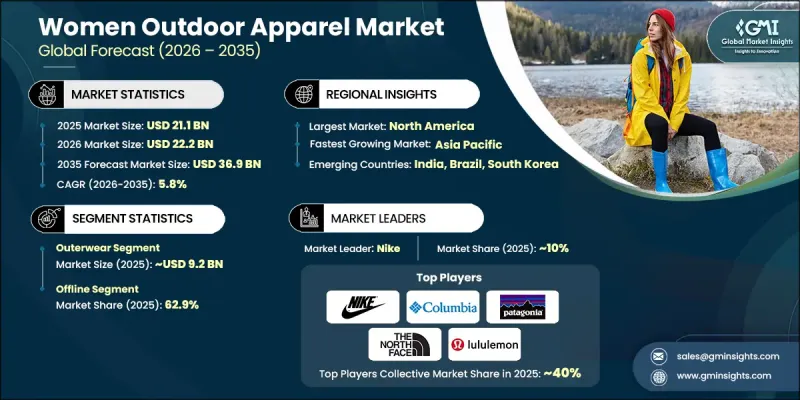
這個市場專注於功能性服裝,其設計涵蓋健行、遠足、冬季運動和探險旅行等各種戶外活動。推動其成長的因素包括女性參與戶外休閒的增加、消費者對功能性和時尚性兼顧的偏好轉變,以及對永續生產實踐的日益重視。近年來,越來越多的女性積極參與戶外活動,顯著改變了市場需求,促使品牌開發專為女性需求量身訂製的服裝。數位化平台和主導互動進一步加速了女性參與戶外活動,從而形成對創新產品的持續需求循環。永續性也是該市場的重點,企業紛紛投資於可追溯系統和先進技術,以提高透明度和確保符合道德規範的採購。這些努力正在推動循環經營模式的普及,強調耐用性、可重複使用性和負責任的生產,並引領市場走向長期成長。
| 市場範圍 | |
|---|---|
| 開始年份 | 2025 |
| 預測期 | 2026-2035 |
| 起始金額 | 211億美元 |
| 預計金額 | 369億美元 |
| 複合年成長率 | 5.8% |
預計到2025年,外套市場規模將達到92億美元,並在2026年至2035年間以5.9%的複合年成長率成長。由於外套在戶外防護中發揮著至關重要的作用,並且能夠設定較高的價格,因此它是規模最大、價值最高的細分市場。該細分市場的產品旨在提供功能性、舒適性和耐用性,並在塑造品牌形象方面具有很高的知名度和影響力。布料技術的不斷進步,例如增強了防風雨性能、提高了保暖效率以及採用了永續材料,正在推動該細分市場的成長。外套也為品牌提供了一個展示其創新和技術專長的平台,從而增強其在市場中的競爭地位。
預計到2025年,線下零售通路將佔據62.9%的市場佔有率,並在2035年之前以5.3%的複合年成長率成長。實體店仍然至關重要,因為它們在個人化客戶服務和產品評估方面具有顯著價值。消費者可以在購買前親自查看尺寸、布料品質和搭配建議,從而受益匪淺。實體店擁有知識淵博的員工和精心挑選的產品系列,持續吸引從戶外新手到資深人士的各類顧客,從而推動了該通路的持續成長。
美國女性用戶外服飾市場預計到2025年將達到68億美元,並在2026年至2035年間以5.3%的複合年成長率成長。該地區受益於成熟的戶外文化、完善的產業基礎設施以及人們對健康和積極生活方式日益成長的興趣。加拿大憑藉其廣闊的戶外休閒環境做出了重要貢獻,而墨西哥則在消費者興趣成長和經濟成長的推動下,正在崛起為新興市場。總體而言,北美市場正呈現穩定擴張的態勢,這主要得益於高階產品的供應、不斷變化的消費者偏好以及穩定的更換需求。
目錄
第1章:調查方法和範圍
第2章執行摘要
第3章業界考察
- 產業生態系分析
- 供應商情況
- 利潤率
- 每個階段增加的價值
- 影響價值鏈的因素
- 影響產業的因素
- 成長促進因素
- 女性參與戶外活動的人數增加
- 消費者偏好永續和可追溯的材料
- 電子商務和數位管道的成長
- 產業潛在風險與挑戰
- 化學物質法規及合規成本
- 原料和投入成本的波動
- 成長促進因素
- 成長潛力分析
- 未來市場趨勢
- 科技與創新趨勢
- 當前技術趨勢
- 新興技術
- 價格趨勢
- 按地區
- 依產品類型
- 監理情勢
- 標準和合規要求
- 區域法規結構
- 認證標準
- 波特五力分析
- PESTEL 分析
- 消費行為分析
- 購買模式
- 偏好分析
- 不同地區的消費行為差異
第4章 競爭情勢
- 介紹
- 企業市佔率分析
- 按地區
- 企業矩陣分析
- 主要市場公司的競爭分析
- 競爭定位矩陣
- 主要進展
- 併購
- 夥伴關係與合作
- 新產品發布
- 業務拓展計劃
第5章 市場估算與預測:依產品類型分類,2022-2035年
- 外套
- 最高額
- 底部
- 其他
第6章 市場估計與預測:依功能分類,2022-2035年
- 雨衣
- 冬季裝備
- 其他
第7章 市場估計與預測:依應用領域分類,2022-2035年
- 健行
- 露營和背包旅行
- 冬季運動
- 越野跑和戶外健身
- 休閒戶外/生活方式
- 其他
第8章 市場估算與預測:依通路分類,2022-2035年
- 線上
- 電子商務網站
- 企業網站
- 離線
- 大賣場/超級市場
- 專賣店
- 其他
第9章 市場估計與預測:依地區分類,2022-2035年
- 北美洲
- 美國
- 加拿大
- 歐洲
- 德國
- 英國
- 法國
- 義大利
- 西班牙
- 亞太地區
- 中國
- 印度
- 日本
- 韓國
- 澳洲
- 印尼
- 馬來西亞
- 拉丁美洲
- 巴西
- 墨西哥
- 阿根廷
- 中東和非洲
- 沙烏地阿拉伯
- 阿拉伯聯合大公國
- 南非
第10章:公司簡介
- Adidas
- Arc'teryx
- Columbia Sportswear
- Decathlon
- Lululemon Athletica
- Mammut
- Nike
- Outdoor Research
- Patagonia
- prAna
- Puma
- REI Co-op
- Salomon
- The North Face(VF Corporation)
- Under Armour
The Global Women Outdoor Apparel Market was valued at USD 21.1 billion in 2025 and is estimated to grow at a CAGR of 5.8% to reach USD 36.9 billion by 2035.
This market encompasses performance-driven clothing designed for a wide range of outdoor activities, including hiking, trekking, winter sports, and adventure travel. Growth is being fueled by rising female participation in outdoor recreation, evolving preferences that combine functionality with style, and increasing awareness of sustainable manufacturing practices. In recent years, more women have actively engaged in outdoor activities, significantly reshaping market demand and encouraging brands to develop specialized apparel tailored to their needs. The influence of digital platforms and community-driven engagement has further accelerated participation, creating a continuous cycle of demand for innovative products. Sustainability has also become a key focus area, with companies investing in traceability systems and advanced technologies to improve transparency and ethical sourcing. These efforts are driving the adoption of circular business models that emphasize durability, reuse, and responsible production, positioning the market for long-term growth.
| Market Scope | |
|---|---|
| Start Year | 2025 |
| Forecast Year | 2026-2035 |
| Start Value | $21.1 Billion |
| Forecast Value | $36.9 Billion |
| CAGR | 5.8% |
The outerwear segment generated USD 9.2 billion in 2025 and is expected to grow at a CAGR of 5.9% between 2026 and 2035. This category represents the largest and most valuable segment due to its essential role in outdoor protection and its ability to command premium pricing. Products in this segment are designed to deliver performance, comfort, and durability, making them highly visible and influential in shaping brand identity. Continuous advancements in fabric technologies, including improved weather resistance, insulation efficiency, and sustainable material integration, are driving segment growth. Outerwear also serves as a platform for brands to showcase innovation and technical expertise, reinforcing their competitive positioning in the market.
The offline distribution segment accounted for 62.9% share in 2025 and is anticipated to grow at a CAGR of 5.3% through 2035. Physical retail outlets remain highly relevant due to the value they provide in terms of personalized customer service and product evaluation. Consumers benefit from the ability to assess fit, material quality, and layering compatibility before making purchasing decisions. Retail environments that offer knowledgeable staff and curated product selections continue to attract both new and experienced outdoor participants, contributing to sustained demand across this channel.
United States Women Outdoor Apparel Market reached USD 6.8 billion in 2025, and is projected to grow at a CAGR of 5.3% from 2026 to 2035. The region benefits from a well-established outdoor culture, strong industry infrastructure, and a growing focus on health and active lifestyles. Canada contributes significantly due to its extensive outdoor recreation landscape, while Mexico is emerging as a developing market supported by increasing consumer interest and economic growth. Overall, the North America market demonstrates stable expansion, driven by premium product offerings, evolving consumer preferences, and consistent replacement demand.
Leading companies in the Global Women Outdoor Apparel Market include Nike, Adidas, Patagonia, The North Face (VF Corporation), Columbia Sportswear, Lululemon Athletica, Puma, Decathlon, Arc'teryx, Mammut, prAna, Salomon, Outdoor Research, Under Armour, and REI Co-op. Companies operating in the women outdoor apparel market are focusing on innovation, sustainability, and brand differentiation to strengthen their competitive position. Investments in advanced fabric technologies and eco-friendly materials enable the development of high-performance products that meet evolving consumer expectations. Strategic collaborations and partnerships help expand global reach and enhance distribution capabilities. Brands leverage digital marketing and community engagement to build strong customer loyalty and promote outdoor participation. Additionally, companies are adopting circular economy practices, including recycling programs and product lifecycle management, to align with sustainability goals. Expanding product portfolios and targeting diverse consumer segments further support market growth and long-term positioning.
Table of Contents
Chapter 1 Methodology & Scope
- 1.1 Market scope and definition
- 1.2 Research design
- 1.2.1 Research approach
- 1.2.2 Data collection methods
- 1.3 Data mining sources
- 1.3.1 Global
- 1.3.2 Regional/Country
- 1.4 Base estimates and calculations
- 1.4.1 Base year calculation
- 1.4.2 Key trends for market estimation
- 1.5 Primary research and validation
- 1.5.1 Primary sources
- 1.6 Forecast model
- 1.7 Research assumptions and limitations
Chapter 2 Executive Summary
- 2.1 Industry 360° synopsis
- 2.2 Key market trends
- 2.2.1 Regional
- 2.2.2 Product type
- 2.2.3 Functionality
- 2.2.4 End use
- 2.2.5 Distribution channel
Chapter 3 Industry Insights
- 3.1 Industry ecosystem analysis
- 3.1.1 Supplier landscape
- 3.1.2 Profit margin
- 3.1.3 Value addition at each stage
- 3.1.4 Factor affecting the value chain
- 3.2 Industry impact forces
- 3.2.1 Growth drivers
- 3.2.1.1 Rising outdoor participation among women
- 3.2.1.2 Consumer preference for sustainable, traceable materials
- 3.2.1.3 Growth of e-commerce and digital channels
- 3.2.2 Industry pitfalls & challenges
- 3.2.2.1 Chemical regulation and compliance costs
- 3.2.2.2 Raw material and input volatility
- 3.2.1 Growth drivers
- 3.3 Growth potential analysis
- 3.4 Future market trends
- 3.5 Technology and innovation landscape
- 3.5.1 Current technological trends
- 3.5.2 Emerging technologies
- 3.6 Price trends
- 3.6.1 By region
- 3.6.2 By product type
- 3.7 Regulatory landscape
- 3.7.1 Standards and compliance requirements
- 3.7.2 Regional regulatory frameworks
- 3.7.3 Certification standards
- 3.8 Porter's analysis
- 3.9 PESTEL analysis
- 3.10 Consumer behavior analysis
- 3.10.1 Purchasing patterns
- 3.10.2 Preference analysis
- 3.10.3 Regional variations in consumer behavior
Chapter 4 Competitive Landscape, 2025
- 4.1 Introduction
- 4.2 Company market share analysis
- 4.2.1 By Region
- 4.2.1.1 North America
- 4.2.1.2 Europe
- 4.2.1.3 Asia Pacific
- 4.2.1.4 Latin America
- 4.2.1.5 Middle East & Africa
- 4.2.1 By Region
- 4.3 Company matrix analysis
- 4.4 Competitive analysis of major market players
- 4.5 Competitive positioning matrix
- 4.6 Key developments
- 4.6.1 Mergers & acquisitions
- 4.6.2 Partnerships & collaborations
- 4.6.3 New product launches
- 4.6.4 Expansion plans
Chapter 5 Market Estimates & Forecast, By Product Type, 2022 - 2035, (USD Billion) (Units)
- 5.1 Key trends
- 5.2 Outerwear
- 5.3 Tops
- 5.4 Bottoms
- 5.5 Others
Chapter 6 Market Estimates & Forecast, By Functionality, 2022 - 2035, (USD Billion) (Units)
- 6.1 Key trends
- 6.2 Rain gear
- 6.3 Winter gear
- 6.4 Others
Chapter 7 Market Estimates & Forecast, By End Use, 2022 - 2035, (USD Billion) (Units)
- 7.1 Key trends
- 7.2 Hiking & trekking
- 7.3 Camping & backpacking
- 7.4 Winter Sports
- 7.5 Trail running & outdoor fitness
- 7.6 Casual outdoor/lifestyle
- 7.7 Others
Chapter 8 Market Estimates & Forecast, By Distribution Channel, 2022 - 2035, (USD Billion) (Units)
- 8.1 Key trends
- 8.2 Online
- 8.2.1 E-commerce websites
- 8.2.2 Company websites
- 8.3 Offline
- 8.3.1 Hypermarket/Supermarket
- 8.3.2 Specialty stores
- 8.3.3 Others
Chapter 9 Market Estimates & Forecast, By Region, 2022 - 2035, (USD Billion) (Units)
- 9.1 Key trends
- 9.2 North America
- 9.2.1 U.S.
- 9.2.2 Canada
- 9.3 Europe
- 9.3.1 Germany
- 9.3.2 UK
- 9.3.3 France
- 9.3.4 Italy
- 9.3.5 Spain
- 9.4 Asia Pacific
- 9.4.1 China
- 9.4.2 India
- 9.4.3 Japan
- 9.4.4 South Korea
- 9.4.5 Australia
- 9.4.6 Indonesia
- 9.4.7 Malaysia
- 9.5 Latin America
- 9.5.1 Brazil
- 9.5.2 Mexico
- 9.5.3 Argentina
- 9.6 MEA
- 9.6.1 Saudi Arabia
- 9.6.2 UAE
- 9.6.3 South Africa
Chapter 10 Company Profiles
- 10.1 Adidas
- 10.2 Arc'teryx
- 10.3 Columbia Sportswear
- 10.4 Decathlon
- 10.5 Lululemon Athletica
- 10.6 Mammut
- 10.7 Nike
- 10.8 Outdoor Research
- 10.9 Patagonia
- 10.10 prAna
- 10.11 Puma
- 10.12 REI Co-op
- 10.13 Salomon
- 10.14 The North Face (VF Corporation)
- 10.15 Under Armour

 2026-2030年全球戶外服飾市場
 戶外服裝市場:全球市場按產品類型、材料、銷售管道、最終用戶和應用分類的預測 - 2026-2032年
 2026-2030年全球戰術與戶外服飾市場
 全球戶外服飾市場規模、佔有率、趨勢和成長分析報告(2026-2034)休閒服飾市場規模、佔有率、成長及全球產業分析:按類型、應用和地區分類的洞察,2026-2034 年預測兒童休閒服飾市場規模、佔有率、成長及全球產業分析:按類型、應用和地區分類的洞察,2026-2034 年預測
 戶外服裝市場-全球產業規模、佔有率、趨勢、機會和預測,按產品類型(上衣、下裝)、最終用途(男士、女士)、配銷通路(線上、線下)、地區和競爭格局分類,2020-2030年預測
 戶外服飾市場機會、成長促進因素、產業趨勢分析及預測(2025-2034年)休閒服市場按產品類型、材料類型、年齡層、性別、最終用途和分銷管道分類 - 全球預測,2025-2030 年高階戶外服飾市場機會、成長動力、產業趨勢分析及 2025 - 2034 年預測