

 |
市場調查報告書
商品編碼
2061349
乳墊市場機會、成長要素、產業趨勢分析及2026-2035年預測。Breast Pads Market Opportunity, Growth Drivers, Industry Trend Analysis, and Forecast 2026 - 2035 |
||||||

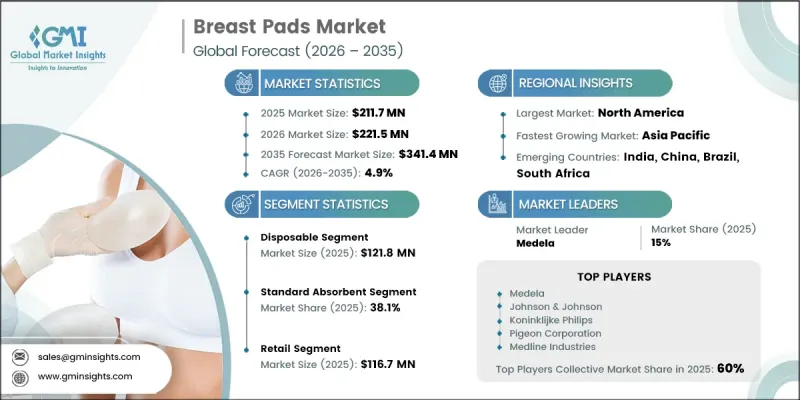
2025年全球乳墊市場規模預計為2.117億美元,預計到2035年將以4.9%的複合年成長率成長至3.414億美元。
母乳哺育市場的成長主要得益於人們對母乳哺育益處的認知不斷提高、女性在全球勞動市場中的參與度不斷增強、政府為意識提升而提供的支持,以及人們對自然母乳哺育方式日益成長的偏好。此外,生活方式的改變和產後護理的日益普及也推動了相關產品在全球範圍內的穩定成長。哺乳墊被廣泛認為是產後必備的衛生用品,旨在吸收滲漏的乳汁,確保哺乳期間的舒適度。這些產品通常佩戴在哺乳胸罩內,用於控制兩次哺乳之間以及泌乳反射期間的乳汁分泌。哺乳墊採用柔軟、高吸水性和透氣性材質製成,有助於保持肌膚乾爽,減少肌膚刺激,並防止衣物沾染乳汁。它們在提升哺乳期間的舒適度、衛生性和自信心方面發揮著重要作用,使其成為產後護理的關鍵要素。隨著越來越多的母親在哺乳期間更加注重便利性和衛生,對隱藏、舒適且高吸水性產品的需求持續成長,從而推動了市場擴張。
| 市場範圍 | |
|---|---|
| 開始年份 | 2025 |
| 預測期 | 2026-2035 |
| 初始市場規模 | 2.117億美元 |
| 預測金額 | 3.414億美元 |
| 複合年成長率 | 4.9% |
預計到2025年,一次性哺乳墊市場規模將達到1.218億美元。一次性哺乳墊專為單次使用而設計,因其便利、衛生且易於處理而廣受歡迎。它們非常適合產後日常護理,因為它們能夠確保性能穩定,同時降低污染風險。哺乳媽媽們對無需清洗或重複使用的便捷衛生哺乳解決方案的需求不斷成長,推動了一次性哺乳墊日益普及。
到2025年,標準吸收型產品將佔據38.1%的市場。這些產品因其卓越的吸水性能而廣受歡迎,有助於在哺乳期間保持清潔和舒適。標準吸收型產品通常被添加到基本款哺乳墊的設計中,並因其能夠有效吸收水分並保護皮膚而備受青睞。價格實惠和易於獲取也進一步推動了其受歡迎程度,尤其受到注重成本、尋求可靠的日常哺乳用品的消費者的青睞。
預計到2025年,北美哺乳墊市佔率將達到33.9%。這一區域主導地位得益於其強大且完善的零售分銷網路,包括超級市場、母嬰用品店、便利商店和線上零售平台。這個廣泛的分銷網路確保了消費者能夠便捷地購買到產品。此外,全部區域較高的可支配收入水準也促使消費者選擇優質、舒適、高品質的哺乳產品,從而進一步推動了市場的持續成長。
目錄
第1章:調查方法
第2章執行摘要
第3章 行業洞察
- 產業生態系分析
- 影響產業的因素
- 促進因素
- 新手媽媽對母乳哺育的認知和需求都在不斷提高。
- 提高全球女性就業率
- 政府是否有任何旨在意識提升的措施?
- 自然育兒方法的日益普及
- 產業潛在風險與挑戰
- 對各種哺乳衛生用品的了解程度較低。
- 永續性和環境議題
- 市場機遇
- 透過電子商務及D2C通路拓展業務
- 促進因素
- 成長潛力分析
- 監理情勢
- 北美洲
- 歐洲
- 亞太地區
- 科技趨勢
- 最新技術
- 高吸收率多層芯材技術
- 曲面與超薄設計技術
- 新興技術
- 具有抗菌和pH調節功能的纖維技術
- 環保和可生物分解材料的創新
- 最新技術
- 未來市場趨勢
- 價格趨勢分析
- 人工智慧和生成式人工智慧對市場的影響
- 波特的分析
- PESTLE分析
- 差距分析
第4章 競爭情勢
- 介紹
- 企業市佔率分析
- 北美洲
- 歐洲
- 亞太地區
- 企業矩陣分析
- 主要市場公司的競爭分析
- 競爭定位矩陣
- 主要進展
- 併購
- 夥伴關係和聯盟
- 新產品發布
- 業務拓展計劃
第5章 市場估算與預測:依產品類型分類,2022-2035年
- 拋棄式的
- 可重複使用的
第6章 市場估計與預測:依材料分類,2022-2035年
- 標準吸收材料
- 水凝膠
- 織物底材
- 矽酮
第7章 市場估計與預測:依應用領域分類,2022-2035年
- 個人使用
- 醫院及婦產科診所
第8章 市場估算與預測:依通路分類,2022-2035年
- 零售
- 批發的
- 電子商務
第9章 市場估計與預測:依地區分類,2022-2035年
- 北美洲
- 美國
- 加拿大
- 歐洲
- 德國
- 英國
- 法國
- 西班牙
- 義大利
- 荷蘭
- 亞太地區
- 中國
- 日本
- 印度
- 澳洲
- 韓國
- 拉丁美洲
- 巴西
- 墨西哥
- 阿根廷
- 中東和非洲
- 南非
- 沙烏地阿拉伯
- UAE
第10章:公司簡介
- Ameda
- Cache Coeur
- Cardinal Health
- Johnson &Johnson
- Kindred Bravely
- Koninklijke Philips
- LatchPad(daLAIT)
- LilyPadz
- MAM Baby
- Medela
- Medline Industries
- MOOGCO
- Newell Brands(NUK USA)
- Pigeon Corporation
- Yoboo
The Global Breast Pads Market was valued at USD 211.7 million in 2025 and is estimated to grow at a CAGR of 4.9% to reach USD 341.4 million by 2035.
The market growth is driven by increasing awareness of breastfeeding benefits, rising participation of women in the global workforce, supportive government initiatives aimed at improving maternal health awareness, and the growing preference for natural infant feeding practices. In addition, evolving lifestyle patterns and higher emphasis on postpartum care are contributing to steady product adoption worldwide. Breast pads are widely recognized as essential maternal hygiene products designed to absorb breast milk leakage and ensure comfort during lactation. These products are typically worn inside nursing bras to manage milk flow between feeding sessions and during let-down reflexes. Manufactured using soft, highly absorbent, and breathable materials, they help maintain skin dryness, reduce irritation, and prevent clothing stains. Their role in enhancing comfort, hygiene, and confidence during breastfeeding makes them an important component of postpartum care. Increasing demand for discreet, comfortable, and highly absorbent solutions continues to support market expansion as more mothers prioritize convenience and hygiene during the breastfeeding period.
| Market Scope | |
|---|---|
| Start Year | 2025 |
| Forecast Year | 2026-2035 |
| Start Value | $211.7 Million |
| Forecast Value | $341.4 Million |
| CAGR | 4.9% |
The disposable segment held generated USD 121.8 million in 2025. Disposable breast pads are designed for single-use applications and are widely preferred due to their convenience, hygiene benefits, and ease of disposal. They help reduce contamination risks while ensuring consistent performance, making them highly suitable for everyday maternal care usage. Their growing preference among nursing mothers is supported by rising demand for hassle-free and hygienic breastfeeding solutions that eliminate the need for washing or reuse.
The standard absorbent segment held a 38.1% share in 2025. These products are widely used due to their effective fluid absorption capabilities, helping maintain cleanliness and comfort during breastfeeding. Standard absorbent materials are commonly incorporated into basic breast pad designs and are valued for their ability to manage moisture efficiently while supporting skin protection. Their affordability and easy availability further enhance their adoption, particularly among cost-conscious consumers seeking reliable everyday breastfeeding support.
North America Breast Pads Market accounted for a share of 33.9% in 2025. The region's dominance is supported by a strong and well-developed retail distribution network that includes supermarkets, maternity specialty outlets, convenience stores, and online retail platforms. This extensive availability ensures easy product access for consumers. In addition, higher disposable income levels across the region encourage the adoption of premium, comfortable, and high-quality breastfeeding products, further supporting sustained market growth.
Key companies operating in the Global Breast Pads Market include Koninklijke Philips, Johnson & Johnson, Medela, Cardinal Health, Pigeon Corporation, Medline Industries, Ameda, Newell Brands (NUK USA), Cache Coeur, Kindred Bravely, MOOGCO, Yoboo, LatchPad (daLAIT), and Lily Padz. Companies operating in the breast pads market are actively focusing on expanding their product portfolios by introducing advanced, skin-friendly, and highly absorbent materials that improve comfort and leakage protection. A major strategy involves increasing investment in product innovation, including breathable fabrics, eco-friendly materials, and ergonomically designed shapes that enhance user convenience. Market players are also strengthening their presence through strategic partnerships with maternity clinics, hospitals, and retail distributors to improve product accessibility. In addition, expanding e-commerce distribution channels has become a key focus area, enabling brands to reach a wider consumer base. Companies are also emphasizing brand positioning through awareness campaigns that highlight breastfeeding benefits and maternal care importance. Furthermore, competitive pricing strategies combined with premium product segmentation are being used to target diverse consumer groups and strengthen long-term market penetration.
Table of Contents
Chapter 1 Research Methodology
- 1.1 Research approach
- 1.2 Quality commitments
- 1.2.1 GMI AI policy & data integrity commitment
- 1.2.1.1 Source consistency protocol
- 1.2.1 GMI AI policy & data integrity commitment
- 1.3 Research trail & confidence scoring
- 1.3.1 Research trail components
- 1.3.2 Scoring components
- 1.4 Data collection
- 1.4.1 Partial list of primary sources
- 1.5 Data mining sources
- 1.5.1 Paid sources
- 1.5.1.1 Sources, by region
- 1.5.1 Paid sources
- 1.6 Base estimates and calculations
- 1.6.1 Base year calculation for any one approach
- 1.7 Forecast model
- 1.7.1 Quantified market impact analysis
- 1.7.1.1 Mathematical impact of growth parameters on forecast
- 1.7.1 Quantified market impact analysis
- 1.8 Research transparency addendum
- 1.8.1 Source attribution framework
- 1.8.2 Quality assurance metrics
- 1.8.3 Our commitment to trust
Chapter 2 Executive Summary
- 2.1 Industry 360° synopsis
- 2.1.1 Key market trends
- 2.1.2 Product type trends
- 2.1.3 Material trends
- 2.1.4 Application trends
- 2.1.5 Distribution channel trends
- 2.2 CXO perspectives: Strategic imperatives
Chapter 3 Industry Insights
- 3.1 Industry ecosystem analysis
- 3.2 Industry impact forces
- 3.2.1 Growth drivers
- 3.2.1.1 Increasing awareness and demand for breastfeeding among new mothers
- 3.2.1.2 Increasing global women employment rates
- 3.2.1.3 Presence of government initiatives aimed at improving consumer awareness levels
- 3.2.1.4 Growing popularity of natural feeding
- 3.2.2 Industry pitfalls and challenges
- 3.2.2.1 Lack of awareness about various breastfeeding hygiene products
- 3.2.2.2 Sustainability and environmental concerns
- 3.2.3 Market opportunity
- 3.2.3.1 Expansion through e-commerce and direct-to-consumer channels
- 3.2.1 Growth drivers
- 3.3 Growth potential analysis
- 3.4 Regulatory landscape (Driven by Primary Research)
- 3.4.1 North America
- 3.4.2 Europe
- 3.4.3 Asia Pacific
- 3.5 Technological landscape (Driven by Primary Research)
- 3.5.1 Current technologies
- 3.5.1.1 High-absorbency multi-layer core technology
- 3.5.1.2 Contoured and ultra-thin design technology
- 3.5.2 Emerging technologies
- 3.5.2.1 Antimicrobial and pH-regulating fabric technology
- 3.5.2.2 Eco-friendly and biodegradable material innovation
- 3.5.1 Current technologies
- 3.6 Future market trends (Driven by Primary Research)
- 3.7 Pricing trend analysis (Driven by Primary Research)
- 3.8 Impact of AI and Generative AI on the market (Driven by Primary Research)
- 3.9 Porter’s analysis
- 3.10 PESTEL analysis
- 3.11 Gap analysis
Chapter 4 Competitive Landscape, 2025
- 4.1 Introduction
- 4.2 Company market share analysis
- 4.2.1 North America
- 4.2.2 Europe
- 4.2.3 Asia Pacific
- 4.3 Company matrix analysis
- 4.4 Competitive analysis of major market players
- 4.5 Competitive positioning matrix
- 4.6 Key developments
- 4.6.1 Merger and acquisition
- 4.6.2 Partnership and collaboration
- 4.6.3 New product launches
- 4.6.4 Expansion plans
Chapter 5 Market Estimates and Forecast, By Product Type, 2022 - 2035 ($ Mn)
- 5.1 Key trends
- 5.2 Disposable
- 5.3 Reusable
Chapter 6 Market Estimates and Forecast, By Material, 2022 - 2035 ($ Mn)
- 6.1 Key trends
- 6.2 Standard absorbent
- 6.3 Hydrogel
- 6.4 Fabric-based
- 6.5 Silicone
Chapter 7 Market Estimates and Forecast, By Application, 2022 - 2035 ($ Mn)
- 7.1 Key trends
- 7.2 Personal use
- 7.3 Hospitals and maternity clinics
Chapter 8 Market Estimates and Forecast, By Distribution Channel, 2022 - 2035 ($ Mn)
- 8.1 Key trends
- 8.2 Retail
- 8.3 Wholesale
- 8.4 E-commerce
Chapter 9 Market Estimates and Forecast, By Region, 2022 - 2035 ($ Mn)
- 9.1 Key trends
- 9.2 North America
- 9.2.1 U.S.
- 9.2.2 Canada
- 9.3 Europe
- 9.3.1 Germany
- 9.3.2 UK
- 9.3.3 France
- 9.3.4 Spain
- 9.3.5 Italy
- 9.3.6 Netherlands
- 9.4 Asia Pacific
- 9.4.1 China
- 9.4.2 Japan
- 9.4.3 India
- 9.4.4 Australia
- 9.4.5 South Korea
- 9.5 Latin America
- 9.5.1 Brazil
- 9.5.2 Mexico
- 9.5.3 Argentina
- 9.6 Middle East and Africa
- 9.6.1 South Africa
- 9.6.2 Saudi Arabia
- 9.6.3 UAE
Chapter 10 Company Profiles
- 10.1 Ameda
- 10.2 Cache Coeur
- 10.3 Cardinal Health
- 10.4 Johnson & Johnson
- 10.5 Kindred Bravely
- 10.6 Koninklijke Philips
- 10.7 LatchPad (daLAIT)
- 10.8 LilyPadz
- 10.9 MAM Baby
- 10.10 Medela
- 10.11 Medline Industries
- 10.12 MOOGCO
- 10.13 Newell Brands (NUK USA)
- 10.14 Pigeon Corporation
- 10.15 Yoboo

 乳房保護罩市場 - 全球產業規模、佔有率、趨勢、機會和預測:銷售管道(醫院藥房、零售店、電子商務、批發商/分銷商、直接購買)、地區和競爭格局分類,2021-2031年護理用品市場-全球產業規模、佔有率、趨勢、機會與預測:按類型、地區和競爭對手分類,2021-2031年
 乳墊市場規模、佔有率和成長分析:按產品類型、材料、銷售管道、吸收性、價格範圍和地區分類-2026-2033年產業預測
 乳房假體殼市場:2026-2032年全球市場預測(按產品類型、材料類型、應用、最終用戶和分銷管道分類)母乳哺育用品市場:2026-2032年全球市場預測(依產品種類、材質、價格範圍、銷售管道及應用分類)
 全球護理用品市場規模、佔有率、趨勢和成長分析報告(2026-2034)
 2026年全球母乳哺育產品市場報告2026年全球護理用品市場報告全球母乳哺育產品市場規模、佔有率、趨勢和成長分析報告(2026-2034年)護理按摩器市場 - 全球產業規模、佔有率、趨勢、機會、預測:按類型、應用、分銷管道、地區和競爭格局分類,2021-2031年