


 |
市場調查報告書
商品編碼
2061286
2026 年至 2035 年商用車輛車隊維修服務市場的商業機會、成長要素、產業趨勢分析與預測。Commercial Vehicle Fleet Maintenance Services Market Opportunity, Growth Drivers, Industry Trend Analysis, and Forecast 2026 - 2035 |
||||||

預計到 2025 年,全球商用車輛車隊維修服務市場價值將達到 1,256 億美元,並預計以 6.4% 的複合年成長率成長,到 2035 年達到 2,342 億美元。
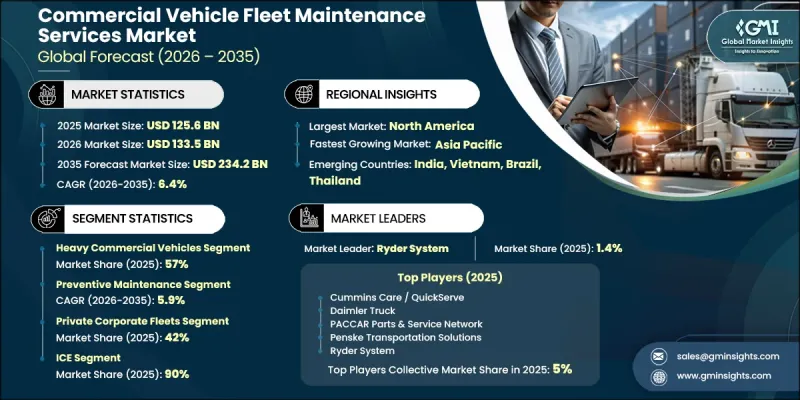
市場成長主要得益於整個運輸和物流網路中商用車的日益普及以及全球貨運量的成長。電子商務的蓬勃發展和末端配送生態系統的快速發展顯著提升了車隊運轉率。同時,遠端資訊處理和聯網汽車技術的引入增強了即時監控能力,從而實現了更高效的維護計劃和營運最佳化。車隊營運商越來越重視預防性和預測性維護方法,以減少停機時間並確保服務連續性。行動維護解決方案和現場維修服務的日益普及進一步強化了市場需求。此外,電動商用車的引進也帶來了與電池系統、電力電子設備和高級診斷相關的新維護需求,進一步豐富了整個產業的服務需求。
| 市場範圍 | |
|---|---|
| 開始年份 | 2025 |
| 預測期 | 2026-2035 |
| 初始市場規模 | 1256億美元 |
| 預測金額 | 2342億美元 |
| 複合年成長率 | 6.4% |
預計到2025年,重型商用車市佔率將達到57%,並在2026年至2035年間以5.8%的複合年成長率成長。其主導地位源自於重型商用車在長途運輸和重型貨物裝卸作業中的廣泛應用,與輕型車輛相比,重型商用車磨損更大,維護要求也更複雜。為了確保營運效率並符合性能標準,重型商用車需要頻繁維護引擎、煞車系統、變速箱、輪胎和排放氣體控制部件等關鍵系統。隨著對重型運輸資產依賴性的增加,全球市場對重型商用車的持續維護需求也不斷成長。
到2025年,企業所擁有車市佔率將達到42%。這主要得益於車輛在物流、零售配送、工業活動、建設活動和電子商務供應鏈中的廣泛應用。這些車輛高度依賴系統化的維護保養計劃,以最大限度地減少營運中斷並提高車輛可靠性。全球公路貨運的高利用率持續推動著對維護保養服務的持續需求,尤其是對於那些專注於提高配送效率和最佳化成本的私營企業運營的商用貨車、卡車和多用途車輛而言。
預計2025年,美國商用車輛車隊維修服務市場規模將達392億美元,市佔率高達85%。推動美國市場擴張的主要因素包括貨運量的成長、電子商務出貨量的成長以及物流和配送網路的持續擴張。全美各地的車隊營運商正擴大採用預防性維護框架,以減少停機時間並提高生產效率。遠端資訊處理系統和預測性維護的整合進一步提升了車隊營運中維護工作的準確性和營運管理水準。
目錄
第1章:調查方法
第2章執行摘要
第3章 行業洞察
- 產業生態系分析
- 供應商情況
- 利潤率分析
- 成本結構
- 每個階段增加的價值
- 影響價值鏈的因素
- 中斷
- 影響產業的因素
- 促進因素
- 貨運和物流網路的擴展
- 擴大遠端資訊處理和預測性維護的應用
- 車輛維修服務外包增加
- 電子商務的擴張和最後一公里配送活動的活性化
- 產業潛在風險與挑戰
- 勞動力和工程師嚴重短缺
- 備件和先進診斷設備的成本不斷上漲
- 市場機遇
- 電動商用車維修服務的成長
- 擴展移動車輛維護解決方案
- 人工智慧與預測分析的融合
- 促進因素
- 成長潛力分析
- 技術與創新展望
- 最新科技趨勢
- 新興技術
- 價格分析
- 對過去價格趨勢的分析
- 定價策略:按業務類型分類
- 監理情勢
- 北美洲
- FMCSA 第 396 部分州際維修與保養規定
- 美國運輸部(US DOT)商用車輛定期檢驗標準
- OSHA 29 CFR 1910 維修車間安全與合規
- 美國環保署第609輛汽車空調認證
- 加拿大運輸部國家安全標準(NSC)第11號標準
- 歐洲
- 歐盟道路適用性指令 2014/45/EU 關於技術檢驗
- 歐盟關於車輛和零件市場監管的第2018/858號法規
- 歐6和歐7排放氣體系統維護要求
- 關於危險液體和電池處置的廢棄物框架指令
- 歐盟第二輪流動性方案:數位設備和行車記錄器法規
- 亞太地區
- 中國GB 18565技術安全與維護標準
- 中國汽車維修保養企業管理條例
- 印度 CMVR 和 BS-VI 排氣和引擎合規標準
- 日本的「車輛檢驗」:強制性定期車輛檢驗
- 澳洲國家重型車輛檢驗手冊(NHVIM)
- 拉丁美洲
- 巴西 CONTRAN 強制性定期技術檢驗 (ITV)
- 墨西哥 NOM-068-SCT 物理和機械安全標準
- 阿根廷貨運公司對貨運車輛進行強制性技術檢驗
- 智利第156號法令:預防性維護與檢查規程
- 南方共同市場跨境運輸的技術操作合格
- 中東和非洲
- 沙烏地阿拉伯 SASO 服務中心認證和備件要求
- 阿拉伯聯合大公國ESMA商用車輛安全技術法規
- 南非道路運輸管理系統(RTMS)標準
- 卡達 GSO 42/2015 車輛定期檢驗條例
- 北美洲
- 波特的分析
- PESTLE分析
- 專利分析
- 成本細分分析
- 人工智慧和生成式人工智慧對市場的影響
- 利用人工智慧改造現有經營模式
- 按細分市場分類的生成式人工智慧用例和部署藍圖
- 風險、限制和監管考量
- 永續性和環境方面
- 永續計劃
- 減少廢棄物策略
- 生產中的能源效率
- 具有環保意識的舉措
- 考慮碳足跡
- 預測假設和情境分析
- 基本案例:驅動複合年成長率的關鍵宏觀經濟與產業變量
- 樂觀情境:宏觀經濟與產業的順風
- 悲觀情景:宏觀經濟放緩或產業逆風
第4章 競爭情勢
- 介紹
- 企業市佔率分析
- 北美洲
- 歐洲
- 亞太地區
- LATAM
- 中東和非洲
- 主要市場公司的競爭分析
- 競爭定位矩陣
- 主要進展
- 併購
- 夥伴關係和聯盟
- 新產品發布
- 業務拓展計劃及資金籌措
- 按公司規模進行基準測試
- 排名分類標準與遴選標準
- 按銷售額、地區和創新能力分類的層級定位矩陣。
第5章 市場估價與預測:依車輛類型分類,2022-2035年
- 輕型商用車(LCV)
- 皮卡車
- 貨車
- 廂型車
- 其他
- 中型商用車(MCV)
- 中型卡車
- 廂型車
- 平板車
- 其他
- 重型商用車(HCV)
- 大型卡車
- 牽引式半拖車/半掛卡車
- 公車和公共交通
- 其他
第6章 市場估計與預測:依服務業分類,2022-2035年
- 預防性維護
- 預測性保護
- 汽車修理廠的碰撞維修
- 緊急維修和糾正性維修
- 輪胎、煞車片、電池、潤滑油
- 其他
第7章 市場估算與預測:按類型分類的車隊擁有量,2022-2035年
- 私人公司擁有的車輛
- 政府所有的車輛
- 租賃公司
- 行動服務供應商
- 其他
第8章 市場估算與預測:依促進因素分類,2022-2035年
- 內燃機
- 電的
- 混合
第9章 市場估算與預測:依服務提供者分類,2022-2035年
- 內部/專屬式研討會
- 外包服務供應商
- 行動/現場服務
- 混合模式
第10章 市場估價與預測:依地區分類,2022-2035年
- 北美洲
- 美國
- 加拿大
- 歐洲
- 德國
- 英國
- 法國
- 義大利
- 西班牙
- 俄羅斯
- 挪威
- 荷蘭
- 瑞典
- 亞太地區
- 中國
- 印度
- 日本
- 澳洲
- 韓國
- 新加坡
- 泰國
- 印尼
- 越南
- 拉丁美洲
- 巴西
- 墨西哥
- 阿根廷
- 中東和非洲
- 南非
- 沙烏地阿拉伯
- UAE
- 土耳其
第11章:公司簡介
- 世界公司
- Cummins
- Daimler Truck
- Isuzu Motors
- IVECO
- MAN Truck & Bus
- PACCAR
- Penske Transportation Solutions
- 當地公司
- Ryder System
- Scania
- Volvo
- Holman(ARI Fleet Services)
- Element Fleet Management
- Enterprise Fleet Management
- Ashok Leyland
- Al-Futtaim Motors Fleet Services
- Grupo Comfortrans
- 新興企業
- Fleetio
- Ridecell
- OTONOMO
- Mahindra Last Mile Mobility(MLLM)
The Global Commercial Vehicle Fleet Maintenance Services Market was valued at USD 125.6 billion in 2025 and is estimated to grow at a CAGR of 6.4% to reach USD 234.2 billion by 2035.
The market growth is supported by the rising deployment of commercial vehicles across transportation and logistics networks, along with increasing freight movement volumes worldwide. Expanding e-commerce activities and the rapid development of last-mile delivery ecosystems are significantly boosting fleet utilization rates. At the same time, the adoption of telematics and connected vehicle technologies is enhancing real-time monitoring, enabling more efficient maintenance scheduling and operational optimization. Fleet operators are increasingly prioritizing preventive and predictive maintenance approaches to reduce downtime and ensure uninterrupted service continuity. The rising penetration of mobile maintenance solutions and on-site repair services is further strengthening market demand. Additionally, the integration of electric commercial vehicles is introducing new maintenance requirements related to battery systems, power electronics, and advanced diagnostics, further diversifying service needs across the sector.
| Market Scope | |
|---|---|
| Start Year | 2025 |
| Forecast Year | 2026-2035 |
| Start Value | $125.6 Billion |
| Forecast Value | $234.2 Billion |
| CAGR | 6.4% |
The heavy commercial vehicles segment held a 57% share in 2025 and is forecast to grow at a CAGR of 5.8% between 2026 and 2035. This dominance is attributed to their extensive usage in long-distance transportation and freight-heavy operations, which results in higher wear and tear and more complex servicing requirements compared to lighter vehicle categories. These vehicles require frequent upkeep of critical systems including engines, braking assemblies, transmissions, tires, and emission control components to ensure operational efficiency and compliance with performance standards. The growing dependency on heavy-duty transportation assets continues to reinforce consistent maintenance demand across global markets.
The private corporate fleets segment accounted for 42% share in 2025, driven by widespread fleet deployment across logistics, retail distribution, industrial operations, construction activities, and e-commerce supply chains. These fleets depend heavily on structured maintenance programs to minimize operational disruptions and enhance vehicle reliability. The high utilization of road-based freight transport globally continues to generate sustained demand for maintenance services, particularly for commercial vans, trucks, and utility vehicles operated by private enterprises focused on delivery efficiency and cost optimization.
United States Commercial Vehicle Fleet Maintenance Services Market held a share 85% of generating USD 39.2 billion in 2025. Market expansion in the country is supported by rising freight transportation activity, growing e-commerce shipments, and the continuous scaling of logistics and distribution networks. Fleet operators across the country are increasingly adopting preventive maintenance frameworks to reduce downtime and improve productivity. The integration of telematics systems and predictive diagnostics is further enhancing maintenance precision and operational control across fleet operations.
Major participants in the Global Commercial Vehicle Fleet Maintenance Services Market include Cummins, Daimler Truck, Element Fleet Management, Holman, MAN Truck & Bus, PACCAR, Penske Transportation Solutions, Ryder System, Scania, and Volvo. Companies operating in the commercial vehicle fleet maintenance services market are actively strengthening their market position through multiple strategic initiatives. A key approach includes expanding digital fleet management capabilities supported by telematics, IoT-based monitoring systems, and predictive analytics tools that enable real-time diagnostics and proactive maintenance scheduling. Market players are also focusing on building integrated service networks by expanding mobile repair units, authorized service centers, and on-site maintenance solutions to improve service accessibility and reduce vehicle downtime. Strategic partnerships with logistics providers, fleet operators, and technology firms are further helping companies enhance service efficiency and broaden customer reach. In addition, organizations are investing in workforce training programs to address the growing complexity of modern vehicle systems, especially electric and connected fleets.
Table of Contents
Chapter 1 Research Methodology
- 1.1 Research approach
- 1.2 Quality Commitments
- 1.2.1 GMI AI policy & data integrity commitment
- 1.2.1.1 Source consistency protocol
- 1.2.1 GMI AI policy & data integrity commitment
- 1.3 Research Trail & Confidence Scoring
- 1.3.1 Research Trail Components
- 1.3.2 Scoring Components
- 1.4 Data Collection
- 1.4.1 Partial list of primary sources
- 1.5 Data mining sources
- 1.5.1 Paid sources
- 1.5.1.1 Sources, by region
- 1.5.1 Paid sources
- 1.6 Base estimates and calculations
- 1.6.1 Base year calculation for any one approach
- 1.7 Forecast model
- 1.7.1 Quantified market impact analysis
- 1.7.1.1 Mathematical impact of growth parameters on forecast
- 1.7.1 Quantified market impact analysis
- 1.8 Research transparency addendum
- 1.8.1 Source attribution framework
- 1.8.2 Quality assurance metrics
- 1.8.3 Our commitment to trust
Chapter 2 Executive Summary
- 2.1 Industry 360° synopsis, 2022 - 2035
- 2.2 Key market trends
- 2.2.1 Regional
- 2.2.2 Vehicle
- 2.2.3 Service
- 2.2.4 Fleet Ownership
- 2.2.5 Propulsion
- 2.2.6 Service Delivery
- 2.3 TAM Analysis, 2026-2035
- 2.4 CXO perspectives: Strategic imperatives
Chapter 3 Industry Insights
- 3.1 Industry ecosystem analysis
- 3.1.1 Supplier landscape
- 3.1.2 Profit margin analysis
- 3.1.3 Cost structure
- 3.1.4 Value addition at each stage
- 3.1.5 Factor affecting the value chain
- 3.1.6 Disruptions
- 3.2 Industry impact forces
- 3.2.1 Growth drivers
- 3.2.1.1 Expansion of freight transportation and logistics networks
- 3.2.1.2 Growing adoption of telematics and predictive diagnostics
- 3.2.1.3 Increasing outsourcing of fleet maintenance operations
- 3.2.1.4 Rising ecommerce and last mile delivery activity
- 3.2.2 Industry pitfalls and challenges
- 3.2.2.1 High labor and technician shortage
- 3.2.2.2 Rising costs of spare parts and advanced diagnostics equipment
- 3.2.3 Market opportunities
- 3.2.3.1 Growth in electric commercial vehicle maintenance services
- 3.2.3.2 Expansion of mobile fleet maintenance solutions
- 3.2.3.3 Integration of artificial intelligence and predictive analytics
- 3.2.1 Growth drivers
- 3.3 Growth potential analysis
- 3.4 Technology and innovation landscape
- 3.4.1 Current technological trends
- 3.4.2 Emerging technologies
- 3.5 Pricing Analysis (Driven by primary research)
- 3.5.1 Historical Price Trend Analysis
- 3.5.2 Pricing Strategy by Player Type
- 3.6 Regulatory landscape
- 3.6.1 North America
- 3.6.1.1 FMCSA Part 396 interstate repair and maintenance mandates
- 3.6.1.2 U.S. DOT periodic commercial vehicle inspection standards
- 3.6.1.3 OSHA 29 CFR 1910 service shop safety and compliance
- 3.6.1.4 EPA Section 609 motor vehicle air conditioning certifications
- 3.6.1.5 Transport Canada National Safety Code (NSC) Standard 11
- 3.6.2 Europe
- 3.6.2.1 EU Roadworthiness Directive 2014/45/EU for technical inspections
- 3.6.2.2 EU Regulation 2018/858 on vehicle and part market surveillance
- 3.6.2.3 Euro 6 and Euro 7 emission system maintenance requirements
- 3.6.2.4 Waste Framework Directive for hazardous fluid and battery disposal
- 3.6.2.5 EU Mobility Package II digital maintenance and tachograph rules
- 3.6.3 Asia Pacific
- 3.6.3.1 China GB 18565 technical safety and maintenance standards
- 3.6.3.2 China Administration of Automobile Maintenance and Repair Industry regulations
- 3.6.3.3 India CMVR and BS-VI exhaust/engine compliance standards
- 3.6.3.4 Japan "Shaken" mandatory periodic vehicle inspections
- 3.6.3.5 Australia National Heavy Vehicle Inspection Manual (NHVIM)
- 3.6.4 Latin America
- 3.6.4.1 Brazil CONTRAN mandatory periodic technical inspections (ITV)
- 3.6.4.2 Mexico NOM-068-SCT physical-mechanical safety standards
- 3.6.4.3 Argentina RTO mandatory technical review for freight transport
- 3.6.4.4 Chile Decree 156 preventive maintenance and inspection protocols
- 3.6.4.5 Mercosur technical roadworthiness for cross-border transport
- 3.6.5 Middle East & Africa
- 3.6.5.1 Saudi SASO workshop certifications and spare part requirements
- 3.6.5.2 UAE ESMA technical regulations for commercial vehicle safety
- 3.6.5.3 South Africa Road Transport Management System (RTMS) standards
- 3.6.5.4 Qatar GSO 42/2015 motor vehicle periodic inspection rules
- 3.6.1 North America
- 3.7 Porter's analysis
- 3.8 PESTEL analysis
- 3.9 Patent analysis (Driven by primary research)
- 3.10 Cost breakdown analysis
- 3.11 Impact of AI and Generative AI on the Market
- 3.11.1 AI Driven Disruption of Existing Business Models
- 3.11.2 GenAI Use Cases and Adoption Roadmap by Segment
- 3.11.3 Risks Limitations and Regulatory Considerations
- 3.12 Sustainability and environmental aspects
- 3.12.1 Sustainable practices
- 3.12.2 Waste reduction strategies
- 3.12.3 Energy efficiency in production
- 3.12.4 Eco-friendly Initiatives
- 3.12.5 Carbon footprint considerations
- 3.13 Forecast assumptions & scenario analysis (Driven by Primary Research)
- 3.13.1 Base Case- Key Macro & Industry Variables Driving CAGR
- 3.13.2 Optimistic Scenarios- Favorable macro and industry tailwinds
- 3.13.3 Pessimistic Scenario - Macroeconomic slowdown or industry headwinds
Chapter 4 Competitive Landscape, 2025
- 4.1 Introduction
- 4.2 Company market share analysis
- 4.2.1 North America
- 4.2.2 Europe
- 4.2.3 Asia Pacific
- 4.2.4 LATAM
- 4.2.5 MEA
- 4.3 Competitive analysis of major market players
- 4.4 Competitive positioning matrix
- 4.5 Key developments
- 4.5.1 Mergers & acquisitions
- 4.5.2 Partnerships & collaborations
- 4.5.3 New Product Launches
- 4.5.4 Expansion Plans and funding
- 4.6 Company tier benchmarking
- 4.6.1 Tier classification criteria & qualifying thresholds
- 4.6.2 Tier positioning matrix by revenue, geography & innovation
Chapter 5 Market Estimates & Forecast, By Vehicle, 2022 - 2035 (USD Mn)
- 5.1 Key trends
- 5.2 Light Commercial Vehicles (LCV)
- 5.2.1 Pickup Trucks
- 5.2.2 Cargo Vans
- 5.2.3 Panel Vans
- 5.2.4 Others
- 5.3 Medium Commercial Vehicles (MCV)
- 5.3.1 Medium-Duty Trucks
- 5.3.2 Box Trucks
- 5.3.3 Flatbed Trucks
- 5.3.4 Others
- 5.4 Heavy Commercial Vehicles (HCV)
- 5.4.1 Heavy-Duty Trucks
- 5.4.2 Tractor-Trailers / Semi-Trucks
- 5.4.3 Buses & Public Transport
- 5.4.4 Others
Chapter 6 Market Estimates & Forecast, By Service, 2022 - 2035 (USD Mn)
- 6.1 Key trends
- 6.2 Preventive Maintenance
- 6.3 Predictive Maintenance
- 6.4 Body-shop Collision Repairs
- 6.5 Emergency/Corrective Repairs
- 6.6 Tires, Brakes, Batteries & Lubricants
- 6.7 Others
Chapter 7 Market Estimates & Forecast, By Fleet Ownership, 2022 - 2035 (USD Mn)
- 7.1 Key trends
- 7.2 Private Corporate Fleets
- 7.3 Government Fleets
- 7.4 Rental and Leasing Companies
- 7.5 Mobility Service Providers
- 7.6 Others
Chapter 8 Market Estimates & Forecast, By Propulsion, 2022 - 2035 (USD Mn)
- 8.1 Key trends
- 8.2 ICE
- 8.3 Electric
- 8.4 Hybrid
Chapter 9 Market Estimates & Forecast, By Service Delivery, 2022 - 2035 (USD Mn)
- 9.1 Key trends
- 9.2 In-House/Captive Workshops
- 9.3 Outsourced Service Providers
- 9.4 Mobile/On-Site Services
- 9.5 Hybrid Models
Chapter 10 Market Estimates & Forecast, By Region, 2022 - 2035 (USD Mn)
- 10.1 Key trends
- 10.2 North America
- 10.2.1 US
- 10.2.2 Canada
- 10.3 Europe
- 10.3.1 Germany
- 10.3.2 UK
- 10.3.3 France
- 10.3.4 Italy
- 10.3.5 Spain
- 10.3.6 Russia
- 10.3.7 Norway
- 10.3.8 Netherlands
- 10.3.9 Sweden
- 10.4 Asia Pacific
- 10.4.1 China
- 10.4.2 India
- 10.4.3 Japan
- 10.4.4 Australia
- 10.4.5 South Korea
- 10.4.6 Singapore
- 10.4.7 Thailand
- 10.4.8 Indonesia
- 10.4.9 Vietnam
- 10.5 Latin America
- 10.5.1 Brazil
- 10.5.2 Mexico
- 10.5.3 Argentina
- 10.6 MEA
- 10.6.1 South Africa
- 10.6.2 Saudi Arabia
- 10.6.3 UAE
- 10.6.4 Turkey
Chapter 11 Company Profiles
- 11.1 Global Players
- 11.1.1 Cummins
- 11.1.2 Daimler Truck
- 11.1.3 Isuzu Motors
- 11.1.4 IVECO
- 11.1.5 MAN Truck & Bus
- 11.1.6 PACCAR
- 11.1.7 Penske Transportation Solutions
- 11.2 Regional Players
- 11.2.1 Ryder System
- 11.2.2 Scania
- 11.2.3 Volvo
- 11.2.4 Holman (ARI Fleet Services)
- 11.2.5 Element Fleet Management
- 11.2.6 Enterprise Fleet Management
- 11.2.7 Ashok Leyland
- 11.2.8 Al-Futtaim Motors Fleet Services
- 11.2.9 Grupo Comfortrans
- 11.3 Emerging Players
- 11.3.1 Fleetio
- 11.3.2 Ridecell
- 11.3.3 OTONOMO
- 11.3.4 Mahindra Last Mile Mobility (MLLM)

 充氣式起重袋市場-2026-2032年全球市場預測汽車維修保養服務市場:2026-2032年全球市場預測(依服務類型、提供者類型、範圍、收入模式、車輛類型和客戶類型分類)
 全球車輛車隊維護和服務市場規模、佔有率、趨勢和成長分析報告(2026-2034年)
 汽車維修保養服務市場分析及預測(至2035年):依類型、產品類型、服務、技術、組件、應用、流程、最終使用者、設備及解決方案分類
 2026-2030年全球汽車維修保養服務市場
 搭乘用電動車維修服務市場:商機、成長要素、產業趨勢分析及2026-2035年預測汽車電池再生服務市場機會、成長促進因素、產業趨勢分析及2026-2035年預測2026 年至 2035 年商業按需車輛維修市場的商業機會、成長要素、產業趨勢分析與預測。電動車維修服務市場規模、佔有率、成長、全球產業分析、區域趨勢及2026-2034年預測乘用車車隊維護與服務市場:商業機會、成長要素、產業趨勢分析及2026-2035年預測