

 |
市場調查報告書
商品編碼
2045848
無菌醫療包裝市場機會、成長要素、產業趨勢分析及2026年至2035年預測。Sterile Medical Packaging Market Opportunity, Growth Drivers, Industry Trend Analysis, and Forecast 2026 - 2035 |
||||||

2025年全球無菌醫療包裝市場價值為709億美元,預計2035年將以11%的複合年成長率成長至1,969億美元。
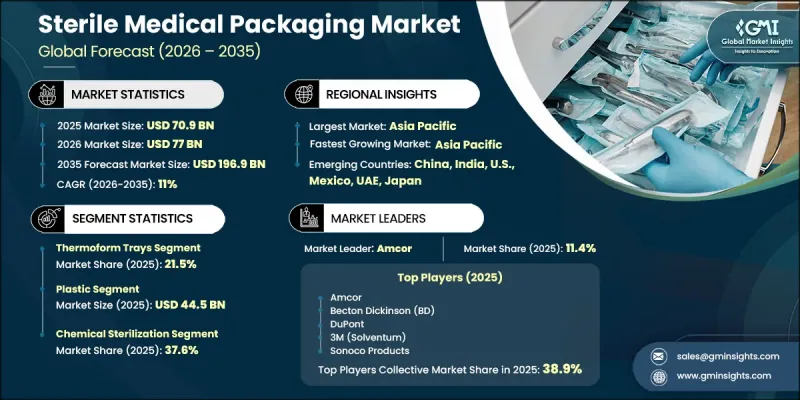
無菌醫療包裝產業的整體成長主要受以下因素驅動:一次性醫療產品的日益普及、全球外科手術數量的增加以及有關消毒和病人安全的醫療法規日益嚴格。藥品、生技藥品和先進醫療設備產量的增加也顯著促進了市場擴張。醫療服務提供者和製造商越來越重視能夠確保產品在整個分銷和儲存過程中得到保護、防止污染並延長保存期限的包裝解決方案。對即用型無菌醫療產品日益成長的需求進一步加速了先進包裝材料和技術的應用。此外,主要經濟體醫療系統對感染預防和供應鏈可靠性的日益重視,也持續推動了對高性能無菌包裝解決方案的需求。醫療包裝技術的不斷創新,加上醫療基礎設施的擴建和藥品生產活動的增加,預計將支持全球無菌醫療包裝市場的長期發展。
| 市場範圍 | |
|---|---|
| 開始年份 | 2025 |
| 預測期 | 2026-2035 |
| 上市時的市場規模 | 709億美元 |
| 預計金額 | 1969億美元 |
| 複合年成長率 | 11% |
隨著全球慢性病發生率的上升,無菌醫療包裝市場持續成長。需要長期治療、手術和高級醫療程序的患者數量不斷增加,推動了對無菌醫療設備、植入式產品、診斷工具和一次性醫療用品的需求。醫療品質標準的提高和法規結構的加強進一步提升了整個醫療行業檢驗的無菌屏障包裝系統的需求。此外,製藥和生物製藥生產的擴張,以及一次性醫療產品和預組裝醫療包的日益普及,也推動了對能夠確保產品在整個供應鏈中完整性的可靠無菌包裝解決方案的需求。
預計到2025年,熱成型托盤市佔率將達到21.5%。市場對熱成型托盤的強勁需求源自於其在包裝易碎、高價值醫療產品方面的廣泛應用,這些產品需要強而有力的保護和無菌環境。熱成型托盤的設計柔軟性、與各種滅菌製程的兼容性以及高效的儲存性能,持續推動其在醫療設備製造領域的應用。熱成型托盤在運輸、搬運和儲存過程中對敏感醫療產品的保護能力,進一步鞏固了其市場地位。
以滅菌方法分類,預計2025年,化學滅菌將佔據37.6%的市場。此細分市場的成長主要得益於其與多種材料的兼容性以及在處理複雜醫療產品和溫度敏感材料方面的高效性。低溫滅菌技術在大規模醫療設備加工上的日益普及,也持續推動醫療和製藥業對化學滅菌包裝解決方案的需求。
預計到2025年,北美無菌醫療包裝市佔率將達到37.5%。區域市場成長主要得益於先進的醫療基礎設施、醫療設備領域的強勁創新以及外科手術量的增加。北美成熟的製藥和醫療製造業持續對支援大規模生產和分銷活動的無菌包裝系統產生巨大需求。此外,公共和私營部門加大投資,旨在加強製藥生產能力並提高醫療供應鏈的韌性,這也有助於全部區域市場的持續擴張。
目錄
第1章:調查方法和範圍
第2章執行摘要
第3章:行業洞察
- 工業生態系分析
- 供應商情況
- 利潤率
- 成本結構
- 每個階段增加的價值
- 影響價值鏈的因素
- 中斷
- 影響產業的因素
- 促進因素
- 慢性病和手術數量增加
- 更嚴格的法規和品質合規要求
- 擴大製藥和生物製藥生產
- 一次性醫療設備和預包裝試劑盒的成長
- 人們越來越關注醫療機構中的感染預防問題
- 產業潛在風險與挑戰
- 受監管的無菌包裝材料高成本且結構複雜。
- 與滅菌適用性和驗證計畫相關的操作挑戰。
- 市場機遇
- 新興市場醫療保健基礎設施的擴建
- 擴大滅菌和包裝外包
- 促進因素
- 成長潛力分析
- 監理情勢
- 北美洲
- 歐洲
- 亞太地區
- 拉丁美洲
- 中東和非洲
- 波特的分析
- PESTLE分析
- 技術與創新展望
- 最新科技趨勢
- 新技術
- 價格趨勢
- 按地區
- 依產品
- 定價策略
- 新興經營模式
- 合規要求
- 專利和智慧財產權分析
第4章 競爭情勢
- 介紹
- 企業市佔率分析
- 按地區
- 北美洲
- 歐洲
- 亞太地區
- 拉丁美洲
- 中東和非洲
- 市場集中度分析
- 按地區
- 主要公司的競爭標竿分析
- 財務績效比較
- 收入
- 利潤率
- R&D
- 產品系列比較
- 產品線寬度
- 科技
- 創新
- 區域擴張比較
- 全球擴張分析
- 服務網路覆蓋
- 按地區分類的市場滲透率
- 競爭定位矩陣
- 領導者
- 挑戰者
- 追蹤者
- 利基參與企業
- 戰略展望矩陣
- 併購
- 夥伴關係和聯盟
- 技術進步
- 擴張和投資策略
- 數位轉型計劃
- 財務績效比較
- 新興企業競爭公司和新創企業的發展趨勢
第5章 市場估算與預測:依產品類型分類,2022-2035年
- 熱成型
- 裹
- 已消毒的瓶子和容器
- 水泡蛤殼
- 預填充式注射器
- 管瓶和安瓿
- 包包
- 瓶蓋和封口
- 其他
第6章 市場估計與預測:依材料分類,2022-2035年
- 金屬
- 防鏽的
- 鋁箔
- 塑膠
- PVC
- 聚丙烯
- 聚酯纖維
- 聚苯乙烯
- 聚碳酸酯
- HDPE
- 紙張和紙板
- 玻璃
- 其他
第7章 市場估算與預測:依滅菌方法分類,2022-2035年
- 高溫高壓滅菌
- 化學滅菌
- 放射線殺菌
第8章 市場估計與預測:依應用領域分類,2022-2035年
- 體外診斷產品
- 藥品和生技藥品
- 醫療植入
- 外科和醫療器械
- 其他
第9章 市場估計與預測:依地區分類,2022-2035年
- 北美洲
- 美國
- 加拿大
- 歐洲
- 德國
- 英國
- 法國
- 西班牙
- 義大利
- 俄羅斯
- 亞太地區
- 中國
- 印度
- 日本
- 澳洲
- 韓國
- 拉丁美洲
- 巴西
- 墨西哥
- 阿根廷
- 中東和非洲
- 南非
- 沙烏地阿拉伯
- 阿拉伯聯合大公國
第10章:公司簡介
- 全球主要公司
- Amcor
- Becton Dickinson(BD)
- DuPont
- 3M(Solventum)
- Sonoco Products
- 該地區的主要公司
- 北美洲
- Winpak
- Tekni-Plex
- Oliver Healthcare Packaging
- UFP MedTech
- ProAmpac
- Spectrum Plastics Group
- PPC Flex
- 亞太地區
- Sigma Medical Supplies
- 歐洲
- Gerresheimer
- Constantia Flexibles
- Billerud
- Nelipak
- Middle East & Africa
- Sterilmedipac
- 北美洲
- 小眾參與企業和顛覆者
- Technipaq
The Global Sterile Medical Packaging Market was valued at USD 70.9 billion in 2025 and is estimated to grow at a CAGR of 11% to reach USD 196.9 billion by 2035.
Growth across the sterile medical packaging industry is driven by the increasing adoption of disposable medical products, rising surgical procedures worldwide, and stricter healthcare regulations related to sterility and patient safety. The growing production of pharmaceuticals, biologics, and advanced medical devices is also contributing significantly to market expansion. Healthcare providers and manufacturers are increasingly prioritizing packaging solutions that ensure product protection, contamination prevention, and extended shelf life throughout distribution and storage processes. Rising demand for ready-to-use sterile healthcare products is further accelerating the adoption of advanced packaging materials and technologies. In addition, healthcare systems across major economies are placing stronger emphasis on infection prevention and supply chain reliability, creating sustained demand for high-performance sterile packaging solutions. Continuous innovation in medical packaging technologies, combined with expanding healthcare infrastructure and growing pharmaceutical manufacturing activities, is expected to support long-term development of the global sterile medical packaging market.
| Market Scope | |
|---|---|
| Start Year | 2025 |
| Forecast Year | 2026-2035 |
| Start Value | $70.9 Billion |
| Forecast Value | $196.9 Billion |
| CAGR | 11% |
The sterile medical packaging market continues to gain momentum due to the increasing prevalence of chronic medical conditions worldwide. Growing numbers of patients requiring long-term treatments, surgeries, and advanced medical procedures are driving demand for sterile medical equipment, implantable products, diagnostic tools, and disposable healthcare supplies. Rising healthcare quality standards and tightening regulatory frameworks are further increasing the need for validated sterile barrier packaging systems across the medical industry. In addition, expansion in pharmaceutical and biologics manufacturing, along with the increasing adoption of single-use medical products and preassembled healthcare kits, is creating higher demand for dependable sterile packaging solutions capable of maintaining product integrity throughout the supply chain.
The thermoform trays segment accounted for 21.5% share in 2025. Strong demand for thermoformed trays is attributed to their extensive use in packaging delicate and high-value medical products that require rigid protection and sterility assurance. Their design flexibility, compatibility with various sterilization processes, and efficient storage capabilities continue to support widespread adoption across medical device manufacturing operations. The ability of thermoform trays to protect sensitive healthcare products during transportation, handling, and storage further strengthens their market position.
Based on sterilization type, the chemical sterilization segment held a 37.6% share in 2025. Segment growth is primarily driven by broad material compatibility and the effectiveness of chemical sterilization methods in processing complex medical products and temperature-sensitive materials. The increasing utilization of low-temperature sterilization technologies for large-scale medical device processing continues to support demand for chemically sterilized packaging solutions across the healthcare and pharmaceutical industries.
North America Sterile Medical Packaging Market captured 37.5% share in 2025. Regional market growth is being supported by advanced healthcare infrastructure, strong innovation in medical devices, and rising surgical procedure volumes. The well-established pharmaceutical and healthcare manufacturing sector across North America continues to generate substantial demand for sterile packaging systems that support large-scale production and distribution activities. In addition, increasing investments from both public and private sectors aimed at strengthening pharmaceutical manufacturing capacity and improving healthcare supply chain resilience are contributing to continued market expansion throughout the region.
Key companies operating in the Global Sterile Medical Packaging Market include Amcor, Becton Dickinson (BD), Gerresheimer, 3M, Winpak, Sonoco Products, Constantia Flexibles, Tekni-Plex, Oliver Healthcare Packaging, UFP MedTech, Nelipak, Proampac, Billerud, Spectrum Plastics Group, PPC Flex, Technipaq, Sterilmedipac, Sigma Medical Supplies, and DuPont. Companies operating in the sterile medical packaging market are implementing several strategic initiatives to strengthen their market presence and improve long-term competitiveness. Leading manufacturers are investing heavily in research and development to introduce innovative packaging materials with improved sterility protection, sustainability, and durability. Many companies are also expanding manufacturing capacities and strengthening regional distribution networks to address growing global healthcare demand. Strategic mergers, acquisitions, and partnerships with pharmaceutical and medical device manufacturers are helping businesses broaden their product portfolios and enhance customer reach. In addition, organizations are increasingly focusing on sustainable and recyclable packaging solutions to align with evolving environmental regulations and healthcare sustainability goals.
Table of Contents
Chapter 1 Methodology and Scope
- 1.1 Market scope and definition
- 1.2 Research design
- 1.2.1 Research approach
- 1.2.2 Data collection methods
- 1.3 Data mining sources
- 1.3.1 Global
- 1.3.2 Regional/Country
- 1.4 Base estimates and calculations
- 1.4.1 Base year calculation
- 1.4.2 Key trends for market estimation
- 1.5 Primary research and validation
- 1.5.1 Primary sources
- 1.6 Forecast model
- 1.7 Research assumptions and limitations
Chapter 2 Executive Summary
- 2.1 Industry 360° synopsis, 2022 - 2035
- 2.2 Key market trends
- 2.2.1 Product type trends
- 2.2.2 Material trends
- 2.2.3 Sterilization method trends
- 2.2.4 Application trends
- 2.2.5 Regional trends
- 2.3 TAM Analysis, 2026-2035
- 2.4 CXO perspectives: Strategic imperatives
Chapter 3 Industry Insights
- 3.1 Industry ecosystem analysis
- 3.1.1 Supplier Landscape
- 3.1.2 Profit Margin
- 3.1.3 Cost structure
- 3.1.4 Value addition at each stage
- 3.1.5 Factor affecting the value chain
- 3.1.6 Disruptions
- 3.2 Industry impact forces
- 3.2.1 Growth drivers
- 3.2.1.1 Rising prevalence of chronic diseases and surgeries.
- 3.2.1.2 Stricter regulatory and quality compliance requirements
- 3.2.1.3 Expansion of pharmaceutical and biologics manufacturing
- 3.2.1.4 Growth of single-use medical devices and pre-packaged kits
- 3.2.1.5 Rising focus on infection prevention in healthcare settings
- 3.2.2 Industry pitfalls and challenges
- 3.2.2.1 High cost and complexity of compliant sterile packaging materials
- 3.2.2.2 Operational challenges linked to sterilization compatibility and validation timelines
- 3.2.3 Market opportunities
- 3.2.3.1 Expansion of healthcare infrastructure in emerging markets
- 3.2.3.2 Growing outsourcing of sterilization and packaging operations
- 3.2.1 Growth drivers
- 3.3 Growth potential analysis
- 3.4 Regulatory landscape
- 3.4.1 North America
- 3.4.2 Europe
- 3.4.3 Asia Pacific
- 3.4.4 Latin America
- 3.4.5 Middle East & Africa
- 3.5 Porter's analysis
- 3.6 PESTEL analysis
- 3.7 Technology and Innovation landscape
- 3.7.1 Current technological trends
- 3.7.2 Emerging technologies
- 3.8 Price trends
- 3.8.1 By region
- 3.8.2 By product
- 3.9 Pricing Strategies
- 3.10 Emerging Business Models
- 3.11 Compliance Requirements
- 3.12 Patent and IP analysis
Chapter 4 Competitive Landscape, 2025
- 4.1 Introduction
- 4.2 Company market share analysis
- 4.2.1 By region
- 4.2.1.1 North America
- 4.2.1.2 Europe
- 4.2.1.3 Asia Pacific
- 4.2.1.4 Latin America
- 4.2.1.5 Middle East & Africa
- 4.2.2 Market concentration analysis
- 4.2.1 By region
- 4.3 Competitive benchmarking of key players
- 4.3.1 Financial performance comparison
- 4.3.1.1 Revenue
- 4.3.1.2 Profit margin
- 4.3.1.3 R&D
- 4.3.2 Product portfolio comparison
- 4.3.2.1 Product range breadth
- 4.3.2.2 Technology
- 4.3.2.3 Innovation
- 4.3.3 Geographic presence comparison
- 4.3.3.1 Global footprint analysis
- 4.3.3.2 Service network coverage
- 4.3.3.3 Market penetration by region
- 4.3.4 Competitive positioning matrix
- 4.3.4.1 Leaders
- 4.3.4.2 Challengers
- 4.3.4.3 Followers
- 4.3.4.4 Niche players
- 4.3.5 Strategic outlook matrix
- 4.3.1 Financial performance comparison
- 4.4 Key developments
- 4.4.1 Mergers and acquisitions
- 4.4.2 Partnerships and collaborations
- 4.4.3 Technological advancements
- 4.4.4 Expansion and investment strategies
- 4.4.5 Digital transformation initiatives
- 4.5 Emerging/ startup competitors landscape
Chapter 5 Market Estimates and Forecast, By Product Type, 2022 - 2035 (USD Million)
- 5.1 Key trends
- 5.2 Thermoform trays
- 5.3 Wraps
- 5.4 Sterile bottles & containers
- 5.5 Blister & clamshells
- 5.6 Pre-filled syringes
- 5.7 Vials & ampoules
- 5.8 Bags
- 5.9 Closures
- 5.10 Others
Chapter 6 Market Estimates and Forecast, By Material, 2022 - 2035 (USD Million)
- 6.1 Key trends
- 6.2 Metal
- 6.2.1 Stainless steel
- 6.2.2 Aluminum foil
- 6.3 Plastic
- 6.3.1 PVC
- 6.3.2 Polypropylene
- 6.3.3 Polyester
- 6.3.4 Polystyrene
- 6.3.5 Polycarbonate
- 6.3.6 HDPE
- 6.4 Paper & paperboard
- 6.5 Glass
- 6.6 Others
Chapter 7 Market Estimates and Forecast, By Sterilization Method, 2022 - 2035 (USD Million)
- 7.1 Key trends
- 7.2 High Temperature / pressure sterilization
- 7.3 Chemical sterilization
- 7.4 Radiation sterilization
Chapter 8 Market Estimates and Forecast, By Application, 2022 - 2035 (USD Million)
- 8.1 Key trends
- 8.2 In vitro diagnostic products
- 8.3 Pharmaceutical & biological
- 8.4 Medical implants
- 8.5 Surgical & medical instruments
- 8.6 Other
Chapter 9 Market Estimates and Forecast, By Region, 2022 - 2035 (USD Million)
- 9.1 Key trends
- 9.2 North America
- 9.2.1 U.S.
- 9.2.2 Canada
- 9.3 Europe
- 9.3.1 Germany
- 9.3.2 UK
- 9.3.3 France
- 9.3.4 Spain
- 9.3.5 Italy
- 9.3.6 Russia
- 9.4 Asia Pacific
- 9.4.1 China
- 9.4.2 India
- 9.4.3 Japan
- 9.4.4 Australia
- 9.4.5 South Korea
- 9.5 Latin America
- 9.5.1 Brazil
- 9.5.2 Mexico
- 9.5.3 Argentina
- 9.6 Middle East and Africa
- 9.6.1 South Africa
- 9.6.2 Saudi Arabia
- 9.6.3 UAE
Chapter 10 Company Profiles
- 10.1 Global Key Players
- 10.1.1 Amcor
- 10.1.2 Becton Dickinson (BD)
- 10.1.3 DuPont
- 10.1.4 3M (Solventum)
- 10.1.5 Sonoco Products
- 10.2 Regional key players
- 10.2.1 North America
- 10.2.1.1 Winpak
- 10.2.1.2 Tekni-Plex
- 10.2.1.3 Oliver Healthcare Packaging
- 10.2.1.4 UFP MedTech
- 10.2.1.5 ProAmpac
- 10.2.1.6 Spectrum Plastics Group
- 10.2.1.7 PPC Flex
- 10.2.2 Asia Pacific
- 10.2.2.1 Sigma Medical Supplies
- 10.2.3 Europe
- 10.2.3.1 Gerresheimer
- 10.2.3.2 Constantia Flexibles
- 10.2.3.3 Billerud
- 10.2.3.4 Nelipak
- 10.2.4 Middle East & Africa
- 10.2.4.1 Sterilmedipac
- 10.2.1 North America
- 10.3 Niche Players/Disruptors
- 10.3.1 Technipaq

 全球無菌醫療包裝市場規模、佔有率、趨勢和成長分析報告(2026-2034年)
 無菌醫療包裝市場:2026-2032年全球市場預測(按產品類型、滅菌方法、材料、最終用戶、應用和分銷管道分類)
 無菌醫療包裝市場分析及預測(至2035年):依類型、材質、產品類型、應用、技術、最終用戶、製程及設備分類無菌醫療包裝市場規模、佔有率、成長及全球產業分析:按類型、應用和地區分類,並提供2026-2034年的洞察和預測
 無菌醫療包裝:市場佔有率分析、產業趨勢與統計、成長預測(2026-2031)
 2026年全球無菌醫療包裝市場報告
 無菌醫療包裝市場-全球產業規模、佔有率、趨勢、機會及預測(按類型、材料、滅菌方法、應用、地區和競爭格局分類),2021-2031年醫用包裝薄膜市場(依材料類型、包裝類型、滅菌方式、應用領域和最終用戶分類)-全球預測,2026-2032年
 無菌醫療包裝市場規模、佔有率和成長分析(按材料、類型、滅菌方法、應用和地區分類)—產業預測(2026-2033 年)
 醫療包裝市場規模、佔有率和成長分析(按類型、材料、應用、最終用戶和地區分類)-2026-2033年產業預測