


 |
市場調查報告書
商品編碼
2045786
自主海洋航行器市場:商業機會、成長要素、產業趨勢分析及2026-2035年預測Autonomous Marine Vehicle Market Opportunity, Growth Drivers, Industry Trend Analysis, and Forecast 2026 - 2035 |
||||||

全球自主海洋航行器市場預計到 2025 年將價值 35 億美元,預計到 2035 年將以 11.6% 的複合年成長率成長至 108 億美元。
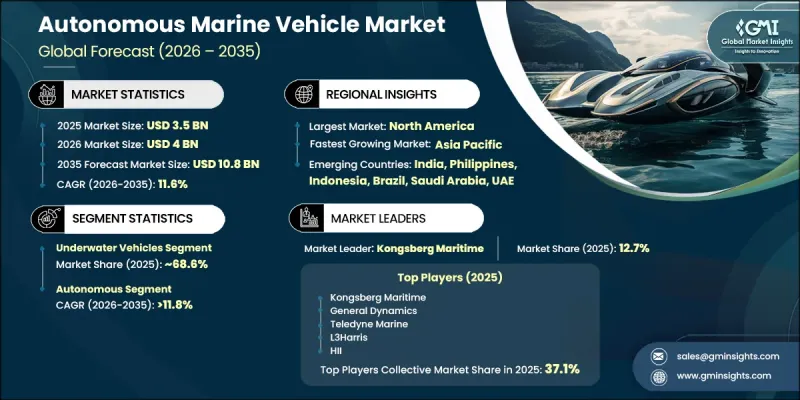
在對無人海洋任務日益成長的需求以及人工智慧、感測器融合和水下通訊系統不斷進步的推動下,隨著海上作業自動化程度的提高,該行業正經歷著快速的技術變革。隨著能夠以最小的人為干預執行複雜任務的自主和半自動平台的普及,對傳統載人船舶的依賴正在穩步下降。現代自主海洋航行器整合了聲吶系統、衛星通訊、基於人工智慧的導航、雷射雷達、先進成像負載和即時監測功能,顯著提高了商業、國防和科學應用中的任務效率、作業續航能力和情境察覺。對海上基礎設施監測、增強海上安全和海洋資料收集的日益重視,正在加速自主水下和水面航行器的應用。各國政府、海軍和海洋營運商正在加大對智慧海洋系統的投資,以降低作業風險、提高監測效率,並支持在偏遠和危險的海洋環境中執行長期任務。此外,防撞和自主導航技術的進步正在提高安全性、減少對人為干預的依賴,並降低海上作業的成本效益。與海底檢查、管道監測、離岸風力發電發電廠維護和水下資產評估等海洋能源相關活動也大大促進了需求的成長。
| 市場範圍 | |
|---|---|
| 開始年份 | 2025 |
| 預測期 | 2026-2035 |
| 上市時的市場規模 | 35億美元 |
| 預測市場規模 | 108億美元 |
| 複合年成長率 | 11.6% |
預計到2025年,水下航行器市佔率將達到68.6%,並在2035年之前以12.1%的複合年成長率成長。由於自主水下航行器(AUV)和遙控水下航行器(ROV)在國防、海洋能源、科學探勘和海底勘測等領域的應用日益廣泛,該細分市場將繼續保持領先主導。這些系統被廣泛應用於水雷探測、水下監視、海底測繪、管道評估、水文測量和海洋資料收集。它們能夠在深水和高風險環境中高效運行,且只需極少的人工干預,從而提高了安全性、延長了任務時間並提高了數據精度,使其成為軍事和商業海上活動不可或缺的工具。
預計到2025年,全自主系統將佔據74%的市場佔有率,並在2026年至2035年間以11.8%的複合年成長率成長。這一主導地位源自於國防、海洋能源、科學研究和商業海事活動中對無需持續人工控制即可運作的自主海洋系統日益成長的需求。自主平台能夠提高營運效率,減少對人員的依賴,擴展任務能力,並在偏遠和危險水域實現更安全的作業。水下監視、水雷對抗、海洋資產檢查、水文測量和環境監測等領域的不斷擴展應用,持續推動全球的普及。
預計2025年,美國自主海洋航行器市場將佔據83.6%的市場佔有率,市場規模將達到11.273億美元。日益加劇的地緣政治緊張局勢以及對海上情境察覺的不斷提升,正推動著能夠在深水和高風險區域作業並最大限度減少人為干預的無人海洋系統的採購量成長。人工智慧、聲吶影像處理、水下通訊系統和自主導航技術的快速發展進一步促進了市場擴張。此外,海上能源開發、海洋學研究和環境監測計畫的拓展也推動了自主海洋航行器的商業性化應用。同時,國防相關企業、海洋機器人開發商以及政府支持的海洋創新項目的強大影響力,也持續推動技術進步和國內市場成長。
目錄
第1章:調查方法
第2章執行摘要
第3章 行業洞察
- 產業生態系分析
- 供應商情況
- 利潤率分析
- 成本結構
- 每個階段增加的價值
- 影響價值鏈的因素
- 中斷
- 影響產業的因素
- 促進因素
- 海軍現代化建設和加大對海上安全的投入。
- 對海洋和環境監測的需求日益成長
- 海上能源基礎設施的擴張
- 人工智慧、感測器融合和自主導航技術的進步
- 產業潛在風險與挑戰
- 高昂的開發和實施成本
- 水下通訊能力的局限性
- 市場機遇
- 擴大自主船隊在海洋調查的應用
- 擴大離岸風力發電電廠的偵測服務範圍
- 集群機器人與協作任務的融合
- 發展智慧海洋和數位海事舉措
- 促進因素
- 成長潛力分析
- 技術與創新展望
- 最新科技趨勢
- 新興技術
- 價格分析
- 對過去價格趨勢的分析
- 依球員類型分類的定價策略(高級球員、超值球員、成本加成球員)
- 監管指南
- 北美洲
- 美國:美國海岸警衛隊防衛隊(USCG)無人海上系統指南、《海上運輸安全法》(MTSA)、NOAA自主系統
- 加拿大:《加拿大船舶法》、《加拿大運輸部海事安全條例》和《海洋保護計畫架構》
- 歐洲
- 德國:聯邦海事和水文事務局 (BSH) 的海事法規,以及歐盟海事安全局 (EMSA) 的自主船舶框架。
- 英國:《海事海岸防衛隊(MCA)海上自主航行條例》、 《英國海事安全守則》
- 法國:《海事法典》和《國家自主航行海事戰略》。
- 義大利:義大利海岸警衛隊海上安全條例、歐盟海洋設備指令 (MED)
- 亞太地區
- 中國:海事局(MSA)智慧航運法規、中國船級社(CCS)自主船舶指南
- 印度:海事運輸總局(DGS)海事法規,《薩加爾馬拉海事現代化框架》
- 日本:日本海上保全廳的自主船舶指南、國土交通省的智慧導航政策
- 澳洲:澳洲海事安全局(AMSA)海上自主框架、航行法合規標準
- 拉丁美洲
- 巴西:巴西海軍海事標準(NORMAM)、國家水路運輸政策
- 墨西哥:海軍部(SEMAR)海事法規,聯邦海事航行標準
- 阿根廷:國家海事管理條例,海上安全與航行框架
- 中東和非洲
- 阿拉伯聯合大公國:阿拉伯聯合大公國海事法、杜拜海事城管理局(DMCA)智慧海事法規
- 沙烏地阿拉伯:沙烏地阿拉伯港務局 (MAWANI) 海事數位化框架,「2030願景」海事戰略
- 南非:南非海事安全局(SAMSA)船舶條例、《國家港口法》
- 北美洲
- PESTLE分析
- 專利趨勢
- 貿易數據分析
- 進出口量及進口額趨勢
- 主要貿易路線及關稅的影響
- 人工智慧和生成式人工智慧對市場的影響
- 利用人工智慧改造現有經營模式
- 按細分市場分類的生成式人工智慧用例和部署藍圖
- 風險、限制和監管考量
- 生產能力和生產情況
- 生產能力:按地區和主要生產商分類
- 運轉率和擴張計劃
- 永續性和環境方面
- 永續計劃
- 減少廢棄物策略
- 生產中的能源效率
- 具有環保意識的舉措
- 考慮碳足跡
- 預測假設和情境分析
- 基本案例:驅動複合年成長率的關鍵宏觀經濟與產業變量
- 樂觀情境:宏觀經濟與產業的順風
- 悲觀情景:宏觀經濟放緩或產業逆風
第4章 競爭情勢
- 介紹
- 企業市佔率分析
- 主要市場公司的競爭分析
- 競爭定位矩陣
- 主要進展
- 併購
- 夥伴關係和聯盟
- 新產品發布
- 業務拓展計劃及資金籌措
- 按公司規模進行基準測試
- 排名分類標準與遴選標準
- 按銷售額、地區和創新能力分類的層級定位矩陣。
第5章 市場估算與預測:依產品類型分類,2022-2035年
- 水上交通工具
- 水下航行器
第6章 市場估計與預測:依類型分類,2022-2035年
- 半自動
- 自主
第7章 市場估計與預測:依子系統分類,2022-2035年
- 推進系統
- 驅動系統
- 避免碰撞
- 有效載荷和成像
- 通訊與導航
第8章 市場估計與預測:依應用領域分類,2022-2035年
- 軍事/國防
- 石油和天然氣
- 環境監測
- 海洋學
- 考古與探勘
- 搜救行動
第9章 市場估計與預測:依地區分類,2022-2035年
- 北美洲
- 美國
- 加拿大
- 歐洲
- 德國
- 英國
- 法國
- 義大利
- 西班牙
- 俄羅斯
- 荷蘭
- 比利時
- 亞太地區
- 中國
- 印度
- 日本
- 澳洲
- 韓國
- 菲律賓
- 印尼
- 拉丁美洲
- 巴西
- 墨西哥
- 阿根廷
- 中東和非洲
- 南非
- 沙烏地阿拉伯
- UAE
第10章:公司簡介
- 世界公司
- Kongsberg Maritime
- Teledyne Marine
- General Dynamics Mission Systems
- L3Harris Technologies
- Boeing
- Saab Seaeye
- BAE Systems
- Thales
- Oceanalpha
- Exail
- 當地公司
- Huntington Ingalls
- Lockheed Martin
- ST Engineering
- Maritime Robotics
- Textron Systems
- Elbit Systems
- Atlas Elektronik
- ISE
- Subsea Tech
- Yunzhou Tech
- 新興企業
- Ocean Infinity
- Sea Machines Robotics
- Cellula Robotics
- AutoNaut
- Seabed BV
The Global Autonomous Marine Vehicle Market was valued at USD 3.5 billion in 2025 and is estimated to grow at a CAGR of 11.6% to reach USD 10.8 billion by 2035.
The industry is undergoing a rapid technological shift as maritime operations increasingly adopt automation, driven by rising demand for unmanned ocean missions and continuous improvements in artificial intelligence, sensor fusion, and underwater communication systems. Traditional reliance on crewed vessels is steadily declining as the sector transitions toward autonomous and semi-autonomous platforms capable of executing complex tasks with minimal human input. Modern autonomous marine vehicles integrate sonar systems, satellite connectivity, AI-based navigation, LiDAR, advanced imaging payloads, and real-time monitoring capabilities, significantly improving mission efficiency, operational endurance, and situational awareness across commercial, defense, and scientific applications. Expanding focus on offshore infrastructure monitoring, maritime security enhancement, and ocean data collection is accelerating the deployment of autonomous underwater and surface vehicles. Governments, naval forces, and offshore operators are increasingly investing in intelligent marine systems to reduce operational risks, improve surveillance efficiency, and enable extended missions in remote and hazardous marine environments. In addition, advances in collision avoidance and autonomous navigation technologies are improving safety, lowering manpower dependency, and enabling more cost-efficient marine operations. Offshore energy activities, including subsea inspections, pipeline monitoring, offshore wind maintenance, and underwater asset evaluation, are also significantly contributing to rising demand.
| Market Scope | |
|---|---|
| Start Year | 2025 |
| Forecast Year | 2026-2035 |
| Start Value | $3.5 Billion |
| Forecast Value | $10.8 Billion |
| CAGR | 11.6% |
The underwater vehicle category held a 68.6% share in 2025 and is projected to grow at a CAGR of 12.1% through 2035. This segment remains dominant due to increasing deployment of autonomous underwater vehicles and remotely operated systems across defense, offshore energy, scientific exploration, and subsea inspection applications. These systems are widely used for mine detection operations, underwater surveillance, seabed mapping, pipeline assessment, hydrographic surveying, and oceanographic data acquisition. Their ability to operate efficiently in deep-sea and high-risk environments with minimal human intervention enhances safety, extends mission duration, and improves data precision, making them indispensable in both military and commercial marine operations.
The fully autonomous segment accounted for 74% share in 2025 and is expected to grow at a CAGR of 11.8% between 2026 and 2035. This dominance is attributed to growing demand for independent marine systems that can function without continuous human control across defense, offshore energy, scientific research, and commercial maritime operations. Autonomous platforms deliver higher operational efficiency, reduced workforce dependency, extended mission capability, and safe performance in remote or hazardous marine zones. Their expanding use in underwater surveillance, mine countermeasure operations, offshore asset inspection, hydrographic mapping, and environmental monitoring continue to drive global adoption.
U.S. Autonomous Marine Vehicle Market held an 83.6% share in 2025 generating USD 1,127.3 million. Rising geopolitical tensions and the growing need for maritime situational awareness are driving increased procurement of unmanned marine systems capable of operating in deep and high-risk waters with minimal human involvement. Market expansion is further supported by rapid advancements in artificial intelligence, sonar imaging, underwater communication systems, and autonomous navigation technologies. Expanding offshore energy development, oceanographic research initiatives, and environmental monitoring programs are also strengthening commercial adoption of autonomous marine vehicles. In addition, the strong presence of defense contractors, marine robotics developers, and government-supported maritime innovation programs continues to enhance technological progress and domestic market growth.
Key companies operating in the Global Autonomous Marine Vehicle Market include Kongsberg Maritime, General Dynamics, Teledyne Marine, L3Harris, HII (REMUS), BAE Systems, Thales, Boeing, Lockheed Martin, and Atlas Elektronik. Companies in the autonomous marine vehicle market are focusing on strengthening their competitive position through continuous investment in artificial intelligence integration, advanced sensor fusion, and high-precision navigation systems. Strategic partnerships with defense agencies, offshore energy operators, and research institutions are enabling faster commercialization and wider deployment of autonomous platforms. Firms are also prioritizing modular and scalable vehicle designs to support diverse mission requirements across commercial and military applications. Expanding research and development in battery efficiency, underwater communication, and long-endurance autonomy is improving operational performance. Additionally, companies are adopting cloud-based data analytics and real-time monitoring systems to enhance mission intelligence.
Table of Contents
Chapter 1 Methodology
- 1.1 Research approach
- 1.2 Quality Commitments
- 1.2.1 GMI AI policy & data integrity commitment
- 1.2.1.1 Source consistency protocol
- 1.2.1 GMI AI policy & data integrity commitment
- 1.3 Research Trail & Confidence Scoring
- 1.3.1 Research Trail Components
- 1.3.2 Scoring Components
- 1.4 Data Collection
- 1.4.1 Partial list of primary sources
- 1.5 Data mining sources
- 1.5.1 Paid sources
- 1.5.1.1 Sources, by region
- 1.5.1 Paid sources
- 1.6 Base estimates and calculations
- 1.6.1 Base year calculation
- 1.7 Forecast Model
- 1.7.1 Quantified market impact analysis
- 1.7.1.1 Mathematical impact of growth parameters on forecast
- 1.7.1 Quantified market impact analysis
- 1.8 Research transparency addendum
- 1.8.1 Source attribution framework
- 1.8.2 Quality assurance metrics
- 1.8.3 Our commitment to trust
Chapter 2 Executive Summary
- 2.1 Industry 360° synopsis, 2022 - 2035
- 2.2 Key market trends
- 2.2.1 Regional
- 2.2.2 Product Type
- 2.2.3 Type
- 2.2.4 Sub-system
- 2.2.5 Application
- 2.3 TAM Analysis, 2026-2035
- 2.4 CXO perspectives: Strategic imperatives
Chapter 3 Industry Insights
- 3.1 Industry ecosystem analysis
- 3.1.1 Supplier landscape
- 3.1.2 Profit margin analysis
- 3.1.3 Cost structure
- 3.1.4 Value addition at each stage
- 3.1.5 Factor affecting the value chain
- 3.1.6 Disruptions
- 3.2 Industry impact forces
- 3.2.1 Growth drivers
- 3.2.1.1 Increasing Naval Modernization and Maritime Security Investments
- 3.2.1.2 Growing Demand for Oceanographic and Environmental Monitoring
- 3.2.1.3 Expansion of Offshore Energy Infrastructure
- 3.2.1.4 Advancements in AI, Sensor Fusion, and Autonomous Navigation
- 3.2.2 Industry pitfalls and challenges
- 3.2.2.1 High Development and Deployment Costs
- 3.2.2.2 Limited Underwater Communication Capability.
- 3.2.3 Market opportunities
- 3.2.3.1 Growing Adoption of Autonomous Fleets for Ocean Mapping
- 3.2.3.2 Expansion in Offshore Wind Farm Inspection Services
- 3.2.3.3 Integration of Swarm Robotics and Collaborative Missions
- 3.2.3.4 Rising Smart Ocean and Digital Maritime Initiatives.
- 3.2.1 Growth drivers
- 3.3 Growth potential analysis
- 3.4 Technology and Innovation landscape
- 3.4.1 Current technological trends
- 3.4.2 Emerging technologies
- 3.5 Pricing Analysis (Driven by Primary Research)
- 3.5.1 Historical Price Trend Analysis
- 3.5.2 Pricing Strategy by Player Type (Premium / Value / Cost-plus)
- 3.6 Regulatory guideline
- 3.6.1 North America
- 3.6.1.1 U.S.: U.S. Coast Guard (USCG) Unmanned Maritime Systems Guidelines, Maritime Transportation Security Act (MTSA), NOAA Autonomous
- 3.6.1.2 Canada: Canada Shipping Act, Transport Canada Marine Safety Regulations, Ocean Protection Plan Framework
- 3.6.2 Europe
- 3.6.2.1 Germany: Federal Maritime and Hydrographic Agency (BSH) Maritime Regulations, EU Maritime Safety Agency (EMSA) Autonomous Vessel Framework
- 3.6.2.2 UK: Maritime and Coastguard Agency (MCA) Maritime Autonomy Regulations, UK Marine Safety Code
- 3.6.2.3 France: Code des Transports Maritimes, National Maritime Strategy for Autonomous Navigation
- 3.6.2.4 Italy: Italian Coast Guard Maritime Safety Rules, EU Marine Equipment Directive (MED)
- 3.6.3 Asia Pacific
- 3.6.3.1 China: Maritime Safety Administration (MSA) Smart Shipping Regulations, China Classification Society (CCS) Autonomous Vessel Guidelines
- 3.6.3.2 India: Directorate General of Shipping (DGS) Maritime Regulations, Sagarmala Maritime Modernization Framework
- 3.6.3.3 Japan: Japan Maritime Bureau Autonomous Ship Guidelines, MLIT Smart Navigation Policies
- 3.6.3.4 Australia: Australian Maritime Safety Authority (AMSA) Marine Autonomy Framework, Navigation Act Compliance Standards
- 3.6.4 Latin America
- 3.6.4.1 Brazil: Brazilian Navy Maritime Authority Standards (NORMAM), National Waterway Transportation Policies
- 3.6.4.2 Mexico: Secretariat of the Navy (SEMAR) Maritime Regulations, Federal Marine Navigation Standards
- 3.6.4.3 Argentina: National Naval Prefecture Regulations, Maritime Safety and Navigation Framework
- 3.6.5 MEA
- 3.6.5.1 UAE: UAE Maritime Law, Dubai Maritime City Authority (DMCA) Smart Marine Regulations
- 3.6.5.2 Saudi Arabia: Saudi Ports Authority (MAWANI) Maritime Digitalization Framework, Vision 2030 Maritime Strategy
- 3.6.5.3 South Africa: South African Maritime Safety Authority (SAMSA) Marine Vessel Regulations, National Ports Act
- 3.6.1 North America
- 3.7 PESTEL analysis
- 3.8 Patent Landscape (Driven by Primary Research)
- 3.9 Trade Data Analysis (Based on Paid Database)
- 3.9.1 Import/Export Volume & Value Trends
- 3.9.2 Key Trade Corridors & Tariff Impact
- 3.10 Impact of AI & Generative AI on the Market (Driven by Primary Research)
- 3.10.1 AI-Driven Disruption of Existing Business Models
- 3.10.2 GenAI Use Cases & Adoption Roadmap by Segment
- 3.10.3 Risks, Limitations & Regulatory Considerations
- 3.11 Capacity & Production Landscape (Driven by Primary Research)
- 3.11.1 Production Capacity by Region & Key Producer
- 3.11.2 Capacity Utilization Rates & Expansion Pipelines
- 3.12 Sustainability and environmental aspects
- 3.12.1 Sustainable practices
- 3.12.2 Waste reduction strategies
- 3.12.3 Energy efficiency in production
- 3.12.4 Eco-friendly initiatives
- 3.12.5 Carbon footprint considerations
- 3.13 Forecast assumptions & scenario analysis (Driven by Primary Research)
- 3.13.1 Base Case - Key Macro & Industry Variables Driving CAGR
- 3.13.2 Optimistic Scenarios - Favourable macro and industry tailwinds
- 3.13.3 Pessimistic Scenario - Macroeconomic slowdown or industry headwinds
Chapter 4 Competitive Landscape, 2025
- 4.1 Introduction
- 4.2 Company market share analysis
- 4.2.1 North America
- 4.2.2 Europe
- 4.2.3 Asia Pacific
- 4.2.4 Latin America
- 4.2.5 MEA
- 4.3 Competitive analysis of major market players
- 4.4 Competitive positioning matrix
- 4.5 Key developments
- 4.5.1 Mergers & acquisitions
- 4.5.2 Partnerships & collaborations
- 4.5.3 New Product Launches
- 4.5.4 Expansion Plans and funding
- 4.6 Company Tier Benchmarking
- 4.6.1 Tier Classification Criteria & Qualifying Thresholds
- 4.6.2 Tier Positioning Matrix by Revenue, Geography & Innovation
Chapter 5 Market Estimates & Forecast, By Product Type, 2022 - 2035 ($Bn, Units)
- 5.1 Key trends
- 5.2 Surface vehicles
- 5.3 Underwater vehicles
Chapter 6 Market Estimates & Forecast, By Type, 2022 - 2035 ($Bn, Units)
- 6.1 Key trends
- 6.2 Semi-Autonomous
- 6.3 Autonomous
Chapter 7 Market Estimates & Forecast, By Sub-system, 2022 - 2035 ($Bn, Units)
- 7.1 Key trends
- 7.2 Propulsion
- 7.3 Drive system
- 7.4 Collision avoidance
- 7.5 Payloads & imaging
- 7.6 Communication & navigation
Chapter 8 Market Estimates & Forecast, By Application, 2022 - 2035 ($Bn, Units)
- 8.1 Key trends
- 8.2 Military & defence
- 8.3 Oil & gas
- 8.4 Environment monitoring
- 8.5 Oceanography
- 8.6 Archaeology & exploration
- 8.7 Search & salvage operation
Chapter 9 Market Estimates & Forecast, By Region, 2022 - 2035 ($Bn, Units)
- 9.1 Key trends
- 9.2 North America
- 9.2.1 US
- 9.2.2 Canada
- 9.3 Europe
- 9.3.1 Germany
- 9.3.2 UK
- 9.3.3 France
- 9.3.4 Italy
- 9.3.5 Spain
- 9.3.6 Russia
- 9.3.7 Netherlands
- 9.3.8 Belgium
- 9.4 Asia Pacific
- 9.4.1 China
- 9.4.2 India
- 9.4.3 Japan
- 9.4.4 Australia
- 9.4.5 South Korea
- 9.4.6 Philippines
- 9.4.7 Indonesia
- 9.5 Latin America
- 9.5.1 Brazil
- 9.5.2 Mexico
- 9.5.3 Argentina
- 9.6 MEA
- 9.6.1 South Africa
- 9.6.2 Saudi Arabia
- 9.6.3 UAE
Chapter 10 Company Profiles
- 10.1 Global Players
- 10.1.1 Kongsberg Maritime
- 10.1.2 Teledyne Marine
- 10.1.3 General Dynamics Mission Systems
- 10.1.4 L3Harris Technologies
- 10.1.5 Boeing
- 10.1.6 Saab Seaeye
- 10.1.7 BAE Systems
- 10.1.8 Thales
- 10.1.9 Oceanalpha
- 10.1.10 Exail
- 10.2 Regional Players
- 10.2.1 Huntington Ingalls
- 10.2.2 Lockheed Martin
- 10.2.3 ST Engineering
- 10.2.4 Maritime Robotics
- 10.2.5 Textron Systems
- 10.2.6 Elbit Systems
- 10.2.7 Atlas Elektronik
- 10.2.8 ISE
- 10.2.9 Subsea Tech
- 10.2.10 Yunzhou Tech
- 10.3 Emerging Players
- 10.3.1 Ocean Infinity
- 10.3.2 Sea Machines Robotics
- 10.3.3 Cellula Robotics
- 10.3.4 AutoNaut
- 10.3.5 Seabed BV


