


 |
市場調查報告書
商品編碼
2045703
2026-2035 年葡萄酒、蘇格蘭威士忌和威士忌酒桶的市場機會、成長要素、產業趨勢和預測。Wine, Scotch, and Whiskey Barrels Market Opportunity, Growth Drivers, Industry Trend Analysis, and Forecast 2026 - 2035 |
||||||

預計到 2025 年,全球葡萄酒、蘇格蘭威士忌和威士忌酒桶市場價值將達到 22 億美元,並預計以 3% 的複合年成長率成長,到 2035 年達到 30 億美元。
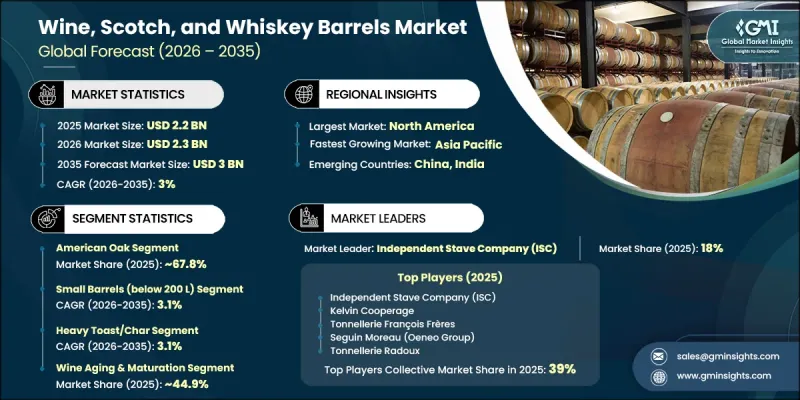
在高階酒精飲料需求不斷成長、精釀飲品生產迅速擴張以及消費者對風味更佳的陳年烈酒和葡萄酒的偏好日益增強的推動下,市場持續穩步成長。永續性發展正成為整個產業的首要任務,製桶商也被鼓勵採用環保的採購和生產方法。各公司正加大對永續林業實踐、酒桶再利用專案和再生解決方案的投資,以提高營運效率並最大限度地減少對環境的影響。替代木材的廣泛應用也為整體陳釀應用的風味創新和產品差異化創造了新的機會。美國橡木因其價格實惠且風味浸潤能力強,繼續主導著行業;法國橡木則憑藉其精緻的陳釀特性,在高階市場保持領先。東歐橡木也因其性能和成本的平衡性而逐漸被接受。小型酒桶因其能夠加速陳釀並增強風味強度,在精釀生產商中需求旺盛;而中型酒桶仍然是傳統陳釀應用的首選。葡萄酒陳釀佔了最大的使用佔有率,這得益於全球葡萄酒消費量的成長。同時,由於橡木桶使用方面的監管要求,威士忌和波本威士忌的生產持續帶動強勁的需求。釀酒廠仍然是主要的終端用戶,但精品和手工生產商正在崛起,成為市場中一個快速成長的細分領域。
| 市場範圍 | |
|---|---|
| 開始年份 | 2025 |
| 預測期 | 2026-2035 |
| 上市時的市場規模 | 22億美元 |
| 預計金額 | 30億美元 |
| 複合年成長率 | 3% |
預計到2025年,美國橡木的市佔率將達到67.8%,並在2035年之前以3.1%的複合年成長率成長。美國橡木之所以能夠保持主導地位,是因為它經濟實惠,且風味濃郁,適用於各種陳釀應用。其耐用性、易得性和與多種酒精飲料的兼容性,是其持續被生產商廣泛採用的關鍵因素。
預計到2025年,容量小於200公升的小型酒桶將佔據57.1%的市場佔有率,並在2026年至2035年間以3.1%的複合年成長率成長。這些酒桶因其能縮短熟成週期,並在熟成過程中形成更豐富的風味,而受到精釀飲品生產商的青睞。儘管小型酒桶比大型酒桶價格更高,但生產商仍然傾向於使用小型酒桶來生產高階和特色飲品,因為它們能在更短的時間內創造出獨特的風味。
預計2026年至2035年,北美葡萄酒、蘇格蘭威士忌和威士忌酒桶市場將以2.7%的複合年成長率成長。美國威士忌和波本威士忌的強勁產量是推動該地區市場成長的主要動力。強制要求波本威士忌生產使用新酒桶的法規持續全部區域創造了穩定的酒桶需求。此外,精釀酒廠的擴張、高階飲品消費量的成長以及先進酒桶製造技術的日益普及,都進一步推動了北美市場的成長。
目錄
第1章:調查方法和範圍
第2章執行摘要
第3章 行業洞察
- 產業生態系分析
- 供應商情況
- 利潤率
- 每個階段增加的價值
- 影響價值鏈的因素
- 中斷
- 影響產業的因素
- 促進因素
- 產業潛在風險與挑戰
- 市場機遇
- 成長潛力分析
- 監理情勢
- 波特的分析
- PESTLE分析
- 價格趨勢
- 按地區
- 材料
- 未來市場趨勢
- 技術與創新展望
- 最新科技趨勢
- 新興技術
- 專利趨勢
- 貿易統計
- 主要進口國
- 主要出口國
- 永續性和環境方面
- 永續計劃
- 減少廢棄物策略
- 生產中的能源效率
- 具有環保意識的舉措
第4章 競爭情勢
- 介紹
- 企業市佔率分析
- 按地區
- 北美洲
- 歐洲
- 亞太地區
- LATAM
- 中東和非洲
- 按地區
- 企業矩陣分析
- 主要市場公司的競爭分析
- 競爭定位矩陣
- 主要進展
- 併購
- 夥伴關係和聯盟
- 新產品發布
- 業務拓展計劃
第5章 市場估算與預測:依材料類型分類,2022-2035年
- 美國橡樹
- 法國橡樹
- 東歐橡樹
- 其他類型的木材
第6章 市場估價與預測:以桶裝規格分類,2022-2035年
- 小桶(小於200公升)
- 中型桶(200-300公升)
- 大型桶(300公升或以上)
第7章 市場估價與預測:依吐司等級分類,2022-2035年
- 烤得焦黑的麵包/燒焦的
- 中型烤麵包
- 淺烤麵包
- 未烘焙/原橡木
第8章 市場估計與預測:依應用領域分類,2022-2035年
- 葡萄酒的陳釀與成熟
- 威士忌和波本威士忌的陳釀
- 蘇格蘭威士忌的陳釀
- 其他靈魂
第9章 市場估計與預測:依最終用途分類,2022-2035年
- 酒廠
- 酒莊和葡萄園
- 手工藝品/精品生產商
- 酒廠
- 零售和消費者
第10章 市場估價與預測:依通路分類,2022-2035年
- 直銷(B2B)
- 銷售代理商和批發商
- 桶製造和銷售方面的專家和代理商。
- 線上零售(B2C)
第11章 市場估價與預測:按地區分類,2022-2035年
- 北美洲
- 美國
- 加拿大
- 歐洲
- 德國
- 英國
- 法國
- 西班牙
- 義大利
- 其他歐洲國家
- 亞太地區
- 中國
- 印度
- 日本
- 澳洲
- 韓國
- 其他亞太國家
- 拉丁美洲
- 巴西
- 墨西哥
- 阿根廷
- 其他拉丁美洲國家
- 中東和非洲
- 沙烏地阿拉伯
- 南非
- UAE
- 其他中東和非洲國家
第12章:公司簡介
- Independent Stave Company(ISC)
- Kelvin Cooperage
- Tonnellerie Francois Freres
- Seguin Moreau(Oeneo Group)
- Tonnellerie Radoux
- Tonnellerie Taransaud
- Tonnellerie Demptos
- Nadalie(Tonnellerie Nadalie)
- Speyside Cooperage
- Cooperages 1912/Heinrich
The Global Wine, Scotch, And Whiskey Barrels Market was valued at USD 2.2 billion in 2025 and is estimated to grow at a CAGR of 3% to reach USD 3 billion by 2035.
The market continues to expand steadily due to rising demand for premium alcoholic beverages, the rapid growth of craft beverage production, and changing consumer preferences for aged spirits and wines with refined flavor profiles. Sustainability is becoming a major priority across the industry, encouraging barrel manufacturers to adopt environmentally responsible sourcing and production methods. Companies are increasingly investing in sustainable forestry practices, barrel reuse programs, and refurbishment solutions to minimize environmental impact while improving operational efficiency. The growing use of alternative wood materials is also creating new opportunities for flavor innovation and product differentiation across aging applications. American oak continues to dominate the industry because of its affordability and strong flavor contribution, while French oak maintains a premium market position due to its refined aging characteristics. Eastern European oak is also gaining acceptance as a balanced option between performance and cost. Small barrels are witnessing strong demand among craft producers because they accelerate maturation and enhance flavor intensity, while medium-sized barrels continue to remain widely preferred for traditional aging applications. Wine maturation accounts for the largest application share, supported by growing global wine consumption, while whiskey and bourbon production continue to generate strong demand due to regulatory requirements surrounding oak barrel usage. Distilleries remain the leading end-user category, with boutique and craft producers emerging as a rapidly expanding segment within the market.
| Market Scope | |
|---|---|
| Start Year | 2025 |
| Forecast Year | 2026-2035 |
| Start Value | $2.2 Billion |
| Forecast Value | $3 Billion |
| CAGR | 3% |
The American oak segment accounted for 67.8% share in 2025 and is expected to grow at a CAGR of 3.1% through 2035. The segment continues to lead because American oak offers a cost-effective solution while delivering strong flavor characteristics preferred across various aging applications. Its durability, availability, and compatibility with different alcoholic beverages continue to support widespread adoption among producers.
The small barrels with capacities below 200 liters held a share of 57.1% in 2025 and is projected to grow at a CAGR of 3.1% from 2026 to 2035. These barrels are gaining significant popularity among craft beverage manufacturers because they allow faster maturation cycles and produce richer flavor extraction during the aging process. Despite higher costs compared to larger barrels, producers continue to favor smaller formats for premium and specialty beverage production due to their ability to create distinct flavor profiles within shorter timeframes.
North America Wine, Scotch, And Whiskey Barrels Market is anticipated to grow at a CAGR of 2.7% during 2026-2035. Regional growth is supported by strong production volumes of whiskey and bourbon, particularly across the United States. Regulations requiring the use of new oak barrels in bourbon production continue to drive consistent demand for barrels throughout the region. Expanding craft distillery operations, rising premium beverage consumption, and increasing adoption of technologically advanced barrel manufacturing practices are further contributing to market growth across North America.
Major companies operating in the Global Wine, Scotch, and Whiskey Barrels Market include Independent Stave Company (ISC), Kelvin Cooperage, Tonnellerie Francois Freres, Seguin Moreau (Oeneo Group), Tonnellerie Radoux, Tonnellerie Taransaud, Tonnellerie Demptos, Nadalie (Tonnellerie Nadalie), Speyside Cooperage, and Cooperages 1912/Heinrich. Companies operating in the wine, scotch, and whiskey barrels market are focusing on sustainable sourcing practices, product innovation, and strategic partnerships to strengthen their competitive position. Manufacturers are expanding investments in responsible forestry programs and barrel recycling initiatives to meet growing sustainability expectations across the beverage industry. Many producers are also developing customized barrel solutions with unique toasting techniques and alternative wood options to create differentiated flavor profiles for premium alcoholic beverages. Capacity expansion and modernization of cooperage facilities are helping companies improve production efficiency and maintain supply consistency.
Table of Contents
Chapter 1 Methodology & Scope
- 1.1 Research approach
- 1.2 Quality Commitments
- 1.2.1 GMI AI policy & data integrity commitment
- 1.2.1.1 Source consistency protocol
- 1.2.1 GMI AI policy & data integrity commitment
- 1.3 Research Trail & Confidence Scoring
- 1.3.1 Research Trail Components
- 1.3.2 Scoring Components
- 1.4 Data Collection
- 1.4.1 Partial list of primary sources
- 1.5 Data mining sources
- 1.5.1 Paid sources
- 1.5.1.1 Sources, by region
- 1.5.1 Paid sources
- 1.6 Base estimates and calculations
- 1.6.1 Base year calculation for any one approach
- 1.7 Forecast model
- 1.7.1 Quantified market impact analysis
- 1.7.1.1 Mathematical impact of growth parameters on forecast
- 1.7.1 Quantified market impact analysis
- 1.8 Research transparency addendum
- 1.8.1 Source attribution framework
- 1.8.2 Quality assurance metrics
- 1.8.3 Our commitment to trust
Chapter 2 Executive Summary
- 2.1 Industry 360° synopsis
- 2.2 Key market trends
- 2.2.1 Regional
- 2.2.2 Material Type
- 2.2.3 Barrel Size
- 2.2.4 Toast Level
- 2.2.5 Application
- 2.2.6 End-Use
- 2.2.7 Distribution Channel
- 2.3 TAM Analysis, 2025-2034
- 2.4 CXO perspectives: Strategic imperatives
Chapter 3 Industry Insights
- 3.1 Industry ecosystem analysis
- 3.1.1 Supplier landscape
- 3.1.2 Profit margin
- 3.1.3 Value addition at each stage
- 3.1.4 Factor affecting the value chain
- 3.1.5 Disruptions
- 3.2 Industry impact forces
- 3.2.1 Growth drivers
- 3.2.2 Industry pitfalls and challenges
- 3.2.3 Market opportunities
- 3.3 Growth potential analysis
- 3.4 Regulatory landscape
- 3.4.1 North America
- 3.4.2 Europe
- 3.4.3 Asia Pacific
- 3.4.4 Latin America
- 3.4.5 Middle East & Africa
- 3.5 Porter's analysis
- 3.6 PESTEL analysis
- 3.7 Price trends
- 3.7.1 By region
- 3.7.2 By material
- 3.8 Future market trends
- 3.9 Technology and Innovation landscape
- 3.9.1 Current technological trends
- 3.9.2 Emerging technologies
- 3.10 Patent Landscape
- 3.11 Trade statistics (HS code)
- 3.11.1 Major importing countries
- 3.11.2 Major exporting countries
- 3.12 Sustainability and environmental aspects
- 3.12.1 Sustainable practices
- 3.12.2 Waste reduction strategies
- 3.12.3 Energy efficiency in production
- 3.12.4 Eco-friendly initiatives
Chapter 4 Competitive Landscape, 2025
- 4.1 Introduction
- 4.2 Company market share analysis
- 4.2.1 By region
- 4.2.1.1 North America
- 4.2.1.2 Europe
- 4.2.1.3 Asia Pacific
- 4.2.1.4 LATAM
- 4.2.1.5 MEA
- 4.2.1 By region
- 4.3 Company matrix analysis
- 4.4 Competitive analysis of major market players
- 4.5 Competitive positioning matrix
- 4.6 Key developments
- 4.6.1 Mergers & acquisitions
- 4.6.2 Partnerships & collaborations
- 4.6.3 New Product Launches
- 4.6.4 Expansion Plans
Chapter 5 Market Estimates and Forecast, By Material Type, 2022-2035 (USD Million) (Unit)
- 5.1 Key trends
- 5.2 American Oak
- 5.3 French Oak
- 5.4 Eastern European Oak
- 5.5 Other Wood Types
Chapter 6 Market Estimates and Forecast, By Barrel Size, 2022-2035 (USD Million) (Unit)
- 6.1 Key trends
- 6.2 Small Barrels (Below 200L)
- 6.3 Medium Barrels (200-300L)
- 6.4 Large Barrels (Above 300L)
Chapter 7 Market Estimates and Forecast, By Toast Level, 2022-2035 (USD Million) (Unit)
- 7.1 Key trends
- 7.2 Heavy Toast/Char
- 7.3 Medium Toast
- 7.4 Light Toast
- 7.5 Untoasted/Raw Oak
Chapter 8 Market Estimates and Forecast, By Application, 2022-2035 (USD Million) (Unit)
- 8.1 Key trends
- 8.2 Wine Aging & Maturation
- 8.3 Whiskey/Bourbon Aging
- 8.4 Scotch Whiskey Maturation
- 8.5 Other Spirits
Chapter 9 Market Estimates and Forecast, By End Use, 2022-2035 (USD Million) (Unit)
- 9.1 Key trends
- 9.2 Distilleries
- 9.3 Wineries & Vineyards
- 9.4 Craft/Boutique Producers
- 9.5 Breweries
- 9.6 Retail & Home Consumers
Chapter 10 Market Estimates and Forecast, By Distribution Channel, 2022-2035 (USD Million) (Unit)
- 10.1 Key trends
- 10.2 Direct Sales (B2B)
- 10.3 Distributors & Wholesalers
- 10.4 Cooperage Specialists & Agents
- 10.5 Online Retail (B2C)
Chapter 11 Market Estimates and Forecast, By Region, 2022-2035 (USD Million) (Unit)
- 11.1 Key trends
- 11.2 North America
- 11.2.1 U.S.
- 11.2.2 Canada
- 11.3 Europe
- 11.3.1 Germany
- 11.3.2 UK
- 11.3.3 France
- 11.3.4 Spain
- 11.3.5 Italy
- 11.3.6 Rest of Europe
- 11.4 Asia Pacific
- 11.4.1 China
- 11.4.2 India
- 11.4.3 Japan
- 11.4.4 Australia
- 11.4.5 South Korea
- 11.4.6 Rest of Asia Pacific
- 11.5 Latin America
- 11.5.1 Brazil
- 11.5.2 Mexico
- 11.5.3 Argentina
- 11.5.4 Rest of Latin America
- 11.6 Middle East and Africa
- 11.6.1 Saudi Arabia
- 11.6.2 South Africa
- 11.6.3 UAE
- 11.6.4 Rest of Middle East and Africa
Chapter 12 Company Profiles
- 12.1 Independent Stave Company (ISC)
- 12.2 Kelvin Cooperage
- 12.3 Tonnellerie Francois Freres
- 12.4 Seguin Moreau (Oeneo Group)
- 12.5 Tonnellerie Radoux
- 12.6 Tonnellerie Taransaud
- 12.7 Tonnellerie Demptos
- 12.8 Nadalie (Tonnellerie Nadalie)
- 12.9 Speyside Cooperage
- 12.10 Cooperages 1912/Heinrich

 烈酒市場報告:趨勢、預測和競爭分析(至2035年)濃縮汁飲料市場報告:趨勢、預測和競爭分析(至2035年)
 龍舌蘭酒市場分析及預測(至2035年):類型、產品、技術、應用、形式、製程、最終用戶、安裝類型
 按產品類型、分銷通路和地區分類的蒸餾酒市場
 風味烈酒市場規模、佔有率及成長分析(按烈酒類型、口味、分銷管道、最終用戶和地區分類)-2026-2033年產業預測
 頂級烈酒市場規模、佔有率及成長分析(按產品類型、原料、通路、最終用戶及地區分類)-2026-2033年產業預測
 按口味、配料、甜味劑類型、包裝類型、配銷通路和地區分類的濃縮果汁飲料市場規模、佔有率和成長分析 - 行業預測(2026-2033 年)
 全球頂級烈酒市場全球甜飲料市場全球波本酒市場