


 |
市場調查報告書
商品編碼
2045692
遊艇市場機會、成長要素、產業趨勢分析及2026-2035年預測。Yacht Market Opportunity, Growth Drivers, Industry Trend Analysis, and Forecast 2026 - 2035 |
||||||

2025年全球遊艇市場價值143億美元,預計到2035年將以7%的複合年成長率成長至279億美元。
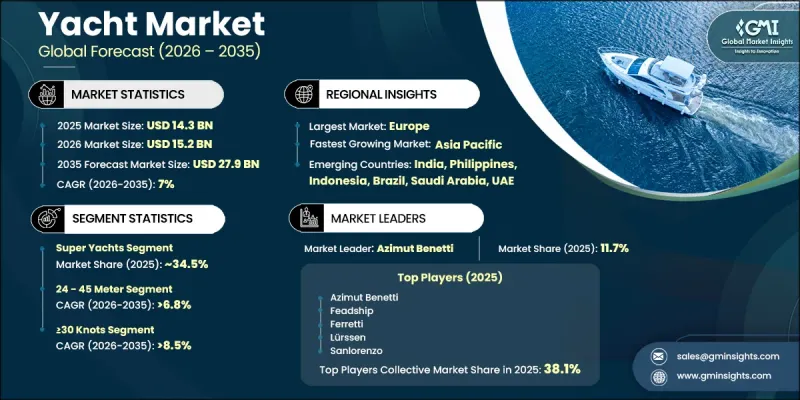
在全球財富成長和豪華旅遊快速擴張的推動下,市場正經歷一場變革,重塑著人們對高階海上體驗的需求。日益成長的富裕人口、對休閒旅遊的偏好以及私人遊艇租賃的普及,都顯著推動了遊艇的擁有量和使用量的成長。曾經集中在成熟海域的需求,如今正隨著對碼頭基礎設施和豪華旅遊生態系統投資的增加,向新的區域擴展。遊艇租賃服務的日益普及也提高了遊艇的可及性,使消費者無需擁有所有權即可體驗豪華遊艇。同時,人們對永續性的期望以及日益嚴格的環境法規正在重塑遊艇的設計和營運標準。業內相關人員越來越關注混合動力推進系統、清潔燃料和節能型船舶技術,以減少排放並提高合規性。環保旅遊意識的增強也影響消費者的購買決策,促使製造商在現代遊艇設計中採用更多環保材料、先進的船體工程技術和低影響的推進解決方案。這些因素共同推動遊艇產業朝著更永續、技術主導、體驗導向的成長模式發展。
| 市場範圍 | |
|---|---|
| 開始年份 | 2025 |
| 預測期 | 2026-2035 |
| 上市時的市場規模 | 143億美元 |
| 預測市場規模 | 279億美元 |
| 複合年成長率 | 7% |
預計到2025年,超級遊艇市佔率將達到34.5%,並在2035年之前以8%的複合年成長率成長。該細分市場之所以能夠推動整個產業的發展,主要歸功於其高額的收入貢獻以及超級富豪階級對獨特海上奢華體驗的強勁需求。超級遊艇的特點是高度客製化的設計、頂級的船上設施和先進的船上技術,這些都顯著提升了其整體價值,使其遠超普通船舶。儘管銷量相對較低,但由於其高階定價結構,該細分市場佔據了大部分市場收入。超級遊艇高度重視獨特性、尊貴感和個人化的奢華體驗,因此仍然是尋求全球交通和私人休閒環境的富裕買家的首選。
預計到2025年,24-45公尺遊艇市場將佔據41.8%的市場佔有率,並在2026年至2035年間以6.8%的複合年成長率成長。該細分市場之所以能夠保持其主導地位,是因為其在豪華設施、便利的操作和整體成本效益之間實現了有效平衡。此類遊艇通常擁有多層甲板、先進的導航系統和專屬船員艙,與大型船舶相比,擁有和維護成本更低。其多功能性使其成為眾多追求高階海上體驗且希望避免超大型遊艇高昂成本的富裕人士的理想之選。此外,易於錨碇、操作柔軟性以及適用於私人和租賃服務等特點也進一步提升了該細分市場的吸引力。
預計到2025年,義大利遊艇市場將佔據全球33.6%的佔有率,市場規模將達到17.956億美元。憑藉其悠久的航海文化、先進的造船技術以及享譽全球的遊艇製造商,義大利遊艇市場持續保持強勁成長勢頭。義大利擁有許多知名的造船企業,例如法拉帝集團(Ferretti Group)、阿茲慕貝內蒂(Azimut Benetti)和聖洛倫佐(San Lorenzo),這些企業在遊艇設計、性能和客製化方面都做出了卓越貢獻。此外,義大利完善的沿海基礎設施、地中海旅遊業的強大吸引力以及成熟的豪華酒店體系,也進一步支撐了遊艇所有權和租賃市場的穩定需求。
目錄
第1章:調查方法
第2章執行摘要
第3章 行業洞察
- 產業生態系分析
- 供應商情況
- 利潤率分析
- 成本結構
- 每個階段增加的價值
- 影響價值鏈的因素
- 中斷
- 影響產業的因素
- 促進因素
- 資產成長與高淨值人士 (HNWI)
- 豪華旅遊和休閒活動的日益普及
- 技術進步和客製化
- 遊艇租賃市場的擴張
- 沿海基礎設施開發擴張
- 產業潛在風險與挑戰
- 高昂的維護和營運成本
- 經濟和市場波動
- 市場機遇
- 亞太地區新興市場與資產成長
- 環保永續遊艇
- 數位化和智慧遊艇技術
- 遊艇共享和分權模式的成長
- 促進因素
- 成長潛力分析
- 監管指南
- 北美洲
- 美國:美國海岸警衛隊隊(USCG)航行和船舶檢查規則(46 CFR)
- 加拿大:《2001年加拿大航運法》
- 歐洲
- 德國:歐盟休閒船舶指令(RCD)(依據德國法律實施)
- 英國:《2017年英國休閒船舶條例》
- 法國:第240條-法國關於休閒船舶安全的法規
- 亞太地區
- 中國:休閒船舶安全管理條例
- 印度:《2021年內河航運法》
- 日本:船舶安全法
- 澳洲:《國家海事安全法(國內商船運輸)》,2012年
- 拉丁美洲
- 巴西:巴西海事局關於休閒船舶的規則(NORMAM)
- 墨西哥:航海和海事商法
- 阿根廷:國家航海法(Ley de la Navegacion No. 20,094)
- 中東和非洲
- 阿拉伯聯合大公國:阿拉伯聯合大公國海事法(1981年第26號聯邦法律)
- 沙烏地阿拉伯:沙烏地阿拉伯王國海事法
- 南非:1951年商船法
- 北美洲
- 波特的分析
- PESTLE分析
- 技術與創新展望
- 最新科技趨勢
- 新興技術
- 價格分析
- 對過去價格趨勢的分析
- 定價策略:按業務類型分類
- 貿易數據分析
- 進出口量及進口額趨勢
- 主要貿易路線及關稅的影響
- 人工智慧和生成式人工智慧對市場的影響
- 利用人工智慧改造現有經營模式
- 按細分市場分類的生成式人工智慧用例和部署藍圖
- 風險、限制和監管考量
- 生產能力和生產情況
- 生產能力:按地區和主要生產商分類
- 運轉率和擴張計劃
- 專利趨勢
- 永續性和環境方面
- 永續計劃
- 減少廢棄物策略
- 生產中的能源效率
- 具有環保意識的舉措
- 考慮碳足跡
- 預測假設和情境分析
- 基本案例:驅動複合年成長率的關鍵宏觀經濟與產業變量
- 樂觀情境:宏觀經濟與產業的順風
- 悲觀情景:宏觀經濟放緩或產業逆風
第4章 競爭情勢
- 介紹
- 企業市佔率分析
- 主要市場公司的競爭分析
- 競爭定位矩陣
- 主要進展
- 併購
- 夥伴關係和聯盟
- 新產品發布
- 業務拓展計劃及資金籌措
- 按公司規模進行基準測試
- 排名分類標準與選擇標準
- 按銷售額、地區和創新能力分類的層級定位矩陣。
第5章 市場估計與預測:依類型分類,2022-2035年
- 飛橋遊艇
- 運動遊艇
- 超級遊艇
- 其他
第6章 市場估計與預測:依長度分類,2022-2035年
- 小於24米
- 24-45米
- 超過45米
第7章 市場估計與預測:依促進因素分類,2022-2035年
- 引擎
- 帆
- 混合動力/電動
第8章 市場估算與預測:依速度分類,2022-2035年
- 低於12節
- 12-20節
- 20-30節
- 超過30節
第9章 市場估計與預測:依地區分類,2022-2035年
- 北美洲
- 美國
- 加拿大
- 歐洲
- 德國
- 英國
- 法國
- 義大利
- 西班牙
- 俄羅斯
- 荷蘭
- 比利時
- 亞太地區
- 中國
- 印度
- 日本
- 澳洲
- 韓國
- 菲律賓
- 印尼
- 拉丁美洲
- 巴西
- 墨西哥
- 阿根廷
- 中東和非洲
- 南非
- 沙烏地阿拉伯
- UAE
第10章:公司簡介
- 世界公司
- Azimut Benetti
- Beneteau
- Feadship
- Ferretti
- Heesen Yachts
- Lurssen
- Oceanco
- Princess Yachts
- Sanlorenzo
- Sunseeker International
- 當地公司
- Bavaria Yachts
- Codecasa
- Gulf Craft
- Hallberg-Rassy
- Horizon Yachts
- Nautor's Swan
- Riviera
- Royal Huisman
- Viking Yachts
- Westport Yachts
- 新興企業
- Baglietto
- Damen Yachting
- Moonen Yachts
The Global Yacht Market was valued at USD 14.3 billion in 2025 and is estimated to grow at a CAGR of 7% to reach USD 27.9 billion by 2035.
The market is undergoing transformation as rising global wealth creation and the rapid expansion of luxury tourism reshape demand for premium marine experiences. Increasing numbers of high-net-worth individuals, growing preference for customized leisure travel, and rising participation in private yacht charters are significantly boosting both ownership and usage trends. Demand, once concentrated in mature maritime regions, is now expanding into new geographies supported by investments in marina infrastructure and luxury tourism ecosystems. The growing popularity of yacht rental and charter services is also improving accessibility, enabling consumers to experience high-end vessels without full ownership commitments. At the same time, sustainability expectations and tightening environmental regulations are reshaping yacht design and operational standards. Industry participants are increasingly focusing on hybrid propulsion systems, cleaner fuels, and energy-efficient marine technologies to reduce emissions and improve compliance. Growing awareness around eco-friendly tourism is also influencing purchasing decisions, encouraging manufacturers to integrate greener materials, advanced hull engineering, and low-impact propulsion solutions into modern yacht designs. These combined factors are steadily shifting the yacht industry toward more sustainable, technology-driven, and experience-oriented growth.
| Market Scope | |
|---|---|
| Start Year | 2025 |
| Forecast Year | 2026-2035 |
| Start Value | $14.3 Billion |
| Forecast Value | $27.9 Billion |
| CAGR | 7% |
The super yachts segment accounted for 34.5% share in 2025 and is projected to grow at a CAGR of 8% through 2035. This segment leads the industry primarily due to its high revenue contribution and strong demand from ultra-wealthy individuals seeking exclusive marine luxury. Super yachts are characterized by highly customized designs, premium onboard amenities, and advanced onboard technologies, which significantly increase their overall value compared to standard vessels. Even with relatively lower unit sales, this segment generates a disproportionate share of market revenue due to its premium pricing structure. Strong emphasis on exclusivity, prestige, and personalized luxury experiences continues to make super yachts a preferred option among affluent buyers seeking global mobility and private leisure environments.
The 24-45 meter segment held a 41.8% share in 2025 and is expected to grow at a CAGR of 6.8% between 2026 and 2035. This segment remains dominant as it offers an effective balance between luxury features, operational convenience, and overall cost efficiency. Yachts in this category typically include multiple decks, advanced navigation systems, and dedicated crew spaces while remaining more manageable in terms of ownership and maintenance compared to larger vessels. Their versatility makes them attractive to a broader base of high-net-worth individuals who seek premium marine experiences without the significantly higher costs associated with ultra-large yachts. In addition, their ease of docking, operational flexibility, and suitability for both private use and charter services further enhance their market appeal.
Italy Yacht Market held a 33.6% share in 2025 and generated USD 1,795.6 million. The country continues to witness strong market growth supported by its long-standing maritime heritage, advanced shipbuilding capabilities, and globally recognized yacht manufacturers. Italy is home to prominent shipbuilding companies such as Ferretti Group, Azimut Benetti, and Sanlorenzo, all of which contribute significantly to innovation in yacht design, performance, and customization. The country's extensive coastal infrastructure, strong Mediterranean tourism appeal, and established luxury hospitality ecosystem further support consistent demand for yachts across both ownership and charter markets.
Key companies operating in the Global Yacht Market include Azimut Benetti, Bavaria Yachts, Beneteau, Feadship, Ferretti Group, Horizon Yachts, Lurssen, Princess Yachts, and Sanlorenzo. Companies operating in the yacht market are adopting several strategic approaches to strengthen their market presence and enhance competitive positioning. Manufacturers are increasingly focusing on advanced customization options, allowing buyers to design highly personalized luxury vessels tailored to specific lifestyle preferences. Investment in hybrid propulsion systems, fuel-efficient engines, and sustainable marine technologies is also rising to meet stricter environmental regulations and growing eco-conscious demand. Strategic partnerships with luxury tourism operators, charter service providers, and marina developers are helping companies expand their global reach and improve customer accessibility. In addition, firms are expanding shipyard capacities and enhancing production capabilities to meet the rising demand for premium yachts.
Table of Contents
Chapter 1 Methodology
- 1.1 Research approach
- 1.2 Quality Commitments
- 1.2.1 GMI AI policy & data integrity commitment
- 1.2.1.1 Source consistency protocol
- 1.2.1 GMI AI policy & data integrity commitment
- 1.3 Research Trail & Confidence Scoring
- 1.3.1 Research Trail Components
- 1.3.2 Scoring Components
- 1.4 Data Collection
- 1.4.1 Partial list of primary sources
- 1.5 Data mining sources
- 1.5.1 Paid sources
- 1.5.1.1 Sources, by region
- 1.5.1 Paid sources
- 1.6 Base estimates and calculations
- 1.6.1 Base year calculation
- 1.7 Forecast Model
- 1.7.1 Quantified market impact analysis
- 1.7.1.1 Mathematical impact of growth parameters on forecast
- 1.7.1 Quantified market impact analysis
- 1.8 Research transparency addendum
- 1.8.1 Source attribution framework
- 1.8.2 Quality assurance metrics
- 1.8.3 Our commitment to trust
Chapter 2 Executive Summary
- 2.1 Industry 360° synopsis, 2022 - 2035
- 2.2 Key market trends
- 2.2.1 Regional
- 2.2.2 Type
- 2.2.3 Length
- 2.2.4 Propulsion
- 2.2.5 Speed
- 2.3 TAM Analysis, 2026-2035
- 2.4 CXO perspectives: Strategic imperatives
Chapter 3 Industry Insights
- 3.1 Industry ecosystem analysis
- 3.1.1 Supplier landscape
- 3.1.2 Profit margin analysis
- 3.1.3 Cost structure
- 3.1.4 Value addition at each stage
- 3.1.5 Factor affecting the value chain
- 3.1.6 Disruptions
- 3.2 Industry impact forces
- 3.2.1 Growth drivers
- 3.2.1.1 Rising wealth and high net-worth individuals (HNWIs)
- 3.2.1.2 Growing popularity of luxury tourism and leisure activities
- 3.2.1.3 Technological advancements and customization
- 3.2.1.4 Expansion of yacht charter market
- 3.2.1.5 Increasing coastal infrastructure development
- 3.2.2 Industry pitfalls & challenges
- 3.2.2.1 High maintenance and operating costs
- 3.2.2.2 Economic and market volatility.
- 3.2.3 Market opportunities
- 3.2.3.1 Emerging markets and increasing wealth in Asia-Pacific
- 3.2.3.2 Eco-friendly and sustainable yachts
- 3.2.3.3 Digitalization and smart yacht technologies
- 3.2.3.4 Growth of yacht sharing and fractional ownership models
- 3.2.1 Growth drivers
- 3.3 Growth potential analysis
- 3.4 Regulatory guidline
- 3.4.1 North America
- 3.4.1.1 U.S.: U.S. Coast Guard (USCG) Navigation and Vessel Inspection Regulations (46 CFR)
- 3.4.1.2 Canada: Canada Shipping Act, 2001
- 3.4.2 Europe
- 3.4.2.1 Germany: EU Recreational Craft Directive (RCD) (implemented under German law)
- 3.4.2.2 UK: UK Recreational Craft Regulations 2017
- 3.4.2.3 France: Division 240 - French Regulations for Recreational Craft Safety
- 3.4.3 Asia Pacific
- 3.4.3.1 China: Regulations on the Safety Administration of Recreational Boats
- 3.4.3.2 India: Inland Vessels Act, 2021
- 3.4.3.3 Japan: Ship Safety Act
- 3.4.3.4 Australia: Marine Safety (Domestic Commercial Vessel) National Law Act 2012
- 3.4.4 Latin America
- 3.4.4.1 Brazil: Brazilian Maritime Authority Regulations (NORMAM) for Recreational Vessels
- 3.4.4.2 Mexico: Navigation and Maritime Commerce Law
- 3.4.4.3 Argentina: National Navigation Law (Ley de la Navegacion No. 20,094)
- 3.4.5 MEA
- 3.4.5.1 UAE: UAE Maritime Law (Federal Law No. 26 of 1981)
- 3.4.5.2 Saudi Arabia: Maritime Law of the Kingdom of Saudi Arabia
- 3.4.5.3 South Africa: Merchant Shipping Act, 1951
- 3.4.1 North America
- 3.5 Porter's analysis
- 3.6 PESTEL analysis
- 3.7 Technology and Innovation landscape
- 3.7.1 Current technological trends
- 3.7.2 Emerging technologies
- 3.8 Pricing Analysis (Driven by Primary Research)
- 3.8.1 Historical Price Trend Analysis
- 3.8.2 Pricing Strategy by Player Type
- 3.9 Trade Data Analysis (Based on Paid Database)
- 3.9.1 Import/Export Volume & Value Trends
- 3.9.2 Key Trade Corridors & Tariff Impact
- 3.10 Impact of AI & Generative AI on the Market (Driven by Primary Research)
- 3.10.1 AI-Driven Disruption of Existing Business Models
- 3.10.2 GenAI Use Cases & Adoption Roadmap by Segment
- 3.10.3 Risks, Limitations & Regulatory Considerations
- 3.11 Capacity & Production Landscape (Driven by Primary Research)
- 3.11.1 Production Capacity by Region & Key Producer
- 3.11.2 Capacity Utilization Rates & Expansion Pipelines
- 3.12 Patent Landscape (Driven by Primary Research)
- 3.13 Sustainability and environmental aspects
- 3.13.1 Sustainable practices
- 3.13.2 Waste reduction strategies
- 3.13.3 Energy efficiency in production
- 3.13.4 Eco-friendly initiatives
- 3.13.5 Carbon footprint considerations
- 3.14 Forecast assumptions & scenario analysis (Driven by Primary Research)
- 3.14.1 Base Case - key macro & industry variables driving CAGR
- 3.14.2 Optimistic Scenarios - Favorable Macro and Industry Tailwinds
- 3.14.3 Pessimistic Scenario - Macroeconomic slowdown or industry headwinds
Chapter 4 Competitive Landscape, 2025
- 4.1 Introduction
- 4.2 Company market share analysis
- 4.2.1 North America
- 4.2.2 Europe
- 4.2.3 Asia Pacific
- 4.2.4 Latin America
- 4.2.5 MEA
- 4.3 Competitive analysis of major market players
- 4.4 Competitive positioning matrix
- 4.5 Key developments
- 4.5.1 Mergers & acquisitions
- 4.5.2 Partnerships & collaborations
- 4.5.3 New Product Launches
- 4.5.4 Expansion Plans and funding
- 4.6 Company Tier Benchmarking
- 4.6.1 Tier Classification Criteria & Qualifying Thresholds
- 4.6.2 Tier Positioning Matrix by Revenue, Geography & Innovation
Chapter 5 Market Estimates & Forecast, By Type, 2022 - 2035 ($Bn, Units)
- 5.1 Key trends
- 5.2 Flybridge Yacht
- 5.3 Sport Yacht
- 5.4 Super Yachts
- 5.5 Others
Chapter 6 Market Estimates & Forecast, By Length, 2022 - 2035 ($Bn, Units)
- 6.1 Key trends
- 6.2 Below 24 meter
- 6.3 24 - 45 meter
- 6.4 Above 45 meter
Chapter 7 Market Estimates & Forecast, By Propulsion, 2022 - 2035 ($Bn, Units)
- 7.1 Key trends
- 7.2 Motor
- 7.3 Sail
- 7.4 Hybrid/electric
Chapter 8 Market Estimates & Forecast, By Speed, 2022 - 2035 ($Bn, Units)
- 8.1 Key trends
- 8.2 <12 knots
- 8.3 12 to 20 knots
- 8.4 20 to 30 knots
- 8.5 ≥ 30 knots
Chapter 9 Market Estimates & Forecast, By Region, 2022 - 2035 ($Bn, Units)
- 9.1 Key trends
- 9.2 North America
- 9.2.1 US
- 9.2.2 Canada
- 9.3 Europe
- 9.3.1 Germany
- 9.3.2 UK
- 9.3.3 France
- 9.3.4 Italy
- 9.3.5 Spain
- 9.3.6 Russia
- 9.3.7 Netherlands
- 9.3.8 Belgium
- 9.4 Asia Pacific
- 9.4.1 China
- 9.4.2 India
- 9.4.3 Japan
- 9.4.4 Australia
- 9.4.5 South Korea
- 9.4.6 Philippines
- 9.4.7 Indonesia
- 9.5 Latin America
- 9.5.1 Brazil
- 9.5.2 Mexico
- 9.5.3 Argentina
- 9.6 MEA
- 9.6.1 South Africa
- 9.6.2 Saudi Arabia
- 9.6.3 UAE
Chapter 10 Company Profiles
- 10.1 Global Players
- 10.1.1 Azimut Benetti
- 10.1.2 Beneteau
- 10.1.3 Feadship
- 10.1.4 Ferretti
- 10.1.5 Heesen Yachts
- 10.1.6 Lurssen
- 10.1.7 Oceanco
- 10.1.8 Princess Yachts
- 10.1.9 Sanlorenzo
- 10.1.10 Sunseeker International
- 10.2 Regional Players
- 10.2.1 Bavaria Yachts
- 10.2.2 Codecasa
- 10.2.3 Gulf Craft
- 10.2.4 Hallberg-Rassy
- 10.2.5 Horizon Yachts
- 10.2.6 Nautor's Swan
- 10.2.7 Riviera
- 10.2.8 Royal Huisman
- 10.2.9 Viking Yachts
- 10.2.10 Westport Yachts
- 10.3 Emerging Players
- 10.3.1 Baglietto
- 10.3.2 Damen Yachting
- 10.3.3 Moonen Yachts


