


 |
市場調查報告書
商品編碼
2045671
可重複使用生物反應器市場機會、成長要素、產業趨勢分析及2026-2035年預測Reusable Bioreactors Market Opportunity, Growth Drivers, Industry Trend Analysis, and Forecast 2026 - 2035 |
||||||

2025年全球可重複使用生物反應器市值為96億美元,預計2035年將以9.9%的複合年成長率成長至247億美元。
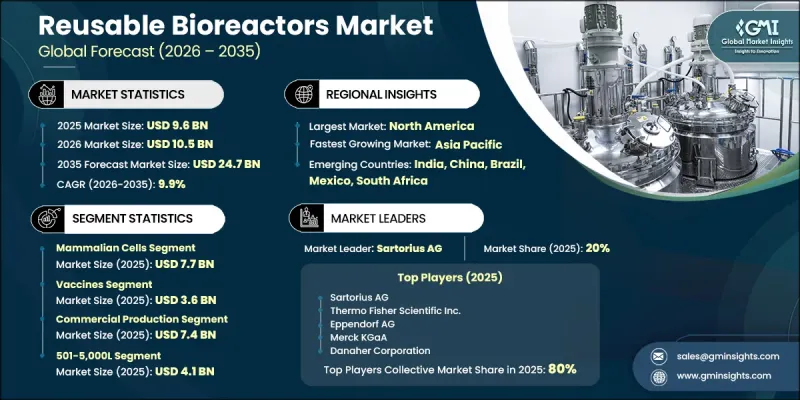
可重複使用生物反應器產業的擴張得益於製藥和生物技術產業的持續成長、個人化醫療需求的不斷增加以及生物製程技術的不斷進步。隨著對生物製藥生產和先進治療方法研發投資的不斷增加,製造商正在加速採用能夠支持大規模商業化的高效耐用生物反應器系統。細胞研究、再生醫學和先進治療藥物製造的進步正在迅速改變生物技術格局,進一步強化了對可重複使用生物反應器技術的需求。這些系統之所以備受關注,是因為它們能夠在高產量生產環境中提供長期運作可靠性、製程穩定性和更高的成本效益。此外,自動化、監控系統以及整合清潔和滅菌功能的進步正在提高可重複使用生物反應器的整體功能和使用壽命。在日益重視法規遵循、生產一致性和可擴展生產基礎設施的背景下,可重複使用生物反應器市場正進一步鞏固其作為現代生物製藥生產設施關鍵要素的地位。
| 市場範圍 | |
|---|---|
| 開始年份 | 2025 |
| 預測期 | 2026-2035 |
| 上市時的市場規模 | 96億美元 |
| 預計金額 | 247億美元 |
| 複合年成長率 | 9.9% |
可重複使用的生物反應器具有許多操作優勢,包括精確的製程控制、在重複生產週期中的耐用性以及符合嚴格的驗證和監管標準。隨著生物製藥企業不斷擴大產能以支持商業規模運作和先進治療產品線,可重複使用的生物反應器系統對於維持產品完整性和確保生產結果的一致性仍然至關重要。製程自動化和整合滅菌技術的不斷發展也有助於企業提高效率並減少停機時間。預計全球對生物製藥生產設施投資的增加將進一步推動可重複使用的生物反應器系統在高產能、注重成本的生產環境中得到應用。
預計到2025年,哺乳動物細胞市場規模將達到77億美元。哺乳動物細胞培養在先進生物製藥的生產中發揮著至關重要的作用,因為它能夠支持治療藥物生產所需的高度複雜的細胞過程。這些細胞培養需要嚴格控制的生產條件,包括穩定的溫度、氧氣控制、營養平衡維持和pH值控制。可重複使用的生物反應器因其能夠提供高度可控且可重複的加工環境,從而在多個運作週期中保持穩定的產品質量,因此在這些應用中被廣泛採用。它們維持製程精度和運作穩定性的能力,持續有力地推動其在哺乳動物細胞生產操作中的應用。
預計到2025年,疫苗市場規模將達到36億美元。疫苗生產高度依賴複雜的生物製造程序,這些工藝需要受控的培養環境和可靠的生產穩定性。可重複使用的生物反應器系統因其能夠支援大規模細胞培養,並在重複的生產週期中精確控制關鍵操作參數,而被廣泛應用於疫苗生產。全球對疾病預防日益成長的關注以及不斷擴大的免疫接種舉措,持續支撐著該領域的需求。預計在預測期內,對先進疫苗研發技術的投資增加以及健康意識的提高,將進一步鞏固疫苗在可重複使用生物反應器行業中的地位。
預計到2025年,北美可重複使用生物反應器市佔率將達到38.9%。由於美國和加拿大製藥及生技產業的擴張,該地區市場預計將持續強勁成長。對能夠重複進行大批量生產的耐用、檢驗的生產系統的需求不斷成長,是該地區市場擴張的主要驅動力。可重複使用生物反應器正日益融入以大規模治療藥物生產和先進治療方法開發為重點的生物製藥生產流程。此外,生物製藥基礎設施投資的增加、對複雜生物製藥的日益關注以及對高效且擴充性生產系統需求不斷成長的個人化醫療方法的日益普及,也推動了該地區市場的發展。
目錄
第1章:調查方法和範圍
第2章執行摘要
第3章 行業洞察
- 產業生態系分析
- 影響產業的因素
- 促進因素
- 製藥和生物技術產業持續成長。
- 生物反應器的技術進步
- 人們對罕見疾病藥物的研發越來越感興趣。
- 對個人化醫療的需求日益成長
- 產業潛在風險與挑戰
- 一次性生物反應器產能短缺
- 關於萃取物和洗脫液的問題
- 市場機遇
- 精準發酵技術在醫療保健領域的新應用
- 促進因素
- 成長潛力分析
- 監理情勢
- 技術進步
- 最新科技趨勢
- 新興技術
- 價格趨勢分析
- 專利分析
- 未來市場趨勢
- 人工智慧和生成式人工智慧對市場的影響
- 波特的分析
- PESTLE分析
第4章 競爭情勢
- 介紹
- 企業市佔率分析
- 企業矩陣分析
- 主要市場公司的競爭分析
- 競爭定位矩陣
- 主要進展
- 併購
- 夥伴關係和聯盟
- 新產品發布
- 業務拓展計劃
第5章 市場估計與預測:依細胞類型分類,2022-2035年
- 哺乳動物細胞
- 細菌細胞
- 酵母菌細胞
- 其他細胞
第6章 市場估計與預測:依分子分類,2022-2035年
- 單株抗體
- 疫苗
- 重組蛋白
- 幹細胞
- 基因治療
- 其他分子
第7章 市場估計與預測:依用途分類,2022-2035年
- 開發、臨床前和臨床
- 商業生產
第8章 市場估算與預測:依材料分類,2022-2035年
- 不銹鋼
- 玻璃
第9章 市場規模估算與預測(2022-2035年)
- 小於500公升
- 501~5,000 L
- 5000公升或更多
第10章 市場估價與預測:依最終用途分類,2022-2035年
- 研究與發展機構
- 生物製藥製造商
- 契約製造公司(CMO)
第11章 市場估價與預測:按地區分類,2022-2035年
- 北美洲
- 美國
- 加拿大
- 歐洲
- 德國
- 英國
- 法國
- 西班牙
- 義大利
- 荷蘭
- 亞太地區
- 中國
- 印度
- 日本
- 澳洲
- 韓國
- 拉丁美洲
- 巴西
- 墨西哥
- 阿根廷
- 中東和非洲
- 沙烏地阿拉伯
- 南非
- UAE
第12章:公司簡介
- 世界公司
- Danaher Corporation
- Eppendorf Group
- GEA Group Aktiengesellschaft
- Getinge AB
- Merck KGaA
- Sartorius AG
- Thermo Fisher Scientific Inc.
- 當地公司
- Cellexus International Ltd.
- Esco Micro Pte. Ltd.
- Infors AG
- 新興企業
- Bbi-biotech
- PBS Biotech, Inc.
The Global Reusable Bioreactors Market was valued at USD 9.6 billion in 2025 and is estimated to grow at a CAGR of 9.9% to reach USD 24.7 billion by 2035.
Expansion across the reusable bioreactors industry is strongly supported by the continuous growth of the pharmaceutical and biotechnology sectors, rising demand for personalized therapies, and ongoing advancements in bioprocessing technologies. Increasing investments in biologics production and advanced therapeutic development are encouraging manufacturers to adopt highly efficient and durable bioreactor systems capable of supporting large-scale commercial operations. The biotechnology landscape is evolving rapidly due to progress in cell-based research, regenerative medicine, and advanced therapeutic manufacturing, which continues to strengthen demand for reusable bioreactor technologies. These systems are gaining significant traction because they provide long-term operational reliability, process stability, and improved cost efficiency for large-volume production environments. In addition, technological enhancements in automation, monitoring systems, and integrated cleaning and sterilization capabilities are improving the overall functionality and lifespan of reusable bioreactors. Growing emphasis on regulatory compliance, production consistency, and scalable manufacturing infrastructure is further positioning the reusable bioreactors market as a vital component of modern biopharmaceutical production facilities.
| Market Scope | |
|---|---|
| Start Year | 2025 |
| Forecast Year | 2026-2035 |
| Start Value | $9.6 Billion |
| Forecast Value | $24.7 Billion |
| CAGR | 9.9% |
Reusable bioreactors deliver multiple operational advantages, including accurate process management, durability across repeated production cycles, and compatibility with strict validation and regulatory standards. As biopharmaceutical manufacturers continue expanding production capacities to support commercial-scale operations and advanced therapeutic pipelines, reusable bioreactor systems remain essential for maintaining product integrity and ensuring consistent manufacturing outcomes. Continuous developments in process automation and integrated sterilization technologies are also helping manufacturers improve efficiency while reducing operational downtime. Increasing investments in biologics manufacturing facilities worldwide are expected to further reinforce the adoption of reusable bioreactor systems in high-capacity and cost-sensitive production settings.
The mammalian cells segment generated USD 7.7 billion in 2025. Mammalian cell cultures play a critical role in the production of advanced biologic therapies due to their ability to support highly sophisticated cellular processes required for therapeutic manufacturing. These cell cultures require tightly regulated production conditions, including stable temperature levels, oxygen control, nutrient balance, and pH management. Reusable bioreactors are widely preferred for these applications because they provide highly controlled and repeatable processing environments capable of supporting consistent production quality over multiple operational cycles. Their ability to maintain process precision and operational stability continues to drive strong adoption within mammalian cell-based manufacturing operations.
The vaccines segment accounted for USD 3.6 billion in 2025. Vaccine manufacturing relies heavily on complex biological production processes that require controlled cultivation environments and reliable production consistency. Reusable bioreactor systems are extensively utilized in vaccine manufacturing due to their ability to support large-scale cell cultivation while maintaining precise control over critical operational parameters throughout repeated manufacturing cycles. Strong global focus on disease prevention and expanding immunization initiatives continue to support demand within this segment. Increasing investment in advanced vaccine development technologies and growing healthcare awareness are expected to further strengthen the position of the vaccines segment within the reusable bioreactors industry over the forecast period.
North America Reusable Bioreactors Market represented 38.9% share in 2025. The region continues to witness strong market growth due to the expanding pharmaceutical and biotechnology industries across the United States and Canada. Rising demand for durable and validated manufacturing systems capable of supporting repeated high-volume production is contributing significantly to regional market expansion. Reusable bioreactors are increasingly being integrated into biologics manufacturing operations focused on large-scale therapeutic production and advanced treatment development. The regional market is also benefiting from growing investments in biopharmaceutical infrastructure, increasing focus on complex biologic therapies, and rising adoption of personalized medicine approaches that require highly efficient and scalable production systems.
Key companies operating in the Global Reusable Bioreactors Market include Bbi-biotech, Danaher Corporation, Eppendorf Group, Esco Micro Pte. Ltd., GEA Group Aktiengesellschaft, Getinge AB, Infors AG, Merck KGaA, Sartorius AG, Thermo Fisher Scientific Inc., PBS Biotech, Inc., and Cellexus International Ltd. Companies operating in the reusable bioreactors industry are implementing several strategic initiatives to strengthen their competitive position and expand their global presence. Major market participants are focusing on technological innovation by developing advanced automation systems, enhanced monitoring solutions, and more efficient sterilization technologies to improve operational productivity and system performance. Many companies are also investing in research and development activities aimed at increasing scalability, process consistency, and regulatory compliance across biologics manufacturing operations. Strategic collaborations, facility expansions, and partnerships with pharmaceutical and biotechnology firms are helping manufacturers strengthen distribution networks and broaden customer reach. In addition, organizations are prioritizing customized bioprocessing solutions and expanding manufacturing capacities to address rising global demand for biologics, vaccines, and advanced therapeutic products within the reusable bioreactors market.
Table of Contents
Chapter 1 Methodology and Scope
- 1.1 Research approach
- 1.2 Quality commitments
- 1.2.1 GMI AI policy & data integrity commitment
- 1.2.1.1 Source consistency protocol
- 1.2.1 GMI AI policy & data integrity commitment
- 1.3 Research trail & confidence scoring
- 1.3.1 Research trail components
- 1.3.2 Scoring components
- 1.4 Data collection
- 1.4.1 Partial list of primary sources
- 1.5 Data mining sources
- 1.5.1 Paid sources
- 1.5.1.1 Sources, by region
- 1.5.1 Paid sources
- 1.6 Base estimates and calculations
- 1.6.1 Base year calculation for any one approach
- 1.7 Forecast model
- 1.7.1 Quantified market impact analysis
- 1.7.1.1 Mathematical impact of growth parameters on forecast
- 1.7.1 Quantified market impact analysis
- 1.8 Research transparency addendum
- 1.8.1 Source attribution framework
- 1.8.2 Quality assurance metrics
- 1.8.3 Our commitment to trust
Chapter 2 Executive Summary
- 2.1 Industry 360° synopsis
- 2.2 Key market trends
- 2.2.1 Regional trends
- 2.2.2 Cell trends
- 2.2.3 Molecule trends
- 2.2.4 Usage trends
- 2.2.5 Material trends
- 2.2.6 Size trends
- 2.2.7 End use trends
- 2.3 CXO perspectives: Strategic imperatives
Chapter 3 Industry Insights
- 3.1 Industry ecosystem analysis
- 3.2 Industry impact forces
- 3.2.1 Growth drivers
- 3.2.1.1 Growing pharmaceutical and biotechnology industry
- 3.2.1.2 Technological advancements in bioreactors
- 3.2.1.3 Growing focus on orphan drug development
- 3.2.1.4 Rising demand for personalized medicines
- 3.2.2 Industry pitfalls and challenges
- 3.2.2.1 Low capacity of single-use bioreactors
- 3.2.2.2 Concerns regarding extractables and/or leachables
- 3.2.3 Market opportunities
- 3.2.3.1 Precision fermentation for novel healthcare applications
- 3.2.1 Growth drivers
- 3.3 Growth potential analysis
- 3.4 Regulatory landscape
- 3.4.1 North America
- 3.4.2 Europe
- 3.4.3 Asia Pacific
- 3.4.4 Latin America
- 3.4.5 Middle East and Africa
- 3.5 Technological advancements
- 3.5.1 Current technological trends
- 3.5.2 Emerging technologies
- 3.6 Pricing trend analysis
- 3.7 Patent analysis
- 3.8 Future market trends
- 3.9 Impact of AI and Generative AI on the market
- 3.10 Porter's analysis
- 3.11 PESTEL analysis
Chapter 4 Competitive Landscape, 2024
- 4.1 Introduction
- 4.2 Company market share analysis
- 4.3 Company matrix analysis
- 4.4 Competitive analysis of major market players
- 4.5 Competitive positioning matrix
- 4.6 Key developments
- 4.6.1 Mergers and acquisitions
- 4.6.2 Partnerships and collaborations
- 4.6.3 New product launches
- 4.6.4 Expansion plans
Chapter 5 Market Estimates and Forecast, By Cell, 2022 - 2035 ($ Mn)
- 5.1 Key trends
- 5.2 Mammalian cells
- 5.3 Bacterial cells
- 5.4 Yeast cells
- 5.5 Other cells
Chapter 6 Market Estimates and Forecast, By Molecule, 2022 - 2035 ($ Mn)
- 6.1 Key trends
- 6.2 Monoclonal antibodies
- 6.3 Vaccines
- 6.4 Recombinant proteins
- 6.5 Stem cells
- 6.6 Gene therapy
- 6.7 Other molecules
Chapter 7 Market Estimates and Forecast, By Usage, 2022 - 2035 ($ Mn)
- 7.1 Key trends
- 7.2 Developmental, pre-clinical & clinical
- 7.3 Commercial production
Chapter 8 Market Estimates and Forecast, By Materials, 2022 - 2035 ($ Mn)
- 8.1 Key trends
- 8.2 Stainless steel
- 8.3 Glass
Chapter 9 Market Estimates and Forecast, By Size, 2022 - 2035 ($ Mn)
- 9.1 Key trends
- 9.2 Less than 500 L
- 9.3 501-5,000 L
- 9.4 More than 5,000 L
Chapter 10 Market Estimates and Forecast, By End Use, 2022 - 2035 ($ Mn)
- 10.1 Key trends
- 10.2 R&D organizations
- 10.3 Biopharma manufacturers
- 10.4 Contract manufacturing organizations (CMOs)
Chapter 11 Market Estimates and Forecast, By Region, 2022 - 2035 ($ Mn)
- 11.1 Key trends
- 11.2 North America
- 11.2.1 U.S.
- 11.2.2 Canada
- 11.3 Europe
- 11.3.1 Germany
- 11.3.2 UK
- 11.3.3 France
- 11.3.4 Spain
- 11.3.5 Italy
- 11.3.6 Netherlands
- 11.4 Asia Pacific
- 11.4.1 China
- 11.4.2 India
- 11.4.3 Japan
- 11.4.4 Australia
- 11.4.5 South Korea
- 11.5 Latin America
- 11.5.1 Brazil
- 11.5.2 Mexico
- 11.5.3 Argentina
- 11.6 Middle East and Africa
- 11.6.1 Saudi Arabia
- 11.6.2 South Africa
- 11.6.3 UAE
Chapter 12 Company Profiles
- 12.1 Global players
- 12.1.1 Danaher Corporation
- 12.1.2 Eppendorf Group
- 12.1.3 GEA Group Aktiengesellschaft
- 12.1.4 Getinge AB
- 12.1.5 Merck KGaA
- 12.1.6 Sartorius AG
- 12.1.7 Thermo Fisher Scientific Inc.
- 12.2 Regional players
- 12.2.1 Cellexus International Ltd.
- 12.2.2 Esco Micro Pte. Ltd.
- 12.2.3 Infors AG
- 12.3 Emerging players
- 12.3.1 Bbi-biotech
- 12.3.2 PBS Biotech, Inc.

 精準發酵生物反應器市場規模、佔有率和趨勢分析報告:按產品類型、運作規模、反應器技術、應用、地區和細分市場預測(2026-2033 年)
 小型生物反應器市場:依生物反應器容量、細胞培養類型、運作方法、生物反應器類型、最終用戶、運作規模和地區分類-趨勢與預測至2035年
 工業用精密發酵生物反應器市場機會、成長要素、產業趨勢分析及2026-2035年預測
 高通量微型生物反應器市場規模:按類型、應用、最終用戶、地區和預測。
 生物反應器市場:按類型、組件、運作模式、類別、容量、結構材料、控制方法、應用和最終用戶分類-2026-2032年全球市場預測
 2026-2030年全球生物反應器市場全球小規模生物反應器市場:產業趨勢及至2035年預測:按生物反應器容量、細胞培養類型、運作、生物反應器類型、最終用戶、運作規模、地區和主要參與者細分
 生物反應器市場規模、佔有率、趨勢和預測:按類型、用途、規模、控制類型和地區分類,2026-2034年
 生物反應器市場:按生物反應器類型、應用、容量、最終用戶和地區分類
 2026年全球一次性生物反應器袋市場報告