


 |
市場調查報告書
商品編碼
2038776
種子披衣市場機會、成長要素、產業趨勢分析及2026-2035年預測。Seed Coating Market Opportunity, Growth Drivers, Industry Trend Analysis, and Forecast 2026 - 2035 |
||||||

全球種子披衣市場預計到 2025 年將達到 10.9 億美元,年複合成長率為 4.8%,到 2035 年將達到 17 億美元。
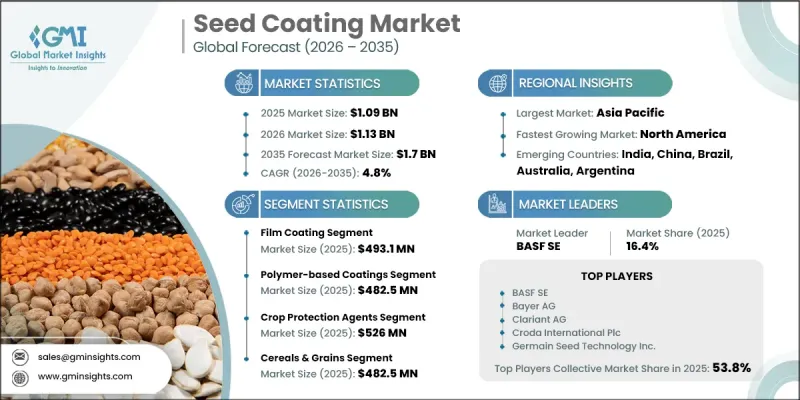
種子披衣是指一系列農業加工工藝,利用薄膜包衣、造粒、包覆和浸種等技術,在種子表面形成保護性或功能性包衣層。這些製程通常包括混合、壓片、乾燥和品質控制等步驟,旨在提高種子耐久性、增強抗病蟲害能力並確保播種性能的一致性。與未經處理的種子相比,種子包衣能夠提高發芽率、促進作物生長並提升農業價值。種子披衣在現代農業系統中圖至關重要的作用,它將未經處理的種子轉化為高性能產品,從而提高產量並減少作物損失。在糧食穩定生產、資源高效利用和病蟲害控制至關重要的大規模農業地區,種子包衣得到了廣泛應用。該行業結合了先進的機械、化學和生物加工方法,並利用專業設施和大規模自動化種子加工系統進行生產。
| 市場範圍 | |
|---|---|
| 開始年份 | 2025 |
| 預測期 | 2026-2035 |
| 上市時的市場規模 | 10.9億美元 |
| 預計金額 | 17億美元 |
| 複合年成長率 | 4.8% |
在精密農業實踐和先進種子改良技術的推動下,種子披衣市場也不斷發展。配方科學的持續進步使得人們能夠更好地控制種子的性能特徵,包括發芽率和環境耐受性。對永續農業實踐日益成長的需求,推動了環保包衣材料的研發,這些材料在保持有效性的同時,也能減少化學品的使用。種子處理系統的技術進步,進一步提高了大規模農業生產的效率、擴充性和產品均勻性。此外,全球糧食需求的成長,也促使人們更多地採用處理過的種子,以提高產量穩定性並降低生產風險。
預計到2025年,薄膜包衣市場規模將達到4.931億美元。此方法仍是應用最廣泛的包衣方式,因為它能夠實現均勻包衣,同時保持種子的天然形狀,並確保活性成分的精準輸送。此外,它與現代播種設備高度親和性,並允許在單層包衣中塗覆多種功能性成分。憑藉其高效性和多功能性,薄膜包衣成為商業種子生產商和大型農業企業的首選。
預計到2025年,聚合物塗層市場規模將達到4.825億美元。這些塗層憑藉其強附著力、緩釋性能以及與多種活性成分的相容性,佔據了市場主導地位。它們能夠在各種環境條件下保護種子並提升作物性能。根據特定的農業和環境要求,還會使用其他類型的塗層,包括可生物分解塗層、礦物基塗層和混合塗層。除了先進的聚合物配方外,人們對永續性的日益關注也進一步推動了環保替代品的應用。
預計北美種子披衣市場規模將從2025年的3.535億美元成長到2035年的5.451億美元。該地區的成長主要得益於對高性能農業材料需求的不斷成長,這些材料能夠提高產量效率、抗蟲害能力和資源利用率。先進種子技術的應用正逐漸成為大規模農業生產的標準做法,尤其是在大田作物和特種作物種植領域。精密農業系統和現代種子分銷網路的日益普及進一步推動了市場擴張。永續農業實踐的推廣也促進了全部區域種子包衣市場的穩定成長。
目錄
第1章:調查方法和範圍
第2章執行摘要
第3章業界考察
- 生態系分析
- 供應商情況
- 利潤率
- 每個階段增加的價值
- 影響價值鏈的因素
- 中斷
- 影響產業的因素
- 促進因素
- 產業潛在風險與挑戰
- 市場機遇
- 成長潛力分析
- 監理情勢
- 波特五力分析
- PESTEL 分析
- 價格趨勢
- 按地區
- 透過塗層材料
- 未來市場趨勢
- 科技與創新趨勢
- 當前技術趨勢
- 新興技術
- 專利趨勢
- 貿易統計(HS編碼)
- 主要進口國
- 主要出口國
- 永續性和環境方面
- 永續計劃
- 減少廢棄物策略
- 生產中的能源效率
- 環保意識的舉措
- 考慮碳足跡
第4章 競爭情勢
- 介紹
- 企業市佔率分析
- 按地區
- 北美洲
- 歐洲
- 亞太地區
- 拉丁美洲
- 中東和非洲(MEA)
- 按地區
- 主要市場公司的競爭分析
- 競爭定位矩陣
- 主要進展
- 併購
- 夥伴關係和聯盟
- 新產品發布
- 業務拓展計劃
第5章 市場估算與預測:依塗層技術分類,2022-2035年
- 薄膜塗層
- 覆蓋
- 造粒
- 底漆和性能增強塗層
- 其他
第6章 市場估價與預測:依塗料類型分類,2022-2035年
- 聚合物基塗料
- 天然和可生物分解材料
- 礦物基材料
- 混合/複合材料
第7章 市場估計與預測:依功能活性成分分類,2022-2035年
- 作物保護劑
- 殺蟲劑
- 消毒劑
- 殺線蟲劑
- 營養強化劑
- 生技藥品
- 種子活力增強劑和發芽促進劑
- 顏料和馬克筆
第8章 市場估算與預測:依作物類型分類,2022-2035年
- 穀類和穀類食品
- 玉米
- 小麥
- 米
- 大麥
- 高粱
- 其他
- 油籽/豆類
- 大豆
- 向日葵
- 菜籽
- 花生
- 扁豆和鷹嘴豆
- 蔬菜
- 番茄
- 生菜和綠葉蔬菜
- 胡蘿蔔和根莖類蔬菜
- 洋蔥和韭菜
- 十字花科(高麗菜、綠花椰菜)
- 其他
- 水果
- 莓果
- 瓜
- 其他
- 其他
第9章 市場估價與預測:依最終用戶分類,2022-2035年
- 商業種子公司
- 直接來自農民和生產者
- 農業合作社
- 其他
第10章 市場估價與預測:依地區分類,2022-2035年
- 北美洲
- 美國
- 加拿大
- 歐洲
- 德國
- 英國
- 法國
- 西班牙
- 義大利
- 其他歐洲地區
- 亞太地區
- 中國
- 印度
- 日本
- 澳洲
- 韓國
- 亞太其他地區
- 拉丁美洲
- 巴西
- 墨西哥
- 阿根廷
- 其他拉丁美洲地區
- 中東和非洲
- 沙烏地阿拉伯
- 南非
- 阿拉伯聯合大公國
- 其他中東和非洲地區
第11章:公司簡介
- BASF SE
- Bayer AG
- Brett Young Seeds Ltd
- Clariant AG
- Croda International Plc
- Germain Seed Technology Inc.
- Michelman, Inc
- Precision Laboratories
- Sensient Technologies
- Smith Seed Service.
The Global Seed Coating Market was valued at USD 1.09 billion in 2025 and is estimated to grow at a CAGR of 4.8% to reach USD 1.7 billion by 2035.
Seed coating refers to a set of agricultural processes that apply protective and functional layers to seeds using techniques such as film coating, pelleting, encrusting, and priming. These processes typically involve mixing, layering, drying, and quality assurance steps that improve seed durability, protect against pests and diseases, and ensure uniform planting performance. The result is improved germination, stronger crop establishment, and enhanced agronomic value compared to untreated seeds. Seed coating plays a crucial role in modern agricultural systems by converting raw seeds into higher-performing commercial products that support productivity and reduce crop losses. It is widely adopted in large-scale farming regions where consistent food production, efficient resource utilization, and pest management are essential. The industry combines advanced mechanical, chemical, and biological processing methods through both specialized facilities and large automated seed treatment systems.
| Market Scope | |
|---|---|
| Start Year | 2025 |
| Forecast Year | 2026-2035 |
| Start Value | $1.09 Billion |
| Forecast Value | $1.7 Billion |
| CAGR | 4.8% |
The seed coating market is also evolving through increased integration of precision agriculture practices and advanced seed enhancement technologies. Continuous improvements in formulation science are enabling better control over seed performance characteristics, including germination uniformity and environmental resistance. Rising demand for sustainable farming practices is encouraging the development of environmentally friendly coating materials that reduce chemical impact while maintaining effectiveness. Technological advancements in seed processing systems are further improving efficiency, scalability, and product consistency across large agricultural operations. Expanding global food demand is also driving greater adoption of treated seeds to improve yield reliability and reduce production risks.
The film coating segment accounted for USD 493.1 million in 2025. This method remains the most widely used due to its ability to deliver uniform seed coverage while preserving natural seed shape and ensuring precise delivery of active ingredients. It is highly compatible with modern sowing equipment and supports the application of multiple functional components in a single layer. Its efficiency and versatility make it a preferred choice among commercial seed producers and large-scale farming operations.
The polymer-based coatings segment reached USD 482.5 million in 2025. These coatings dominate the market due to their strong adhesion properties, controlled-release functionality, and compatibility with a wide range of active ingredients. They support improved seed protection and performance under varying environmental conditions. Other coating types, including biodegradable, mineral-based, and hybrid systems, are also used based on specific agricultural and environmental requirements. Growing emphasis on sustainability is further supporting the adoption of eco-friendly alternatives alongside advanced polymer formulations.
North America Seed Coating Market is projected to grow from USD 353.5 million in 2025 to USD 545.1 million by 2035. The region's growth is driven by rising demand for high-performance agricultural inputs that improve yield efficiency, pest resistance, and resource utilization. The adoption of advanced seed technologies is becoming standard practice in large-scale farming operations, particularly in row crop cultivation and specialty agriculture. Increasing use of precision farming systems and modern seed distribution networks is further strengthening market expansion. The integration of sustainable agricultural practices is also contributing to consistent adoption across the region.
Key companies operating in the Global Seed Coating Market include Bayer AG, BASF SE, Croda International Plc, Clariant AG, Sensient Technologies, Germain Seed Technology Inc., Brett Young Seeds Ltd, Michelman Inc, Precision Laboratories, and Smith Seed Service. Companies in the seed coating market are focusing on innovation, sustainability, and strategic expansion to strengthen their competitive position. They are investing in advanced formulation technologies to improve seed performance, durability, and environmental compatibility. Partnerships with seed producers and agricultural firms are helping expand product reach and improve application efficiency. Many players are prioritizing the development of bio-based and eco-friendly coating solutions to align with sustainability goals and regulatory requirements. Continuous research in polymer science and seed enhancement technologies is enabling better product differentiation.
Table of Contents
Chapter 1 Methodology & Scope
- 1.1 Market scope and definition
- 1.2 Research design
- 1.2.1 Research approach
- 1.2.2 Data collection methods
- 1.3 Data mining sources
- 1.3.1 Global
- 1.3.2 Regional/Country
- 1.4 Base estimates and calculations
- 1.4.1 Base year calculation
- 1.4.2 Key trends for market estimation
- 1.5 Primary research and validation
- 1.5.1 Primary sources
- 1.6 Forecast model
- 1.7 Research assumptions and limitations
Chapter 2 Executive Summary
- 2.1 Industry 360° synopsis
- 2.2 Key market trends
- 2.2.1 Coating technology
- 2.2.2 Coating material
- 2.2.3 Functional active ingredient
- 2.2.4 Crop type
- 2.2.5 End-user
- 2.2.6 Regional
- 2.3 TAM Analysis, 2026-2035
- 2.4 CXO perspectives: Strategic imperatives
Chapter 3 Industry Insights
- 3.1 Industry ecosystem analysis
- 3.1.1 Supplier landscape
- 3.1.2 Profit margin
- 3.1.3 Value addition at each stage
- 3.1.4 Factor affecting the value chain
- 3.1.5 Disruptions
- 3.2 Industry impact forces
- 3.2.1 Growth drivers
- 3.2.2 Industry pitfalls and challenges
- 3.2.3 Market opportunities
- 3.3 Growth potential analysis
- 3.4 Regulatory landscape
- 3.4.1 North America
- 3.4.2 Europe
- 3.4.3 Asia Pacific
- 3.4.4 Latin America
- 3.4.5 Middle East & Africa
- 3.5 Porter's analysis
- 3.6 PESTEL analysis
- 3.7 Price trends
- 3.7.1 By region
- 3.7.2 By coating material
- 3.8 Future market trends
- 3.9 Technology and Innovation landscape
- 3.9.1 Current technological trends
- 3.9.2 Emerging technologies
- 3.10 Patent Landscape
- 3.11 Trade statistics (HS code)
- 3.11.1 Major importing countries
- 3.11.2 Major exporting countries
- 3.12 Sustainability and environmental aspects
- 3.12.1 Sustainable practices
- 3.12.2 Waste reduction strategies
- 3.12.3 Energy efficiency in production
- 3.12.4 Eco-friendly initiatives
- 3.13 Carbon footprint consideration
Chapter 4 Competitive Landscape, 2025
- 4.1 Introduction
- 4.2 Company market share analysis
- 4.2.1 By region
- 4.2.1.1 North America
- 4.2.1.2 Europe
- 4.2.1.3 Asia Pacific
- 4.2.1.4 LATAM
- 4.2.1.5 MEA
- 4.2.1 By region
- 4.3 Competitive analysis of major market players
- 4.4 Competitive positioning matrix
- 4.5 Key developments
- 4.5.1 Mergers & acquisitions
- 4.5.2 Partnerships & collaborations
- 4.5.3 New Product Launches
- 4.5.4 Expansion Plans
Chapter 5 Market Estimates and Forecast, By Coating Technology, 2022-2035 (USD Billion) (Kilo Tons)
- 5.1 Key trends
- 5.2 Film Coating
- 5.3 Encrusting
- 5.4 Pelleting
- 5.5 Priming & Enhancement Coatings
- 5.6 Others
Chapter 6 Market Estimates and Forecast, By Coating Material, 2022-2035 (USD Billion) (Kilo Tons)
- 6.1 Key trends
- 6.2 Polymer-Based Coatings
- 6.3 Natural/Biodegradable Materials
- 6.4 Mineral-Based Materials
- 6.5 Hybrid/Composite Materials
Chapter 7 Market Estimates and Forecast, By Functional Active Ingredient, 2022-2035 (USD Billion) (Kilo Tons)
- 7.1 Key trends
- 7.2 Crop Protection Agents
- 7.2.1 Insecticides
- 7.2.2 Fungicides
- 7.2.3 Nematicides
- 7.3 Nutritional Enhancements
- 7.4 Biological Agents
- 7.5 Seed Vigor & Germination Enhancers
- 7.6 Colorants & Markers
Chapter 8 Market Estimates and Forecast, By Crop Type, 2022-2035 (USD Billion) (Kilo Tons)
- 8.1 Key trends
- 8.2 Cereals & Grains
- 8.2.1 Corn/Maize
- 8.2.2 Wheat
- 8.2.3 Rice
- 8.2.4 Barley
- 8.2.5 Sorghum
- 8.2.6 Others
- 8.3 Oilseeds & Pulses
- 8.3.1 Soybean
- 8.3.2 Sunflower
- 8.3.3 Canola/Rapeseed
- 8.3.4 Peanuts
- 8.3.5 Lentils & Chickpeas
- 8.4 Vegetables
- 8.4.1 Tomato
- 8.4.2 Lettuce & Leafy Greens
- 8.4.3 Carrot & Root Vegetables
- 8.4.4 Onion & Alliums
- 8.4.5 Brassicas (Cabbage, Broccoli)
- 8.4.6 Others
- 8.5 Fruits
- 8.5.1 Berries
- 8.5.2 Melons
- 8.5.3 Others
- 8.6 Others
Chapter 9 Market Estimates and Forecast, By End-user, 2022-2035 (USD Billion) (Kilo Tons)
- 9.1 Key trends
- 9.2 Commercial Seed Companies
- 9.3 Farmer/Grower Direct
- 9.4 Agricultural Cooperatives
- 9.5 Others
Chapter 10 Market Estimates and Forecast, By Region, 2022-2035 (USD Billion) (Kilo Tons)
- 10.1 Key trends
- 10.2 North America
- 10.2.1 U.S.
- 10.2.2 Canada
- 10.3 Europe
- 10.3.1 Germany
- 10.3.2 UK
- 10.3.3 France
- 10.3.4 Spain
- 10.3.5 Italy
- 10.3.6 Rest of Europe
- 10.4 Asia Pacific
- 10.4.1 China
- 10.4.2 India
- 10.4.3 Japan
- 10.4.4 Australia
- 10.4.5 South Korea
- 10.4.6 Rest of Asia Pacific
- 10.5 Latin America
- 10.5.1 Brazil
- 10.5.2 Mexico
- 10.5.3 Argentina
- 10.5.4 Rest of Latin America
- 10.6 Middle East and Africa
- 10.6.1 Saudi Arabia
- 10.6.2 South Africa
- 10.6.3 UAE
- 10.6.4 Rest of Middle East and Africa
Chapter 11 Company Profiles
- 11.1 BASF SE
- 11.2 Bayer AG
- 11.3 Brett Young Seeds Ltd
- 11.4 Clariant AG
- 11.5 Croda International Plc
- 11.6 Germain Seed Technology Inc.
- 11.7 Michelman, Inc
- 11.8 Precision Laboratories
- 11.9 Sensient Technologies
- 11.10 Smith Seed Service.

 全球種子披衣市場:依添加劑類型、包衣類型、作物類型、形態、加工類型和地區分類-預測至2031年
 全球種子披衣市場規模、佔有率、趨勢和成長分析報告(2026-2034年)
 種子披衣市場商機、成長要素、產業趨勢分析及2026-2035年預測。
 種子處理和包衣技術市場預測至2032年:按處理類型、包衣技術、功能、配方、作物類型、添加劑和地區分類的全球分析
 種子披衣市場規模、佔有率和成長分析(按包衣類型、技術、應用、最終用戶和地區分類)-2026-2033年產業預測
 種子披衣材料市場規模、佔有率及成長分析(按類型、作物類型、添加劑和地區分類)-2026-2033年產業預測全球種子包衣材料市場:市場規模、份額、成長率、產業分析、按類型、應用和地區劃分的考量因素以及未來預測(2026-2034)
 全球種子包衣材料市場:市場規模、產業趨勢、機會分析及預測(2025-2033 年),依產地、成分、類型、作物及地區劃分
 種子披衣的到市場規模,佔有率,預測:類別,各有效成分,作物類別 - 2032年為止的世界預測
 種子披衣材料市場按作物類型、產品類型和地區分類