


 |
市場調查報告書
商品編碼
2038749
循環聚合物市場機會、成長要素、產業趨勢分析及2026-2035年預測Circular Polymers Market Opportunity, Growth Drivers, Industry Trend Analysis, and Forecast 2026 - 2035 |
||||||

全球循環聚合物市場預計到 2025 年價值 1,042 億美元,以 8.3% 的複合年成長率成長,到 2035 年達到 2,369 億美元。
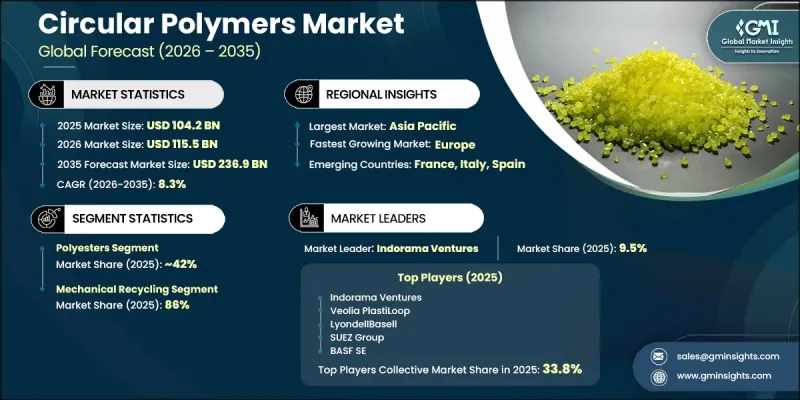
隨著永續性在各行各業日益受到重視,材料的使用方式正在重組,整個產業也持續發展壯大。企業正擴大採用資源高效利用的實踐,以最大限度地減少廢棄物並提升產品生命週期性能。消費者環保意識的增強正在加速向可回收和可重複使用材料的轉變,尤其是在包裝和消費品領域。循環聚合物正逐漸成為更受歡迎的替代方案,因為它們既能減少塑膠廢棄物,又能保持產品的耐用性。回收基礎設施的進步,以及分類、清洗和再加工技術的創新,正在提升材料的品質和可用性。促進再生材料使用和鼓勵環保生產的法規結構,進一步推動了市場擴張。產業永續性目標與消費者期望的日益契合,正在增強製造業、汽車業和包裝業的採用率,為長期成長奠定了堅實的基礎。
| 市場範圍 | |
|---|---|
| 開始年份 | 2025 |
| 預測期 | 2026-2035 |
| 初始市場規模 | 1042億美元 |
| 預測金額 | 2369億美元 |
| 複合年成長率 | 8.3% |
機械回收業憑藉其成本效益和完善的基礎設施,預計到2025年將佔據86%的市場佔有率。此方法依賴物理加工技術,在不改變塑膠廢棄物化學成分的前提下,將其轉化為可回收的材料,因此非常適合廣泛使用的聚合物。其簡單性、擴充性和與現有系統的兼容性,使其在眾多產業中持續佔據主導地位。
預計到2025年,聚酯纖維市佔率將達到42%,並在2035年之前以7.2%的複合年成長率成長。其優異的可回收性、耐用性和適應性使其成為眾多應用領域的首選材料。包裝和紡織品生產領域對永續材料日益成長的需求,持續推動聚酯基循環解決方案的普及。
預計2026年至2035年,北美循環聚合物市場將以7.8%的複合年成長率成長。這一區域成長的驅動力包括更嚴格的環境法規、不斷提升的回收能力以及消費者日益增強的永續性意識。對先進回收系統和環保生產實踐的投資也進一步推動了區域市場的擴張。
目錄
第1章:調查方法和範圍
第2章執行摘要
第3章業界考察
- 生態系分析
- 供應商情況
- 利潤率
- 每個階段增加的價值
- 影響價值鏈的因素
- 中斷
- 影響產業的因素
- 促進因素
- 各行各業越來越意識到使用回收材料可以減少碳足跡。
- 包裝產業對可回收材料的日益普及正在推動市場發展。
- 促進再生塑膠回收利用的可取舉措
- 產業潛在風險與挑戰
- 高昂的回收成本阻礙了循環聚合物的盈利。
- 由於消費者意識不足,對再生聚合物的需求正在下降。
- 市場機遇
- 監管支持的擴大正在加速再生聚合物的採用。
- 全球對永續包裝解決方案的需求日益成長
- 促進因素
- 成長潛力分析
- 監理情勢
- 北美洲
- 歐洲
- 亞太地區
- 拉丁美洲
- 中東和非洲
- 波特五力分析
- PESTEL 分析
- 價格趨勢
- 按地區
- 聚合物類型
- 未來市場趨勢
- 科技與創新趨勢
- 當前技術趨勢
- 新興技術
- 專利趨勢
- 貿易統計(HS編碼)
- 主要進口國
- 主要出口國
- 永續性和環境方面
- 永續計劃
- 減少廢棄物策略
- 生產中的能源效率
- 環保意識的舉措
- 考慮碳足跡
第4章 競爭情勢
- 介紹
- 企業市佔率分析
- 按地區
- 北美洲
- 歐洲
- 亞太地區
- 拉丁美洲
- 中東和非洲(MEA)
- 按地區
- 主要市場公司的競爭分析
- 競爭定位矩陣
- 主要進展
- 併購
- 夥伴關係和聯盟
- 新產品發布
- 業務拓展計劃
第5章 市場估算與預測:聚合物類型,2022-2035年
- 聚酯纖維
- PET(聚對苯二甲酸乙二醇酯)
- PTT(聚對苯二甲酸丙二醇酯)
- PBT(聚丁烯對苯二甲酸酯)
- 聚烯
- 聚乙烯(PE)
- 聚丙烯(PP)
- 乙烯基聚合物
- PVC(聚氯乙烯)
- 聚乙烯醇(PVA)
- 苯乙烯樹脂
- 聚苯乙烯(PS)
- ABS(丙烯腈-丁二烯-苯乙烯)
- SAN(苯乙烯-丙烯腈)
- 工程和特種聚合物
- 聚醯胺(PA/尼龍)
- 聚碳酸酯(PC)
- 其他工程聚合物
第6章 市場估算與預測:依回收技術分類,2022-2035年
- 機械回收
- 消費品回收 (PCR)
- 工業衍生再生材料(PIR)
- 化學回收
- 熱解
- 解聚
- 溶劑純化
- 氣化
- 生物基可回收聚合物
- 插入式生物基聚合物
- 新型生物聚合物
第7章 市場估計與預測:依應用領域分類,2022-2035年
- 包裝
- 食品包裝
- 非食品包裝
- 軟包裝
- 硬包裝
- 建築/施工
- 隔熱材料
- 管道和供水/排水系統
- 設定檔和金屬製品
- 地板材料、露台、屋頂材料
- 車
- 內部零件
- 外部部件
- 引擎室部件
- 結構和安全部件
- 電氣和電子
- 家用電子電器
- 電纜和線路
- 零件和連接器
- 白色家電和家用電器
- 農業
- 電影
- 灌溉系統
- 容器和存儲
- 紡織服裝
- 聚酯纖維(rPET)
- 尼龍纖維(再生聚醯胺)
- 不織布
- 消費品及其他
- 家具/家居用品
- 玩具和休閒用品
- 其他用途
第8章 市場估計與預測:依地區分類,2022-2035年
- 北美洲
- 美國
- 加拿大
- 歐洲
- 德國
- 英國
- 法國
- 西班牙
- 義大利
- 其他歐洲地區
- 亞太地區
- 中國
- 印度
- 日本
- 澳洲
- 韓國
- 亞太其他地區
- 拉丁美洲
- 巴西
- 墨西哥
- 阿根廷
- 其他拉丁美洲地區
- 中東和非洲
- 沙烏地阿拉伯
- 南非
- 阿拉伯聯合大公國
- 其他中東和非洲地區
第9章:公司簡介
- Amcor
- BASF SE
- Brightmark
- Carbios
- Eastman
- Enka
- Gr3n
- Indorama Ventures
- KW Plastics
- Loop Industries
- LyondellBasell
- MBA Polymers
- Plastic Energy
- Plastipak
- PureCycle Technologies
- SUEZ Group
- Veolia PlastiLoop
The Global Circular Polymers Market was valued at USD 104.2 billion in 2025 and is estimated to grow at a CAGR of 8.3% to reach USD 236.9 billion by 2035.
The industry continues to gain traction as sustainability priorities reshape material usage across sectors. Companies are increasingly adopting resource-efficient practices to minimize waste and improve lifecycle performance. Rising environmental awareness among consumers is accelerating the shift toward recyclable and reusable materials, particularly in packaging and consumer goods. Circular polymers are emerging as a preferred alternative due to their ability to reduce plastic waste while maintaining product durability. Advancements in recycling infrastructure, combined with innovations in sorting, cleaning, and reprocessing technologies, are improving material quality and usability. Regulatory frameworks promoting recycled content usage and incentivizing eco-friendly production further support market expansion. Growing alignment between industrial sustainability goals and consumer expectations is reinforcing adoption across manufacturing, automotive, and packaging industries, creating a strong foundation for long-term growth.
| Market Scope | |
|---|---|
| Start Year | 2025 |
| Forecast Year | 2026-2035 |
| Start Value | $104.2 Billion |
| Forecast Value | $236.9 Billion |
| CAGR | 8.3% |
The mechanical recycling segment captured a share of 86% in 2025, supported by its cost efficiency and well-established infrastructure. This method relies on physical processing techniques to convert plastic waste into reusable material without altering its chemical composition, making it highly suitable for widely used polymers. Its simplicity, scalability, and compatibility with existing systems continue to strengthen its dominance across multiple industries.
The polyesters segment held a 42% share in 2025 and is forecast to grow at a CAGR of 7.2% through 2035. Their strong recyclability, durability, and adaptability make them a preferred choice for a wide range of applications. Increasing demand for sustainable materials in packaging and textile production continues to drive the adoption of polyester-based circular solutions.
North America Circular Polymers Market is expected to grow at a CAGR of 7.8% between 2026 and 2035. Growth in the region is driven by stricter environmental regulations, improved recycling capabilities, and heightened consumer awareness regarding sustainability. Investments in advanced recycling systems and eco-conscious manufacturing practices are further strengthening regional market expansion.
Key participants in the Global Circular Polymers Market include Amcor, Brightmark, BASF SE, Carbios, Eastman, Enka, Gr3n, Indorama Ventures, KW Plastics, Loop Industries, LyondellBasell, MBA Polymers, Plastic Energy, Plastipak, PureCycle Technologies, SUEZ Group, and Veolia PlastiLoop. Companies operating in the circular polymers market are focusing on expanding recycling capabilities, investing in advanced processing technologies, and forming strategic collaborations to strengthen their competitive position. Many players are prioritizing chemical recycling innovations to complement mechanical methods and improve material recovery rates. Partnerships across the value chain, including waste management firms and packaging companies, are helping ensure consistent raw material supply. Businesses are also emphasizing product innovation by developing high-quality recycled polymers that meet performance standards.
Table of Contents
Chapter 1 Methodology & Scope
- 1.1 Market scope and definition
- 1.2 Research design
- 1.2.1 Research approach
- 1.2.2 Data collection methods
- 1.3 Data mining sources
- 1.3.1 Global
- 1.3.2 Regional/Country
- 1.4 Base estimates and calculations
- 1.4.1 Base year calculation
- 1.4.2 Key trends for market estimation
- 1.5 Primary research and validation
- 1.5.1 Primary sources
- 1.6 Forecast model
- 1.7 Research assumptions and limitations
Chapter 2 Executive Summary
- 2.1 Industry 360° synopsis
- 2.2 Key market trends
- 2.2.1 Regional
- 2.2.2 Polymer type
- 2.2.3 Recycling technology
- 2.2.4 Application
- 2.3 TAM Analysis, 2026-2035
- 2.4 CXO perspectives: Strategic imperatives
Chapter 3 Industry Insights
- 3.1 Industry ecosystem analysis
- 3.1.1 Supplier landscape
- 3.1.2 Profit margin
- 3.1.3 Value addition at each stage
- 3.1.4 Factor affecting the value chain
- 3.1.5 Disruptions
- 3.2 Industry impact forces
- 3.2.1 Growth drivers
- 3.2.1.1 Rising awareness among various industries to use recycled materials to reduce their carbon footprints
- 3.2.1.2 Increasing adoption of recyclable materials in the packaging industry is driving the market
- 3.2.1.3 Favorable initiatives to promote recycled plastics
- 3.2.2 Industry pitfalls and challenges
- 3.2.2.1 High recycling costs hinder profitability for circular polymers
- 3.2.2.2 Limited consumer awareness reduces demand for recycled polymers
- 3.2.3 Market opportunities
- 3.2.3.1 Growing regulatory support promotes adoption of circular polymers
- 3.2.3.2 Increasing global demand for sustainable packaging solutions
- 3.2.1 Growth drivers
- 3.3 Growth potential analysis
- 3.4 Regulatory landscape
- 3.4.1 North America
- 3.4.2 Europe
- 3.4.3 Asia Pacific
- 3.4.4 Latin America
- 3.4.5 Middle East & Africa
- 3.5 Porter's analysis
- 3.6 PESTEL analysis
- 3.7 Price trends
- 3.7.1 By region
- 3.7.2 By polymer type
- 3.8 Future market trends
- 3.9 Technology and innovation landscape
- 3.9.1 Current technological trends
- 3.9.2 Emerging technologies
- 3.10 Patent Landscape
- 3.11 Trade statistics (HS code)
- 3.11.1 Major importing countries
- 3.11.2 Major exporting countries
- 3.12 Sustainability and environmental aspects
- 3.12.1 Sustainable practices
- 3.12.2 Waste reduction strategies
- 3.12.3 Energy efficiency in production
- 3.12.4 Eco-friendly initiatives
- 3.13 Carbon footprint consideration
Chapter 4 Competitive Landscape, 2025
- 4.1 Introduction
- 4.2 Company market share analysis
- 4.2.1 By region
- 4.2.1.1 North America
- 4.2.1.2 Europe
- 4.2.1.3 Asia Pacific
- 4.2.1.4 LATAM
- 4.2.1.5 MEA
- 4.2.1 By region
- 4.3 Competitive analysis of major market players
- 4.4 Competitive positioning matrix
- 4.5 Key developments
- 4.5.1 Mergers & acquisitions
- 4.5.2 Partnerships & collaborations
- 4.5.3 New Product Launches
- 4.5.4 Expansion Plans
Chapter 5 Market Estimates and Forecast, By Polymer Type, 2022-2035 (USD Billion) (Kilo Tons)
- 5.1 Key trends
- 5.2 Polyesters
- 5.2.1 PET (Polyethylene Terephthalate)
- 5.2.2 PTT (Polytrimethylene Terephthalate)
- 5.2.3 PBT (Polybutylene Terephthalate)
- 5.3 Polyolefins
- 5.3.1 Polyethylene (PE)
- 5.3.2 Polypropylene (PP)
- 5.4 Vinyl Polymers
- 5.4.1 PVC (Polyvinyl Chloride)
- 5.4.2 PVA (Polyvinyl Alcohol)
- 5.5 Styrenics
- 5.5.1 Polystyrene (PS)
- 5.5.2 ABS (Acrylonitrile Butadiene Styrene)
- 5.5.3 SAN (Styrene Acrylonitrile)
- 5.6 Engineering & Specialty Polymers
- 5.6.1 Polyamides (PA/Nylon)
- 5.6.2 Polycarbonate (PC)
- 5.6.3 Other Engineering Polymers
Chapter 6 Market Estimates and Forecast, By Recycling Technology, 2022-2035 (USD Billion) (Kilo Tons)
- 6.1 Key trends
- 6.2 Mechanical recycling
- 6.2.1 Post-consumer recycled (PCR)
- 6.2.2 Post-industrial recycled (PIR)
- 6.3 Chemical recycling
- 6.3.1 Pyrolysis
- 6.3.2 Depolymerization
- 6.3.3 Solvent-based purification
- 6.3.4 Gasification
- 6.4 Bio-based circular polymers
- 6.4.1 Drop-in bio-based polymers
- 6.4.2 Novel bio-polymers
Chapter 7 Market Estimates and Forecast, By Application, 2022-2035 (USD Billion) (Kilo Tons)
- 7.1 Key trends
- 7.2 Packaging
- 7.2.1 Food-grade packaging
- 7.2.2 Non-food packaging
- 7.2.3 Flexible packaging
- 7.2.4 Rigid packaging
- 7.3 Building & construction
- 7.3.1 Insulation materials
- 7.3.2 Pipes & plumbing systems
- 7.3.3 Profiles & fittings
- 7.3.4 Flooring, decking & roofing
- 7.4 Automotive
- 7.4.1 Interior components
- 7.4.2 Exterior components
- 7.4.3 Under-the-hood components
- 7.4.4 Structural & safety components
- 7.5 Electrical & electronics
- 7.5.1 Consumer electronics
- 7.5.2 Cables & wiring
- 7.5.3 Components & connectors
- 7.5.4 White goods & appliances
- 7.6 Agriculture
- 7.6.1 Films
- 7.6.2 Irrigation systems
- 7.6.3 Containers & storage
- 7.7 Textiles & apparel
- 7.7.1 Polyester fibers (rPET)
- 7.7.2 Nylon fibers (recycled pa)
- 7.7.3 Non-woven fabrics
- 7.8 Consumer goods & others
- 7.8.1 Furniture & home goods
- 7.8.2 Toys & recreational products
- 7.8.3 Other applications
Chapter 8 Market Estimates and Forecast, By Region, 2022-2035 (USD Billion) (Kilo Tons)
- 8.1 Key trends
- 8.2 North America
- 8.2.1 U.S.
- 8.2.2 Canada
- 8.3 Europe
- 8.3.1 Germany
- 8.3.2 UK
- 8.3.3 France
- 8.3.4 Spain
- 8.3.5 Italy
- 8.3.6 Rest of Europe
- 8.4 Asia Pacific
- 8.4.1 China
- 8.4.2 India
- 8.4.3 Japan
- 8.4.4 Australia
- 8.4.5 South Korea
- 8.4.6 Rest of Asia Pacific
- 8.5 Latin America
- 8.5.1 Brazil
- 8.5.2 Mexico
- 8.5.3 Argentina
- 8.5.4 Rest of Latin America
- 8.6 Middle East and Africa
- 8.6.1 Saudi Arabia
- 8.6.2 South Africa
- 8.6.3 UAE
- 8.6.4 Rest of Middle East and Africa
Chapter 9 Company Profiles
- 9.1 Amcor
- 9.2 BASF SE
- 9.3 Brightmark
- 9.4 Carbios
- 9.5 Eastman
- 9.6 Enka
- 9.7 Gr3n
- 9.8 Indorama Ventures
- 9.9 KW Plastics
- 9.10 Loop Industries
- 9.11 LyondellBasell
- 9.12 MBA Polymers
- 9.13 Plastic Energy
- 9.14 Plastipak
- 9.15 PureCycle Technologies
- 9.16 SUEZ Group
- 9.17 Veolia PlastiLoop

 循環聚合物:市場佔有率分析、產業趨勢與統計、成長預測(2026-2031)
 2026-2030年全球再生聚合物市場
 再生塑膠和循環聚合物市場:預測至2034年-按聚合物類型、回收技術、循環經濟模式、最終用戶和地區分類的全球分析
 圓形聚合物薄膜市場規模、佔有率和趨勢分析報告:按材料類型、厚度、最終用途、地區和細分市場預測(2026-2033 年)
 循環聚合物市場規模、佔有率和成長分析:按聚合物類型、製造流程、應用、最終用途和地區分類-2026-2033年產業預測
 2026年全球循環聚合物市場報告環狀聚合物原料市場預測至2032年:依聚合物類型、原料類型、產地、最終用戶及地區分類2032 年環狀聚合物市場預測:按聚合物類型、形態、環狀度、製造流程、應用、最終用戶和地區進行的全球分析
 全球循環聚合物市場