


 |
市場調查報告書
商品編碼
2038700
磁振造影造影(MRI)市場機會、成長要素、產業趨勢分析及2026-2035年預測Magnetic Resonance Imaging Systems Market Opportunity, Growth Drivers, Industry Trend Analysis, and Forecast 2026 - 2035 |
||||||

全球磁振造影(MRI)市場預計到 2025 年將價值 68 億美元,預計到 2035 年將以 6.5% 的複合年成長率成長至 127 億美元。
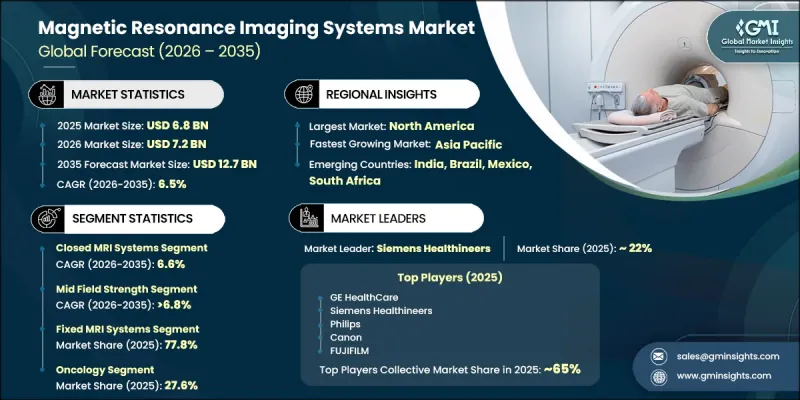
全球慢性病發病率上升、對早期精準診斷的日益重視以及人們對先進醫學影像解決方案認知度的不斷提高,共同推動了市場擴張。影像硬體和軟體技術的持續進步提高了診斷準確性、運作效率和掃描速度,進一步促進了市場普及。此外,老年人口的成長也顯著增加了市場需求,因為與老齡化相關的疾病需要更頻繁、更詳細的診斷評估。磁振造影(MRI)系統因其能夠提供高解析度、非侵入性且無電離輻射的影像,正日益被現代醫療基礎設施所採用。這使得MRI系統成為檢測和監測複雜疾病(包括神經系統疾病、心血管疾病、腫瘤疾病和肌肉骨骼疾病)的關鍵工具。醫療保健投資的增加和醫院現代化改造計畫也進一步推動了MRI系統在已開發市場和新興市場醫療領域的廣泛應用。
| 市場範圍 | |
|---|---|
| 開始年份 | 2025 |
| 預測期 | 2026-2035 |
| 上市時的市場規模 | 68億美元 |
| 預測金額 | 127億美元 |
| 複合年成長率 | 6.5% |
磁振造影(MRI) 系統是一種先進的診斷平台,它利用強大的磁場、射頻能源和電腦訊號處理技術,產生人體極其清晰的影像。這些系統與人體組織內的氫原子相互作用,產生清晰、高對比的軟組織和器官影像,且不會使患者暴露於有害輻射中。其非侵入性和卓越的影像清晰度使其成為識別、評估和後續觀察多種疾病的首選診斷工具。慢性病在全球範圍內的日益普遍是推動 MRI 系統需求成長的主要因素,因為早期診斷和持續監測對於獲得有效的治療效果至關重要。老年人口的成長也促進了市場發展,因為老年人更容易出現長期健康問題,並且往往需要先進的影像技術進行診斷和疾病管理。
預計2026年至2035年間,封閉式磁振造影系統市場將以6.6%的複合年成長率成長。該市場的成長主要得益於技術進步,例如改進的孔徑設計、提升的患者舒適度以及更快的影像擷取序列。封閉式磁振造影系統透過減少外部干擾和運動引起的影像失真,提供卓越的影像質量,使其成為精準診斷成像的理想選擇。其優異的臨床表現使其在神經病學、肌肉骨骼、循環系統和腫瘤學等領域中廣泛應用,在這些領域,影像的準確性和一致性對於診斷和治療方案的發展至關重要。
截至2025年,固定式磁振造影系統將佔77.8%的市場。固定式磁振造影系統憑藉其廣泛的臨床應用能力和應對力,仍然是全球市場的主要產品類別。這些系統廣泛應用於先進的診斷中心和大規模醫療機構,滿足其複雜影像、介入治療和研究性應用的需求。儘管其安裝和基礎設施要求較高,但其運作長、擴充性以及患者處理能力強等優點,持續推動市場需求的穩定成長。
美國磁振造影造影(MRI)系統市場預計到2025年將達到24億美元。這一區域成長主要受美國和加拿大慢性病盛行率上升的推動。相當一部分成年人患有需要先進影像技術進行診斷和持續監測的長期疾病,這支撐了對MRI系統的持續需求。完善的醫療基礎設施和對醫學影像技術的持續投資進一步推動了北美市場的擴張。
目錄
第1章:調查方法
- 研究途徑
- 品質改進計劃
- GMI人工智慧政策及對資料完整性的承諾
- 資訊來源一致性協議
- GMI人工智慧政策及對資料完整性的承諾
- 調查過程和可靠性評分
- 調查過程的組成部分
- 評分組成部分
- 數據收集
- 主要來源部分列表
- 資料探勘資訊來源
- 付費資訊來源
- 區域資訊來源
- 付費資訊來源
- 基本估算和計算方法
- 每種方法中基準年的計算
- 預測模型
- 量化市場影響分析
- 生長參數對預測的數學影響
- 量化市場影響分析
- 關於調查透明度的補充信息
- 資訊來源歸屬框架
- 品質保證指標
- 對信任的承諾
第2章執行摘要
第3章業界考察
- 生態系分析
- 影響產業的因素
- 促進因素
- 人口老化的進程
- 全球慢性病盛行率不斷上升
- 提高對早期診斷的認知
- 磁振造影系統的技術進步
- 事故數量增加
- 產業潛在風險與挑戰
- 熟練專業人員短缺
- 核磁共振成像系統成本高昂
- 市場機遇
- 用於急診和床邊成像的可攜式磁振造影系統。
- 人工智慧驅動的工作流程最佳化和診斷支持
- 促進因素
- 成長潛力分析
- 監理情勢
- 北美洲
- 歐洲
- 亞太地區
- 技術趨勢(基於初步調查)
- 當前技術趨勢
- 超高場磁振造影技術
- 將人工智慧(AI)整合到磁振造影系統中
- 新興技術
- 攜帶式和即時磁振造影技術的創新
- 零蒸發(ZBO)磁體技術與無氦磁振造影系統
- 當前技術趨勢
- 未來市場趨勢(基於初步研究)
- 人工智慧和生成式人工智慧對市場的影響(基於初步研究)
- 價格分析(2025 年)(基於初步調查)
- 投資趨勢
- 波特五力分析
- PESTEL 分析
第4章 競爭情勢
- 介紹
- GE醫療
- 西門子醫療內部
- 飛利浦
- 企業市佔率分析
- 北美洲
- 歐洲
- 亞太地區
- 企業矩陣分析
- 主要市場公司的競爭分析
- 競爭定位矩陣
- 主要進展
- 併購
- 夥伴關係與合作
- 新產品發布
- 業務拓展計劃
第5章 市場估價與預測:依建築類型分類,2022-2035年
- 開放系統
- 封閉式系統
第6章 市場估算與預測:依磁場強度分類,2022-2035年
- 低磁場強度
- 中等磁場強度
- 高磁場強度
第7章 市場估價與預測:依設計分類,2022-2035年
- 固定式磁振造影系統
- 可攜式磁振造影系統
第8章 市場估計與預測:依應用領域分類,2022-2035年
- 腫瘤學
- 神經病學
- 肌肉骨骼系統
- 血管
- 消化系統
- 循環系統
- 其他用途
第9章 市場估計與預測:依最終用途分類,2022-2035年
- 醫院
- 診斷影像中心
- 門診手術中心
- 其他最終用戶
第10章 市場估價與預測:依地區分類,2022-2035年
- 北美洲
- 美國
- 加拿大
- 歐洲
- 德國
- 英國
- 法國
- 西班牙
- 義大利
- 荷蘭
- 亞太地區
- 中國
- 日本
- 印度
- 澳洲
- 韓國
- 拉丁美洲
- 巴西
- 墨西哥
- 阿根廷
- 中東和非洲
- 南非
- 沙烏地阿拉伯
- 阿拉伯聯合大公國
第11章:公司簡介
- ASG SUPERCONDUCTORS
- aspectimaging
- AURORA
- esaote
- Canon
- FONAR
- FUJIFILM
- GE HealthCare
- Philips
- MinFound
- MRSOLUTIONS
- Neusoft
- UNITED IMAGING
- Siemens Healthineers
- Synaptive
- TIME MEDICAL SYSTEMS
The Global Magnetic Resonance Imaging Systems Market was valued at USD 6.8 billion in 2025 and is estimated to grow at a CAGR of 6.5% to reach USD 12.7 billion by 2035.
The market expansion is supported by the rising incidence of chronic diseases worldwide, increasing emphasis on early and accurate diagnosis, and growing awareness regarding advanced medical imaging solutions. Continuous technological advancements in imaging hardware and software are improving diagnostic precision, operational efficiency, and scan speed, further strengthening market adoption. In addition, the growing elderly population is significantly contributing to demand, as age-related conditions require frequent and detailed diagnostic evaluation. Magnetic resonance imaging systems are increasingly being integrated into modern healthcare infrastructure due to their ability to deliver high-resolution, non-invasive imaging without ionizing radiation exposure. This makes them essential for detecting and monitoring complex medical conditions, including neurological, cardiovascular, oncological, and musculoskeletal disorders. Expanding healthcare investments and hospital modernization programs are further supporting widespread installation of MRI systems across both developed and emerging healthcare markets.
| Market Scope | |
|---|---|
| Start Year | 2025 |
| Forecast Year | 2026-2035 |
| Start Value | $6.8 Billion |
| Forecast Value | $12.7 Billion |
| CAGR | 6.5% |
Magnetic resonance imaging systems are advanced diagnostic platforms that utilize strong magnetic fields, radiofrequency energy, and computerized signal processing to produce highly detailed internal body images. These systems work by interacting with hydrogen atoms in human tissues to generate clear and contrast-rich images of soft tissues and organs without exposing patients to harmful radiation. Their non-invasive nature and superior imaging clarity make them a preferred diagnostic tool for identifying, evaluating, and tracking a wide range of diseases. Rising global chronic disease prevalence is a key factor accelerating demand for MRI systems, as early diagnosis and continuous monitoring are critical for effective treatment outcomes. The increasing elderly population is also contributing to market growth, as older individuals are more prone to long-term health conditions requiring advanced imaging support for diagnosis and disease management.
The closed MRI systems segment is expected to register a CAGR of 6.6% during 2026-2035. Growth in this segment is driven by advancements such as improved bore designs, enhanced patient comfort features, and faster imaging sequences. Closed MRI systems provide superior image quality by reducing external interference and motion-related distortions, making them highly suitable for precise diagnostic imaging. Their strong clinical performance supports widespread adoption across neurological, musculoskeletal, cardiovascular, and oncology applications, where imaging accuracy and consistency are critical for diagnosis and treatment planning.
The fixed MRI systems segment accounted for 77.8% share in 2025. Fixed MRI systems remain the dominant category in the global market due to their broad clinical capabilities and compatibility across multiple magnetic field strengths. These systems are extensively used in advanced diagnostic centers and large healthcare facilities where complex imaging procedures, interventional support, and research applications are required. Their long operational lifespan, scalability, and ability to support high patient throughput continue to drive steady demand, despite higher installation and infrastructure requirements.
U.S. Magnetic Resonance Imaging Systems Market reached USD 2.4 billion in 2025. Growth in the region is strongly influenced by the rising prevalence of chronic diseases across the United States and Canada. A significant portion of the adult population lives with long-term health conditions that require advanced imaging for diagnosis and ongoing monitoring, supporting sustained demand for MRI systems. The presence of a well-established healthcare infrastructure and continuous investments in medical imaging technologies further reinforce market expansion across North America.
Prominent players operating in the Global Magnetic Resonance Imaging Systems Industry include Siemens Healthineers, GE HealthCare, Philips, Canon, FUJIFILM, United Imaging, Neusoft, Esaote, FONAR, ASG Superconductors, MinFound, MR Solutions, Aspect Imaging, Aurora, Synaptive, and Time Medical Systems. Key strategies adopted by companies in the magnetic resonance imaging systems market include continuous investment in research and development to enhance image resolution, scanning speed, and patient comfort. Manufacturers are increasingly focusing on the development of compact and energy-efficient MRI systems to expand accessibility across smaller healthcare facilities. Strategic collaborations with hospitals, diagnostic centers, and research institutes are being used to strengthen market penetration and accelerate technology adoption. Companies are also integrating artificial intelligence and advanced software solutions to improve image reconstruction, workflow automation, and diagnostic accuracy. Expansion into emerging markets through distribution partnerships and localized production is another key strategy.
Table of Contents
Chapter 1 Research Methodology
- 1.1 Research approach
- 1.2 Quality commitments
- 1.2.1 GMI AI policy & data integrity commitment
- 1.2.1.1 Source consistency protocol
- 1.2.1 GMI AI policy & data integrity commitment
- 1.3 Research trail & confidence scoring
- 1.3.1 Research trail components
- 1.3.2 Scoring components
- 1.4 Data collection
- 1.4.1 Partial list of primary sources
- 1.5 Data mining sources
- 1.5.1 Paid sources
- 1.5.1.1 Sources, by region
- 1.5.1 Paid sources
- 1.6 Base estimates and calculations
- 1.6.1 Base year calculation for any one approach
- 1.7 Forecast model
- 1.7.1 Quantified market impact analysis
- 1.7.1.1 Mathematical impact of growth parameters on forecast
- 1.7.1 Quantified market impact analysis
- 1.8 Research transparency addendum
- 1.8.1 Source attribution framework
- 1.8.2 Quality assurance metrics
- 1.8.3 Our commitment to trust
Chapter 2 Executive Summary
- 2.1 Industry 3600 synopsis
- 2.2 Key market trends
- 2.2.1 Architecture trends
- 2.2.2 Field strength trends
- 2.2.3 Design trends
- 2.2.4 Application trends
- 2.2.5 End use trends
- 2.2.6 Regional trends
- 2.3 CXO perspectives: Strategic imperatives
Chapter 3 Industry Insights
- 3.1 Industry ecosystem analysis
- 3.2 Industry impact forces
- 3.2.1 Growth drivers
- 3.2.1.1 Growing geriatric population
- 3.2.1.2 Increasing chronic disease prevalence globally
- 3.2.1.3 Growing awareness pertaining to early diagnosis
- 3.2.1.4 Technological advancements in the MRI system
- 3.2.1.5 Increasing number of accidents
- 3.2.2 Industry pitfalls and challenges
- 3.2.2.1 Dearth of skilled professionals
- 3.2.2.2 High cost of the MRI system
- 3.2.3 Market opportunities
- 3.2.3.1 Portable MRI systems for emergency and bedside imaging
- 3.2.3.2 AI-enhanced workflow optimization and diagnostic support
- 3.2.1 Growth drivers
- 3.3 Growth potential analysis
- 3.4 Regulatory landscape
- 3.4.1 North America
- 3.4.2 Europe
- 3.4.3 Asia Pacific
- 3.5 Technology landscape (Driven by primary research)
- 3.5.1 Current technological trends
- 3.5.1.1 Ultra high field MRI technology
- 3.5.1.2 Artificial intelligence (AI) integration in MRI systems
- 3.5.2 Emerging technologies
- 3.5.2.1 Portable and point of care MRI innovation
- 3.5.2.2 Zero boil off (ZBO) magnet technology and helium free MRI systems
- 3.5.1 Current technological trends
- 3.6 Future market trends (Driven by primary research)
- 3.7 Impact of AI and Generative AI on the market (Driven by primary research)
- 3.8 Pricing analysis, 2025 (Driven by primary research)
- 3.9 Investment landscape
- 3.10 Porter's analysis
- 3.11 PESTEL analysis
Chapter 4 Competitive Landscape, 2025
- 4.1 Introduction
- 4.1.1 GE HealthCare
- 4.1.2 Siemens Healthineers
- 4.1.3 Philips
- 4.2 Company market share analysis
- 4.2.1 North America
- 4.2.2 Europe
- 4.2.3 Asia Pacific
- 4.3 Company matrix analysis
- 4.4 Competitive analysis of major market players
- 4.5 Competitive positioning matrix
- 4.6 Key developments
- 4.6.1 Mergers and acquisitions
- 4.6.2 Partnerships and collaborations
- 4.6.3 New product launches
- 4.6.4 Expansion plans
Chapter 5 Market Estimates and Forecast, By Architecture, 2022 - 2035 ($ Mn)
- 5.1 Key trends
- 5.2 Open system
- 5.3 Closed system
Chapter 6 Market Estimates and Forecast, By Field Strength, 2022 - 2035 ($ Mn)
- 6.1 Key trends
- 6.2 Low field strength
- 6.3 Mid field strength
- 6.4 High field strength
Chapter 7 Market Estimates and Forecast, By Design, 2022 - 2035 ($ Mn)
- 7.1 Key trends
- 7.2 Fixed MRI systems
- 7.3 Portable MRI systems
Chapter 8 Market Estimates and Forecast, By Application, 2022 - 2035 ($ Mn)
- 8.1 Key trends
- 8.2 Oncology
- 8.3 Neurology
- 8.4 Musculoskeletal
- 8.5 Vascular
- 8.6 Gastroenterology
- 8.7 Cardiology
- 8.8 Other applications
Chapter 9 Market Estimates and Forecast, By End Use, 2022 - 2035 ($ Mn)
- 9.1 Key trends
- 9.2 Hospitals
- 9.3 Imaging centers
- 9.4 Ambulatory surgical centers
- 9.5 Other end users
Chapter 10 Market Estimates and Forecast, By Region, 2022 - 2035 ($ Mn)
- 10.1 Key trends
- 10.2 North America
- 10.2.1 U.S.
- 10.2.2 Canada
- 10.3 Europe
- 10.3.1 Germany
- 10.3.2 UK
- 10.3.3 France
- 10.3.4 Spain
- 10.3.5 Italy
- 10.3.6 Netherlands
- 10.4 Asia Pacific
- 10.4.1 China
- 10.4.2 Japan
- 10.4.3 India
- 10.4.4 Australia
- 10.4.5 South Korea
- 10.5 Latin America
- 10.5.1 Brazil
- 10.5.2 Mexico
- 10.5.3 Argentina
- 10.6 Middle East and Africa
- 10.6.1 South Africa
- 10.6.2 Saudi Arabia
- 10.6.3 UAE
Chapter 11 Company Profiles
- 11.1 ASG SUPERCONDUCTORS
- 11.2 aspectimaging
- 11.3 AURORA
- 11.4 esaote
- 11.5 Canon
- 11.6 FONAR
- 11.7 FUJIFILM
- 11.8 GE HealthCare
- 11.9 Philips
- 11.10 MinFound
- 11.11 MRSOLUTIONS
- 11.12 Neusoft
- 11.13 UNITED IMAGING
- 11.14 Siemens Healthineers
- 11.15 Synaptive
- 11.16 TIME MEDICAL SYSTEMS

 術中磁振造影市場:依系統類型、技術類型、磁體技術、磁場強度、掃描器類型、應用和最終用戶分類-2026-2032年全球市場預測磁振造影造影 (MRI) 市場:2026-2032 年全球市場預測(按產品類型、組件、磁場強度、磁鐵類型、線圈類型、應用和最終用戶分類)
 全球磁振造影系統市場:按應用、架構、設計、最終用戶、磁場強度和地區分類-預測至2031年
 全身MRI市場報告:趨勢、預測與競爭分析(至2035年)磁性測量儀器市場:依產品類型、技術、應用、最終用途、國家及地區分類-全球產業分析、市場規模、市場佔有率及2026年至2033年預測
 磁振造影系統市場報告:按架構、磁場強度、應用、最終用途、技術和地區分類,2026-2034年
 磁振造影(MRI)系統市場:按類型、磁場強度、應用、最終用戶和地區分類
 2026年全球磁振造影(MRI)人工智慧市場報告低場磁振磁振造影系統市場:按產品類型、技術、銷售管道、應用和最終用戶分類的全球預測(2026-2032年)2026年全球磁振造影診斷設備及器材市場報告