


 |
市場調查報告書
商品編碼
2076880
全球磁振造影系統市場:按應用、架構、設計、最終用戶、磁場強度和地區分類-預測至2031年MRI Systems Market by Architecture, Design, Field Strength, Application, End User, and Procedure Volume - Global Forecast to 2031 |
||||||


MRI 系統市場在設計和功能方面正在不斷發展,無氦或低氦 MRI 技術正在成為成長的關鍵驅動力。
這一趨勢很大程度上受到營運成本上升、氦氣供應不穩定以及醫療領域對永續性的關注的影響。
| 調查範圍 | |
|---|---|
| 調查期 | 2026-2031 |
| 基準年 | 2025 |
| 預測期 | 2026-2031 |
| 計算單位 | 金額(10億美元) |
| 部分 | 按應用程式、架構、設計、最終用戶、磁場強度和區域分類 |
| 目標區域 | 北美、歐洲、亞太地區、拉丁美洲、中東和非洲 |
傳統的磁振造影系統通常需要超過1000公升氦氣來冷卻其超導性磁鐵。然而,全球氦氣短缺,例如Gasworld報告的“氦氣短缺4.0”,已導致氦氣價格上漲高達250%,擾亂了診斷成像並增加了維護成本。這些挑戰對於預算緊張的中型醫院和門診診所而言尤其緊迫。為了應對這些挑戰,皇家飛利浦公司(荷蘭)、西門子醫療(德國)和上海聯影醫療(中國)等製造商推出了顯著減少氦氣用量或完全密封的磁振造影系統。
這些創新技術降低了整體擁有成本,同時有助於實現永續性和零碳排放等環境目標。
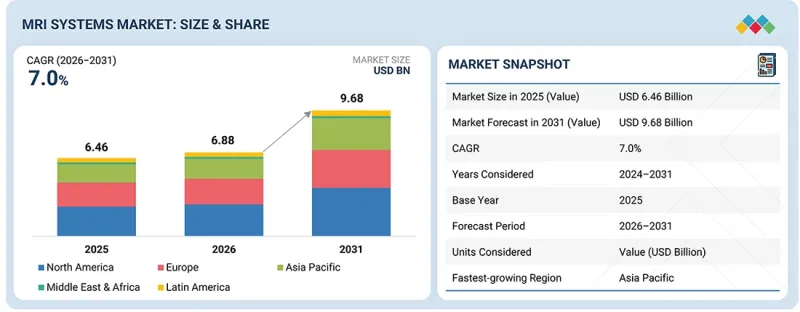
全球 MRI 系統市場預計將從 2026 年的 68.8 億美元成長到 2031 年的 96.8 億美元,2026 年至 2031 年的複合年成長率為 7.0%。
該市場的成長主要受疾病負擔加重的驅動,尤其是在神經系統和肌肉骨骼疾病領域,預計未來幾年這一趨勢將進一步加劇。此外,人口老化以及由此導致的癌症等慢性疾病盛行率上升,預計也將增加全球對磁振造影(MRI)系統的需求。所有這些因素都將促進MRI系統市場的整體成長。
就磁場強度而言,高場和超高場細分市場將推動 2025 年 MRI 系統市場的發展。
根據磁場強度,磁振造影(MRI)系統市場可分為低場至中場MRI系統、高場和超高場MRI系統以及超高場MRI系統。高場和超高場MRI系統以其卓越的信噪比(SNR)而著稱,顯著提升了其臨床效用。這些系統不僅對腦部、肌肉骨骼系統和血管系統的成像至關重要,而且在精神病學、神經病學、生物醫學研究以及多發性硬化症等疾病的早期檢測等專業應用領域也發揮著重要作用。將MRI與PET和超音波等互補成像方法結合,可縮短掃描時間、提高影像解析度、進一步最佳化運作效率並減少氦氣用量。高場MRI系統,尤其是1.5T和3T系統,由於其顯著更優的影像品質、更短的掃描時間和更廣泛的臨床應用範圍,優於低場系統(低於1T)。高場強磁振造影系統具有高訊號雜訊比 (SNR),能夠實現更清晰、更精細的成像,這對於診斷神經系統疾病、肌肉骨骼損傷和心血管異常等複雜病症至關重要。高速掃描能力不僅提高了病患處理能力,也提升了醫療機構的營運效率。這些因素共同推動了高場強磁振造影系統在市場上的普及。
依架構分類,到 2025 年,封閉式MRI 系統市佔率最大。
封閉式磁振造影造影(MRI)掃描儀利用一個小型圓柱形腔室,以極高的細節成像人體結構。大多數高場超導性磁振造影(MRI)系統都設計為封閉式系統。由於其高效率、卓越的影像品質以及高磁場強度帶來的更高吞吐量,封閉式MRI系統被認為是行業標準。與可能需要四到五次掃描才能完成同等評估的開放式MRI系統相比,封閉式MRI系統通常只需一到兩次掃描即可完成檢查過程。這種高效性不僅縮短了檢查時間,還提高了手術和治療的臨床效用。由於封閉式MRI掃描時間較短,因此有助於減少運動偽影並提高病患處理能力,使其特別適用於病患量大的醫院和診斷中心。此外,它還支援功能性磁振造影(fMRI)、擴散加權成像(DWI)和心臟磁振造影等先進成像技術,所有這些技術都需要高磁場強度才能提高精度。
根據設計,到 2025 年,固定式/靜態 MRI 系統預計將佔據最大的市場佔有率。
從設計角度來看,磁振造影(MRI)系統市場可分為固定式/站式MRI系統和可攜式MRI系統。固定式MRI系統通常比可攜式更受歡迎,原因有以下幾點:影像品質更佳、可進行全身掃描、工作流程更簡化以及長期成本效益更高。固定式核磁共振造影系統通常在磁場中運作。固定式MRI系統的另一個主要優勢是能夠進行全身成像,這進一步推動了市場成長。
從應用領域來看,預計在預測期內,腦部和神經系統 MRI 領域將錄得最高的成長率。
依應用領域分類,磁振造影(MRI)系統市場可細分為腦部和神經系統MRI、脊椎和肌肉骨骼系統MRI、骨盆和腹部MRI、血管MRI、乳房MRI、心臟MRI、兒童MRI等應用。預計在預測期內,腦和神經系統MRI細分市場將保持最高的成長率。推動該細分市場快速成長的關鍵因素包括先進人工智慧技術的應用,以及能夠精準定位內臟器官並實現即時影像診斷的創新設備的日益普及。
以最終用戶分類,醫院領域在 2025 年佔據最大的市場佔有率。
從終端使用者角度來看,全球磁振造影(MRI)系統市場可分為醫院、診斷影像中心和其他類別。預計到2025年,醫院將佔據最大的市場佔有率。這一主導地位主要歸功於醫院對先進MRI系統的日益普及,有助於實現精準診斷,並提高人們對早期檢測重要性的認知。此外,新產品的推出、更強大的先進系統在患者照護的應用,以及醫院進行的診斷影像檢查數量的增加,也是推動市場成長的因素。隨著對各種疾病快速且準確診斷的需求不斷成長,許多醫院正在優先考慮採用先進的MRI系統。擁有專門診斷影像部門的大規模公立醫院率先採用了這些技術,而私立醫院也正逐步採用先進的診斷影像解決方案。診斷影像工作流程的現代化趨勢也進一步促進了醫院對MRI系統的應用。
預計亞太地區將呈現MRI系統市場最高的成長率。
磁振造影(MRI)系統市場涵蓋五個區域:北美、歐洲、亞太、拉丁美洲以及中東和非洲。亞太地區尤其有許多MRI系統製造商,提供種類繁多、技術先進且價格極具競爭力的MRI設備。終端用戶,特別是醫療機構,日益面臨預算限制,而近期關稅制裁更是加劇了這一限制,促使他們轉向中國製造商提供的更具成本效益的MRI解決方案。該地區的製造業環境受益於低廉的人事費用和豐富的資源,從而能夠實現高效的MRI系統生產流程。這些趨勢,加上不斷成長的本地需求和策略性定價,預示著亞太市場有望成為全球市場中成長最快的市場。
MRI 系統市場的主要公司包括西門子醫療(德國)、GE 醫療(美國)、皇家飛利浦公司(荷蘭)、富士膠片株式會社(日本)、佳能株式會社(日本)、Fonar 公司(美國)、Esaote SpA(義大利)、上海聯影醫療(中國)、Aspect Imaging Ltd.(美國)和香港聯影醫療時代醫療)。
調查範圍
本研究報告檢驗了磁振造影(MRI)系統市場的規模、架構、設計、應用、終端用戶和區域分佈。研究涵蓋了市場擴張的促進因素,分析了該行業當前面臨的前景和狀況,並提供了包括市場領導和中小企業在內的詳細資訊。此外,報告還基於五個區域和微觀市場分析,對每個細分市場的收入進行了估算。
購買本報告的理由
本報告為市場領導和新參與企業提供了整個磁振造影系統市場及其細分市場收入預測的寶貴資訊。它幫助相關人員了解競爭格局,更有效地進行業務定位,並制定合適的打入市場策略。此外,該報告還深入分析了市場動態,包括關鍵的市場促進因素和挑戰。
本報告就以下幾點提供了富有洞察力的數據:
- 對關鍵市場促進因素(公私合營拓展診斷影像領域、將術中磁振造影 (iMRI) 整合到外科手術中以推動磁振造影系統市場成長、肌肉骨骼疾病 (MSD)盛行率上升以及人口老化導致需求成長)、阻礙因素(磁振造影系統操作和維護複雜、全球氦氣短缺)、機會(無氦磁振造影系統的出現、兒童磁振造影應用案例的擴展、人工智慧與磁振造影技術的整合以最佳化流程)和挑戰(資本預算有限、訓練有素的專業人員短缺)的分析。
- 市場滲透率:對 MRI 系統市場主要參與者提供的產品系列進行詳細分析。
- 產品開發與創新:詳細說明MRI 系統市場領導公司提供的產品系列。
- 市場發展:關於盈利成長領域的深刻洞察數據
- 市場多角化:MRI系統市場近期趨勢與進展詳情
- 競爭分析:對主要競爭對手的產品、成長策略、收入預測和市場類別進行全面評估。
目錄
第1章:引言
第2章執行摘要
第3章重要考察
第4章 市場概覽
- 市場動態
- 促進因素
- 抑制因子
- 機會
- 任務
- 未滿足的需求
- 相互關聯的市場與跨產業機遇
- 一級/二級/三級公司的策略性舉措
第5章 產業趨勢
- 波特五力分析
- 總體經濟指標
- 供應鏈分析
- 價值鏈分析
- 生態系分析
- 價格分析
- 貿易分析
- 2026-2027 年主要會議和活動
- 影響客戶業務的趨勢/顛覆性因素
- 投資和資金籌措場景
- 案例研究分析
- 2025年美國關稅對MRI系統市場的影響
第6章:技術進步、人工智慧的影響、專利、創新與未來應用
- 主要新興技術
- 互補技術
- 鄰近技術
- 專利分析
- 人工智慧對核磁共振系統市場的影響
- 成功案例和實際應用
- 監理情勢
- 贖回方案分析
第7章:顧客趨勢與購買行為
- 決策流程
- 採購過程中的關鍵相關人員及其評估標準
- 實施障礙和內部挑戰
- 各個終端用戶產業尚未滿足的需求
- 市場盈利
第8章:MRI系統市場(依應用領域分類)
- 腦部和神經系統磁振造影
- 脊椎和肌肉骨骼系統的磁振造影
- 血管磁振造影
- 骨盆腔和腹部磁振造影
- 乳房核磁共振成像
- 心臟磁振造影
- 兒童磁振造影
- 其他
第9章:MRI系統市場(依架構分類)
- 封閉式磁振造影系統
- 開放式磁振造影系統
第10章:MRI系統市場(依設計)
- 固定式/靜態磁振造影系統
- 移動式磁振造影系統
第11章:MRI系統市場(依最終使用者分類)
- 醫院
- 診斷影像中心
- 其他
第12章:磁振造影系統市場(以磁場強度分類)
- 高磁場至超高磁場磁振造影系統
- 低至中等磁場磁振造影系統
- 超高磁場磁振造影系統
第13章:MRI系統市場(依地區分類)
- 北美洲
- 美國
- 加拿大
- 歐洲
- 德國
- 英國
- 法國
- 義大利
- 西班牙
- 其他
- 亞太地區
- 日本
- 中國
- 印度
- 澳洲
- 韓國
- 其他
- 拉丁美洲
- 巴西
- 墨西哥
- 其他
- 中東和非洲
- 海灣合作理事會國家
- 其他
第14章 競爭格局
- 2023-2026年主要參與企業的競爭策略/優勢
- 2021-2025年收入分析
- 2025年市佔率分析
- 企業估值和財務指標
- 品牌/產品對比
- 企業估值矩陣:主要公司,2025 年
- 公司估值矩陣:新創企業/中小企業,2025 年
- 競爭格局
第15章:公司簡介
- 主要參與企業
- SIEMENS HEALTHINEERS
- KONINKLIJKE PHILIPS NV
- GE HEALTHCARE
- CANON MEDICAL SYSTEM
- FUJIFILM CORPORATION
- FONAR CORPORATION
- ESAOTE SPA
- SHANGHAI UNITED IMAGING HEALTHCARE CO., LTD.
- ASPECT IMAGING LTD.
- TIME MEDICAL HOLDING
- NEUSOFT MEDICAL SYSTEMS CO., LTD.
- STERNMED GMBH
- HYPERFINE, INC.
- SHENZHEN BASDA MEDICAL APPARATUS CO., LTD.
- SHENZHEN ANKE HIGH-TECH., LTD.
- 其他公司
- MAGNETICA LTD
- AURORA HEALTHCARE US CORP
- INNERVISION MRI LTD.
- BEIJING WANDONG MEDICAL TECHNOLOGY CO., LTD.
- MEDONICA CO., LTD
- NEOSCAN SOLUTIONS GMBH
- KANGDA INTERCONTINENTAL MEDICAL EQUIPMENT CO., LTD.
- MINFOUND MEDICAL SYSTEMS CO., LTD.
- SYNAPTIVE MEDICAL
- XINGAOYI MEDICAL EQUIPMENT CO., LTD
第16章調查方法
第17章附錄
The MRI systems market is shifting in terms of design and features, with helium-free and helium-light MRI technologies emerging as a significant growth driver. This development is largely influenced by increasing operational costs, helium supply instability, and the healthcare sector's growing focus on sustainability.
| Scope of the Report | |
|---|---|
| Years Considered for the Study | 2026-2031 |
| Base Year | 2025 |
| Forecast Period | 2026-2031 |
| Units Considered | Value (USD billion) |
| Segments | Field Strength, Architecture, Design, Application, End User, and Region |
| Regions covered | North America, Europe, the Asia Pacific, Latin America, and the Middle East & Africa |
Conventional MRI systems typically require over 1,000 liters of helium to cool superconducting magnets. However, global helium shortages-such as the Helium Shortage 4.0 reported by Gasworld-have led to price increases of up to 250%, disrupting imaging operations and increasing maintenance costs. Such challenges are particularly pressing for mid-sized hospitals and outpatient facilities with constrained budgets. In response, manufacturers like Koninklijke Philips N.V. (Netherlands), Siemens Healthineers (Germany), and Shanghai United Imaging Healthcare Co., Ltd. (China) have launched MRI systems that require significantly less helium or are completely sealed.
These innovations reduce the total cost of ownership and support environmental goals in terms of sustainability and zero carbon emissions.
The global MRI systems market is projected to reach USD 9.68 billion by 2031, growing from USD 6.88 billion in 2026 at a CAGR of 7.0% from 2026 to 2031.
The market's growth can be attributed to an increase in disease burden, specifically for neurological and musculoskeletal conditions, which is expected to increase in the coming years. Additionally, an increase in the aging population, with the rising prevalence of chronic diseases such as cancer, is anticipated to increase the need for MRI systems across the globe. All these factors, on a broader level, will help to grow the market for MRI systems.
By field strength, the high & very high field segment dominated the MRI systems market in 2025.
The MRI systems market is categorized, by field strength, into low-to-mid-field MRI systems, high and very high field MRI systems, and ultra-high-field MRI systems. High and very high field MRI systems are known for their superior signal-to-noise ratio (SNR), which enhances clinical utility significantly. These systems are not only instrumental in imaging the brain, musculoskeletal structures, and vascular systems but also excel in specialized applications within psychiatry, neurology, biomedical research, and the early identification of conditions such as multiple sclerosis. The integration of MRI with complementary modalities such as PET and ultrasound further optimizes operational throughput and decreases helium usage while also delivering faster scan times and enhanced image resolution. High-field MRI systems, specifically those operating at 1.5T and 3T, are favored over low-field systems (below 1T) due to their markedly superior image quality, reduced acquisition times, and extensive range of clinical applications. The elevated SNR in high-field systems translates to clearer, more detailed imaging essential for diagnosing complex conditions such as neurological disorders, musculoskeletal injuries, and cardiovascular abnormalities. The rapid scan capabilities not only improve patient throughput but also enhance operational efficiency within healthcare facilities. Collectively, these factors have driven the growing adoption of high-field MRI systems within the market.
By architecture, the closed MRI systems segment accounted for the largest share of the market in 2025.
A closed MRI scanner utilizes a small cylindrical chamber to produce highly detailed images of the body's structure. Most high-field superconducting magnetic resonance imaging scanners are designed in a closed format. Due to their higher efficiency, superior image quality, and increased throughput-all resulting from greater magnetic field strengths-closed MRI systems are considered the industry standard. In contrast to open MRI systems, which may require up to four or five scans for a comparable evaluation, closed MRI systems typically complete the scanning process in just one or two scans. This efficiency not only shortens examination times but also enhances the clinical utility of procedures and therapies. Closed MRI offers faster scan times, which helps reduce motion artifacts and improves patient throughput, making it particularly suitable for high-volume hospitals and diagnostic centers. Additionally, it supports advanced imaging techniques such as functional MRI (fMRI), diffusion-weighted imaging (DWI), and cardiac MRI, all of which rely on high-field strength for precision.
By design, the fixed/stationary MRI systems segment accounted for the largest share in 2025.
By design, the MRI systems market is divided into fixed/stationary MRI systems and portable MRI systems. Fixed MRI systems are generally preferred over portable ones for several reasons. They offer superior image quality, the ability to conduct full-body scans, improved workflow efficiency, and better long-term cost-effectiveness. Typically, fixed MRI units operate at a magnetic field. Another significant advantage of fixed MRI systems is their capability for full-body imaging, which further fuels market growth.
By application, the brain & neurological MRI segment is expected to register the highest growth rate during the forecast period.
By application, the MRI systems market is segmented into brain & neurological MRI, spine & musculoskeletal MRI, pelvic & abdominal MRI, vascular MRI, breast MRI, cardiac MRI, pediatric MRI, and other applications. The brain & neurological MRI segment of the MRI systems segment is expected to register the highest growth rate during the forecast period. Key drivers contributing to the rapid growth of this segment include the integration of sophisticated AI technologies as well as the increasing adoption of innovative devices that enable accurate targeting of internal organs, thereby facilitating real-time imaging capabilities.
By end user, the hospitals segment accounted for the largest share of the market in 2025.
By end user, the global MRI systems market is categorized into hospitals, diagnostic imaging centers, and other categories. In 2025, the hospitals segment accounted for the largest market share. This dominance is primarily due to the increased use of advanced MRI systems in hospitals, which enhance accurate diagnosis and raise awareness of the importance of early detection. Additionally, factors such as product launches, the growing adoption of advanced systems with improved features that support patient care, and a rising number of imaging procedures conducted in hospitals are also driving the growth of the market. As the demand for rapid and precise diagnoses of various medical conditions grows, many hospitals are prioritizing the installation of advanced MRI systems. Large government hospitals with dedicated imaging units have been early adopters of these technologies, while private hospitals are increasingly embracing advanced imaging solutions over time. The trend towards modernizing imaging workflows has further driven the adoption of MRI systems in hospitals.
Asia Pacific is expected to exhibit the highest growth rate in the MRI systems market.
The MRI systems market spans five primary regions: North America, Europe, the Asia Pacific, Latin America, and the Middle East & Africa. Notably, the Asia Pacific region houses a significant number of MRI systems manufacturers that deliver a comprehensive range of MRI modalities equipped with advanced technological features, all while maintaining competitive pricing. End users, particularly in healthcare institutions, are increasingly facing budget constraints exacerbated by recent tariff sanctions; this has prompted a shift towards more cost-effective MRI solutions offered by Chinese manufacturers. The region's manufacturing landscape benefits from low labor costs and abundant resources, facilitating efficient production processes for MRI systems. These dynamics position the Asia Pacific market to experience the highest growth rate within the global landscape, driven by both increased local demand and the strategic pricing of offerings.
A breakdown of the primary participants referred to for this report is provided below:
- By Company Type: Tier 1 - 30%; Tier 2 - 40%; and Tier 3 - 30%
- By Designation: Directors - 10%; Managers - 30%; and Others - 60%
- By Region: Asia Pacific - 45%; Europe - 22%; North America - 22%; RoW - 11%
The key players profiled in the MRI systems market include Siemens Healthineers (Germany), GE HealthCare (US), Koninklijke Philips N.V. (Netherlands), FUJIFILM Corporation (Japan), Canon Inc. (Japan), Fonar Corporation (US), Esaote S.p.A (Italy), Shanghai United Imaging Healthcare Co., Ltd (China), Aspect Imaging Ltd. (US), and Time Medical Holding (Hong Kong).
Research Coverage
The research report examines the MRI systems market field strength, architecture, design, application, end user, and region. This research covers factors that are driving market expansion, analyzes prospects and parameters faced by industries in the present time, and provides specifics on the competitive landscape, considering market leaders and small and medium enterprises. This research also estimates the revenue of different market segments by considering five regions and micro-market analysis
Reasons to Buy the Report
The report will provide market leaders and new entrants with valuable information regarding the revenue estimates for the overall MRI systems market and its subsegments. It will help stakeholders understand the competitive landscape, allowing them to position their businesses more effectively and develop appropriate go-to-market strategies. Additionally, the report offers insights into the market dynamics, including key drivers, restraints, challenges, and opportunities.
This report provides insightful data on the following pointers:
- Analysis of key drivers (Public-private partnerships to scale diagnostic imaging landscape, integration of iMRI into surgery to catalyze growth of MRI systems market, growing prevalence of MSDs and increasing geriatric population to increase demand), restraints (Complex operation and maintenance of MRI systems, global shortage of helium), opportunities (Emergence of helium-free MRI systems, expansion of pediatric MRI use cases, AI integration with MRI technology for process optimization), challenges (Limited capital budgets, dearth of trained and skilled professionals)
- Market Penetration: In-depth coverage of product portfolios offered by the top players in the MRI systems market
- Product Development/Innovation: In-depth coverage of product portfolios offered by the top players in the MRI systems market
- Market Development: Insightful data on profitable developing areas
- Market Diversification: Details about recent developments and advancements in the MRI systems market
- Competitive Assessment: Extensive assessment of the products, growth tactics, revenue projections, and market categories of the top competitors
TABLE OF CONTENTS
1 INTRODUCTION
- 1.1 STUDY OBJECTIVES
- 1.2 MARKET DEFINITION
- 1.3 STUDY SCOPE
- 1.3.1 MARKET SEGMENTATION AND REGIONAL SCOPE
- 1.3.2 INCLUSIONS & EXCLUSIONS
- 1.3.3 YEARS CONSIDERED
- 1.4 CURRENCY CONSIDERED
- 1.5 RESEARCH LIMITATIONS
- 1.6 STAKEHOLDERS
- 1.7 SUMMARY OF CHANGES
2 EXECUTIVE SUMMARY
- 2.1 MARKET HIGHLIGHTS & KEY INSIGHTS
- 2.2 KEY MARKET PARTICIPANTS: MAPPING OF STRATEGIC DEVELOPMENTS
- 2.3 DISRUPTIVE TRENDS IN MRI SYSTEMS MARKET
- 2.4 HIGH GROWTH SEGMENTS
- 2.5 REGIONAL SNAPSHOT: MARKET SIZE, GROWTH RATE, AND FORECAST
3 PREMIUM INSIGHTS
- 3.1 MRI SYSTEMS MARKET OVERVIEW
- 3.2 ASIA PACIFIC MRI SYSTEMS MARKET, BY END USER AND COUNTRY
- 3.3 MRI SYSTEMS MARKET: GEOGRAPHIC GROWTH OPPORTUNITIES
4 MARKET OVERVIEW
- 4.1 INTRODUCTION
- 4.2 MARKET DYNAMICS
- 4.2.1 DRIVERS
- 4.2.1.1 Public-private partnerships to scale diagnostic imaging landscape
- 4.2.1.2 Growing prevalence of MSDs and increasing geriatric population
- 4.2.1.3 Integration of iMRI into surgery
- 4.2.2 RESTRAINTS
- 4.2.2.1 Complex operation and maintenance of MRI systems
- 4.2.2.2 Global helium shortage
- 4.2.3 OPPORTUNITIES
- 4.2.3.1 Emergence of helium-free MRI systems
- 4.2.3.2 Expansion of pediatric MRI use cases
- 4.2.3.3 AI integration with MRI technology for process optimization
- 4.2.4 CHALLENGES
- 4.2.4.1 Limited capital budgets
- 4.2.4.2 Dearth of trained and skilled professionals
- 4.2.1 DRIVERS
- 4.3 UNMET NEEDS
- 4.4 INTERCONNECTED MARKETS AND CROSS-SECTOR OPPORTUNITIES
- 4.5 STRATEGIC MOVES BY TIER-1/2/3 PLAYERS
- 4.5.1 OVERVIEW OF STRATEGIES ADOPTED BY PLAYERS IN MRI SYSTEMS MARKET
5 INDUSTRY TRENDS
- 5.1 PORTER'S FIVE FORCES ANALYSIS
- 5.1.1 BARGAINING POWER OF BUYERS
- 5.1.2 BARGAINING POWER OF SUPPLIERS
- 5.1.3 THREAT OF NEW ENTRANTS
- 5.1.4 THREAT OF SUBSTITUTES
- 5.1.5 INTENSITY OF COMPETITIVE RIVALRY
- 5.2 MACROECONOMIC INDICATORS
- 5.2.1 INTRODUCTION
- 5.2.2 GDP TRENDS AND FORECAST
- 5.2.3 TRENDS IN DIAGNOSTIC IMAGING INDUSTRY
- 5.3 SUPPLY CHAIN ANALYSIS
- 5.3.1 PROMINENT COMPANIES
- 5.3.2 SMALL & MEDIUM-SIZED ENTERPRISES
- 5.3.3 DISTRIBUTION/DISTRIBUTOR
- 5.3.4 END USERS
- 5.4 VALUE CHAIN ANALYSIS
- 5.4.1 RESEARCH & PRODUCT DEVELOPMENT
- 5.4.2 RAW MATERIAL PROCUREMENT
- 5.4.3 MANUFACTURING
- 5.4.4 DISTRIBUTION, MARKETING & SALES, AND POST-SALES SERVICES
- 5.5 ECOSYSTEM ANALYSIS
- 5.6 PRICING ANALYSIS
- 5.6.1 AVERAGE SELLING PRICE TREND, BY KEY PLAYER, 2023-2025
- 5.6.2 AVERAGE SELLING PRICE TREND, BY REGION, 2023-2025
- 5.7 TRADE ANALYSIS
- 5.7.1 IMPORT DATA (HS CODE 901813)
- 5.7.2 EXPORT DATA (HS CODE 901813)
- 5.8 KEY CONFERENCES AND EVENTS, 2026-2027
- 5.9 TRENDS/DISRUPTIONS IMPACTING CUSTOMER BUSINESS
- 5.10 INVESTMENT AND FUNDING SCENARIO
- 5.11 CASE STUDY ANALYSIS
- 5.12 IMPACT OF 2025 US TARIFF - MRI SYSTEMS MARKET
- 5.12.1 INTRODUCTION
- 5.12.2 KEY TARIFF RATES
- 5.12.3 KEY TARIFF RATES
- 5.12.4 PRICE IMPACT ANALYSIS
- 5.12.5 IMPACT ON COUNTRIES/REGIONS
- 5.12.5.1 US
- 5.12.5.2 Europe
- 5.12.5.3 Asia Pacific
- 5.12.6 IMPACT ON END-USE INDUSTRIES
6 TECHNOLOGICAL ADVANCEMENTS, AI-DRIVEN IMPACT, PATENTS, INNOVATIONS, AND FUTURE APPLICATIONS
- 6.1 KEY EMERGING TECHNOLOGIES
- 6.1.1 ARTIFICIAL INTELLIGENCE-DRIVEN IMAGE RECONSTRUCTION AND DIAGNOSTIC ASSISTANCE
- 6.1.2 ULTRA-LOW-FIELD AND PORTABLE MRI PLATFORMS
- 6.2 COMPLEMENTARY TECHNOLOGIES
- 6.2.1 PICTURE ARCHIVING AND COMMUNICATION SYSTEMS (PACS) AND HEALTH INFORMATION SYSTEM INTEGRATION
- 6.2.2 SIMULTANEOUS MULTI-SLICE AND ADVANCED PARALLEL IMAGING ACCELERATION
- 6.3 ADJACENT TECHNOLOGIES
- 6.3.1 MRI-COMPATIBLE INTERVENTIONAL AND SURGICAL NAVIGATION TECHNOLOGIES
- 6.4 PATENT ANALYSIS
- 6.5 IMPACT OF AI ON MRI SYSTEMS MARKET
- 6.5.1 TOP USE CASES AND MARKET POTENTIAL
- 6.5.2 KEY COMPANIES IMPLEMENTING AI
- 6.5.3 BEST PRACTICES IN MRI SYSTEMS MARKET
- 6.5.4 INTERCONNECTED ADJACENT ECOSYSTEMS AND IMPACT ON MARKET PLAYERS
- 6.5.5 CLIENTS' READINESS TO ADOPT AI IN MRI SYSTEMS
- 6.6 SUCCESS STORIES AND REAL-WORLD APPLICATIONS
- 6.7 REGULATORY LANDSCAPE
- 6.7.1 REGULATORY BODIES, GOVERNMENT AGENCIES, AND OTHER ORGANIZATIONS
- 6.7.2 REGULATIONS, BY REGION
- 6.7.2.1 North America
- 6.7.2.1.1 US
- 6.7.2.1.2 Canada
- 6.7.2.2 Europe
- 6.7.2.3 Asia Pacific
- 6.7.2.3.1 Japan
- 6.7.2.3.2 China
- 6.7.2.3.3 India
- 6.7.2.1 North America
- 6.8 REIMBURSEMENT SCENARIO ANALYSIS
- 6.8.1 RELEVANT REIMBURSEMENT CODE, BY COUNTRY
- 6.8.2 REIMBURSEMENT TRENDS, BY REGION, 2023-2025
- 6.8.2.1 North America
- 6.8.2.2 Europe
- 6.8.2.3 Asia Pacific
- 6.8.2.4 Latin America
- 6.8.2.5 Middle East & Africa
7 CUSTOMER LANDSCAPE AND BUYER BEHAVIOR
- 7.1 DECISION-MAKING PROCESS
- 7.2 KEY STAKEHOLDERS INVOLVED IN BUYING PROCESS AND THEIR EVALUATION CRITERIA
- 7.2.1 KEY STAKEHOLDERS IN BUYING PROCESS
- 7.2.2 BUYING CRITERIA
- 7.3 ADOPTION BARRIERS AND INTERNAL CHALLENGES
- 7.4 UNMET NEEDS OF VARIOUS END-USE INDUSTRIES
- 7.5 MARKET PROFITABILITY
8 MRI SYSTEMS MARKET, BY APPLICATION
- 8.1 INTRODUCTION
- 8.2 BRAIN & NEUROLOGICAL MRI
- 8.2.1 NEW THERAPIES AND GUIDELINES TO ENHANCE DEMAND FOR MRI SYSTEMS
- 8.3 SPINE & MUSCULOSKELETAL MRI
- 8.3.1 GROWING PREVALENCE OF MUSCULOSKELETAL DISORDERS TO DRIVE MARKET
- 8.4 VASCULAR MRI
- 8.4.1 USE OF VASCULAR MRI AS ALTERNATIVE TO CT TO SUPPORT MARKET GROWTH
- 8.5 PELVIC & ABDOMINAL MRI
- 8.5.1 NEED FOR DETECTING PROSTATE AND CERVICAL CANCERS TO PROPEL MARKET
- 8.6 BREAST MRI
- 8.6.1 GROWING AWARENESS OF EARLY CANCER SCREENING TO DRIVE MARKET GROWTH
- 8.7 CARDIAC MRI
- 8.7.1 UPDATED MEDICAL GUIDELINES FOR CARDIAC THERAPY PLANNING TO DRIVE MARKET GROWTH
- 8.8 PEDIATRIC MRI
- 8.8.1 NEED FOR EFFICIENT DIAGNOSTIC ACCURACY AND EARLY DETECTION TO PROMOTE USE OF PEDIATRIC MRI
- 8.9 OTHER APPLICATIONS
9 MRI SYSTEMS MARKET, BY ARCHITECTURE
- 9.1 INTRODUCTION
- 9.2 CLOSED MRI SYSTEMS
- 9.2.1 STANDARD BORE MRI SYSTEMS
- 9.2.1.1 High accuracy and sensitivity of systems to propel market
- 9.2.2 WIDE-BORE MRI SYSTEMS
- 9.2.2.1 High-quality images and improved patient comfort to drive market
- 9.2.1 STANDARD BORE MRI SYSTEMS
- 9.3 OPEN MRI SYSTEMS
- 9.3.1 USE FOR CHILDREN AND OBESE PATIENTS TO DRIVE MARKET
10 MRI SYSTEMS MARKET, BY DESIGN
- 10.1 INTRODUCTION
- 10.2 FIXED/STATIONARY MRI SYSTEMS
- 10.2.1 FLOOR-FIXED MRI SYSTEMS
- 10.2.1.1 High flexibility and low initial installation costs to drive demand
- 10.2.2 CEILING-FIXED MRI SYSTEMS
- 10.2.2.1 Need for MRI systems with high stability and more space to drive market
- 10.2.1 FLOOR-FIXED MRI SYSTEMS
- 10.3 PORTABLE MRI SYSTEMS
- 10.3.1 PROTOCOLIZED ADOPTION OF PORTABLE MRI SYSTEMS TO DRIVE MARKET GROWTH
11 MRI SYSTEMS MARKET, BY END USER
- 11.1 INTRODUCTION
- 11.2 HOSPITALS
- 11.2.1 UPDATES IN DIAGNOSTIC IMAGING GUIDELINES TO PROPEL MARKET GROWTH
- 11.3 DIAGNOSTIC IMAGING CENTERS
- 11.3.1 INCREASED PRIVATE IMAGING CENTERS AND SHIFT TOWARD OUTPATIENT FACILITIES TO DRIVE MARKET GROWTH
- 11.4 OTHER END USERS
12 MRI SYSTEMS MARKET, BY FIELD STRENGTH
- 12.1 INTRODUCTION
- 12.2 HIGH-TO-VERY-HIGH-FIELD MRI SYSTEMS
- 12.2.1 1.5T
- 12.2.1.1 Rising use of 1.5T MRI systems for routine examinations to propel market
- 12.2.2 3T
- 12.2.2.1 Strong gradient profile and ease of use to drive market growth
- 12.2.1 1.5T
- 12.3 LOW-TO-MID-FIELD MRI SYSTEMS
- 12.3.1 INCREASING NEED FOR LUNG AND CARDIAC IMAGING TO DRIVE MARKET GROWTH
- 12.4 ULTRA-HIGH-FIELD MRI SYSTEMS
- 12.4.1 RISING INNOVATION AND DEEP RESEARCH TO DRIVE MARKET GROWTH
13 MRI SYSTEMS MARKET, BY REGION
- 13.1 INTRODUCTION
- 13.2 NORTH AMERICA
- 13.2.1 US
- 13.2.1.1 Increased diagnostic imaging utilization and strategic reimbursement reforms to drive market growth
- 13.2.2 CANADA
- 13.2.2.1 Progressive government policies and growing pulse of diagnostic imaging to spur market
- 13.2.1 US
- 13.3 EUROPE
- 13.3.1 GERMANY
- 13.3.1.1 Digital push in healthcare access and shift toward outpatient/clinic settings to drive market growth
- 13.3.2 UK
- 13.3.2.1 Strong policy push for community diagnostic centers and capacity expansion to drive market growth
- 13.3.3 FRANCE
- 13.3.3.1 Increasing patient population and reforms in MRI coverage policies to boost growth
- 13.3.4 ITALY
- 13.3.4.1 EU-funded hospital upgrades to increase capital expenditure ability
- 13.3.5 SPAIN
- 13.3.5.1 Strategic policy reforms and increased MRI scans from private hospital chains to grow market
- 13.3.6 REST OF EUROPE
- 13.3.1 GERMANY
- 13.4 ASIA PACIFIC
- 13.4.1 JAPAN
- 13.4.1.1 Nationwide diagnostic imaging coverage plans and supportive government reimbursement policies to boost growth
- 13.4.2 CHINA
- 13.4.2.1 Foreign collaborations and strong demand from public healthcare facilities to drive market growth
- 13.4.3 INDIA
- 13.4.3.1 Strong public-private partnerships to propel market
- 13.4.4 AUSTRALIA
- 13.4.4.1 New research initiatives and policy enhancements to promote growth
- 13.4.5 SOUTH KOREA
- 13.4.5.1 Supportive government policies to promote growth
- 13.4.6 REST OF ASIA PACIFIC
- 13.4.1 JAPAN
- 13.5 LATIN AMERICA
- 13.5.1 BRAZIL
- 13.5.1.1 Increasing disease burden and growing adoption of healthcare insurance to drive market
- 13.5.2 MEXICO
- 13.5.2.1 Industry partnerships to drive market growth
- 13.5.3 REST OF LATIN AMERICA
- 13.5.1 BRAZIL
- 13.6 MIDDLE EAST & AFRICA
- 13.6.1 GCC COUNTRIES
- 13.6.1.1 Favorable government initiatives to contribute to market growth
- 13.6.2 REST OF MIDDLE EAST & AFRICA
- 13.6.2.1 Increased adoption of MRI systems to contribute to growth
- 13.6.1 GCC COUNTRIES
14 COMPETITIVE LANDSCAPE
- 14.1 INTRODUCTION
- 14.2 KEY PLAYER COMPETITIVE STRATEGIES/RIGHT TO WIN, 2023-2026
- 14.2.1 OVERVIEW OF STRATEGIES ADOPTED BY KEY PLAYERS IN MRI SYSTEMS MARKET
- 14.3 REVENUE ANALYSIS, 2021-2025
- 14.4 MARKET SHARE ANALYSIS, 2025
- 14.4.1 MARKET RANKING OF KEY PLAYERS, 2025
- 14.5 COMPANY VALUATION AND FINANCIAL METRICS
- 14.5.1 FINANCIAL METRICS
- 14.5.2 COMPANY VALUATION
- 14.6 BRAND/PRODUCT COMPARISON
- 14.7 COMPANY EVALUATION MATRIX: KEY PLAYERS, 2025
- 14.7.1 STARS
- 14.7.2 EMERGING LEADERS
- 14.7.3 PERVASIVE PLAYERS
- 14.7.4 PARTICIPANTS
- 14.7.5 COMPANY FOOTPRINT: KEY PLAYERS, 2025
- 14.7.5.1 Company footprint
- 14.7.5.2 Region footprint
- 14.7.5.3 Field strength footprint
- 14.7.5.4 Application footprint
- 14.7.5.5 End user footprint
- 14.8 COMPANY EVALUATION MATRIX: STARTUPS/SMES, 2025
- 14.8.1 PROGRESSIVE COMPANIES
- 14.8.2 RESPONSIVE COMPANIES
- 14.8.3 DYNAMIC COMPANIES
- 14.8.4 STARTING BLOCKS
- 14.8.5 COMPETITIVE BENCHMARKING OF STARTUPS/SMES, 2025
- 14.8.5.1 Detailed list of key startups/SMEs
- 14.8.5.2 Competitive benchmarking of key startups/SMEs
- 14.9 COMPETITIVE SCENARIO
- 14.9.1 PRODUCT LAUNCHES
- 14.9.2 DEALS
- 14.9.3 EXPANSIONS
15 COMPANY PROFILES
- 15.1 KEY PLAYERS
- 15.1.1 SIEMENS HEALTHINEERS
- 15.1.1.1 Business overview
- 15.1.1.2 Products offered
- 15.1.1.3 Recent developments
- 15.1.1.3.1 Product launches
- 15.1.1.3.2 Deals
- 15.1.1.3.3 Expansions
- 15.1.1.4 MnM view
- 15.1.1.4.1 Right to win
- 15.1.1.4.2 Strategic choices
- 15.1.1.4.3 Weaknesses & competitive threats
- 15.1.2 KONINKLIJKE PHILIPS N.V.
- 15.1.2.1 Business overview
- 15.1.2.2 Products offered
- 15.1.2.3 Recent developments
- 15.1.2.3.1 Product launches
- 15.1.2.3.2 Deals
- 15.1.2.3.3 Expansions
- 15.1.2.4 MnM view
- 15.1.2.4.1 Right to win
- 15.1.2.4.2 Strategic choices
- 15.1.2.4.3 Weaknesses and competitive threats
- 15.1.3 GE HEALTHCARE
- 15.1.3.1 Business overview
- 15.1.3.2 Products offered
- 15.1.3.3 Recent developments
- 15.1.3.3.1 Product launches
- 15.1.3.3.2 Deals
- 15.1.3.3.3 Expansions
- 15.1.3.4 MnM view
- 15.1.3.4.1 Right to win
- 15.1.3.4.2 Strategic choices
- 15.1.3.4.3 Weaknesses & competitive threats
- 15.1.4 CANON MEDICAL SYSTEM
- 15.1.4.1 Business overview
- 15.1.4.2 Products offered
- 15.1.4.3 Recent developments
- 15.1.4.3.1 Product launches
- 15.1.4.3.2 Deals
- 15.1.4.4 MnM view
- 15.1.4.4.1 Right to win
- 15.1.4.4.2 Strategic choices
- 15.1.4.4.3 Weaknesses & competitive threats
- 15.1.5 FUJIFILM CORPORATION
- 15.1.5.1 Business overview
- 15.1.5.2 Products offered
- 15.1.5.3 Recent developments
- 15.1.5.3.1 Product launches
- 15.1.5.3.2 Deals
- 15.1.5.4 MnM view
- 15.1.5.4.1 Right to win
- 15.1.5.4.2 Strategic choices
- 15.1.5.4.3 Weaknesses & competitive threats
- 15.1.6 FONAR CORPORATION
- 15.1.6.1 Business overview
- 15.1.6.2 Products offered
- 15.1.6.3 Recent developments
- 15.1.6.3.1 Deals
- 15.1.7 ESAOTE S.P.A
- 15.1.7.1 Business overview
- 15.1.7.2 Products offered
- 15.1.7.3 Recent developments
- 15.1.7.3.1 Product launches
- 15.1.7.3.2 Deals
- 15.1.8 SHANGHAI UNITED IMAGING HEALTHCARE CO., LTD.
- 15.1.8.1 Business overview
- 15.1.8.2 Products offered
- 15.1.8.3 Recent developments
- 15.1.8.3.1 Product launches and approvals
- 15.1.8.3.2 Deals
- 15.1.8.3.3 Expansions
- 15.1.9 ASPECT IMAGING LTD.
- 15.1.9.1 Business overview
- 15.1.9.2 Products offered
- 15.1.10 TIME MEDICAL HOLDING
- 15.1.10.1 Business overview
- 15.1.10.2 Products offered
- 15.1.10.3 Recent developments
- 15.1.10.3.1 Product launches and approvals
- 15.1.10.3.2 Expansions
- 15.1.11 NEUSOFT MEDICAL SYSTEMS CO., LTD.
- 15.1.11.1 Business overview
- 15.1.11.2 Products offered
- 15.1.11.3 Recent developments
- 15.1.11.3.1 Deals
- 15.1.12 STERNMED GMBH
- 15.1.12.1 Business overview
- 15.1.12.2 Products offered
- 15.1.12.3 Recent developments
- 15.1.12.3.1 Deals
- 15.1.13 HYPERFINE, INC.
- 15.1.13.1 Business overview
- 15.1.13.2 Products offered
- 15.1.13.3 Recent developments
- 15.1.13.3.1 Product launches and approvals
- 15.1.13.3.2 Deals
- 15.1.14 SHENZHEN BASDA MEDICAL APPARATUS CO., LTD.
- 15.1.14.1 Business overview
- 15.1.14.2 Products offered
- 15.1.15 SHENZHEN ANKE HIGH-TECH., LTD.
- 15.1.15.1 Business overview
- 15.1.15.2 Products offered
- 15.1.1 SIEMENS HEALTHINEERS
- 15.2 OTHER PLAYERS
- 15.2.1 MAGNETICA LTD
- 15.2.2 AURORA HEALTHCARE US CORP
- 15.2.3 INNERVISION MRI LTD.
- 15.2.4 BEIJING WANDONG MEDICAL TECHNOLOGY CO., LTD.
- 15.2.5 MEDONICA CO., LTD
- 15.2.6 NEOSCAN SOLUTIONS GMBH
- 15.2.7 KANGDA INTERCONTINENTAL MEDICAL EQUIPMENT CO., LTD.
- 15.2.8 MINFOUND MEDICAL SYSTEMS CO., LTD.
- 15.2.9 SYNAPTIVE MEDICAL
- 15.2.10 XINGAOYI MEDICAL EQUIPMENT CO., LTD
16 RESEARCH METHODOLOGY
- 16.1 RESEARCH DATA
- 16.1.1 SECONDARY RESEARCH
- 16.1.1.1 Key secondary sources
- 16.1.1.2 Key data from secondary sources
- 16.1.1.3 Objectives of secondary research
- 16.1.2 PRIMARY RESEARCH
- 16.1.2.1 Key primary sources
- 16.1.2.2 Key supply- and demand-side participants
- 16.1.2.3 Breakdown of primary interviews
- 16.1.2.4 Objectives of primary research
- 16.1.2.5 Key primary insights
- 16.1.1 SECONDARY RESEARCH
- 16.2 MARKET SIZE ESTIMATION
- 16.2.1 BOTTOM-UP APPROACH
- 16.2.1.1 Company revenue estimation
- 16.2.1.2 Customer-based market estimation
- 16.2.1.3 Primary interviews
- 16.2.2 TOP-DOWN APPROACH
- 16.2.1 BOTTOM-UP APPROACH
- 16.3 GROWTH RATE ASSUMPTIONS
- 16.4 DATA TRIANGULATION
- 16.5 RESEARCH ASSUMPTIONS
- 16.6 RESEARCH LIMITATIONS
- 16.7 RISK ANALYSIS
17 APPENDIX
- 17.1 DISCUSSION GUIDE
- 17.2 KNOWLEDGESTORE: MARKETSANDMARKETS' SUBSCRIPTION PORTAL
- 17.3 CUSTOMIZATION OPTIONS
- 17.4 RELATED REPORTS
- 17.5 AUTHOR DETAILS
List of Tables
- TABLE 1 MRI SYSTEMS MARKET: UNMET NEEDS
- TABLE 2 OVERVIEW OF STRATEGIES DEPLOYED BY KEY COMPANIES IN THE MRI SYSTEMS MARKET
- TABLE 3 IMPACT OF PORTER'S FIVE FORCES ON MRI SYSTEMS MARKET
- TABLE 4 AVERAGE SELLING PRICE OF MRI SYSTEMS, BY KEY PLAYER, 2023-2025
- TABLE 5 AVERAGE SELLING PRICE OF MRI SYSTEMS, BY REGION, 2023-2025
- TABLE 6 IMPORT DATA FOR MRI SYSTEMS, BY COUNTRY, 2021-2025 (USD THOUSAND)
- TABLE 7 EXPORT DATA FOR MRI SYSTEMS, BY COUNTRY, 2021-2025 (USD THOUSAND)
- TABLE 8 MRI SYSTEMS MARKET: LIST OF MAJOR CONFERENCES AND EVENTS IN 2026-2027
- TABLE 9 CASE STUDY 1: DEPLOYMENT OF WIDE-BORE 3T MRI SYSTEMS TO ENHANCE ONCOLOGICAL DIAGNOSTIC THROUGHPUT IN LARGE TERTIARY HOSPITAL NETWORK
- TABLE 10 CASE STUDY 2: INTEGRATION OF AI-AUGMENTED 1.5T MRI SYSTEMS IN INDEPENDENT DIAGNOSTIC IMAGING CHAIN TO OPTIMIZE MUSCULOSKELETAL REPORTING EFFICIENCY
- TABLE 11 US-ADJUSTED RECIPROCAL TARIFF RATES
- TABLE 12 MRI SYSTEMS MARKET: KEY PATENTS, 2024-2026
- TABLE 13 REGULATORY BODIES, GOVERNMENT AGENCIES, AND OTHER ORGANIZATIONS
- TABLE 14 US FDA: MEDICAL DEVICE CLASSIFICATION
- TABLE 15 US: MEDICAL DEVICE REGULATORY APPROVAL PROCESS
- TABLE 16 CANADA: MEDICAL DEVICE REGULATORY APPROVAL PROCESS
- TABLE 17 JAPAN: MEDICAL DEVICE CLASSIFICATION UNDER PMDA
- TABLE 18 CHINA: CLASSIFICATION OF MEDICAL DEVICES
- TABLE 19 NORTH AMERICA: RELEVANT MRI REIMBURSEMENT CODE
- TABLE 20 EUROPE: RELEVANT MRI REIMBURSEMENT CODE
- TABLE 21 ASIA PACIFIC: RELEVANT MRI REIMBURSEMENT CODE
- TABLE 22 INFLUENCE OF STAKEHOLDERS ON BUYING PROCESS FOR TOP THREE END USERS (%)
- TABLE 23 KEY BUYING CRITERIA FOR TOP THREE END USERS
- TABLE 24 MRI SYSTEMS MARKET, BY APPLICATION, 2024-2031 (USD MILLION)
- TABLE 25 BRAIN & NEUROLOGICAL MRI SYSTEMS MARKET, BY REGION, 2024-2031 (USD MILLION)
- TABLE 26 SPINE & MUSCULOSKELETAL MRI SYSTEMS MARKET, BY REGION, 2024-2031 (USD MILLION)
- TABLE 27 VASCULAR MRI SYSTEMS MARKET, BY REGION, 2024-2031(USD MILLION)
- TABLE 28 PELVIC & ABDOMINAL MRI SYSTEMS MARKET, BY REGION, 2024-2031 (USD MILLION)
- TABLE 29 BREAST MRI SYSTEMS MARKET, BY REGION, 2024-2031 (USD MILLION)
- TABLE 30 CARDIAC MRI SYSTEMS MARKET, BY REGION, 2024-2031 (USD MILLION)
- TABLE 31 PEDIATRIC MRI SYSTEMS MARKET, BY REGION, 2024-2031 (USD MILLION)
- TABLE 32 OTHER APPLICATIONS: MRI SYSTEMS MARKET, BY REGION, 2024-2031 (USD MILLION)
- TABLE 33 MRI SYSTEMS MARKET, BY ARCHITECTURE, 2024-2031 (USD MILLION)
- TABLE 34 CLOSED MRI SYSTEMS MARKET, BY TYPE, 2024-2031 (USD MILLION)
- TABLE 35 CLOSED MRI SYSTEMS MARKET, BY REGION, 2024-2031 (USD MILLION)
- TABLE 36 STANDARD BORE MRI SYSTEMS MARKET, BY REGION, 2024-2031 (USD MILLION)
- TABLE 37 WIDE-BORE MRI SYSTEMS MARKET, BY REGION, 2024-2031 (USD MILLION)
- TABLE 38 OPEN MRI SYSTEMS MARKET, BY REGION, 2024-2031 (USD MILLION)
- TABLE 39 MRI SYSTEMS MARKET, BY DESIGN, 2024-2031 (USD MILLION)
- TABLE 40 FIXED/STATIONARY MRI SYSTEMS MARKET, BY TYPE, 2024-2031 (USD MILLION)
- TABLE 41 FIXED/STATIONARY MRI SYSTEMS MARKET, BY REGION, 2024-2031 (USD MILLION)
- TABLE 42 FLOOR-FIXED MRI SYSTEMS MARKET, BY REGION, 2024-2031 (USD MILLION)
- TABLE 43 CEILING-FIXED MRI SYSTEMS MARKET, BY REGION, 2024-2031 (USD MILLION)
- TABLE 44 PORTABLE MRI SYSTEMS MARKET, BY REGION, 2024-2031 (USD MILLION)
- TABLE 45 MRI SYSTEMS MARKET, BY END USER, 2024-2031 (USD MILLION)
- TABLE 46 MRI SYSTEMS MARKET FOR HOSPITALS, BY REGION, 2024-2031 (USD MILLION)
- TABLE 47 MRI SYSTEMS MARKET FOR DIAGNOSTIC IMAGING CENTERS, BY REGION, 2024-2031 (USD MILLION)
- TABLE 48 MRI SYSTEMS MARKET FOR OTHER END USERS, BY REGION, 2024-2031 (USD MILLION)
- TABLE 49 MRI SYSTEMS MARKET, BY FIELD STRENGTH, 2024-2031 (USD MILLION)
- TABLE 50 MRI SYSTEMS MARKET, BY REGION, 2024-2026 (UNITS)
- TABLE 51 HIGH-TO-VERY-HIGH-FIELD MRI SYSTEMS MARKET, BY REGION, 2024-2031 (USD MILLION)
- TABLE 52 1.5T MRI SYSTEMS MARKET, BY REGION, 2024-2031 (USD MILLION)
- TABLE 53 3T MRI SYSTEMS MARKET, BY REGION, 2024-2031 (USD MILLION)
- TABLE 54 LOW-TO-MID-FIELD MRI SYSTEMS MARKET, BY REGION, 2024-2031 (USD MILLION)
- TABLE 55 ULTRA-HIGH-FIELD MRI SYSTEMS MARKET, BY REGION, 2024-2031 (USD MILLION)
- TABLE 56 MRI SYSTEMS MARKET, BY REGION, 2024-2031 (USD MILLION)
- TABLE 57 NORTH AMERICA: MRI SYSTEMS MARKET, BY COUNTRY, 2024-2031 (USD MILLION)
- TABLE 58 NORTH AMERICA: MRI SYSTEMS MARKET, BY FIELD STRENGTH, 2024-2031 (USD MILLION)
- TABLE 59 NORTH AMERICA: MRI SYSTEMS MARKET, BY ARCHITECTURE, 2024-2031 (USD MILLION)
- TABLE 60 NORTH AMERICA: MRI SYSTEMS MARKET, BY DESIGN, 2024-2031 (USD MILLION)
- TABLE 61 NORTH AMERICA: MRI SYSTEMS MARKET, BY APPLICATION, 2024-2031 (USD MILLION)
- TABLE 62 NORTH AMERICA: MRI SYSTEMS MARKET, BY END USER, 2024-2031 (USD MILLION)
- TABLE 63 US: MRI SYSTEMS MARKET, BY FIELD STRENGTH, 2024-2031 (USD MILLION)
- TABLE 64 CANADA: MRI SYSTEMS MARKET, BY FIELD STRENGTH, 2024-2031 (USD MILLION)
- TABLE 65 EUROPE: MRI SYSTEMS MARKET, BY COUNTRY, 2024-2031 (USD MILLION)
- TABLE 66 EUROPE: MRI SYSTEMS MARKET, BY FIELD STRENGTH, 2024-2031 (USD MILLION)
- TABLE 67 EUROPE: MRI SYSTEMS MARKET, BY ARCHITECTURE, 2024-2031 (USD MILLION)
- TABLE 68 EUROPE: MRI SYSTEMS MARKET, BY DESIGN, 2024-2031 (USD MILLION)
- TABLE 69 EUROPE: MRI SYSTEMS MARKET, BY APPLICATION, 2024-2031 (USD MILLION)
- TABLE 70 EUROPE: MRI SYSTEMS MARKET, BY END USER, 2024-2031 (USD MILLION)
- TABLE 71 GERMANY: MRI SYSTEMS MARKET, BY FIELD STRENGTH, 2024-2031 (USD MILLION)
- TABLE 72 UK: MRI SYSTEMS MARKET, BY FIELD STRENGTH, 2024-2031 (USD MILLION)
- TABLE 73 FRANCE: MRI SYSTEMS MARKET, BY FIELD STRENGTH, 2024-2031 (USD MILLION)
- TABLE 74 ITALY: MRI SYSTEMS MARKET, BY FIELD STRENGTH, 2024-2031 (USD MILLION)
- TABLE 75 SPAIN: MRI SYSTEMS MARKET, BY FIELD STRENGTH, 2024-2031 (USD MILLION)
- TABLE 76 REST OF EUROPE: MRI SYSTEMS MARKET, BY FIELD STRENGTH, 2024-2031 (USD MILLION)
- TABLE 77 ASIA PACIFIC: MRI SYSTEMS MARKET, BY COUNTRY, 2024-2031 (USD MILLION)
- TABLE 78 ASIA PACIFIC: MRI SYSTEMS MARKET, BY FIELD STRENGTH, 2024-2031 (USD MILLION)
- TABLE 79 ASIA PACIFIC: MRI SYSTEMS MARKET, BY ARCHITECTURE, 2024-2031 (USD MILLION)
- TABLE 80 ASIA PACIFIC: MRI SYSTEMS MARKET, BY DESIGN, 2024-2031 (USD MILLION)
- TABLE 81 ASIA PACIFIC: MRI SYSTEMS MARKET, BY APPLICATION, 2024-2031 (USD MILLION)
- TABLE 82 ASIA PACIFIC: MRI SYSTEMS MARKET, BY END USER, 2024-2031 (USD MILLION)
- TABLE 83 JAPAN: MRI SYSTEMS MARKET, BY FIELD STRENGTH, 2024-2031 (USD MILLION)
- TABLE 84 CHINA: MRI SYSTEMS MARKET, BY FIELD STRENGTH, 2024-2031 (USD MILLION)
- TABLE 85 INDIA: MRI SYSTEMS MARKET, BY FIELD STRENGTH, 2024-2031 (USD MILLION)
- TABLE 86 AUSTRALIA: MRI SYSTEMS MARKET, BY FIELD STRENGTH, 2024-2031 (USD MILLION)
- TABLE 87 SOUTH KOREA: MRI SYSTEMS MARKET, BY FIELD STRENGTH, 2024-2031 (USD MILLION)
- TABLE 88 REST OF ASIA PACIFIC: MRI SYSTEMS MARKET, BY FIELD STRENGTH, 2024-2031 (USD MILLION)
- TABLE 89 LATIN AMERICA: MRI SYSTEMS MARKET, BY COUNTRY, 2024-2031 (USD MILLION)
- TABLE 90 LATIN AMERICA: MRI SYSTEMS MARKET, BY FIELD STRENGTH, 2024-2031 (USD MILLION)
- TABLE 91 LATIN AMERICA: MRI SYSTEMS MARKET, BY ARCHITECTURE, 2024-2031 (USD MILLION)
- TABLE 92 LATIN AMERICA: MRI SYSTEMS MARKET, BY DESIGN, 2024-2031 (USD MILLION)
- TABLE 93 LATIN AMERICA: MRI SYSTEMS MARKET, BY APPLICATION, 2024-2031 (USD MILLION)
- TABLE 94 LATIN AMERICA: MRI SYSTEMS MARKET, BY END USER, 2024-2031 (USD MILLION)
- TABLE 95 BRAZIL: MRI SYSTEMS MARKET, BY FIELD STRENGTH, 2024-2031 (USD MILLION)
- TABLE 96 MEXICO: MRI SYSTEMS MARKET, BY FIELD STRENGTH, 2024-2031 (USD MILLION)
- TABLE 97 REST OF LATIN AMERICA: MRI SYSTEMS MARKET, BY FIELD STRENGTH, 2024-2031 (USD MILLION)
- TABLE 98 MIDDLE EAST & AFRICA: MRI SYSTEMS MARKET, BY COUNTRY, 2024-2031 (USD MILLION)
- TABLE 99 MIDDLE EAST & AFRICA: MRI SYSTEMS MARKET, BY FIELD STRENGTH, 2024-2031 (USD MILLION)
- TABLE 100 MIDDLE EAST & AFRICA: MRI SYSTEMS MARKET, BY ARCHITECTURE, 2024-2031 (USD MILLION)
- TABLE 101 MIDDLE EAST & AFRICA: MRI SYSTEMS MARKET, BY DESIGN, 2024-2031 (USD MILLION)
- TABLE 102 MIDDLE EAST & AFRICA: MRI SYSTEMS MARKET, BY APPLICATION, 2024-2031 (USD MILLION)
- TABLE 103 MIDDLE EAST & AFRICA: MRI SYSTEMS MARKET, BY END USER, 2024-2031 (USD MILLION)
- TABLE 104 GCC COUNTRIES: MRI SYSTEMS MARKET, BY FIELD STRENGTH, 2024-2031 (USD MILLION)
- TABLE 105 REST OF MIDDLE EAST & AFRICA: MRI SYSTEMS MARKET, BY FIELD STRENGTH, 2024-2031 (USD MILLION)
- TABLE 106 OVERVIEW OF STRATEGIES DEPLOYED BY KEY PLAYERS IN MRI SYSTEMS MARKET, 2023-2026
- TABLE 107 MRI SYSTEMS MARKET: DEGREE OF COMPETITION
- TABLE 108 MRI SYSTEMS MARKET: REGION FOOTPRINT
- TABLE 109 MRI SYSTEMS MARKET: FIELD STRENGTH FOOTPRINT
- TABLE 110 MRI SYSTEMS MARKET: APPLICATION FOOTPRINT
- TABLE 111 MRI SYSTEMS MARKET: END USER FOOTPRINT
- TABLE 112 MRI SYSTEMS MARKET: DETAILED LIST OF KEY STARTUPS/SMES
- TABLE 113 MRI SYSTEMS MARKET: COMPETITIVE BENCHMARKING OF KEY STARTUPS/SMES
- TABLE 114 MRI SYSTEMS MARKET: PRODUCT LAUNCHES, JANUARY 2023- MAY 2026
- TABLE 115 MRI SYSTEMS MARKET: DEALS, JANUARY 2023- MAY 2026
- TABLE 116 MRI SYSTEMS MARKET: EXPANSIONS, JANUARY 2023- MAY 2026
- TABLE 117 THERMO FISHER SCIENTIFIC INC.: COMPANY OVERVIEW
- TABLE 118 SIEMENS HEALTHINEERS: PRODUCTS OFFERED
- TABLE 119 SIEMENS HEALTHINEERS: PRODUCT LAUNCHES
- TABLE 120 SIEMENS HEALTHINEERS: DEALS
- TABLE 121 SIEMENS HEALTHINEERS: EXPANSIONS
- TABLE 122 KONINKLIJKE PHILIPS N.V.: COMPANY OVERVIEW
- TABLE 123 KONINKLIJKE PHILIPS N.V.: PRODUCTS OFFERED
- TABLE 124 KONINKLIJKE PHILIPS N.V.: PRODUCT LAUNCHES
- TABLE 125 KONINKLIJKE PHILIPS N.V.: DEALS
- TABLE 126 KONINKLIJKE PHILIPS N.V.: EXPANSIONS
- TABLE 127 GE HEALTHCARE: COMPANY OVERVIEW
- TABLE 128 GE HEALTHCARE: PRODUCTS OFFERED
- TABLE 129 GE HEALTHCARE: PRODUCT LAUNCHES
- TABLE 130 GE HEALTHCARE: DEALS
- TABLE 131 GE HEALTHCARE: EXPANSIONS
- TABLE 132 CANON MEDICAL SYSTEMS: COMPANY OVERVIEW
- TABLE 133 CANON MEDICAL SYSTEMS: PRODUCTS OFFERED
- TABLE 134 CANON MEDICAL SYSTEMS: PRODUCT LAUNCHES
- TABLE 135 CANON MEDICAL SYSTEMS: DEALS
- TABLE 136 FUJIFILM CORPORATION: COMPANY OVERVIEW
- TABLE 137 FUJIFILM CORPORATION: PRODUCTS OFFERED
- TABLE 138 FUJIFILM CORPORATION: PRODUCT LAUNCHES
- TABLE 139 FUJIFILM CORPORATION: DEALS
- TABLE 140 FONAR CORPORATION: COMPANY OVERVIEW
- TABLE 141 FONAR CORPORATION: PRODUCTS OFFERED
- TABLE 142 FONAR CORPORATION: DEALS
- TABLE 143 ESAOTE SPA: COMPANY OVERVIEW
- TABLE 144 ESAOTE SPA: PRODUCTS OFFERED
- TABLE 145 ESAOTE SPA: PRODUCT LAUNCHES
- TABLE 146 ESAOTE SPA: DEALS
- TABLE 147 SHANGHAI UNITED IMAGING HEALTHCARE CO., LTD.: COMPANY OVERVIEW
- TABLE 148 SHANGHAI UNITED IMAGING HEALTHCARE CO., LTD.: PRODUCTS OFFERED
- TABLE 149 SHANGHAI UNITED IMAGING HEALTHCARE CO., LTD.: PRODUCT LAUNCHES AND APPROVALS, JANUARY 2023-MAY 2026
- TABLE 150 SHANGHAI UNITED IMAGING HEALTHCARE CO., LTD.: DEALS, JANUARY 2023-MAY 2026
- TABLE 151 SHANGHAI UNITED IMAGING HEALTHCARE CO., LTD.: EXPANSIONS
- TABLE 152 ASPECT IMAGING LTD.: COMPANY OVERVIEW
- TABLE 153 ASPECT IMAGING LTD.: PRODUCTS OFFERED
- TABLE 154 TIME MEDICAL HOLDING: COMPANY OVERVIEW
- TABLE 155 TIME MEDICAL HOLDING: PRODUCTS OFFERED
- TABLE 156 TIME MEDICAL HOLDING: PRODUCT LAUNCHES AND APPROVALS, JANUARY 2023-MAY 2026
- TABLE 157 TIME MEDICAL HOLDING: EXPANSIONS, JANUARY 2023-MAY 2026
- TABLE 158 NEUSOFT MEDICAL SYSTEMS CO., LTD. : COMPANY OVERVIEW
- TABLE 159 NEUSOFT MEDICAL SYSTEMS CO., LTD.: PRODUCTS OFFERED
- TABLE 160 NEUSOFT MEDICAL SYSTEMS CO., LTD.: DEALS, JANUARY 2023-MAY 2026
- TABLE 161 STERNMED GMBH: COMPANY OVERVIEW
- TABLE 162 STERNMED GMBH: PRODUCTS OFFERED
- TABLE 163 STERNMED GMBH: DEALS, JANUARY 2023-MAY 2026
- TABLE 164 HYPERFINE, INC.: COMPANY OVERVIEW
- TABLE 165 HYPERFINE, INC.: PRODUCTS OFFERED
- TABLE 166 HYPERFINE, INC.: PRODUCT LAUNCHES AND APPROVALS, JANUARY 2023-MAY 2026
- TABLE 167 HYPERFINE, INC.: DEALS, JANUARY 2023-MAY 2026
- TABLE 168 SHENZHEN BASDA MEDICAL APPARATUS CO., LTD.: COMPANY OVERVIEW
- TABLE 169 SHENZHEN BASDA MEDICAL APPARATUS CO., LTD.: PRODUCTS OFFERED
- TABLE 170 SHENZHEN ANKE HIGH-TECH., LTD.: COMPANY OVERVIEW
- TABLE 171 SHENZHEN ANKE HIGH-TECH., LTD: PRODUCTS OFFERED
- TABLE 172 MAGNETICA LTD: COMPANY OVERVIEW
- TABLE 173 AURORA HEALTHCARE US CORP: COMPANY OVERVIEW
- TABLE 174 INNERVISION MRI LTD.: COMPANY OVERVIEW
- TABLE 175 BEIJING WANDONG MEDICAL TECHNOLOGY CO., LTD.: COMPANY OVERVIEW
- TABLE 176 MEDONICA CO., LTD: COMPANY OVERVIEW
- TABLE 177 NEOSCAN SOLUTIONS GMBH: COMPANY OVERVIEW
- TABLE 178 KANGDA INTERCONTINENTAL MEDICAL EQUIPMENT CO., LTD.: COMPANY OVERVIEW
- TABLE 179 MINFOUND MEDICAL SYSTEMS CO., LTD.: COMPANY OVERVIEW
- TABLE 180 SYNAPTIVE MEDICAL: COMPANY OVERVIEW
- TABLE 181 XINGAOYI MEDICAL EQUIPMENT CO,. LTD: COMPANY OVERVIEW
- TABLE 182 MRI SYSTEMS MARKET: RESEARCH ASSUMPTIONS
- TABLE 183 MRI SYSTEMS MARKET: RISK ANALYSIS
List of Figures
- FIGURE 1 MARKET SCENARIO
- FIGURE 2 GLOBAL MRI SYSTEMS MARKET, 2024-2031
- FIGURE 3 MAJOR STRATEGIES ADOPTED BY KEY PLAYERS IN MRI SYSTEMS MARKET, 2024-2025
- FIGURE 4 DISRUPTIONS INFLUENCING GROWTH OF MRI SYSTEMS MARKET
- FIGURE 5 HIGH-GROWTH SEGMENTS IN MRI SYSTEMS MARKET, 2026-2031
- FIGURE 6 ASIA PACIFIC TO REGISTER HIGHEST CAGR IN MRI SYSTEMS MARKET, IN TERMS OF VALUE, DURING FORECAST PERIOD
- FIGURE 7 GROWING BURDEN OF CHRONIC AND AGE RELATED DISEASES TO DRIVE MARKET
- FIGURE 8 CHINA AND JAPAN TO HOLD MAJOR SHARE IN ASIA PACIFIC MARKET IN 2025
- FIGURE 9 CHINA TO REGISTER HIGHEST CAGR FROM 2026 TO 2031
- FIGURE 10 MRI SYSTEMS MARKET: DRIVERS, RESTRAINTS, OPPORTUNITIES, AND CHALLENGES
- FIGURE 11 MRI SYSTEMS MARKET: PORTER'S FIVE FORCES ANALYSIS
- FIGURE 12 MRI SYSTEMS MARKET: SUPPLY CHAIN ANALYSIS
- FIGURE 13 MRI SYSTEMS MARKET: VALUE CHAIN ANALYSIS
- FIGURE 14 MRI SYSTEMS MARKET: ECOSYSTEM ANALYSIS
- FIGURE 15 AVERAGE SELLING PRICE TREND OF MRI SYSTEMS, BY KEY PLAYER, 2023-2025 (USD MILLION)
- FIGURE 16 AVERAGE SELLING PRICE TREND OF MRI SYSTEMS, BY REGION, 2023-2025 (USD MILLION)
- FIGURE 17 IMPORT SCENARIO FOR MRI SYSTEMS (HS CODE 901813) (USD THOUSAND)
- FIGURE 18 IMPORT SCENARIO FOR MRI SYSTEMS (HS CODE 901813) (USD THOUSAND)
- FIGURE 19 MRI SYSTEMS MARKET: TRENDS/DISRUPTIONS IMPACTING CUSTOMER BUSINESS
- FIGURE 20 MRI SYSTEMS MARKET: INVESTMENT AND FUNDING SCENARIO, 2019-2023
- FIGURE 21 MRI SYSTEMS MARKET: NUMBER OF INVESTOR DEALS, BY KEY PLAYER, 2019-2023
- FIGURE 22 MRI SYSTEMS MARKET: VALUE OF INVESTOR DEALS, BY KEY PLAYER, 2019-2023 (USD MILLION)
- FIGURE 23 PATENTS APPLIED AND GRANTED, 2015-2025
- FIGURE 24 INFLUENCE OF STAKEHOLDERS ON BUYING PROCESS FOR TOP THREE END USERS
- FIGURE 25 KEY BUYING CRITERIA FOR TOP THREE END USERS
- FIGURE 26 NORTH AMERICA: MRI SYSTEMS MARKET SNAPSHOT
- FIGURE 27 ASIA PACIFIC: MRI SYSTEMS MARKET SNAPSHOT
- FIGURE 28 REVENUE ANALYSIS OF KEY PLAYERS IN MRI SYSTEMS MARKET, 2021-2025 (USD MILLION)
- FIGURE 29 SHARE ANALYSIS OF KEY PLAYERS IN MRI SYSTEMS MARKET, 2025
- FIGURE 30 RANKING OF KEY PLAYERS IN MRI SYSTEMS MARKET, 2025
- FIGURE 31 EV/EBITDA OF TOP THREE PLAYERS (2026)
- FIGURE 32 YEAR-TO-DATE (YTD) PRICE, TOTAL RETURN, AND 5-YEAR STOCK BETA OF TOP THREE PLAYERS (2026)
- FIGURE 33 MRI SYSTEMS MARKET: BRAND/PRODUCT COMPARATIVE ANALYSIS
- FIGURE 34 MRI SYSTEMS MARKET: COMPANY EVALUATION MATRIX (KEY PLAYERS), 2025
- FIGURE 35 COMPANY FOOTPRINT
- FIGURE 36 MRI SYSTEMS MARKET: COMPANY EVALUATION MATRIX (STARTUPS/SMES), 2025
- FIGURE 37 SIEMENS HEALTHINEERS: COMPANY SNAPSHOT (2025)
- FIGURE 38 KONINKLIJKE PHILIPS N.V.: COMPANY SNAPSHOT (2025)
- FIGURE 39 GE HEALTHCARE: COMPANY SNAPSHOT (2025)
- FIGURE 40 CANON MEDICAL SYSTEMS: COMPANY SNAPSHOT (2025)
- FIGURE 41 FUJIFILM CORPORATION: COMPANY SNAPSHOT (2025)
- FIGURE 42 FONAR CORPORATION: COMPANY SNAPSHOT (2025)
- FIGURE 43 SHANGHAI UNITED IMAGING HEALTHCARE CO., LTD.: COMPANY SNAPSHOT (2025)
- FIGURE 44 HYPERFINE, INC.: COMPANY SNAPSHOT (2024)
- FIGURE 45 MRI SYSTEMS MARKET: RESEARCH DATA
- FIGURE 46 MRI SYSTEMS MARKET: RESEARCH DESIGN
- FIGURE 47 MRI SYSTEMS MARKET: KEY SECONDARY SOURCES
- FIGURE 48 MRI SYSTEMS MARKET: KEY DATA FROM SECONDARY SOURCES
- FIGURE 49 MRI SYSTEMS MARKET: KEY PRIMARY SOURCES (DEMAND AND SUPPLY SIDES)
- FIGURE 50 MRI SYSTEMS MARKET: KEY SUPPLY- AND DEMAND-SIDE PARTICIPANTS
- FIGURE 51 MRI SYSTEMS MARKET: BREAKDOWN OF PRIMARY INTERVIEWS (BY COMPANY TYPE, DESIGNATION, AND REGION)
- FIGURE 52 MRI SYSTEMS MARKET: KEY INSIGHTS FROM PRIMARY EXPERTS
- FIGURE 53 RESEARCH METHODOLOGY: HYPOTHESIS BUILDING
- FIGURE 54 MRI SYSTEMS MARKET: COMPANY REVENUE ESTIMATION
- FIGURE 55 MRI SYSTEMS MARKET: END USER AND REVENUE MAPPING-BASED MARKET SIZE ESTIMATION METHODOLOGY
- FIGURE 56 MRI SYSTEMS MARKET: TOP-DOWN APPROACH
- FIGURE 57 GROWTH PROJECTIONS ON REVENUE IMPACT OF KEY MACRO INDICATORS
- FIGURE 58 MRI SYSTEMS MARKET: DATA TRIANGULATION METHODOLOGY

 術中磁振造影市場:依系統類型、技術類型、磁體技術、磁場強度、掃描器類型、應用和最終用戶分類-2026-2032年全球市場預測磁振造影造影 (MRI) 市場:2026-2032 年全球市場預測(按產品類型、組件、磁場強度、磁鐵類型、線圈類型、應用和最終用戶分類)
 全身MRI市場報告:趨勢、預測與競爭分析(至2035年)磁性測量儀器市場:依產品類型、技術、應用、最終用途、國家及地區分類-全球產業分析、市場規模、市場佔有率及2026年至2033年預測
 磁振造影造影(MRI)市場機會、成長要素、產業趨勢分析及2026-2035年預測
 磁振造影系統市場報告:按架構、磁場強度、應用、最終用途、技術和地區分類,2026-2034年
 磁振造影(MRI)系統市場:按類型、磁場強度、應用、最終用戶和地區分類磁振造影運動追蹤系統市場:按組件、磁場強度和應用分類-2026-2032年全球市場預測
 2026年全球磁振造影(MRI)人工智慧市場報告低場磁振磁振造影系統市場:按產品類型、技術、銷售管道、應用和最終用戶分類的全球預測(2026-2032年)