

 |
市場調查報告書
商品編碼
2038687
資料中心冷卻器市場商機、成長要素、產業趨勢分析及2026-2035年預測。Data Center Chillers Market Opportunity, Growth Drivers, Industry Trend Analysis, and Forecast 2026 - 2035 |
||||||

全球資料中心冷卻器市場預計到 2025 年將價值 26 億美元,預計到 2035 年將以 9.6% 的複合年成長率成長至 64 億美元。
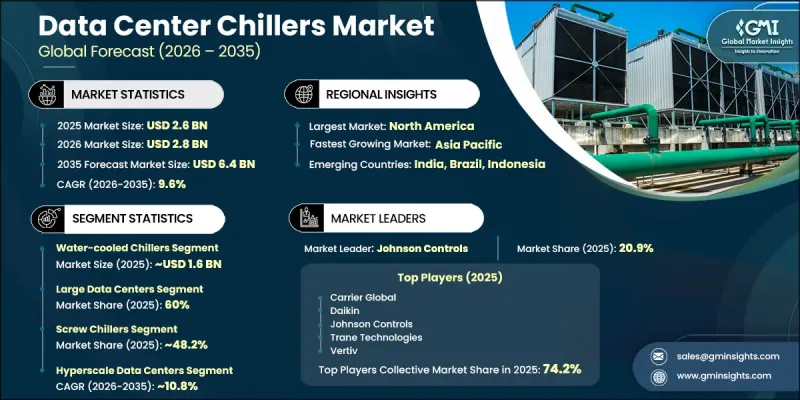
隨著對數位基礎設施的依賴日益加深,現代資料中心對能夠應對不斷成長的運算負載的先進冷卻系統的需求正在推動市場發展。隨著電力消耗量的持續攀升,冷卻需求也成比例成長,從而催生了對高效能溫度控管解決方案的強勁需求。高效能運算系統密度的不斷提高也改變了冷卻器的設計,要求系統更加緊湊、節能且容量更大。冷卻技術的創新在提升性能的同時,也克服了空間受限環境下的運作限制。基礎設施發展和環境條件的區域差異也會圖部署策略。資源安全是至關重要的考量因素,尤其是在面臨環境限制的地區,促使人們採用永續的冷卻技術。總而言之,不斷發展的數位生態系統對可靠且高效冷卻的需求日益成長,預計將推動資料中心冷卻器市場的持續成長。
| 市場範圍 | |
|---|---|
| 開始年份 | 2025 |
| 預測期 | 2026-2035 |
| 上市時的市場規模 | 26億美元 |
| 預計金額 | 64億美元 |
| 複合年成長率 | 9.6% |
資料中心冷卻器市場受益於IT基礎設施日益複雜化以及對精密溫度控管系統需求的成長。不斷增加的運算負載要求營運商採用更有效率的冷卻解決方案,以確保系統穩定性和效能。持續的技術進步提高了能源效率並最佳化了運行,進一步推動了市場成長。
預計2026年至2035年間,水冷系統市場將以10%的複合年成長率成長。這一成長主要得益於其卓越的傳熱能力、擴充性和在大規模運作中的高效率。對於需要持續、高容量冷卻性能的設施而言,水冷系統正日益成為首選。
預計2026年至2035年,超大規模資料中心市場將以10.8%的複合年成長率成長。該市場成長的主要驅動力是對大規模運算能力日益成長的需求,而這需要先進的冷卻解決方案來應對不斷增加的熱負荷。高容量資料基礎設施的擴展也催生了對強大且高效的冷卻器系統的強勁需求。
美國資料中心冷卻器市場預計到2025年將達到12億美元,並在2026年至2035年間以9.3%的複合年成長率成長。該國市場成長的主要驅動力是先進運算基礎設施的快速擴張和能源需求的不斷成長。對高效冷卻解決方案日益成長的需求正在推動下一代技術的應用,這些技術旨在處理高性能工作負載的同時提高能源效率。
目錄
第1章:調查方法
第2章執行摘要
第3章業界考察
- 生態系分析
- 供應商情況
- 利潤率
- 成本結構
- 每個階段增加的價值
- 影響價值鏈的因素
- 中斷
- 影響產業的因素
- 促進因素
- 超大規模和邊緣資料中心的快速成長
- AI/HPC工作負載導致機架功率密度增加
- 嚴格的能源效率和永續性法規
- 現有資料中心的升級與維修
- 產業潛在風險與挑戰
- 巨額資本投資和基礎設施成本
- 對水資源短缺的擔憂限制了水冷系統的應用。
- 市場機遇
- 液冷技術在高密度工作負載的興起
- 實施自然冷卻和混合冷卻解決方案
- 模組化和貨櫃型資料中心的廣泛應用
- 促進因素
- 科技與創新趨勢
- 目前技術
- 空冷式冷卻器
- 水冷式冷卻器
- 直接膨脹式(DX)冷卻系統
- Inro冷卻裝置
- 新興技術
- 磁浮(無油)冷卻器
- 絕熱冷卻/蒸發冷卻系統
- 人工智慧最佳化冷卻器機組控制
- 目前技術
- 成長潛力分析
- 價格分析(基於初步調查)
- 對過去價格趨勢的分析
- 按球員類型分類的定價策略(高階/超值/成本加成)
- 監理情勢
- 北美洲
- 美國 - 美國環保署
- 加拿大自然資源部
- 歐洲
- 歐盟委員會
- 英國- BSI集團
- 亞太地區
- 印度能源效率委員會
- 中國生態環境部
- 拉丁美洲
- 巴西國家電力局
- 墨西哥能源部
- 中東和非洲
- 沙烏地阿拉伯 - 沙烏地阿拉伯標準、計量和品質研究所
- 阿拉伯聯合大公國 - 杜拜電力和水務局
- 北美洲
- 波特五力分析
- PESTEL 分析
- 專利趨勢(基於初步調查)
- 成本細分分析
- 資料中心容量和基礎設施的現狀
- 各國裝置容量(兆瓦)
- 2025-2027年擴建計劃
- 運轉率及供需狀況
- 整合可再生能源的影響
- 將太陽能和風能發電與冷卻器機組整合
- 對降低能源成本和提高營運效率的影響
- 間歇性挑戰與儲熱解決方案
- 電網連接和需量反應功能
- 減少碳排放和永續性目標
- 人工智慧和生成式人工智慧對市場的影響
- 利用人工智慧改造現有經營模式
- 按細分市場分類的生成式人工智慧用例和部署藍圖
- 風險、限制和監管考量
- 預測假設和情境分析(基於初步研究)
- 基本案例-驅動複合年成長率的關鍵宏觀經濟與產業變量
- 樂觀情境-宏觀經濟與產業的順風
- 悲觀情景-宏觀經濟放緩或產業逆風
第4章 競爭情勢
- 介紹
- 企業市佔率分析
- 北美洲
- 歐洲
- 亞太地區
- 拉丁美洲
- 中東和非洲(MEA)
- 主要市場公司的競爭分析
- 競爭定位矩陣
- 主要進展
- 併購
- 夥伴關係和聯盟
- 新產品發布
- 業務拓展計劃及資金籌措
- 企業級分層基準測試
- 層級分類標準與選擇標準
- 按收入、地區和創新能力分類的層級定位矩陣。
第5章 市場估價與預測:依產品分類,2022-2035年
- 空冷式冷卻器
- 水冷式冷卻器
- 乙二醇冷卻式冷卻器
第6章 市場估計與預測:依技術分類,2022-2035年
- 渦卷式冷卻器
- 螺桿式冷卻器
- 離心式冷卻器
- 吸收式製冷機
- 磁浮冷卻器
第7章 市場估計與預測:依冷氣量分類,2022-2035年
- 小於500千瓦
- 500~1,000 kW
- 1,000~2,000 kW
- 超過2000千瓦
第8章 市場估算與預測:依資料中心分類,2022-2035年
- 超大規模資料中心
- 託管資料中心
- 企業資料中心
- 邊緣資料中心
第9章 市場估算與預測:依資料中心規模分類,2022-2035年
- 小規模資料中心
- 中型資料中心
- 大型資料中心
第10章 市場估計與預測:依發展階段分類,2022-2035年
- 新推出
- 更新需求
第11章 市場估價與預測:按地區分類,2022-2035年
- 北美洲
- 美國
- 加拿大
- 歐洲
- 德國
- 英國
- 法國
- 義大利
- 西班牙
- 瑞典
- 瑞士
- 荷蘭
- 波蘭
- 亞太地區
- 中國
- 日本
- 韓國
- 印度
- 澳洲
- 紐西蘭
- 新加坡
- 印尼
- 拉丁美洲
- 巴西
- 墨西哥
- 阿根廷
- 智利
- 中東和非洲(MEA)
- 南非
- 沙烏地阿拉伯
- 阿拉伯聯合大公國
第12章:公司簡介
- 世界公司
- Trane Technologies
- Daikin Industries
- Johnson Controls
- Carrier Global
- Schneider Electric
- Vertiv
- Mitsubishi Electric
- LG Electronics
- STULZ
- Rittal
- Airedale International
- 當地公司
- Thermax
- Dimplex Thermal
- Blue Star
- Dunham-Bush
- Aermec
- Motivair
- 新興企業
- ENGIE
- Geoclima
- GalxC
The Global Data Center Chillers Market was valued at USD 2.6 billion in 2025 and is estimated to grow at a CAGR of 9.6% to reach USD 6.4 billion by 2035.
Increasing reliance on digital infrastructure is driving demand for advanced cooling systems capable of handling rising computing loads across modern data centers. As power consumption continues to increase, cooling requirements scale proportionally, creating strong demand for efficient thermal management solutions. The growing density of high-performance computing systems is reshaping chiller design, requiring more compact, energy-efficient, and high-capacity systems. Innovations in cooling technologies are addressing operational constraints while improving performance in space-constrained environments. Geographic variations in infrastructure development and environmental conditions are also influencing deployment strategies. Resource availability is becoming an important consideration, particularly in regions facing environmental constraints, which is shaping the adoption of sustainable cooling technologies. Overall, the increasing need for reliable and efficient cooling across evolving digital ecosystems is expected to drive sustained growth in the data center chillers market.
| Market Scope | |
|---|---|
| Start Year | 2025 |
| Forecast Year | 2026-2035 |
| Start Value | $2.6 Billion |
| Forecast Value | $6.4 Billion |
| CAGR | 9.6% |
The data center chillers market is also benefiting from the rising complexity of IT infrastructure and the need for advanced thermal management systems. Increasing computing intensity is pushing operators to adopt more efficient cooling solutions that ensure system stability and performance. Continuous technological advancements are enabling improved energy efficiency and operational optimization, further strengthening market growth.
The water-cooled systems segment is projected to grow at a CAGR of 10% between 2026 and 2035. This growth is supported by their superior heat transfer capabilities, scalability, and ability to deliver high efficiency in large-scale operations. These systems are increasingly preferred in facilities requiring consistent and high-capacity cooling performance.
The hyperscale data centers segment is anticipated to grow at a CAGR of 10.8% during 2026 to 2035. Growth in this segment is driven by the increasing demand for large-scale computing capabilities, which require advanced cooling solutions to manage rising thermal loads. The expansion of high-capacity data infrastructure is creating a strong need for robust and efficient chiller systems.
U.S. Data Center Chillers Market reached USD 1.2 billion in 2025 and is expected to grow at a CAGR of 9.3% from 2026 to 2035. Market growth in the country is supported by the rapid expansion of advanced computing infrastructure and increasing energy requirements. Rising demand for efficient cooling solutions is encouraging the adoption of next-generation technologies designed to handle high-performance workloads while improving energy efficiency.
Key players operating in the Global Data Center Chillers Market include Carrier Global, Trane Technologies, Johnson Controls, Daikin, Mitsubishi Electric, LG Electronics, Vertiv, Schneider Electric, STULZ, and Rittal. Companies in the Data Center Chillers Market are focusing on innovation, efficiency, and scalability to strengthen their competitive position. They are investing in advanced cooling technologies that enhance performance while reducing energy consumption. Many players are integrating smart monitoring and automation capabilities to improve system management and reliability. Strategic partnerships and collaborations help companies expand their global footprint and address evolving customer requirements. Additionally, manufacturers are prioritizing sustainable solutions, including energy-efficient designs and environmentally friendly refrigerants, to align with regulatory standards. Continuous research and development, along with capacity expansion and product diversification, are enabling companies to meet the growing demand for high-performance cooling systems in modern data center environments.
Table of Contents
Chapter 1 Methodology
- 1.1 Research approach
- 1.2 Quality Commitments
- 1.2.1 GMI AI policy & data integrity commitment
- 1.3 Research Trail & Confidence Scoring
- 1.3.1 Research Trail Components
- 1.3.2 Scoring Components
- 1.4 Data Collection
- 1.5 Data mining sources
- 1.5.1 Paid sources
- 1.6 Base estimates and calculations
- 1.6.1 Base year calculation for any one approach
- 1.7 Forecast
- 1.7.1 Quantified market impact analysis
- 1.8 Research transparency addendum
- 1.8.1 Source attribution framework
- 1.8.2 Quality assurance metrics
- 1.8.3 Our commitment to trust
Chapter 2 Executive Summary
- 2.1 Industry 360° synopsis
- 2.2 Key market trends
- 2.2.1 Regional
- 2.2.2 Product
- 2.2.3 Technology
- 2.2.4 Cooling Capacity
- 2.2.5 Data Center
- 2.2.6 Data Center Size
- 2.2.7 Deployment
- 2.3 TAM analysis, 2026-2035
- 2.4 CXO perspectives: Strategic imperatives
Chapter 3 Industry Insights
- 3.1 Industry ecosystem analysis
- 3.1.1 Supplier landscape
- 3.1.2 Profit margin
- 3.1.3 Cost structure
- 3.1.4 Value addition at each stage
- 3.1.5 Factor affecting the value chain
- 3.1.6 Disruptions
- 3.2 Industry impact forces
- 3.2.1 Growth drivers
- 3.2.1.1 Exponential growth in hyperscale & edge data centers
- 3.2.1.2 Rising rack power densities from AI/HPC workloads
- 3.2.1.3 Stringent energy efficiency & sustainability regulations
- 3.2.1.4 Upgrades and retrofits of existing data centers
- 3.2.2 Industry pitfalls and challenges
- 3.2.2.1 High capital investment & infrastructure costs
- 3.2.2.2 Water scarcity concerns limiting water-cooled systems
- 3.2.3 Market opportunities
- 3.2.3.1 Emergence of liquid cooling technologies for high-density workloads
- 3.2.3.2 Adoption of free cooling & hybrid cooling solutions
- 3.2.3.3 Growing modular & containerized data center deployments
- 3.2.1 Growth drivers
- 3.3 Technology and innovation landscape
- 3.3.1 Current technologies
- 3.3.1.1 Air-Cooled Chillers
- 3.3.1.2 Water-Cooled Chillers
- 3.3.1.3 Direct Expansion (DX) Cooling Systems
- 3.3.1.4 In-Row Cooling Units
- 3.3.2 Emerging technologies
- 3.3.2.1 Magnetic Bearing (Oil-Free) Chillers
- 3.3.2.2 Adiabatic / Evaporative Cooling Systems
- 3.3.2.3 AI-Optimized Chiller Plant Controls
- 3.3.1 Current technologies
- 3.4 Growth potential analysis
- 3.5 Pricing analysis (Driven by Primary Research)
- 3.5.1 Historical price trend analysis
- 3.5.2 Pricing strategy by player type (Premium / Value / Cost-plus)
- 3.6 Regulatory landscape
- 3.6.1 North America
- 3.6.1.1 US - U.S. Environmental Protection Agency
- 3.6.1.2 Canada - Natural Resources Canada
- 3.6.2 Europe
- 3.6.2.1 EU - European Commission
- 3.6.2.2 UK - BSI Group
- 3.6.3 Asia Pacific
- 3.6.3.1 India - Bureau of Energy Efficiency
- 3.6.3.2 China - Ministry of Ecology and Environment
- 3.6.4 Latin America
- 3.6.4.1 Brazil - Agencia Nacional de Energia Eletrica
- 3.6.4.2 Mexico - Secretaria de Energia
- 3.6.5 Middle East & Africa
- 3.6.5.1 Saudi Arabia - Saudi Standards Metrology and Quality Organization
- 3.6.5.2 UAE - Dubai Electricity and Water Authority
- 3.6.1 North America
- 3.7 Porter's analysis
- 3.8 PESTEL analysis
- 3.9 Patent landscape (Driven by Primary Research)
- 3.10 Cost breakdown analysis
- 3.11 Data center capacity & infrastructure landscape
- 3.11.1 Installed capacity (MW) by country
- 3.11.2 Expansion pipeline 2025-2027
- 3.11.3 Utilization rates & supply-demand
- 3.12 Impact of renewable energy integration
- 3.12.1 Integration of solar and wind power with chiller systems
- 3.12.2 Impact on energy cost reduction and operational efficiency
- 3.12.3 Intermittency challenges and thermal storage solutions
- 3.12.4 Grid interaction and demand response capabilities
- 3.12.5 Carbon emission reduction and sustainability goals
- 3.13 Impact of AI & Generative AI on the Market
- 3.13.1 AI-driven disruption of existing business models
- 3.13.2 GenAI use cases & adoption roadmap by segment
- 3.13.3 Risks, limitations & regulatory considerations
- 3.14 Forecast assumptions & scenario analysis (Driven by Primary Research)
- 3.14.1 Base Case - key macro & industry variables driving CAGR
- 3.14.2 Optimistic Scenarios - Favorable macro and industry tailwinds
- 3.14.3 Pessimistic Scenario - Macroeconomic slowdown or industry headwinds
Chapter 4 Competitive Landscape, 2025
- 4.1 Introduction
- 4.2 Company market share analysis
- 4.2.1 North America
- 4.2.2 Europe
- 4.2.3 Asia Pacific
- 4.2.4 LATAM
- 4.2.5 MEA
- 4.3 Competitive analysis of major market players
- 4.4 Competitive positioning matrix
- 4.5 Key developments
- 4.5.1 Mergers & acquisitions
- 4.5.2 Partnerships & collaborations
- 4.5.3 New product launches
- 4.5.4 Expansion plans and funding
- 4.6 Company tier benchmarking
- 4.6.1 Tier classification criteria & qualifying thresholds
- 4.6.2 Tier positioning matrix by revenue, geography & innovation
Chapter 5 Market Estimates & Forecast, By Product, 2022 - 2035 ($Mn, Units)
- 5.1 Key trends
- 5.2 Air-cooled chillers
- 5.3 Water-cooled chillers
- 5.4 Glycol-cooled chillers
Chapter 6 Market Estimates & Forecast, By Technology, 2022 - 2035 ($Mn, Units)
- 6.1 Key trends
- 6.2 Scroll chillers
- 6.3 Screw chillers
- 6.4 Centrifugal chillers
- 6.5 Absorption chillers
- 6.6 Magnetic bearing chillers
Chapter 7 Market Estimates & Forecast, By Cooling Capacity, 2022 - 2035 ($Mn, Units)
- 7.1 Key trends
- 7.2 <500 kW
- 7.3 500-1,000 kW
- 7.4 1,000-2,000 kW
- 7.5 >2,000 kW
Chapter 8 Market Estimates & Forecast, By Data Center, 2022 - 2035 ($Mn, Units)
- 8.1 Key trends
- 8.2 Hyperscale data centers
- 8.3 Colocation data centers
- 8.4 Enterprise data centers
- 8.5 Edge data centers
Chapter 9 Market Estimates & Forecast, By Data Center Size, 2022 - 2035 ($Mn, Units)
- 9.1 Key trends
- 9.2 Small-scale data centers
- 9.3 Medium data centers
- 9.4 Large data centers
Chapter 10 Market Estimates & Forecast, By Deployment, 2022 - 2035 ($Mn, Units)
- 10.1 Key trends
- 10.2 New Installations
- 10.3 Replacements
Chapter 11 Market Estimates & Forecast, By Region, 2022 - 2035 ($Mn, Units)
- 11.1 Key trends
- 11.2 North America
- 11.2.1 US
- 11.2.2 Canada
- 11.3 Europe
- 11.3.1 Germany
- 11.3.2 UK
- 11.3.3 France
- 11.3.4 Italy
- 11.3.5 Spain
- 11.3.6 Sweden
- 11.3.7 Switzerland
- 11.3.8 Netherlands
- 11.3.9 Poland
- 11.4 Asia Pacific
- 11.4.1 China
- 11.4.2 Japan
- 11.4.3 South Korea
- 11.4.4 India
- 11.4.5 Australia
- 11.4.6 New Zealand
- 11.4.7 Singapore
- 11.4.8 Indonesia
- 11.5 Latin America
- 11.5.1 Brazil
- 11.5.2 Mexico
- 11.5.3 Argentina
- 11.5.4 Chile
- 11.6 MEA
- 11.6.1 South Africa
- 11.6.2 Saudi Arabia
- 11.6.3 UAE
Chapter 12 Company Profiles
- 12.1 Global players
- 12.1.1 Trane Technologies
- 12.1.2 Daikin Industries
- 12.1.3 Johnson Controls
- 12.1.4 Carrier Global
- 12.1.5 Schneider Electric
- 12.1.6 Vertiv
- 12.1.7 Mitsubishi Electric
- 12.1.8 LG Electronics
- 12.1.9 STULZ
- 12.1.10 Rittal
- 12.1.11 Airedale International
- 12.2 Regional players
- 12.2.1 Thermax
- 12.2.2 Dimplex Thermal
- 12.2.3 Blue Star
- 12.2.4 Dunham-Bush
- 12.2.5 Aermec
- 12.2.6 Motivair
- 12.3 Emerging players
- 12.3.1 ENGIE
- 12.3.2 Geoclima
- 12.3.3 GalxC

 資料中心冷卻市場-2026-2032年全球市場預測
 人工智慧資料中心暖通空調冷卻系統:2026-2032年全球市佔率及排名、總收入及需求預測
 2026-2030年全球資料中心冷卻解決方案市場
 全球資料中心冷卻CDU泵浦市場:按泵浦類型、冷卻方式、資料中心類型、CDU類型和地區分類-預測至2032年
 全球資料中心冷卻解決方案市場規模、佔有率、趨勢和成長分析報告(2026-2034年)
 資料中心溫度控管市場預測至2034年-按組件、冷卻技術、資料中心類型、冷卻方式、最終用戶和地區分類的全球分析
 全球資料中心直接晶片冷卻液市場(至2032年):依冷卻液類型、冷卻技術、資料中心類型及地區分類
 美國資料中心冷卻市場規模、佔有率和趨勢分析:按組件、類型、封閉方式、結構、應用、解決方案、服務和細分市場預測(2026-2033 年)
 資料中心冷卻市場-全球產業規模、佔有率、趨勢、機會和預測:按產品、資料中心類型、冷卻技術、地區和競爭格局分類,2021-2031年
 資料中心冷媒市場:按冷媒、應用、資料中心類型、冷卻方式、最終用戶、國家和地區分類-全球產業分析、市場規模及佔有率和未來預測(2026-2033)