

 |
市場調查報告書
商品編碼
2038668
2026 年至 2035 年住宅PVC 電線導管市場的商業機會、成長要素、產業趨勢分析與預測。Residential PVC Electrical Conduit Market Opportunity, Growth Drivers, Industry Trend Analysis, and Forecast 2026 - 2035 |
||||||

2025年全球住宅PVC電線導管市場價值為11億美元,預計到2035年將以6.9%的複合年成長率成長至21億美元。
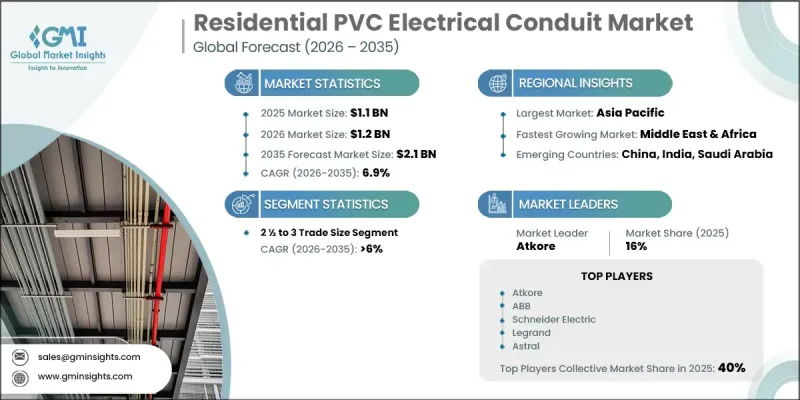
住宅建設增加、翻新趨勢以及對具成本效益高性能材料的強勁需求推動了這一成長。 PVC導線管因其輕便、耐腐蝕、易於搬運和維修等優點而備受關注。更嚴格的電氣安全法規促使人們使用不可燃材料,以降低電氣故障引發火災的風險。此外,政府主導的旨在推廣更安全、更節能的基礎設施的舉措,以及智慧家庭技術的日益普及,都在加速市場需求。同時,消費者環保意識的增強也促使他們傾向於選擇符合永續建築實踐的可回收材料,例如PVC。快速的都市化和綠色建築設計的興起進一步推動了市場成長,使PVC導管成為傳統材料的理想替代品。
| 市場範圍 | |
|---|---|
| 開始年份 | 2025 |
| 預測期 | 2026-2035 |
| 上市時的市場規模 | 11億美元 |
| 預測金額 | 21億美元 |
| 複合年成長率 | 6.9% |
預計到2035年,2.5至3吋標準尺寸導管的複合年成長率將達到6%。這些尺寸的導管越來越受歡迎,因為它們可以容納多種佈線系統,使其適用於現代住宅建築中先進的電氣佈線配置。它們的強度、耐用性以及防潮和防腐蝕性能確保了其長期可靠的性能。此外,易於安裝和與不斷發展的電氣基礎設施的兼容性也推動了它們的廣泛應用。對先進住宅電氣系統日益成長的需求以及不斷擴大的住宅開發項目將繼續推動這些尺寸導管的普及。
2025年,美國住宅PVC電線管市場規模為1.565億美元,預計2035年將達2.8億美元。市場擴張的驅動力包括持續的住宅建設活動、翻新項目的增加以及對永續建築解決方案的大力需求。 PVC電線管因其價格實惠、耐熱、耐防腐蝕、易於安裝和維護成本低而廣受歡迎。其優異的絕緣性能也使其適用於需要提高能源效率並符合嚴格電氣安全標準的場合。
目錄
第1章:調查方法和範圍
第2章執行摘要
第3章業界考察
- 生態系分析
- 監理情勢
- 影響產業的因素
- 促進因素
- 產業潛在風險與挑戰
- 成長潛力分析
- 波特五力分析
- PESTEL 分析
- PVC電線管成本結構分析
- 貿易數據分析(基於初步調查)
- 進出口額趨勢(基於初步調查)
- 主要貿易路線及關稅的影響(基於初步調查)
- 生產能力和運轉率(基於初步調查)
- 區域生產能力(基於初步調查)
- 運轉率和擴張計劃(基於初步調查)
- 新機會和趨勢
- 投資分析及未來展望
第4章 競爭情勢
- 介紹
- 企業市佔率分析:按地區分類
- 北美洲
- 歐洲
- 亞太地區
- 中東和非洲
- 拉丁美洲
- 競爭定位矩陣
- 主要進展
- 併購
- 夥伴關係與合作
- 新產品發布
- 業務拓展計劃及資金籌措
第5章 市場規模及預測:以交易量計算,2022-2035年
- 1/2~1
- 1 1/4~2
- 2 1/2~3
- 3~4
- 5~6
- 其他
第6章 市場規模及預測:依地區分類,2022-2035年
- 北美洲
- 美國
- 加拿大
- 墨西哥
- 歐洲
- 法國
- 德國
- 義大利
- 英國
- 俄羅斯
- 亞太地區
- 中國
- 印度
- 日本
- 韓國
- 澳洲
- 中東和非洲
- 沙烏地阿拉伯
- 阿拉伯聯合大公國
- 卡達
- 南非
- 拉丁美洲
- 巴西
- 阿根廷
第7章:公司簡介
- ABB
- ALVA Manufacturing
- Anamet Electrical
- ASTRAL
- Atkore
- Bahra Electric
- Champion Fiberglass
- CANTEX
- Electri-Flex
- Guangdong Ctube Industry
- Hubbell
- HellermannTyton
- IPEX Electrical
- Iplex Pipelines
- Legrand
- Schneider Electric
- Sundeep Electricals
- TOYO INDUSTRY LAO FACTORY
- Vinidex
- Wienerberger
The Global Residential PVC Electrical Conduit Market was valued at USD 1.1 billion in 2025 and is estimated to grow at a CAGR of 6.9% to reach USD 2.1 billion by 2035.
Growth momentum is driven by increasing residential construction, renovation trends, and a strong preference for cost-efficient and high-performance materials. PVC conduits are gaining traction due to their lightweight structure, resistance to corrosion, and ease of handling and repair. Regulatory frameworks are becoming stricter regarding electrical safety, encouraging the adoption of non-combustible materials that reduce fire hazards caused by electrical faults. In addition, government-backed initiatives promoting safer and energy-efficient infrastructure, along with the growing integration of smart home technologies, are accelerating demand. Consumers are also becoming more environmentally conscious, favoring recyclable materials such as PVC, which aligns with sustainable construction practices. Rapid urbanization and the shift toward green building designs further reinforce market growth, positioning PVC conduits as a preferred alternative to traditional materials.
| Market Scope | |
|---|---|
| Start Year | 2025 |
| Forecast Year | 2026-2035 |
| Start Value | $1.1 Billion |
| Forecast Value | $2.1 Billion |
| CAGR | 6.9% |
The 2 1/2 to 3 trade size segment is anticipated to register a CAGR of 6% through 2035. These conduit sizes are increasingly favored due to their ability to accommodate multiple wiring systems, making them suitable for advanced electrical configurations in modern residential structures. Their strength, durability, and resistance to moisture and corrosion contribute to reliable long-term performance. Additionally, ease of installation and compatibility with evolving electrical infrastructure are supporting their growing adoption. Rising demand for advanced residential electrical systems and expanding housing developments continue to drive the uptake of these conduit sizes.
United States Residential PVC Electrical Conduit Market was valued at USD 156.5 million in 2025 and is expected to reach USD 280 million by 2035. Market expansion is supported by ongoing residential construction activities, increased remodeling projects, and a strong push toward sustainable building solutions. PVC conduits are widely preferred for their affordability, thermal resistance, and corrosion protection, along with their ease of installation and low maintenance requirements. Their insulation properties also make them suitable for applications that require enhanced energy efficiency and compliance with stringent electrical safety standards.
Key companies operating in the Global Residential PVC Electrical Conduit Market include ABB, Atkore, Schneider Electric, Legrand, Hubbell, Astral, IPEX Electrical, CANTEX, Electri-Flex, Anamet Electrical, HellermannTyton, Vinidex, Wienerberger, Guangdong Ctube Industry, ALVA Manufacturing, Bahra Electric, Champion Fiberglass, Iplex Pipelines, Sundeep Electricals, and TOYO INDUSTRY LAO FACTORY. Companies in the Residential PVC Electrical Conduit Market are strengthening their positions through a mix of innovation, strategic partnerships, and geographic expansion. Manufacturers are investing in advanced production technologies to improve product durability, flexibility, and environmental performance. Many firms are also focusing on expanding their product portfolios to meet evolving regulatory standards and customer demands for sustainable solutions. Collaborations with construction firms and electrical contractors are helping companies secure long-term supply agreements. In addition, businesses are increasing their presence in emerging markets to capitalize on rapid urbanization and infrastructure growth.
Table of Contents
Chapter 1 Methodology & Scope
- 1.1 Research approach
- 1.2 Quality commitment
- 1.2.1 GMI AI policy & data integrity commitment
- 1.2.1.1 Source consistency protocol
- 1.2.1 GMI AI policy & data integrity commitment
- 1.3 Research Trail & Confidence Scoring
- 1.3.1 Research Trail Components
- 1.3.2 Scoring Components
- 1.4 Data Collection
- 1.4.1 Partial list of primary sources
- 1.5 Data mining sources
- 1.5.1 Paid sources
- 1.5.1.1 Sources, by region
- 1.5.1 Paid sources
- 1.6 Base estimates and calculations
- 1.6.1 Base year calculation for any one approach
- 1.7 Forecast model
- 1.8 Research transparency addendum
- 1.8.1 Source attribution framework
- 1.8.2 Quality assurance metrics
- 1.8.3 Our commitment to trust
- 1.8.3.1 Market definitions
Chapter 2 Executive Summary
- 2.1 Industry synopsis, 2022 - 2035
- 2.2 Business trends
- 2.3 Trade size trends
- 2.4 Regional trends
Chapter 3 Industry Insights
- 3.1 Industry ecosystem analysis
- 3.2 Regulatory landscape
- 3.3 Industry impact forces
- 3.3.1 Growth drivers
- 3.3.2 Industry pitfalls & challenges
- 3.4 Growth potential analysis
- 3.5 Porter's analysis
- 3.5.1 Bargaining power of suppliers
- 3.5.2 Bargaining power of buyers
- 3.5.3 Threat of new entrants
- 3.5.4 Threat of substitutes
- 3.6 PESTEL analysis
- 3.7 Cost structure analysis of PVC electrical conduits
- 3.8 Trade data analysis (Driven by Primary Research)
- 3.8.1 Import/export value trends (Driven by Primary Research)
- 3.8.2 Key trade corridors & tariff impact (Driven by Primary Research)
- 3.9 Production capacity & utilization (Driven by Primary Research)
- 3.9.1 Production capacity by region (Driven by Primary Research)
- 3.9.2 Utilization rates and expansion pipeline (Driven by Primary Research)
- 3.10 Emerging opportunities & trends
- 3.11 Investment analysis & future outlook
Chapter 4 Competitive Landscape, 2026
- 4.1 Introduction
- 4.2 Company market share analysis, by region, 2025
- 4.2.1 North America
- 4.2.2 Europe
- 4.2.3 Asia Pacific
- 4.2.4 Middle East & Africa
- 4.2.5 Latin America
- 4.3 Competitive positioning matrix
- 4.4 Key Developments
- 4.4.1 Mergers & acquisitions
- 4.4.2 Partnerships & collaborations
- 4.4.3 New product launches
- 4.4.4 Expansion plans and funding
Chapter 5 Market Size and Forecast, By Trade Size, 2022 - 2035 (USD Million)
- 5.1 Key trends
- 5.2 1/2 to 1
- 5.3 1 1/4 to 2
- 5.4 2 1/2 to 3
- 5.5 3 to 4
- 5.6 5 to 6
- 5.7 Others
Chapter 6 Market Size and Forecast, By Region, 2022 - 2035 (USD Million)
- 6.1 Key trends
- 6.2 North America
- 6.2.1 U.S.
- 6.2.2 Canada
- 6.2.3 Mexico
- 6.3 Europe
- 6.3.1 France
- 6.3.2 Germany
- 6.3.3 Italy
- 6.3.4 UK
- 6.3.5 Russia
- 6.4 Asia Pacific
- 6.4.1 China
- 6.4.2 India
- 6.4.3 Japan
- 6.4.4 South Korea
- 6.4.5 Australia
- 6.5 Middle East & Africa
- 6.5.1 Saudi Arabia
- 6.5.2 UAE
- 6.5.3 Qatar
- 6.5.4 South Africa
- 6.6 Latin America
- 6.6.1 Brazil
- 6.6.2 Argentina
Chapter 7 Company Profiles
- 7.1 ABB
- 7.2 ALVA Manufacturing
- 7.3 Anamet Electrical
- 7.4 ASTRAL
- 7.5 Atkore
- 7.6 Bahra Electric
- 7.7 Champion Fiberglass
- 7.8 CANTEX
- 7.9 Electri-Flex
- 7.10 Guangdong Ctube Industry
- 7.11 Hubbell
- 7.12 HellermannTyton
- 7.13 IPEX Electrical
- 7.14 Iplex Pipelines
- 7.15 Legrand
- 7.16 Schneider Electric
- 7.17 Sundeep Electricals
- 7.18 TOYO INDUSTRY LAO FACTORY
- 7.19 Vinidex
- 7.20 Wienerberger

 電氣管道市場:按材料、管道類型、應用和最終用戶分類-2026-2032年全球市場預測
 液密軟性金屬導管市場:按應用、最終用途、公稱直徑、國家和地區分類-全球產業分析、市場規模、市場佔有率和預測(2025-2032 年)
 2026-2034年全球公共產業導線管市場規模、佔有率、趨勢和成長分析報告
 日本電氣管道市場規模、佔有率、趨勢及預測(按類型、材質、應用和地區分類),2026-2034年
 2026年全球電氣管道市場報告
 導線管市場規模、佔有率和趨勢分析報告:按材料、類型、應用、地區和細分市場預測(2026-2033 年)
 全球工業導線管市場全球工業液密軟性金屬導線管市場全球工業軟性金屬管市場全球商用液密軟性金屬導管市場