

 |
市場調查報告書
商品編碼
2038446
對 2026 年至 2035 年菸草產品市場的商業機會、成長要素、產業趨勢和預測進行分析。Tobacco Products Market Opportunity, Growth Drivers, Industry Trend Analysis, and Forecast 2026 - 2035 |
||||||

預計到 2025 年,全球菸草產品市場價值將達到 9,652 億美元,年複合成長率為 3.2%,到 2035 年將達到 1.3 兆美元。
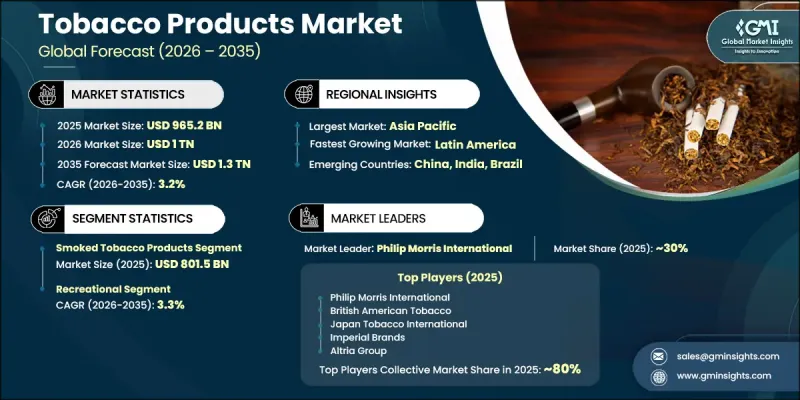
菸草產業正處於轉型期,各公司都在調整產品組合,將傳統菸草產品與新興替代品結合。儘管監管力道加大,消費者也越來越注重健康,但市場仍透過多元化策略和創新保持穩定。廠商積極投資研發,推出新一代尼古丁輸送解決方案,同時也強化其高級產品線。全球性公司專注於創新、品牌定位和地理擴張,從而塑造了競爭格局。在吸菸率下降、監管嚴格的成熟市場,各公司優先考慮價值主導成長而非銷售量擴張。同時,亞太地區憑藉著強勁的消費需求、龐大的人口規模和相對靈活的法規環境,保持主導地位。消費者對減害產品的日益關注,促使各公司重新評估自身定位,並在已開發市場和新興市場抓住新的成長機會。
| 市場範圍 | |
|---|---|
| 開始年份 | 2025 |
| 預測期 | 2026-2035 |
| 上市時的市場規模 | 9652億美元 |
| 預測金額 | 1.3兆美元 |
| 複合年成長率 | 3.2% |
預計到2025年,菸草製品市場規模將達到8,015億美元,並在2026年至2035年間以3.2%的複合年成長率成長。憑藉其龐大的消費群和廣泛的市場覆蓋,該細分市場持續保持主導地位。產業參與者正透過在其產品線中加入減害替代品,來滿足不斷變化的消費者期望並確保長期競爭力。推動該細分市場成長的因素包括策略性市場擴張、高級產品的推出以及特定地區人口結構變化所帶來的需求成長。
預計到2025年,休閒菸草市場佔有率將達到95.2%,並在2026年至2035年間以3.3%的複合年成長率成長。此細分市場的成長主要得益於菸草製品因其刺激作用而被廣泛消費。尼古丁透過影響認知功能和壓力反應來影響行為模式,從而推動了市場需求。尼古丁的高成癮性導致持續使用模式的形成,從而支撐了全球市場的穩定需求。
美國菸草產品市場預計到2025年將達到1,405億美元,並在2026年至2035年間以2.1%的複合年成長率成長,推動北美地區的成長。美國的法規環境對產品開發、核准和商業化實施嚴格監管,在塑造市場動態發揮至關重要的作用。企業必須遵守全面的合規要求,包括產品評估、成分揭露和行銷限制,並採取措施應對年齡限制和公共衛生問題。
目錄
第1章:調查方法
- 研究途徑
- 品質改進計劃
- GMI人工智慧政策及對資料完整性的承諾
- 資訊來源一致性協議
- GMI人工智慧政策及對資料完整性的承諾
- 調查過程和可靠性評分
- 研究路徑的組成部分
- 評分組成部分
- 數據收集
- 主要來源部分列表
- 資料探勘資訊來源
- 付費資訊來源
- 區域資訊來源
- 付費資訊來源
- 基本估算和計算方法
- 基準年的計算
- 預測模型
- 量化市場影響分析
- 生長參數對預測的數學影響
- 量化市場影響分析
- 關於調查透明度的補充信息
- 資訊來源歸屬框架
- 品質保證指標
- 對信任的承諾
第2章執行摘要
第3章業界考察
- 生態系分析
- 供應商情況
- 利潤率分析
- 每個階段增加的價值
- 影響價值鏈的因素
- 影響產業的因素
- 促進因素
- 對下一代產品的需求不斷成長
- 新興市場優質化趨勢
- 產品創新與多元化
- 亞太市場擴張
- 產業潛在風險與挑戰
- 嚴格的法規環境和合規成本
- 提高健康意識和進行戒菸宣傳活動
- 已開發國家吸菸率下降
- 促進因素
- 成長潛力分析
- 未來市場趨勢
- 科技與創新趨勢
- 當前技術趨勢
- 新興技術
- 價格趨勢
- 按地區
- 依產品類型
- 監理情勢
- 標準和合規要求
- 區域法規結構
- 認證標準
- 消費行為分析
- 購買模式
- 偏好分析
- 不同地區的消費行為差異
- 波特五力分析
- PESTEL 分析
- 人工智慧和生成式人工智慧對市場的影響
- 利用人工智慧改造現有經營模式
- 針對特定領域的生成式人工智慧應用案例和實施藍圖
- 風險、限制和監管考量
第4章 競爭情勢
- 介紹
- 企業市佔率分析
- 按地區
- 企業矩陣分析
- 主要市場公司的競爭分析
- 競爭定位矩陣
- 主要進展
- 併購
- 夥伴關係與合作
- 新產品發布
- 業務拓展計劃
第5章 市場估算與預測:依產品類型分類,2022-2035年
- 吸煙用煙草製品
- 紙煙
- 雪茄和煙鬥
- 水煙
- 電子菸
- 其他
- 無煙煙草製品
- 嚼煙
- 鼻煙
- 乾鼻煙
- 濕鼻煙
- 溶解煙草
- 其他
- 尼古丁產品
- 電子菸
- 一次性的
- 可充電的
- 尼古丁袋
- 電子菸
第6章 市場估計與預測:依應用領域分類,2022-2035年
- 醫療的
- 為了休閒
第7章 市場估計與預測:依消費者區隔市場分類,2022-2035年
- 男性
- 女士
第8章 市場估計與預測:依年齡層別分類,2022-2035年
- 青少年(13-17歲)
- 青年(18-24歲)
- 成年人(25-44歲)
- 老年人(45歲以上)
第9章 市場估計與預測:依價格分類,2022-2035年
- 低的
- 中等的
- 高的
第10章 市場估價與預測:依銷售管道分類,2022-2035年
- 線上
- 電子商務
- 企業網站
- 離線
- 超級市場/大賣場
- 電子菸及菸草專賣店
- 便利商店和加油站
- 其他
第11章 市場估價與預測:按地區分類,2022-2035年
- 北美洲
- 美國
- 加拿大
- 歐洲
- 德國
- 英國
- 法國
- 義大利
- 西班牙
- 瑞典
- 亞太地區
- 中國
- 印度
- 日本
- 韓國
- 澳洲
- 印尼
- 拉丁美洲
- 巴西
- 墨西哥
- 阿根廷
- 中東和非洲(MEA)
- 沙烏地阿拉伯
- 阿拉伯聯合大公國
- 南非
第12章:公司簡介
- 全球主要公司
- Philip Morris International
- Altria Group
- British American Tobacco
- Japan Tobacco International
- Imperial Brands
- ITC
- China National Tobacco Corporation(CNTC)
- 當地公司
- KT&G Corp
- PT Gudang Garam Tbk
- Shanghai Tobacco Group
- Eastern Company SAE
- PT Hanjaya Mandala Sampoerna Tbk
- Turning Point Brands
- Godfrey Phillips
- 新興企業和創新者
- Smoore International Holdings Limited
- Pyxus International
- Scandinavian Tobacco Group
- US Smokeless Tobacco
- Universal Corp
- Vector Group
- Benson and Hedges
The Global Tobacco Products Market was valued at USD 965.2 billion in 2025 and is estimated to grow at a CAGR of 3.2% to reach USD 1.3 trillion by 2035.
The industry is experiencing a period of transition as companies adjust their portfolios to include both conventional tobacco offerings and emerging alternatives. Despite increasing regulatory scrutiny and a growing shift toward health-conscious consumption patterns, the market continues to demonstrate stability through diversification strategies and innovation. Manufacturers are actively investing in research and development to introduce next-generation nicotine delivery solutions, while also strengthening their premium product lines. Competitive dynamics are shaped by global players focusing on innovation, brand positioning, and geographic expansion. In mature markets, where smoking rates are declining and regulations are stringent, companies are prioritizing value-driven growth over volume expansion. Meanwhile, the Asia Pacific region maintains a leading position due to strong consumer demand, population scale, and relatively flexible regulatory conditions. The increasing focus on reduced-risk products is enabling companies to reposition themselves and capture new growth opportunities across both developed and emerging markets.
| Market Scope | |
|---|---|
| Start Year | 2025 |
| Forecast Year | 2026-2035 |
| Start Value | $965.2 Billion |
| Forecast Value | $1.3 Trillion |
| CAGR | 3.2% |
The smoked tobacco products segment generated USD 801.5 billion in 2025 and is expected to grow at a CAGR of 3.2% between 2026 and 2035. This segment continues to hold a dominant position within the market due to its established consumer base and widespread availability. Industry players are responding to evolving consumer expectations by incorporating reduced-risk alternatives into their portfolios, ensuring long-term competitiveness. Growth in this segment is supported by factors such as strategic market expansion, premium product offerings, and demographic trends that sustain demand in specific regions.
The recreational segment accounted for 95.2% share in 2025 and is projected to grow at a CAGR of 3.3% from 2026 to 2035. This segment leads the market due to the widespread consumption of tobacco products for their stimulating effects. Demand is reinforced by nicotine's ability to influence behavioral patterns through its impact on cognitive function and stress response. The reinforcing nature of nicotine contributes to consistent usage patterns, supporting steady demand across global markets.
U.S. Tobacco Products Market reached USD 140.5 billion in 2025 and is anticipated to grow at a CAGR of 2.1% from 2026 to 2035, leading the North American region. The regulatory environment in the United States plays a critical role in shaping market dynamics, with strict oversight governing product development, approval, and commercialization. Companies must adhere to comprehensive compliance requirements, including product evaluations, ingredient disclosures, and marketing restrictions, while also implementing measures to address age-related access and public health considerations.
Key companies operating in the Global Tobacco Products Market include Philip Morris International, British American Tobacco, Altria Group, Imperial Brands, Japan Tobacco International, ITC, KT&G Corp, China National Tobacco Corporation (CNTC), Godfrey Phillips, Benson and Hedges, Eastern Company S.A.E., PT Gudang Garam Tbk, PT Hanjaya Mandala Sampoerna Tbk, Pyxus International, Scandinavian Tobacco Group, Shanghai Tobacco Group, Smoore International Holdings Limited, Turning Point Brands, U.S. Smokeless Tobacco, Universal Corp, and Vector Group. Companies in the tobacco products market are focusing on innovation, portfolio diversification, and regulatory alignment to strengthen their market position. Significant investments are being directed toward the development of reduced-risk products and alternative nicotine solutions to meet shifting consumer preferences. Strategic partnerships and acquisitions are helping companies expand their geographic footprint and enhance distribution capabilities. Firms are also emphasizing premiumization to improve margins and brand value in competitive markets. Digital transformation and data-driven insights are being utilized to better understand consumer behavior and optimize product offerings.
Table of Contents
Chapter 1 Research methodology
- 1.1 Research approach
- 1.2 Quality Commitments
- 1.2.1 GMI AI policy & data integrity commitment
- 1.2.1.1 Source consistency protocol
- 1.2.1 GMI AI policy & data integrity commitment
- 1.3 Research trail & confidence scoring
- 1.3.1 Research trail components
- 1.3.2 Scoring components
- 1.4 Data Collection
- 1.4.1 Partial list of primary sources
- 1.5 Data mining sources
- 1.5.1 Paid sources
- 1.5.1.1 Sources, by region
- 1.5.1 Paid sources
- 1.6 Base estimates and calculations
- 1.6.1 Base year calculation
- 1.7 Forecast model
- 1.7.1 Quantified market impact analysis
- 1.7.1.1 Mathematical impact of growth parameters on forecast
- 1.7.1 Quantified market impact analysis
- 1.8 Research transparency addendum
- 1.8.1 Source attribution framework
- 1.8.2 Quality assurance metrics
- 1.8.3 Our commitment to trust
Chapter 2 Executive Summary
- 2.1 Industry 360° synopsis
- 2.2 Key market trends
- 2.2.1 Regional
- 2.2.2 Product type
- 2.2.3 Usage
- 2.2.4 Consumer group
- 2.2.5 Age group
- 2.2.6 Price
- 2.2.7 Distribution channel
Chapter 3 Industry Insights
- 3.1 Industry ecosystem analysis
- 3.1.1 Supplier landscape
- 3.1.2 Profit margin analysis
- 3.1.3 Value addition at each stage
- 3.1.4 Factor affecting the value chain
- 3.2 Industry impact forces
- 3.2.1 Growth drivers
- 3.2.1.1 Rising demand for next generation products
- 3.2.1.2 Premiumization trends in emerging markets
- 3.2.1.3 Product innovation & diversification
- 3.2.1.4 Expansion in Asia-Pacific Markets
- 3.2.2 Industry pitfalls & challenges
- 3.2.2.1 Stringent regulatory environment & compliance costs
- 3.2.2.2 Increasing health awareness & anti-smoking campaigns
- 3.2.2.3 Declining smoking prevalence in developed markets
- 3.2.1 Growth drivers
- 3.3 Growth potential analysis
- 3.4 Future market trends
- 3.5 Technology and innovation landscape
- 3.5.1 Current technological trends
- 3.5.2 Emerging technologies
- 3.6 Price trends
- 3.6.1 By region
- 3.6.2 By product type
- 3.7 Regulatory landscape
- 3.7.1 Standards and compliance requirements
- 3.7.2 Regional regulatory frameworks
- 3.7.3 Certification standards
- 3.8 Consumer behavior analysis
- 3.8.1 Purchasing patterns
- 3.8.2 Preference analysis
- 3.8.3 Regional variations in consumer behavior
- 3.9 Porter's analysis
- 3.10 PESTEL analysis
- 3.11 Impact of AI & generative AI on the market
- 3.11.1 AI-driven disruption of existing business models
- 3.11.2 GenAI use cases & adoption roadmap by segment
- 3.11.3 Risks, limitations & regulatory considerations
Chapter 4 Competitive Landscape, 2025
- 4.1 Introduction
- 4.2 Company market share analysis
- 4.2.1 By Region
- 4.2.1.1 North America
- 4.2.1.2 Europe
- 4.2.1.3 Asia Pacific
- 4.2.1.4 Latin America
- 4.2.1.5 Middle East & Africa
- 4.2.1 By Region
- 4.3 Company matrix analysis
- 4.4 Competitive analysis of major market players
- 4.5 Competitive positioning matrix
- 4.6 Key developments
- 4.6.1 Mergers & acquisitions
- 4.6.2 Partnerships & collaborations
- 4.6.3 New product launches
- 4.6.4 Expansion plans
Chapter 5 Market Estimates & Forecast, By Product Type, 2022 - 2035, (USD Billion) (Units)
- 5.1 Key trends
- 5.2 Smoked tobacco products
- 5.2.1 Cigarettes
- 5.2.2 Cigars and pipes
- 5.2.3 Hookah
- 5.2.4 E-cigarettes
- 5.2.5 Others
- 5.3 Smokeless tobacco products
- 5.3.1 Chewing tobacco
- 5.3.2 Snuff
- 5.3.3 Dry snuff
- 5.3.4 Moist snuff
- 5.3.5 Dissolvable tobacco
- 5.3.6 Others
- 5.4 Nicotine products
- 5.4.1 Electronic cigarette
- 5.4.1.1 Disposable
- 5.4.1.2 Rechargeable
- 5.4.2 Nicotine pouches
- 5.4.1 Electronic cigarette
Chapter 6 Market Estimates & Forecast, By Usage, 2022 - 2035, (USD Billion) (Units)
- 6.1 Key trends
- 6.2 Medical
- 6.3 Recreational
Chapter 7 Market Estimates & Forecast, By Consumer Group, 2022 - 2035, (USD Billion) (Units)
- 7.1 Key trends
- 7.2 Men
- 7.3 Women
Chapter 8 Market Estimates & Forecast, By Age Group, 2022 - 2035, (USD Billion) (Units)
- 8.1 Key trends
- 8.2 Youth (13-17 years)
- 8.3 Young Adults (18-24 years)
- 8.4 Adults (25-44 years)
- 8.5 Older Adults (45+ years)
Chapter 9 Market Estimates & Forecast, By Price, 2022 - 2035, (USD Billion) (Units)
- 9.1 Key trends
- 9.2 Low
- 9.3 Medium
- 9.4 High
Chapter 10 Market Estimates & Forecast, By Distribution Channel, 2022 - 2035, (USD Billion) (Units)
- 10.1 Key trends
- 10.2 Online
- 10.2.1 E-commerce
- 10.2.2 Company websites
- 10.3 Offline
- 10.3.1 Supermarkets/hypermarket
- 10.3.2 Specialty vape/tobacco shops
- 10.3.3 Convenience stores and gas stations
- 10.3.4 Others
Chapter 11 Market Estimates & Forecast, By Region, 2022 - 2035, (USD Billion) (Units)
- 11.1 Key trends
- 11.2 North America
- 11.2.1 U.S.
- 11.2.2 Canada
- 11.3 Europe
- 11.3.1 Germany
- 11.3.2 UK
- 11.3.3 France
- 11.3.4 Italy
- 11.3.5 Spain
- 11.3.6 Sweden
- 11.4 Asia Pacific
- 11.4.1 China
- 11.4.2 India
- 11.4.3 Japan
- 11.4.4 South Korea
- 11.4.5 Australia
- 11.4.6 Indonesia
- 11.5 Latin America
- 11.5.1 Brazil
- 11.5.2 Mexico
- 11.5.3 Argentina
- 11.6 MEA
- 11.6.1 Saudi Arabia
- 11.6.2 UAE
- 11.6.3 South Africa
Chapter 12 Company Profiles
- 12.1 Top Global Players
- 12.1.1 Philip Morris International
- 12.1.2 Altria Group
- 12.1.3 British American Tobacco
- 12.1.4 Japan Tobacco International
- 12.1.5 Imperial Brands
- 12.1.6 ITC
- 12.1.7 China National Tobacco Corporation (CNTC)
- 12.2 Regional Players
- 12.2.1 KT&G Corp
- 12.2.2 PT Gudang Garam Tbk
- 12.2.3 Shanghai Tobacco Group
- 12.2.4 Eastern Company S.A.E.
- 12.2.5 PT Hanjaya Mandala Sampoerna Tbk
- 12.2.6 Turning Point Brands
- 12.2.7 Godfrey Phillips
- 12.3 Emerging Players & Innovators
- 12.3.1 Smoore International Holdings Limited
- 12.3.2 Pyxus International
- 12.3.3 Scandinavian Tobacco Group
- 12.3.4 U.S. Smokeless Tobacco
- 12.3.5 Universal Corp
- 12.3.6 Vector Group
- 12.3.7 Benson and Hedges

 手捲煙產品市場-全球市場預測(2026-2032年)加熱不燃燒菸草製品市場:依產品類型、類別、設備技術及通路分類-2026-2032年全球市場預測菸草市場:2026-2032年全球市場預測(依產品類型、口味、尼古丁含量、年齡層、加工方法、菸草混合物、包裝規格、焦油含量、通路和應用分類)
 2026-2030年全球菸草市場
 2026-2030年全球加熱不燃燒菸草製品市場
 菸斗煙絲市場-全球產業規模、佔有率、趨勢、機會與預測:按類型、通路、地區和競爭格局分類,2021-2031年菸草加熱裝置市場-全球產業規模、佔有率、趨勢、機會和預測:按價格範圍、分銷管道、地區和競爭格局分類,2021-2031年
 有機煙草市場:按類型、應用、形狀和地區分類
 加熱不燃燒(HNB)菸草市場:按產品、分銷管道和地區分類(2026-2034 年)菸草市場規模、佔有率、趨勢和預測:按類型和地區分類,2026-2034 年