

 |
市場調查報告書
商品編碼
2038436
線上旅遊市場機會、成長要素、產業趨勢分析及2026-2035年預測Online Travel Market Opportunity, Growth Drivers, Industry Trend Analysis, and Forecast 2026 - 2035 |
||||||

2025年全球線上旅遊市場價值7,130億美元,預計將以7.4%的複合年成長率成長,到2035年達到1.4兆美元。
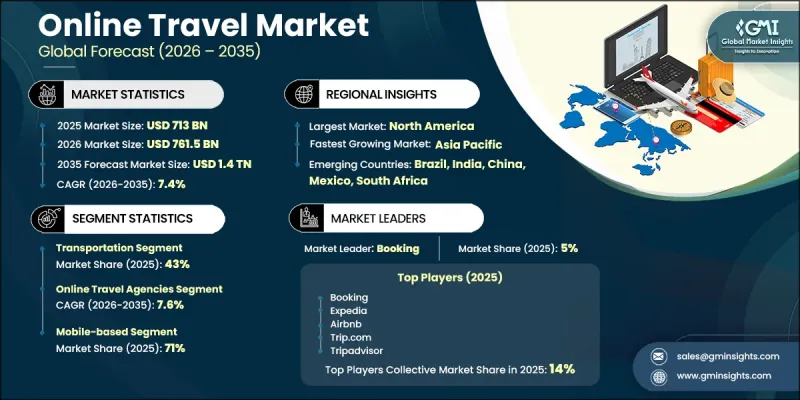
這個市場正在透過數位化旅行者發現、比較和預訂旅遊相關服務的方式,重塑全球旅遊業生態系統。這使得旅客能夠有效率地取得包括交通、住宿、度假計畫和輔助旅遊服務在內的各種服務,同時提升休閒和商務使用者的便利性、價格透明度和預訂柔軟性。服務供應商也受益於更廣泛的數位化覆蓋範圍,使航空公司、飯店業者和旅遊服務供應商能夠與全球更多客戶建立聯繫。該生態系統包括線上旅行社、供應商營運的預訂平台、整合式搜尋引擎和簡化旅行計劃的行動應用程式。人工智慧等先進數位技術正日益塑造著這一行業,這些技術可用於個人化旅遊提案、數據分析用於價格最佳化、自動化客戶支援系統以及安全的線上支付基礎設施。行動裝置的普及和與數位生態系統的融合進一步增強了用戶參與度,並簡化了整個旅行體驗。向即時、個人化和無縫旅行預訂解決方案的持續轉變正在推動全球市場的長期擴張。
| 市場範圍 | |
|---|---|
| 開始年份 | 2025 |
| 預測期 | 2026-2035 |
| 上市時的市場規模 | 7130億美元 |
| 預測金額 | 1.4兆美元 |
| 複合年成長率 | 7.4% |
預計到2025年,交通運輸領域將佔43%的市場佔有率,並在2026年至2035年間以7.1%的複合年成長率成長。該領域涵蓋航空旅行、鐵路系統、巴士運輸和租賃旅行解決方案的數位預訂服務,所有這些領域都在經歷廣泛的數位轉型。雖然人們越來越依賴線上平台進行旅行規劃和購票,提高了效率,但服務供應商正專注於直接的數位化互動和捆綁式服務,以提高客戶維繫並降低分銷成本。
預計到2025年,線上旅行社市佔率將達到56%,並在2026年至2035年間以7.6%的複合年成長率成長。這些平台作為服務供應商和旅客之間的中介,提供整合的旅行產品庫存、比較工具和簡化的預訂流程。它們還支援個人化旅行規劃和靈活的預訂選項,因此成為尋求便利、透明且經濟實惠的多目的地旅行解決方案的用戶的首選。
美國線上旅遊市場預計到2025年將達到2,032億美元,並在2026年至2035年間以4.9%的複合年成長率成長。該市場的主導地位得益於高度數位化、智慧型手機普及率高以及成熟的旅遊平台和服務供應商生態系統。人工智慧建議系統、預測定價模式和精準數位行銷等先進技術被廣泛用於提升客戶參與。服務供應商透過忠誠度計畫和專屬優惠不斷加強直接預訂管道,而線上平台則透過整合服務和靈活的旅行選擇提升競爭力。
目錄
第1章:調查方法
第2章執行摘要
第3章業界考察
- 生態系分析
- 供應商情況
- 利潤率分析
- 成本結構
- 每個階段增加的價值
- 影響價值鏈的因素
- 中斷
- 影響產業的因素
- 促進因素
- 網路普及率提高與行動應用的廣泛應用
- 數位支付解決方案和無縫交易的興起
- 消費者對即時價格比較的偏好
- 人工智慧驅動的個人化建議
- 社群媒體和網紅主導的旅遊趨勢
- 產業潛在風險與挑戰
- 技術整合的碎片化和複雜性
- 網路安全風險與資料隱私問題
- 柔軟性的舊有系統阻礙了創新
- 客戶獲取成本高,且對價格敏感。
- 市場機遇
- 人工智慧和機器學習在超個人化領域的應用
- 永續和負責任的旅行需求
- 改善最後一公里體驗
- 網路普及率低的新興市場
- 區塊鏈實現透明、安全的交易
- 促進因素
- 成長潛力分析
- 監理情勢
- 北美洲
- 美國運輸部(DOT) 和聯邦貿易委員會 (FTC)
- 加拿大-競爭管理局和《資料保護與電子文件法》(PIPEDA)關於數位旅行平台的規定
- 歐洲
- 德國—關於歐盟數位服務法案對線上旅遊市場的影響
- 英國-遵守《消費者權益法》、《旅遊套裝條例》和《數位市場法》
- 亞太地區
- 中國—電子商務法和旅遊法中關於線上預訂平台的規定
- 印度—旅遊部關於消費者保護法、資訊科技法和數位旅遊服務的指導方針
- 日本-《特定商業交易法》和《旅行社法》對線上旅遊預訂進行規範。
- 澳洲 - 競爭與消費者法以及線上旅遊平台的澳洲消費者法
- 拉丁美洲
- 墨西哥 - 聯邦消費者保護法和數位服務NOM標準
- 阿根廷 - 線上旅遊入口網站的消費者保護法和電子商務法規
- 中東和非洲(MEA)
- 阿拉伯聯合大公國-聯邦消費者保護法和杜拜旅遊局關於線上旅遊平台的法規
- 沙烏地阿拉伯—旅遊部支援電子商務法和數位旅遊服務的指導方針
- 北美洲
- 波特五力分析
- PESTEL 分析
- 科技與創新趨勢
- 當前技術趨勢
- 新興技術
- 專利趨勢(基於初步調查)
- 價格分析
- 對過去價格趨勢的分析
- 按球員類型分類的定價策略(高階/超值/成本加成)
- 人工智慧和生成式人工智慧對市場的影響
- 利用人工智慧改造現有經營模式
- 針對特定領域的生成式人工智慧應用案例和實施藍圖
- 風險、限制和監管考量
- 永續性和環境方面
- 永續計劃
- 減少廢棄物策略
- 生產中的能源效率
- 具有環保意識的舉措
- 碳足跡考量
第4章 競爭情勢
- 介紹
- 企業市佔率分析
- 北美洲
- 歐洲
- 亞太地區
- 拉丁美洲
- 中東和非洲(MEA)
- 主要市場公司的競爭分析
- 競爭定位矩陣
- 企業級分層基準測試
- 層級分類標準與選擇標準
- 按銷售額、地區和創新能力分類的層級定位矩陣。
- 主要進展
- 併購
- 夥伴關係和聯盟
- 新產品發布
- 業務拓展計劃及資金籌措
第5章 市場估計與預測:依服務業分類,2022-2035年
- 運輸
- 航空
- 租車
- 鐵路
- 巡航
- 公車
- 住宿設施
- 旅遊套餐
第6章 市場估算與預測:預約方式,2022-2035年
- 線上旅行社
- 旅行社(直營)
第7章 市場估計與預測:依平台分類,2022-2035年
- 移動基地
- 基於網路的
第8章 市場估計與預測:依旅行者分類,2022-2035年
- 休閒旅客
- 商務旅客
第9章 市場估計與預測:依年齡層別分類,2022-2035年
- 22-31歲
- 32-43歲
- 44-56歲
- 56歲或以上
第10章 市場估價與預測:依地區分類,2022-2035年
- 北美洲
- 美國
- 加拿大
- 歐洲
- 德國
- 英國
- 法國
- 義大利
- 西班牙
- 俄羅斯
- 荷蘭
- 瑞典
- 丹麥
- 波蘭
- 亞太地區
- 中國
- 印度
- 日本
- 澳洲
- 韓國
- 新加坡
- 泰國
- 印尼
- 越南
- 拉丁美洲
- 巴西
- 墨西哥
- 阿根廷
- 哥倫比亞
- 中東和非洲(MEA)
- 南非
- 沙烏地阿拉伯
- 阿拉伯聯合大公國
- 以色列
第11章:公司簡介
- 世界公司
- Airbnb
- American Express Travel
- Booking
- Expedia
- Sabre
- Trip.com
- TripAdvisor
- 本地球員
- Despegar
- eDreams ODIGEO
- lastminute.com
- MakeMyTrip
- Traveloka
- Wego
- Yatra
- 新興企業
- Almosafer
- Hopper
- Kiwi.com
- Musafir
- Omio
The Global Online Travel Market was valued at USD 713 billion in 2025 and is estimated to grow at a CAGR of 7.4% to reach USD 1.4 trillion by 2035.
The market is transforming the global travel and tourism ecosystem by digitizing how travelers discover, compare, and book travel-related services. It enables efficient access to a wide range of offerings, including transport, accommodation, holiday planning, and supplementary travel services, while improving convenience, pricing transparency, and booking flexibility for both leisure and corporate users. Service providers benefit from expanded digital reach, allowing airlines, hospitality operators, and mobility services to connect with a larger global audience. The ecosystem includes online travel agencies, supplier-owned booking platforms, meta-search engines, and mobile-based applications that collectively streamline travel planning. The sector is increasingly shaped by advanced digital technologies such as artificial intelligence for personalized travel suggestions, data analytics for pricing optimization, automated customer support systems, and secure online payment infrastructures. Growing mobile usage and integration with digital ecosystems are further enhancing user engagement and simplifying end-to-end travel experiences. The continued shift toward real-time, personalized, and seamless travel booking solutions is strengthening long-term market expansion across global regions.
| Market Scope | |
|---|---|
| Start Year | 2025 |
| Forecast Year | 2026-2035 |
| Start Value | $713 Billion |
| Forecast Value | $1.4 Trillion |
| CAGR | 7.4% |
The transportation segment held a 43% share in 2025 and is projected to grow at a CAGR of 7.1% from 2026 to 2035. This segment covers digital booking services for air travel, rail systems, bus transportation, and rental mobility solutions, all of which have undergone extensive digitization. Increasing reliance on online platforms for travel planning and ticketing is improving efficiency, while service providers are focusing on direct digital engagement and bundled offerings to enhance customer retention and reduce distribution costs.
The online travel agencies segment accounted for 56% in 2025 and is expected to grow at a CAGR of 7.6% during 2026-2035. These platforms act as intermediaries between service providers and travelers by offering consolidated travel inventories, comparison tools, and streamlined booking processes. They also support personalized travel planning and flexible booking options, making them a preferred choice for users seeking convenience, transparency, and cost-effective travel solutions across multiple destinations.
U.S. Online Travel Market reached USD 203.2 billion in 2025 and is projected to grow at a CAGR of 4.9% from 2026 to 2035. Market leadership is supported by high digital adoption, widespread smartphone penetration, and a mature ecosystem of travel platforms and service providers. Advanced technologies such as AI-driven recommendation systems, predictive pricing models, and targeted digital marketing are widely used to improve customer engagement. Service providers continue to strengthen direct booking channels through loyalty programs and exclusive offers, while online platforms enhance competitiveness through integrated services and flexible travel options.
Key companies operating in the Global Online Travel Industry include Booking Holdings, Expedia Group, Airbnb, Trip.com Group, Tripadvisor, MakeMyTrip, eDreams ODIGEO, Despegar, Webjet, and Kiwi.com. Companies in the Online Travel Market are focusing on digital transformation, AI integration, and personalized user experiences to strengthen their competitive position. Many platforms are investing in machine learning algorithms to enhance recommendation accuracy and optimize pricing strategies. Expansion of mobile-first platforms and app-based ecosystems is improving user engagement and booking convenience. Strategic partnerships with airlines, hotels, and mobility providers are enabling broader inventory access and bundled service offerings. Firms are also prioritizing customer retention through loyalty programs, flexible cancellation policies, and dynamic promotional campaigns.
Table of Contents
Chapter 1 Methodology
- 1.1 Research approach
- 1.2 Quality Commitments
- 1.2.1 GMI AI policy & data integrity commitment
- 1.2.1.1 Source consistency protocol
- 1.2.1 GMI AI policy & data integrity commitment
- 1.3 Research Trail & Confidence Scoring
- 1.3.1 Research Trail Components
- 1.3.2 Scoring Components
- 1.4 Data Collection
- 1.4.1 Partial list of primary sources
- 1.5 Data mining sources
- 1.5.1 Paid sources
- 1.5.1.1 Sources, by region
- 1.5.1 Paid sources
- 1.6 Base estimates and calculations
- 1.6.1 Base year calculation
- 1.7 Forecast model
- 1.7.1 Quantified market impact analysis
- 1.7.1.1 Mathematical impact of growth parameters on forecast
- 1.7.1 Quantified market impact analysis
- 1.8 Research transparency addendum
- 1.8.1 Source attribution framework
- 1.8.2 Quality assurance metrics
- 1.8.3 Our commitment to trust
Chapter 2 Executive Summary
- 2.1 Industry 360° synopsis, 2022 - 2035
- 2.2 Key market trends
- 2.2.1 Regional
- 2.2.2 Services
- 2.2.3 Mode of Booking
- 2.2.4 Platform
- 2.2.5 Travelers
- 2.2.6 Age Group
- 2.3 TAM Analysis, 2026-2035
- 2.4 CXO perspectives: Strategic imperatives
Chapter 3 Industry Insights
- 3.1 Industry ecosystem analysis
- 3.1.1 Supplier landscape
- 3.1.2 Profit margin analysis
- 3.1.3 Cost structure
- 3.1.4 Value addition at each stage
- 3.1.5 Factor affecting the value chain
- 3.1.6 Disruptions
- 3.2 Industry impact forces
- 3.2.1 Growth drivers
- 3.2.1.1 Increasing internet penetration and mobile app adoption
- 3.2.1.2 Rise of digital payment solutions and seamless transactions
- 3.2.1.3 Consumer preference for real-time price comparisons
- 3.2.1.4 AI-driven personalized recommendations
- 3.2.1.5 Social media and influencer-driven travel trends
- 3.2.2 Industry pitfalls and challenges
- 3.2.2.1 Technology fragmentation and integration complexity
- 3.2.2.2 Cybersecurity risks and data privacy concerns
- 3.2.2.3 Inflexible legacy systems limiting innovation
- 3.2.2.4 High customer acquisition costs and price sensitivity
- 3.2.3 Market opportunities
- 3.2.3.1 AI and machine learning for hyper-personalization
- 3.2.3.2 Sustainable and responsible travel demand
- 3.2.3.3 Last-mile experience enhancement
- 3.2.3.4 Emerging markets with low online penetration
- 3.2.3.5 Blockchain for transparent and secure transactions
- 3.2.1 Growth drivers
- 3.3 Growth potential analysis
- 3.4 Regulatory landscape
- 3.4.1 North America
- 3.4.1.1 US- Department of Transportation (DOT) and Federal Trade Commission (FTC)
- 3.4.1.2 Canada - Competition Bureau & Personal Information Protection and Electronic Documents Act (PIPEDA) regulations for digital travel platforms
- 3.4.2 Europe
- 3.4.2.1 Germany- EU Digital Services Act for online travel market
- 3.4.2.2 UK- Consumer Rights Act, Package Travel Regulations & Digital Markets Act compliance
- 3.4.3 Asia Pacific
- 3.4.3.1 China- E-commerce Law & Tourism Law regulations for online booking platforms
- 3.4.3.2 India- Consumer Protection Act, IT Act, and Ministry of Tourism guidelines for digital travel services
- 3.4.3.3 Japan- Act on Specified Commercial Transactions & Travel Agency Act governing online travel bookings
- 3.4.3.4 Australia- Competition and Consumer Act & Australian Consumer Law for online travel platforms
- 3.4.4 LATAM
- 3.4.4.1 Mexico- Federal Consumer Protection Law & NOM standards for digital services
- 3.4.4.2 Argentina- Consumer Defense Code & e-commerce regulations for online travel portals
- 3.4.5 MEA
- 3.4.5.1 UAE- Federal Law on Consumer Protection & Dubai Tourism regulations for online travel platforms
- 3.4.5.2 Saudi Arabia- E-commerce Law & Ministry of Tourism guidelines supporting digital travel services
- 3.4.1 North America
- 3.5 Porter's analysis
- 3.6 PESTEL analysis
- 3.7 Technology and innovation landscape
- 3.7.1 Current technological trends
- 3.7.2 Emerging technologies
- 3.8 Patent landscape (driven by primary research)
- 3.9 Pricing analysis
- 3.9.1 Historical price trend analysis
- 3.9.2 Pricing strategy by player type (premium / value / cost-plus)
- 3.10 Impact of AI & generative AI on the market
- 3.10.1 AI-driven disruption of existing business models
- 3.10.2 GenAI use cases & adoption roadmap by segment
- 3.10.3 Risks, limitations & regulatory considerations
- 3.11 Sustainability and environmental aspects
- 3.11.1 Sustainable practices
- 3.11.2 Waste reduction strategies
- 3.11.3 Energy efficiency in production
- 3.11.4 Eco-friendly Initiatives
- 3.11.5 Carbon footprint considerations
Chapter 4 Competitive Landscape, 2025
- 4.1 Introduction
- 4.2 Company market share analysis
- 4.2.1 North America
- 4.2.2 Europe
- 4.2.3 Asia Pacific
- 4.2.4 LATAM
- 4.2.5 MEA
- 4.3 Competitive analysis of major market players
- 4.4 Competitive positioning matrix
- 4.5 Company Tier Benchmarking
- 4.5.1 Tier Classification Criteria & Qualifying Thresholds
- 4.5.2 Tier Positioning Matrix by Revenue, Geography & Innovation
- 4.6 Key developments
- 4.6.1 Mergers & acquisitions
- 4.6.2 Partnerships & collaborations
- 4.6.3 New product launches
- 4.6.4 Expansion plans and funding
Chapter 5 Market Estimates & Forecast, By Service, 2022 - 2035 ($Bn)
- 5.1 Key trends
- 5.2 Transportation
- 5.2.1 Airline
- 5.2.2 Car rental
- 5.2.3 Rail
- 5.2.4 Cruise
- 5.2.5 Bus
- 5.3 Accommodation
- 5.4 Tour packages
Chapter 6 Market Estimates & Forecast, By Mode of Booking, 2022 - 2035 ($Bn)
- 6.1 Key trends
- 6.2 Online travel agencies
- 6.3 Direct travel suppliers
Chapter 7 Market Estimates & Forecast, By Platform, 2022 - 2035 ($Bn)
- 7.1 Key trends
- 7.2 Mobile-based
- 7.3 Web-based
Chapter 8 Market Estimates & Forecast, By Travelers, 2022 - 2035 ($Bn)
- 8.1 Key trends
- 8.2 Leisure travelers
- 8.3 Business travelers
Chapter 9 Market Estimates & Forecast, By Age Group, 2022 - 2035 ($Bn)
- 9.1 Key trends
- 9.2 22-31 years
- 9.3 32-43 years
- 9.4 44-56 years
- 9.5 Above 56 years
Chapter 10 Market Estimates & Forecast, By Region, 2022 - 2035 ($Bn)
- 10.1 Key trends
- 10.2 North America
- 10.2.1 US
- 10.2.2 Canada
- 10.3 Europe
- 10.3.1 Germany
- 10.3.2 UK
- 10.3.3 France
- 10.3.4 Italy
- 10.3.5 Spain
- 10.3.6 Russia
- 10.3.7 Netherlands
- 10.3.8 Sweden
- 10.3.9 Denmark
- 10.3.10 Poland
- 10.4 Asia Pacific
- 10.4.1 China
- 10.4.2 India
- 10.4.3 Japan
- 10.4.4 Australia
- 10.4.5 South Korea
- 10.4.6 Singapore
- 10.4.7 Thailand
- 10.4.8 Indonesia
- 10.4.9 Vietnam
- 10.5 Latin America
- 10.5.1 Brazil
- 10.5.2 Mexico
- 10.5.3 Argentina
- 10.5.4 Colombia
- 10.6 MEA
- 10.6.1 South Africa
- 10.6.2 Saudi Arabia
- 10.6.3 UAE
- 10.6.4 Israel
Chapter 11 Company Profiles
- 11.1 Global Players
- 11.1.1 Airbnb
- 11.1.2 American Express Travel
- 11.1.3 Booking
- 11.1.4 Expedia
- 11.1.5 Sabre
- 11.1.6 Trip.com
- 11.1.7 TripAdvisor
- 11.2 Regional Players
- 11.2.1 Despegar
- 11.2.2 eDreams ODIGEO
- 11.2.3 lastminute.com
- 11.2.4 MakeMyTrip
- 11.2.5 Traveloka
- 11.2.6 Wego
- 11.2.7 Yatra
- 11.3 Emerging Players
- 11.3.1 Almosafer
- 11.3.2 Hopper
- 11.3.3 Kiwi.com
- 11.3.4 Musafir
- 11.3.5 Omio

 獨立住宿設施市場規模、佔有率和成長分析:按物業類型、住宿形式、預訂管道、最終用戶、入住時長和地區分類-2026-2033年產業預測
 行動旅行市場規模、佔有率和成長分析:按服務類型、預訂方式、旅行者類型、最終用戶、支付方式和地區分類-2026-2033年產業預測
 線上旅遊預訂服務市場-全球市場預測(2026-2032年)線上旅遊市場:按平台、服務類型、預訂類型、支付方式和旅客類型分類-全球預測,2026-2032年
 區域性活動及體驗預訂平台市場預測至2034年-按平台類型、體驗類別、預訂模式、支付模式、最終用戶和區域分類的全球分析
 全球線上旅遊預訂市場規模、佔有率、趨勢和成長分析報告(2026-2034)
 線上旅遊市場規模、佔有率、趨勢及預測(按服務類型、平台、預訂方式、年齡層和地區分類,2026-2034 年)
 按平台類型、年齡層和地區分類的線上旅遊市場
 線上旅遊預訂服務市場 - 全球產業規模、佔有率、趨勢、機會及預測(按服務類型、平台、支付方式、地區和競爭格局分類,2021-2031年)線上旅遊市場-2026-2031年預測