


 |
市場調查報告書
商品編碼
2038432
壬酸市場機會、成長要素、產業趨勢分析及2026-2035年預測Pelargonic Acid Market Opportunity, Growth Drivers, Industry Trend Analysis, and Forecast 2026 - 2035 |
||||||

預計到 2025 年,全球壬酸市場價值將達到 2.222 億美元,年複合成長率為 7.1%,到 2035 年將達到 4.412 億美元。
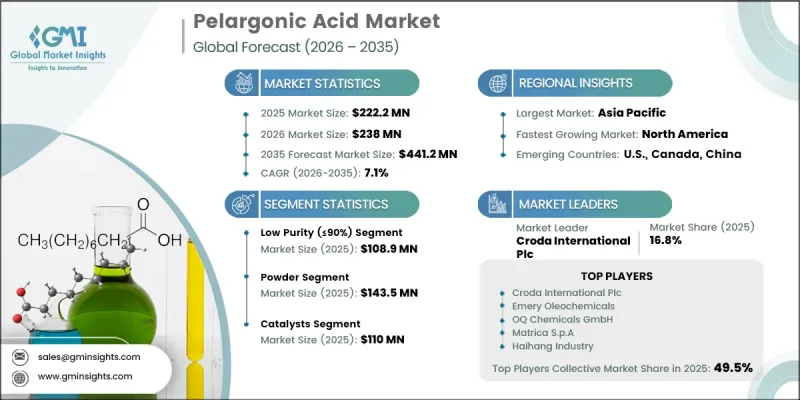
農業、個人護理、製藥和工業領域對生物基和環保化學品的需求不斷成長,推動了市場成長。壬酸(也稱為壬二酸)是一種天然存在於植物油中的9碳飽和脂肪酸,因其可生物分解、低毒性和廣泛的功能多樣性而備受青睞。其化學結構使其應用範圍廣泛,包括除草劑配方、界面活性劑生產和特殊化學品合成。壬酸可透過多種生產途徑製取,包括植物油萃取、油酸氧化以及使用石油衍生原料合成。壬酸在接觸性除草劑中發揮關鍵作用,同時也是藥物合成的中間體以及潤滑劑、塑化劑和工業配方中的添加劑。人們對永續性和可再生原料日益成長的興趣進一步推動了壬酸在各行業的應用。成熟的生產基地擁有強大的油脂化學品加工能力和完善的供應鏈,為市場提供了支撐,壬酸在特種化學品和農業材料生態系統中蓬勃發展。
| 市場範圍 | |
|---|---|
| 開始年份 | 2025 |
| 預測期 | 2026-2035 |
| 上市時的市場規模 | 2.222億美元 |
| 預測金額 | 4.412億美元 |
| 複合年成長率 | 7.1% |
到2025年,低純度(90%或以下)產品市場規模將達到1.089億美元。該細分市場佔據主導地位,主要得益於其在大規模應用中的廣泛應用,在這些應用中,成本效益比高純度更為重要。低純度產品廣泛應用於農業除草劑生產、工業化學品加工和植被管理等領域,這些領域對價格競爭力和功能性能都有較高要求。對大宗製劑的強勁需求持續支撐著該細分市場在終端用戶產業的穩定成長。
預計到2025年,粉末狀壬酸市場規模將達到1.435億美元。粉末狀壬酸因其適用於農業、化妝品和工業配方等廣泛應用而備受青睞。它能夠實現高效混合、均勻分散,並且易於在固體體系中加工。粒徑分佈和流動性等關鍵物理性質對配方的穩定性和性能有顯著影響。製造商不斷最佳化粉末規格,以滿足不同應用中對溶解度、操作效率和儲存穩定性的各種要求。
預計北美壬酸市場規模將從2025年的6,550萬美元成長到2035年的1.27億美元。該地區市場擴張的促進因素包括有機農業實踐的日益普及、有利於低風險農藥使用的法規結構,以及個人護理和特種化學品行業需求的成長。壬酸在農業生產系統、都市區植被管理和天然產品製造領域均有強勁的消費需求。壬酸作為一種低風險活性成分獲得監管機構的認可,使其應用範圍更加廣泛,不再受限於傳統農藥的限制。消費者對永續植物來源產品的日益偏好,以及成熟的油脂化學品生產基地,進一步推動了全部區域市場的發展。
目錄
第1章:調查方法和範圍
第2章執行摘要
第3章業界考察
- 生態系分析
- 供應商情況
- 利潤率
- 每個階段增加的價值
- 影響價值鏈的因素
- 中斷
- 影響產業的因素
- 促進因素
- 產業潛在風險與挑戰
- 市場機遇
- 成長潛力分析
- 監理情勢
- 北美洲
- 歐洲
- 亞太地區
- 拉丁美洲
- 中東和非洲
- 波特五力分析
- PESTEL 分析
- 價格趨勢
- 按地區
- 純度
- 未來市場趨勢
- 科技與創新趨勢
- 當前技術趨勢
- 新興技術
- 專利趨勢
- 貿易統計(HS編碼)
- 主要進口國
- 主要出口國
- 永續性和環境方面
- 永續計劃
- 減少廢棄物策略
- 生產中的能源效率
- 具有環保意識的舉措
第4章 競爭情勢
- 介紹
- 企業市佔率分析
- 按地區
- 北美洲
- 歐洲
- 亞太地區
- 拉丁美洲
- 中東和非洲(MEA)
- 按地區
- 主要市場公司的競爭分析
- 競爭定位矩陣
- 主要進展
- 併購
- 夥伴關係和聯盟
- 新產品發布
- 業務拓展計劃
第5章 市場估算與預測:依供應模式分類,2022-2035年
- 低純度(90%或以下)
- 中等純度(90%-99%)
- 高純度(99%或以上)
第6章 市場估計與預測:依類型分類,2022-2035年
- 粉末
- 顆粒狀
- 奈米結構(奈米級)
第7章 市場估價與預測:依通路分類,2022-2035年
- 催化劑
- 電子與光學
- 儲能
- 化學品
- 製藥和醫療保健
- 其他
第8章 市場估計與預測:依地區分類,2022-2035年
- 北美洲
- 美國
- 加拿大
- 歐洲
- 德國
- 英國
- 法國
- 西班牙
- 義大利
- 其他歐洲地區
- 亞太地區
- 中國
- 印度
- 日本
- 澳洲
- 韓國
- 亞太其他地區
- 拉丁美洲
- 巴西
- 墨西哥
- 阿根廷
- 其他拉丁美洲地區
- 中東和非洲
- 沙烏地阿拉伯
- 南非
- 阿拉伯聯合大公國
- 其他中東和非洲地區
第9章:公司簡介
- Central Drug House
- Croda International Plc
- Emery Oleochemical
- Glentham Life Sciences Limited
- Haihang Industry
- Kunshan Odowell Co., Ltd
- Matrica SpA
- OQ Chemicals GmbH
- Tokyo Chemical Industry Co., Ltd.
- Zhengzhou Yibang Industry &Commerce Co., Ltd
The Global Pelargonic Acid Market was valued at USD 222.2 million in 2025 and is estimated to grow at a CAGR of 7.1% to reach USD 441.2 million by 2035.
Market growth is driven by rising demand for bio-based and environmentally compatible chemicals across agriculture, personal care, pharmaceutical, and industrial sectors. Pelargonic acid, also referred to as nonanoic acid, is a naturally derived nine-carbon saturated fatty acid found in vegetable oils and widely valued for its biodegradability, low toxicity, and broad functional versatility. Its chemical structure enables wide-ranging applications, including herbicide formulations, surfactant production, and specialty chemical synthesis. The compound is produced through multiple routes such as plant oil extraction, oxidative processing of oleic acid, and synthetic manufacturing using petroleum-based inputs. It plays a key role as an active ingredient in contact herbicides, an intermediate in pharmaceutical synthesis, and an additive in lubricants, plasticizers, and industrial formulations. Increasing emphasis on sustainability and renewable raw materials is further strengthening its adoption across industries. The market operates within specialty chemicals and agricultural input ecosystems, supported by established production hubs with strong oleochemical processing capabilities and integrated supply chains.
| Market Scope | |
|---|---|
| Start Year | 2025 |
| Forecast Year | 2026-2035 |
| Start Value | $ 222.2 Million |
| Forecast Value | $ 441.2 Million |
| CAGR | 7.1% |
The low purity (<=90%) segment accounted for USD 108.9 million in 2025. This segment leads due to its extensive use in large-scale applications where cost efficiency is prioritized over high purity levels. It is widely utilized in agricultural herbicide production, industrial chemical processing, and vegetation management applications that require functional performance at competitive pricing. Strong demand for bulk formulations continues to support steady growth in this segment across end-use industries.
The powder form segment reached USD 143.5 million in 2025. Powder-based pelargonic acid is widely preferred due to its adaptability across agricultural, cosmetic, and industrial formulations. It enables efficient blending, consistent dispersion, and ease of processing in solid and liquid systems. Key physical properties such as particle size distribution and flow characteristics significantly influence formulation stability and performance. Manufacturers continue to optimize powder specifications to meet diverse requirements related to solubility, handling efficiency, and storage stability across different applications.
North America Pelargonic Acid Market is expected to grow from USD 65.5 million in 2025 to USD 127 million by 2035. Regional expansion is driven by increasing adoption of organic farming practices, supportive regulatory frameworks promoting reduced-risk agricultural chemicals, and rising demand from personal care and specialty chemical industries. Strong consumption is observed across agricultural production systems, municipal vegetation management, and natural product manufacturing. Regulatory recognition as a minimum-risk active ingredient supports wider application without conventional pesticide restrictions. Growing consumer preference for sustainable and plant-based products, combined with a well-established oleochemical manufacturing base, is further enhancing market development across the region.
Key players operating in the Global Pelargonic Acid Market include OQ Chemicals GmbH, Croda International Plc, Emery Oleochemical, Tokyo Chemical Industry Co., Ltd., Matrica S.p.A, Central Drug House, Glentham Life Sciences Limited, Haihang Industry, Kunshan Odowell Co., Ltd, and Zhengzhou Yibang Industry & Commerce Co., Ltd. Companies in the Pelargonic Acid Market are focusing on expanding production capacity, strengthening bio-based sourcing strategies, and enhancing product purity diversification to improve competitiveness. Investments in research and development are supporting the development of more efficient extraction and synthesis processes to reduce production costs and improve yield efficiency. Strategic partnerships with agricultural and chemical industry players are enabling wider application development and market penetration. Manufacturers are also prioritizing sustainability initiatives by increasing reliance on renewable feedstocks and environmentally friendly production methods. Expansion into emerging regional markets and optimization of distribution networks are further strengthening global reach.
Table of Contents
Chapter 1 Methodology & Scope
- 1.1 Market scope and definition
- 1.2 Research design
- 1.2.1 Research approach
- 1.2.2 Data collection methods
- 1.3 Data mining sources
- 1.3.1 Global
- 1.3.2 Regional/Country
- 1.4 Base estimates and calculations
- 1.4.1 Base year calculation
- 1.4.2 Key trends for market estimation
- 1.5 Primary research and validation
- 1.5.1 Primary sources
- 1.6 Forecast model
- 1.7 Research assumptions and limitations
Chapter 2 Executive Summary
- 2.1 Industry 360° synopsis
- 2.2 Key market trends
- 2.2.1 Purity-based
- 2.2.2 Form
- 2.2.3 Application
- 2.2.4 Regional
- 2.3 TAM Analysis, 2026-2035
- 2.4 CXO perspectives: Strategic imperatives
Chapter 3 Industry Insights
- 3.1 Industry ecosystem analysis
- 3.1.1 Supplier landscape
- 3.1.2 Profit margin
- 3.1.3 Value addition at each stage
- 3.1.4 Factor affecting the value chain
- 3.1.5 Disruptions
- 3.2 Industry impact forces
- 3.2.1 Growth drivers
- 3.2.2 Industry pitfalls and challenges
- 3.2.3 Market opportunities
- 3.3 Growth potential analysis
- 3.4 Regulatory landscape
- 3.4.1 North America
- 3.4.2 Europe
- 3.4.3 Asia Pacific
- 3.4.4 Latin America
- 3.4.5 Middle East & Africa
- 3.5 Porter's analysis
- 3.6 PESTEL analysis
- 3.7 Price trends
- 3.7.1 By region
- 3.7.2 By purity-based
- 3.8 Future market trends
- 3.9 Technology and Innovation landscape
- 3.9.1 Current technological trends
- 3.9.2 Emerging technologies
- 3.10 Patent Landscape
- 3.11 Trade statistics (HS code)
- 3.11.1 Major importing countries
- 3.11.2 Major exporting countries
- 3.12 Sustainability and environmental aspects
- 3.12.1 Sustainable practices
- 3.12.2 Waste reduction strategies
- 3.12.3 Energy efficiency in production
- 3.12.4 Eco-friendly initiatives
Chapter 4 Competitive Landscape, 2025
- 4.1 Introduction
- 4.2 Company market share analysis
- 4.2.1 By region
- 4.2.1.1 North America
- 4.2.1.2 Europe
- 4.2.1.3 Asia Pacific
- 4.2.1.4 LATAM
- 4.2.1.5 MEA
- 4.2.1 By region
- 4.3 Competitive analysis of major market players
- 4.4 Competitive positioning matrix
- 4.5 Key developments
- 4.5.1 Mergers & acquisitions
- 4.5.2 Partnerships & collaborations
- 4.5.3 New Product Launches
- 4.5.4 Expansion Plans
Chapter 5 Market Estimates and Forecast, By Supply Mode, 2022-2035 (USD Million) (Kilo Tons)
- 5.1 Key trends
- 5.2 Low Purity (≤90%)
- 5.3 Medium Purity (90%-99%)
- 5.4 High Purity (≥99%)
Chapter 6 Market Estimates and Forecast, By Application, 2022-2035 (USD Million) (Kilo Tons)
- 6.1 Key trends
- 6.2 Powder
- 6.3 Granular
- 6.4 Nanostructured (Nano-grade)
Chapter 7 Market Estimates and Forecast, By Distribution channel, 2022-2035 (USD Million) (Kilo Tons)
- 7.1 Key trends
- 7.2 Catalysts
- 7.3 Electronics & Optics
- 7.4 Energy Storage
- 7.5 Chemicals
- 7.6 Pharmaceuticals & Healthcare
- 7.7 Others
Chapter 8 Market Estimates and Forecast, By Region, 2022-2035 (USD Million) (Kilo Tons)
- 8.1 Key trends
- 8.2 North America
- 8.2.1 U.S.
- 8.2.2 Canada
- 8.3 Europe
- 8.3.1 Germany
- 8.3.2 UK
- 8.3.3 France
- 8.3.4 Spain
- 8.3.5 Italy
- 8.3.6 Rest of Europe
- 8.4 Asia Pacific
- 8.4.1 China
- 8.4.2 India
- 8.4.3 Japan
- 8.4.4 Australia
- 8.4.5 South Korea
- 8.4.6 Rest of Asia Pacific
- 8.5 Latin America
- 8.5.1 Brazil
- 8.5.2 Mexico
- 8.5.3 Argentina
- 8.5.4 Rest of Latin America
- 8.6 Middle East and Africa
- 8.6.1 Saudi Arabia
- 8.6.2 South Africa
- 8.6.3 UAE
- 8.6.4 Rest of Middle East and Africa
Chapter 9 Company Profiles
- 9.1 Central Drug House
- 9.2 Croda International Plc
- 9.3 Emery Oleochemical
- 9.4 Glentham Life Sciences Limited
- 9.5 Haihang Industry
- 9.6 Kunshan Odowell Co., Ltd
- 9.7 Matrica S.p.A
- 9.8 OQ Chemicals GmbH
- 9.9 Tokyo Chemical Industry Co., Ltd.
- 9.10 Zhengzhou Yibang Industry & Commerce Co., Ltd

 全球草銨膦市場:機會與策略展望(至2035年)
 草銨膦市場:2026-2032 年全球市場預測
 壬酸市場規模、佔有率和成長分析:按產品等級、純度、應用、終端用戶產業和地區分類-2026-2033年產業預測
 草銨膦市場規模、佔有率和成長分析:按製劑、作物類型、應用、加工階段、分銷通路和地區分類-2026-2033年產業預測
 壬二酸市場:依等級、應用和地區分類
 草銨膦:市場佔有率分析、產業趨勢與統計、成長預測(2026-2031)
 草銨膦市場報告:按作物類型、製劑類型、應用和地區分類(2026-2034 年)Fipronil市場:2026-2032年全球市場預測(依作物類型、製劑類型、劑型、最終用途、應用方法及通路分類)
 Fipronil市場 - 全球產業規模、佔有率、趨勢、機會、預測:按形態、應用、區域和競爭格局分類,2021-2031年壬酸市場-全球產業規模、佔有率、趨勢、機會、預測:按等級、應用、地區和競爭格局分類,2021-2031年