


 |
市場調查報告書
商品編碼
2038431
2026 年至 2035 年飼料抗氧化劑的市場機會、成長要素、產業趨勢與預測。Animal Feed Antioxidant Market Opportunity, Growth Drivers, Industry Trend Analysis, and Forecast 2026 - 2035 |
||||||

預計到 2025 年,全球動物飼料用抗氧化劑市場價值將達到 3.993 億美元,年複合成長率為 5.2%,到 2035 年將達到 6.626 億美元。
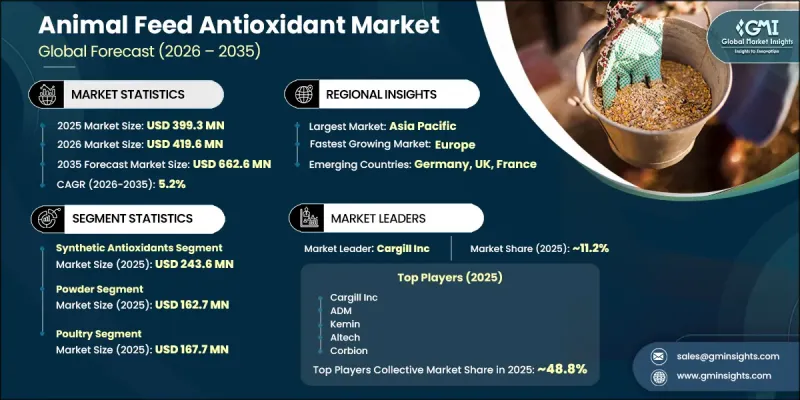
全球畜牧業規模的不斷擴大以及集約化養殖模式的興起,推動了市場成長。集約化養殖需要更多的複合飼料和性能增強添加劑。隨著飼料產量的增加,在長期儲存和運輸過程中保持營養價值和品質穩定性變得至關重要,因此抗氧化劑解決方案的應用日益廣泛。這些添加劑在防止氧化、維持營養完整性和確保飼料性能穩定方面發揮關鍵作用。畜牧業產業化進程的推進進一步刺激了市場需求,因為生產者正在尋求提高生產力和維持飼料品質的有效解決方案。此外,動物性蛋白質消費量的增加也促使生產者最佳化飼料轉換率和畜牧健康。關注飼料安全、品質標準和保存期限穩定性的法律規範也促進了市場擴張,因為生產商正在採用抗氧化劑來滿足不斷變化的行業要求並確保產品可靠性。
| 市場範圍 | |
|---|---|
| 開始年份 | 2025 |
| 預測期 | 2026-2035 |
| 上市時的市場規模 | 3.993億美元 |
| 預測金額 | 6.626億美元 |
| 複合年成長率 | 5.2% |
預計到2025年,合成抗氧化劑市場規模將達到2.436億美元。該市場憑藉其成本效益、高穩定性以及在大規模飼料生產中的抗氧化效果,保持著強勁的市場地位。儘管合成抗氧化劑仍被廣泛應用,但業界對符合不斷變化的監管要求和永續性目標的替代方案越來越感興趣。各公司正在調整產品開發策略,以平衡性能效率和安全性,既滿足飼料生產商不斷變化的需求,也確保符合更嚴格的品質標準。
預計到2025年,家禽市場規模將達到1.677億美元,在推動畜牧業整體需求方面發揮重要作用。包括家禽、生豬和反芻動物在內的整個畜牧業的成長,與大規模生產中保持飼料品質穩定和營養成分保留的需求密切相關。家禽生產的特徵是生長週期短,因此需要穩定且營養豐富的飼料來確保最佳生產力。同樣,其他畜牧業也透過致力於提高生產力和飼料轉換率來促進整體需求。防止大規模生產飼料中營養成分劣化的需求,也使得抗氧化劑在這些領域的重要性日益凸顯。
預計2025年,北美動物飼料抗氧化劑市場規模將達1.308億美元。該地區憑藉先進的飼料生產基礎設施和成熟的畜牧業,佔據了市場領先地位。美國憑藉其大規模的企業發展以及對使用抗氧化劑維持高飼料品質標準的重視,在該市場中發揮著至關重要的作用。有關飼料安全和營養成分保存的監管要求持續影響抗氧化劑的應用趨勢。此外,該地區對潔淨標示飼料解決方案和改進的動物營養管理實踐的興趣日益濃厚。飼料配方技術的不斷進步和複合飼料的廣泛應用,正在推動區域市場的進一步發展,並確保對抗氧化劑解決方案的穩定需求。
目錄
第1章:調查方法和範圍
第2章執行摘要
第3章業界考察
- 生態系分析
- 供應商情況
- 利潤率
- 每個階段增加的價值
- 影響價值鏈的因素
- 中斷
- 影響產業的因素
- 促進因素
- 牲畜數量增加及畜牧業集約化
- 對優質動物性蛋白質的需求日益成長
- 人們越來越意識到氧化壓力對動物健康的影響
- 產業潛在風險與挑戰
- 對合成抗氧化劑的監管限制
- 天然抗氧化劑高成本
- 市場機遇
- 向潔淨標示和天然飼料添加劑過渡
- 植物萃取物衍生抗氧化劑的創新
- 促進因素
- 成長潛力分析
- 監理情勢
- 波特五力分析
- PESTEL 分析
- 價格趨勢
- 按地區
- 產品類型
- 未來市場趨勢
- 科技與創新趨勢
- 當前技術趨勢
- 新興技術
- 專利趨勢
- 貿易統計資料(HS編碼)(註:僅提供主要國家的貿易統計資料)
- 主要進口國
- 主要出口國
- 永續性和環境方面
- 永續計劃
- 減少廢棄物策略
- 生產中的能源效率
- 環保意識的舉措
第4章 競爭情勢
- 介紹
- 企業市佔率分析
- 按地區
- 北美洲
- 歐洲
- 亞太地區
- 拉丁美洲
- 中東和非洲(MEA)
- 按地區
- 企業矩陣分析
- 主要市場公司的競爭分析
- 競爭定位矩陣
- 主要進展
- 併購
- 夥伴關係和聯盟
- 新產品發布
- 業務拓展計劃
第5章 市場估計與預測:依類型分類,2022-2035年
- 合成抗氧化劑
- 二丁基羥基甲苯(BHT)
- 丁基Hydroxyanisole(BHA)
- 乙氧喹
- 沒食子酸丙酯
- 叔丁基氫醌(TBHQ)
- 天然抗氧化劑
- 生育酚(維生素E)
- 抗壞血酸(維生素C)
- 植物萃取物
- 迷迭香萃取物
- 綠茶萃取物
- 牛至萃取物
- 其他
- 類胡蘿蔔素
第6章 市場估計與預測:依類型分類,2022-2035年
- 粉末
- 顆粒
- 液體
- 顆粒
第7章 市場估計與預測:依原料分類,2022-2035年
- 家禽
- 肉雞
- 產蛋母雞
- 豬
- 反芻動物
- 牛(產奶/產肉)
- 羊
- 山羊
- 水產養殖
- 魚
- 蝦
- 伴侶動物
- 狗
- 貓
- 馬
- 其他
第8章 市場估計與預測:依地區分類,2022-2035年
- 北美洲
- 美國
- 加拿大
- 歐洲
- 德國
- 英國
- 法國
- 西班牙
- 義大利
- 其他歐洲地區
- 亞太地區
- 中國
- 印度
- 日本
- 澳洲
- 韓國
- 亞太其他地區
- 拉丁美洲
- 巴西
- 墨西哥
- 其他拉丁美洲地區
- 中東和非洲
- 沙烏地阿拉伯
- 南非
- 阿拉伯聯合大公國
- 其他中東和非洲地區
第9章:公司簡介
- ADM
- Altech
- BTSA
- Camlin fine science
- Cargill Inc
- Corbion
- Food safe technologies
- Kemin
- Lallemand Nutrition
- Miavit
- Oxiris
- VDH chemtech pvt ltd
The Global Animal Feed Antioxidant Market was valued at USD 399.3 million in 2025 and is estimated to grow at a CAGR of 5.2% to reach USD 662.6 million by 2035.
Market growth is being driven by the rising global livestock population and the increasing shift toward intensive farming practices that require higher volumes of compound feed and performance-enhancing additives. As feed production scales up, maintaining nutritional quality and stability over extended storage and distribution periods has become essential, leading to greater adoption of antioxidant solutions. These additives play a critical role in preventing oxidation, preserving nutrient integrity, and ensuring consistent feed performance. The transition toward industrialized animal farming systems has further strengthened demand, as producers seek efficient solutions to enhance productivity and maintain feed quality. Additionally, rising consumption of animal-based protein is encouraging producers to optimize feed efficiency and animal health outcomes. Regulatory frameworks focused on feed safety, quality standards, and shelf-life stability are also contributing to market expansion, as manufacturers adopt antioxidants to comply with evolving industry requirements and ensure product reliability.
| Market Scope | |
|---|---|
| Start Year | 2025 |
| Forecast Year | 2026-2035 |
| Start Value | $399.3 Million |
| Forecast Value | $662.6 Million |
| CAGR | 5.2% |
The synthetic antioxidants segment accounted for USD 243.6 million in 2025. This segment maintains a strong position due to its cost efficiency, high stability, and effectiveness in preventing oxidation in large-scale feed production. While synthetic variants remain widely used, the industry is gradually witnessing increased interest in alternative solutions that align with evolving regulatory expectations and sustainability goals. Companies are adapting their product development strategies to balance performance efficiency with safety considerations, ensuring compliance with stricter quality standards while meeting the changing preferences of feed producers.
The poultry segment generated USD 167.7 million in 2025, reflecting its prominent role in driving demand within the livestock category. Growth across livestock segments, including poultry, swine, and ruminants, is closely linked to the need for maintaining consistent feed quality and nutrient preservation in high-volume operations. Poultry production, characterized by rapid growth cycles, requires stable and nutrient-rich feed to ensure optimal performance. Similarly, other livestock categories contribute to overall demand through their focus on improved productivity and feed efficiency. The necessity to prevent nutrient degradation in bulk feed continues to reinforce the importance of antioxidants across these segments.
North America Animal Feed Antioxidant Market recorded USD 130.8 million in 2025. The region's strong position is supported by its advanced feed production infrastructure and well-established livestock industry. The United States plays a key role due to its large-scale operations and emphasis on maintaining high feed quality standards through the use of antioxidants. Regulatory requirements related to feed safety and nutrient preservation continue to influence adoption patterns. In addition, the region is experiencing increased interest in clean-label feed solutions and enhanced animal nutrition practices. Ongoing advancements in feed formulation technologies and widespread use of compound feed are further contributing to regional market development, ensuring consistent demand for antioxidant solutions.
Major players operating in the Global Animal Feed Antioxidant Industry include ADM, Altech, BTSA, Camlin Fine Science, Cargill Inc, Corbion, Food Safe Technologies, Kemin, Lallemand Nutrition, Miavit, Oxiris, and VDH Chemtech Pvt Ltd. Companies operating in the Animal Feed Antioxidant Market are focusing on strategic initiatives aimed at strengthening their competitive position and expanding their global presence. Key strategies include investing in research and development to create more efficient and sustainable antioxidant solutions that meet evolving regulatory standards. Businesses are also emphasizing product innovation to enhance performance and improve compatibility with modern feed formulations. Strategic partnerships and collaborations with feed manufacturers are helping companies expand their distribution networks and market reach. In addition, firms are prioritizing capacity expansion and technological advancements to support large-scale production requirements. Efforts to align with sustainability trends, including the development of eco-friendly and safer antioxidant solutions, are further enabling companies to differentiate themselves while addressing the growing demand for high-quality feed additives.
Table of Contents
Chapter 1 Methodology & Scope
- 1.1 Market scope and definition
- 1.2 Research design
- 1.2.1 Research approach
- 1.2.2 Data collection methods
- 1.3 Data mining sources
- 1.3.1 Global
- 1.3.2 Regional/Country
- 1.4 Base estimates and calculations
- 1.4.1 Base year calculation
- 1.4.2 Key trends for market estimation
- 1.5 Primary research and validation
- 1.5.1 Primary sources
- 1.6 Forecast model
- 1.7 Research assumptions and limitations
Chapter 2 Executive Summary
- 2.1 Industry 360° synopsis
- 2.2 Key market trends
- 2.2.1 Regional
- 2.2.2 Type
- 2.2.3 Form
- 2.2.4 Feedstock
- 2.3 TAM Analysis, 2026-2035
- 2.4 CXO perspectives: Strategic imperatives
- 2.4.1 Executive decision points
- 2.4.2 Critical success factors
- 2.5 Future Outlook and Strategic Recommendations
Chapter 3 Industry Insights
- 3.1 Industry ecosystem analysis
- 3.1.1 Supplier Landscape
- 3.1.2 Profit Margin
- 3.1.3 Value addition at each stage
- 3.1.4 Factor affecting the value chain
- 3.1.5 Disruptions
- 3.2 Industry impact forces
- 3.2.1 Growth drivers
- 3.2.1.1 Growing livestock population & intensification of animal farming
- 3.2.1.2 Increasing demand for quality animal protein
- 3.2.1.3 Rising awareness of oxidative stress impact on animal health
- 3.2.2 Industry pitfalls and challenges
- 3.2.2.1 Regulatory restrictions on synthetic antioxidants
- 3.2.2.2 High cost of natural antioxidants
- 3.2.3 Market opportunities
- 3.2.3.1 Shift toward clean label & natural feed additives
- 3.2.3.2 Innovation in botanical extract-based antioxidants
- 3.2.1 Growth drivers
- 3.3 Growth potential analysis
- 3.4 Regulatory landscape
- 3.4.1 North America
- 3.4.2 Europe
- 3.4.3 Asia Pacific
- 3.4.4 Latin America
- 3.4.5 Middle East & Africa
- 3.5 Porter's analysis
- 3.6 PESTEL analysis
- 3.7 Price trends
- 3.7.1 By region
- 3.7.2 Product type
- 3.8 Future market trends
- 3.9 Technology and Innovation Landscape
- 3.9.1 Current technological trends
- 3.9.2 Emerging technologies
- 3.10 Patent Landscape
- 3.11 Trade statistics (HS code) (Note: the trade statistics will be provided for key countries only)
- 3.11.1 Major importing countries
- 3.11.2 Major exporting countries
- 3.12 Sustainability and environmental aspects
- 3.12.1 Sustainable practices
- 3.12.2 Waste reduction strategies
- 3.12.3 Energy efficiency in production
- 3.12.4 Eco-friendly initiatives
Chapter 4 Competitive Landscape, 2025
- 4.1 Introduction
- 4.2 Company market share analysis
- 4.2.1 By region
- 4.2.1.1 North America
- 4.2.1.2 Europe
- 4.2.1.3 Asia Pacific
- 4.2.1.4 LATAM
- 4.2.1.5 MEA
- 4.2.1 By region
- 4.3 Company matrix analysis
- 4.4 Competitive analysis of major market players
- 4.5 Competitive positioning matrix
- 4.6 Key developments
- 4.6.1 Mergers & acquisitions
- 4.6.2 Partnerships & collaborations
- 4.6.3 New product launches
- 4.6.4 Expansion plans
Chapter 5 Market Estimates and Forecast, By Type, 2022 - 2035 (USD Billion) (Tons)
- 5.1 Key trends
- 5.2 Synthetic antioxidants
- 5.2.1 Butylated hydroxytoluene (BHT)
- 5.2.2 Butylated hydroxyanisole (BHA)
- 5.2.3 Ethoxyquin
- 5.2.4 Propyl gallate
- 5.2.5 Tertiary butylhydroquinone (TBHQ)
- 5.3 Natural antioxidants
- 5.3.1 Tocopherols (Vitamin E)
- 5.3.2 Ascorbic acid (Vitamin C)
- 5.3.3 Botanical/plant extracts
- 5.3.3.1 Rosemary extract
- 5.3.3.2 Green tea extract
- 5.3.3.3 Oregano extract
- 5.3.3.4 Others
- 5.3.4 Carotenoids
Chapter 6 Market Estimates and Forecast, By Form, 2022 - 2035 (USD Billion) (Tons)
- 6.1 Key trends
- 6.2 Powder
- 6.3 Granular
- 6.4 Liquid
- 6.5 Pellet
Chapter 7 Market Estimates and Forecast, By Feedstock, 2022 - 2035 (USD Million) (Tons)
- 7.1 Key trends
- 7.2 Poultry
- 7.2.1 Broilers
- 7.2.2 Layers
- 7.3 Swine/Pigs
- 7.4 Ruminants
- 7.4.1 Cattle (Dairy & Beef)
- 7.4.2 Sheep
- 7.4.3 Goats
- 7.5 Aquaculture
- 7.5.1 Fish
- 7.5.2 Shrimp
- 7.6 Companion Animals
- 7.6.1 Dogs
- 7.6.2 Cats
- 7.7 Equine
- 7.8 Others
Chapter 8 Market Estimates and Forecast, By Region, 2022 - 2035 (USD Billion) (Tons)
- 8.1 Key trends
- 8.2 North America
- 8.2.1 U.S.
- 8.2.2 Canada
- 8.3 Europe
- 8.3.1 Germany
- 8.3.2 UK
- 8.3.3 France
- 8.3.4 Spain
- 8.3.5 Italy
- 8.3.6 Rest of Europe
- 8.4 Asia Pacific
- 8.4.1 China
- 8.4.2 India
- 8.4.3 Japan
- 8.4.4 Australia
- 8.4.5 South Korea
- 8.4.6 Rest of Asia Pacific
- 8.5 Latin America
- 8.5.1 Brazil
- 8.5.2 Mexico
- 8.5.3 Rest of Latin America
- 8.6 Middle East and Africa
- 8.6.1 Saudi Arabia
- 8.6.2 South Africa
- 8.6.3 UAE
- 8.6.4 Rest of Middle East and Africa
Chapter 9 Company Profiles
- 9.1 ADM
- 9.2 Altech
- 9.3 BTSA
- 9.4 Camlin fine science
- 9.5 Cargill Inc
- 9.6 Corbion
- 9.7 Food safe technologies
- 9.8 Kemin
- 9.9 Lallemand Nutrition
- 9.10 Miavit
- 9.11 Oxiris
- 9.12 VDH chemtech pvt ltd

 動物飼料植酸酶市場規模:按類型、應用、地區和預測分類
 動物飼料微量營養素:市場佔有率分析、產業趨勢與統計及成長預測(2026-2031)
 飼料市場:2026-2032年全球市場預測(依動物種類、原料種類、添加劑種類、形態、飼料種類、特性、包裝種類及分銷管道分類)2026-2034年全球動物飼料安全檢測市場規模、佔有率、趨勢和成長分析報告
 2026-2030年全球動物飼料市場
 飼料微量營養素市場規模、佔有率和成長分析:按營養素類型、產品形式、目標動物、分銷管道和地區分類-2026-2033年產業預測
 智慧食品配方軟體市場分析及預測(至2035年):類型、產品類型、服務、技術、組件、應用、部署模式、最終用戶、功能
 飼料植酸酶市場規模、佔有率和成長分析:按畜種、原料、形態、應用、分銷管道、最終用戶和地區分類-2026-2033年產業預測
 動物飼料昆蟲蛋白質市場規模、佔有率和成長分析:按昆蟲種類、形態、動物種類和地區分類-2026-2033年產業預測
 動物飼料市場規模及預測(2021-2034年),全球及區域佔有率、趨勢和成長機會分析報告:按物種、牲畜類型和地區分類