


 |
市場調查報告書
商品編碼
2117353
動物飼料微量營養素:市場佔有率分析、產業趨勢與統計及成長預測(2026-2031)Animal Feed Micronutrients - Market Share Analysis, Industry Trends & Statistics, Growth Forecasts (2026 - 2031) |
||||||

※ 本網頁內容可能與最新版本有所差異。詳細情況請與我們聯繫。
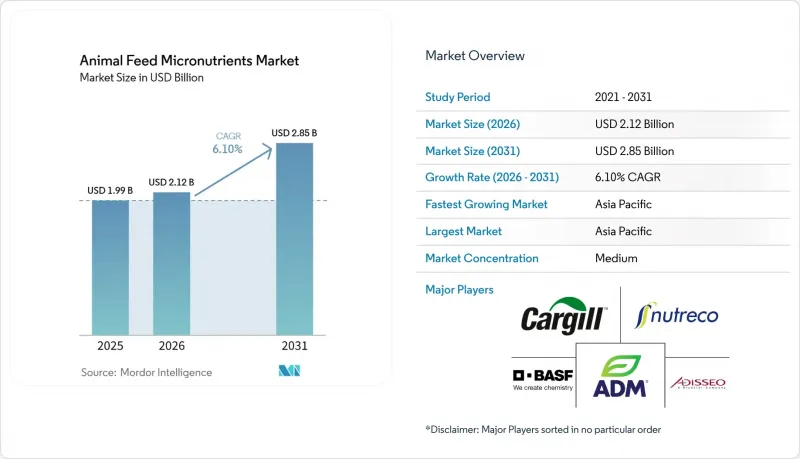
據 Mordor Intelligence 稱,2025 年動物飼料中微量營養素的市值為 19.9 億美元,預計從 2026 年的 21.2 億美元成長到 2031 年的 28.5 億美元,在 2026 年至 2031 年的預測期內,複合年成長率為 6.10%。
本報告按營養素類型(微量元素、維生素、胺基酸、酵素和其他微量營養素)、畜禽(家禽、反芻動物、豬及其他)和地區(北美、歐洲、亞太、南美及其他)進行細分。市場預測以價值(美元)和數量(噸)兩種單位呈現。
動物飼料微量營養素市場的全球趨勢與洞察
畜牧業生產的工業化正在世界範圍內推進。
隨著全球畜牧業日益向工業化體系轉型,對飼料配方的一致性和擴充性需求不斷成長,動物飼料中微量營養素的市場需求也隨之擴大。聯合國糧食及農業組織(糧農組織)預測,到2024年,全球肉類產量將達3.74億噸,其中家禽佔比最大。這項轉變促使飼料生產商採用標準化的微量營養素添加方法,以確保大規模生產中營養成分分佈的一致性和飼料品質。例如,歐洲飼料製造商協會(FEFAC)預測,到2025年,歐盟複合飼料總產量將達到1.476億噸,凸顯了規範化飼料生產的規模。隨著牲畜數量的增加,即使飼料轉換率和牲畜生產力的微小提升也能轉化為顯著的經濟效益。這一趨勢凸顯了微量元素和維生素在動物飼料中的重要性,並推動了動物飼料中微量營養素市場的持續成長。
對動物性蛋白質的需求不斷成長,以及高品質肉類、牛奶、雞蛋和水產品。
由於全球食品體系對動物性蛋白質和優質畜產品的需求不斷成長,飼料微量營養素市場正在蓬勃發展。生產者致力於提高生產力、動物健康和飼料轉換率,因此越來越重視均衡補充微量營養素。聯合國糧食及農業組織(糧農組織)預測,到2024年,全球牛奶產量將達到9.85億噸,顯示乳製品生產將持續成長。為了實現更高的生產目標,精準的營養管理,包括充足的維生素和微量元素,對於維持動物健康、繁殖、免疫力和整體生產力至關重要。隨著畜牧業系統日益注重生產力,對飼料微量營養素的需求預計將保持強勁。
添加維生素和特殊礦物質的成本波動
在飼料微量營養素市場,投入成本的波動仍是短期內的主要限制因素。這是因為盈利高度依賴數量有限的上游必需維生素和特殊微量元素供應商。根據帝斯曼-菲美意公司的報告,到2025年,受市場短缺導致維生素價格飆升的影響,全球維生素市場供應中斷預計將造成約1.5億歐元(1.62億美元)的臨時息稅折舊攤提前利潤(EBITDA)損失。此類必需飼料維生素的供應中斷可能會迅速增加動物飼料生產商的採購成本,迫使他們推遲推出高品質有機微量元素,或最佳化微量營養素配方以控制成本。儘管對必需微量營養素的基本需求仍然強勁,但原料成本的持續波動可能會減緩向高價值配方的轉型,並最終抑制動物飼料微量營養素市場的成長。
細分市場分析
至2025年,微量元素將佔動物飼料微量營養素市場37.8%的最大佔有率。這一地位反映了鋅、銅、錳、硒和鐵在幾乎所有商業畜禽的免疫反應、酶活性、生殖功能、骨骼健康和代謝調節中發揮的廣泛作用。鋅仍然是各種生產系統中應用最廣泛的微量元素之一,用於支持肉雞腿部健康、母豬蹄部強度和蝦的免疫反應。硒正受到監管機構異常嚴格的審查,因為歐盟已將所有物種飼料中硒的含量上限設定為每公斤0.5毫克,有機硒源的含量上限設定為每公斤0.2毫克,這促使人們謹慎地調整配方,轉向更有效率的有機硒形式。鉻在動物飼料微量營養素市場中所佔佔有率仍然相對較小,但隨著歐洲食品安全局 (EFSA) 於 2025 年批准在所有生長中的家禽品種中使用丙酸鉻,每公斤全價飼料中鉻含量最高為 0.4 毫克,鉻的重要性正在增加。
在動物飼料微量營養素市場中,維生素細分市場預計將以7.9%的複合年成長率(CAGR)在2026年至2031年間實現最高成長。這一成長主要得益於家禽和乳牛養殖系統中維生素A、D3、E和K用量的增加,因為穩定的營養供應對於這些養殖系統的繁殖能力、免疫功能和持續生產力至關重要。水溶性維生素在水產養殖領域也日益重要,因為它們對集約化蝦類和魚類養殖系統中的營養脅迫、運輸衝擊和水質波動非常敏感。酵素製劑在各種配方中仍佔據較大且穩定的佔有率,尤其是在單胃動物飼料中,植酸酶的應用更為廣泛。然而,類胡蘿蔔素、膽鹼和保護性營養素等特殊微量營養素在高階飼料中發揮越來越重要的作用。 2025年9月,中國發布了集團標準T/SDFA 053-2025,該標準規定了水產養殖物種和觀賞魚飼料中蝦青素的建議配比。這顯示類胡蘿蔔素在高價值飼料中的應用正變得越來越系統化。
區域分析
到2025年,亞太地區將佔據動物飼料微量營養素市場42.7%的最大佔有率,同時也是成長最快的區域市場,預計2026年至2031年的複合年成長率將達到6.8%。這一主導地位主要歸功於家禽、生豬、乳牛和水產養殖價值鏈中商業飼料生產的擴張。在亞太地區,中國扮演核心角色,因為中國在全球水產養殖和雞蛋生產中佔據主導地位,而這兩項產業都高度依賴富含微量營養素的飼料體系。同樣,印度對全球牛奶生產的巨大貢獻也推動了乳牛飼料中礦物質和維生素補充劑的強勁需求。此外,東南亞以出口為導向的蝦類和魚類產業也促進了對維生素、類胡蘿蔔素和特殊微量營養素組合藥物的需求,進一步鞏固了該地區的市場地位。
北美市場呈現溫和成長態勢,反映出其成熟且仍高價值的市場地位。這一區域成長主要受優質化驅動,消費者對有機微量元素、品種特異性微量營養素解決方案以及以提升生產力為導向的配方產品的需求不斷成長。根據美國農業部預測,到2025年7月,牛數量將達到9,420萬頭,為牛肉和乳牛的微量營養素補充計畫奠定了堅實的基礎。墨西哥和加拿大透過與北美飼料和畜牧系統的融合,持續提供穩定的需求。同時,南美洲市場成長更為迅猛,巴西和阿根廷正在採用標準化的微量營養素補充技術,以支持其出口導向的家禽、生豬和牛的生產。
在歐洲,受嚴格的法規結構推動,促進高品質微量營養素飼料的使用,預計市場將保持溫和成長。相較之下,俄羅斯則面臨制裁和進口替代政策帶來的挑戰,這些政策限制了其從海外供應商取得飼料的管道。中東地區預計將顯著成長,這得益於商業飼料的普及、對糧食安全投資的增加以及正規畜牧業體系的擴張。同樣,隨著飼料生產日益標準化和工業化,非洲預計也將保持穩定成長,但價格限制可能會影響其普及速度。總體而言,動物飼料微量營養素市場預計將呈現因地區而異的成長趨勢。
其他好處
- Excel格式的市場預測(ME)表
- 3個月的分析師支持
目錄
第1章:引言
- 研究假設和市場定義
- 調查範圍
第2章:調查方法
第3章執行摘要
第4章 市場狀況
- 市場概覽
- 市場促進因素
- 全球畜牧業工業化的進展
- 對動物性蛋白質和優質肉類、牛奶、雞蛋和水產產品的需求不斷成長。
- 更嚴格的飼料安全和可追溯性標準
- 過渡到高生物利用度的有機螯合微量營養素
- 精準的飼餵平台,可根據物種和生長階段客製化飼餵劑量。
- 重新評估配方,採用替代原料和低粗蛋白質含量的飼料
- 市場限制因素
- 維生素和特殊礦物質原料成本的波動
- 某些微量元素的最大含量有限制,且審核程序較為繁瑣。
- 減少基於單一微量營養素差異化的綜合飼料添加劑方案
- 飼料儲存和製粒過程中微量營養素穩定性降低。
- 監理情勢
- 技術展望
- 波特五力分析
第5章 市場規模與成長預測
- 營養類型
- 微量元素
- 鋅
- 鐵
- 銅
- 錳
- 碳粉匣
- 鉻
- 其他微量元素
- 維他命
- 脂溶性維生素
- 水溶性維生素
- 胺基酸
- 甲硫胺酸
- 離胺酸
- 蘇胺酸
- 色氨酸
- 其他胺基酸
- 酵素
- 植酸酶
- 蛋白酶
- 碳水化合物消化酶
- 其他酵素
- 其他微量營養素
- 微量元素
- 畜牧業
- 家禽
- 肉雞
- 產蛋母雞
- 種雞
- 反芻動物
- 乳牛
- 肉牛
- 小反芻動物
- 豬
- 小豬
- 肥育豬
- 母豬和公豬
- 水產養殖
- 魚
- 蝦子和其他甲殼類動物
- 馬
- 其他
- 家禽
- 按地區
- 北美洲
- 美國
- 加拿大
- 墨西哥
- 其他北美國家
- 南美洲
- 巴西
- 阿根廷
- 其他南美國家
- 歐洲
- 德國
- 英國
- 法國
- 義大利
- 西班牙
- 俄羅斯
- 其他歐洲國家
- 亞太地區
- 中國
- 印度
- 日本
- 澳洲
- 韓國
- 印尼
- 泰國
- 其他亞太國家
- 中東
- 沙烏地阿拉伯
- 阿拉伯聯合大公國
- 土耳其
- 其他中東國家
- 非洲
- 南非
- 埃及
- 奈及利亞
- 其他非洲地區
- 北美洲
第6章 競爭情勢
- 市場集中度
- 策略趨勢
- 市佔率分析
- 公司簡介
- Cargill, Incorporated
- ADM
- Nutreco NV(SHV Holdings NV)
- BASF SE
- Adisseo France SAS(China National Bluestar Group Co., Ltd.)
- Evonik Industries AG
- Alltech, Inc.
- Kemin Industries, Inc.
- Novus International, Inc.(Mitsui and Co., Ltd. and Nippon Soda Co., Ltd.)
- Phibro Animal Health Corporation
- De Heus Animal Nutrition BV(Royal De Heus)
- Balchem Corporation
- Zinpro Corporation
- Orffa International Holding BV
- Biochem Zusatzstoffe Handels-und Produktionsgesellschaft mbH
第7章 市場機會與未來展望
According to Mordor Intelligence, the animal feed micronutrients market size was valued at USD 1.99 billion in 2025 and is projected to grow from USD 2.12 billion in 2026 to USD 2.85 billion by 2031 at a CAGR of 6.10% during the forecasted period from 2026 to 2031.
This report is Segmented by Nutrient Type (Trace Minerals, Vitamins, Amino Acids, Enzymes, and Other Micronutrients), by Livestock (Poultry, Ruminants, Swine, and More), and by Geography (North America, Europe, Asia-Pacific, South America, and More). The Market Forecasts are Provided in Terms of Value (USD) and Volume (Metric Tons).
Global Animal Feed Micronutrients Market Trends and Insights
Intensifying Industrial Livestock Production Worldwide
The animal feed micronutrients market is expanding as global livestock production increasingly shifts toward industrial systems that demand consistent and scalable feed formulations. In 2024, global meat production reached 374 million metric tons, with poultry meat holding the largest share, according to the Food and Agriculture Organization (FAO). This transition has driven feed mills to adopt standardized micronutrient inclusion practices, ensuring consistent nutrient distribution and feed quality across large-scale production. For instance, according to the European Feed Manufacturers' Federation (FEFAC), the European Union's total compound feed output reached 147.6 million metric tons in 2025, highlighting the scale of organized feed production. As herd and flock sizes grow, even minor improvements in feed efficiency and animal performance offer significant economic benefits. This trend underscores the importance of trace minerals and vitamins in animal feed, supporting the continued expansion of the animal feed micronutrients market.
Rising Demand for Animal Protein and Quality Meat, Milk, Eggs, and Aquaculture Output
The animal feed micronutrients market is experiencing growth due to the rising demand for animal protein and higher-quality livestock products within global food systems. Producers are focusing on enhancing productivity, animal health, and feed efficiency, which has increased the emphasis on balanced micronutrient supplementation. According to the Food and Agriculture Organization (FAO), global milk production reached 985 million metric tons in 2024, indicating continued growth in dairy output. Achieving higher production targets necessitates precise nutritional management, including sufficient levels of vitamins and trace minerals to support animal health, reproduction, immunity, and overall productivity. As livestock systems become more performance-driven, the demand for feed micronutrients is projected to remain robust.
Volatility in Vitamin and Specialty Mineral Input Costs
Input cost volatility remains a key short-term restraint on the animal feed micronutrients market, as profitability depends heavily on a limited number of upstream suppliers for essential vitamins and specialty trace minerals. In 2025, DSM-Firmenich reported that supply disruptions in the global vitamin market generated an estimated temporary EBITDA contribution of €150 million (USD 162 million), driven by higher vitamin prices resulting from market shortages. These disruptions in the supply of essential feed vitamins can rapidly increase procurement costs for animal nutrition manufacturers, prompting feed producers to delay the adoption of premium organic trace minerals or optimize micronutrient inclusion rates to control costs. Although baseline demand for essential micronutrients remains intact, sustained volatility in input costs can slow the transition to higher-value formulations, thereby restraining growth in the animal feed micronutrients market.
Other drivers and restraints analyzed in the detailed report include:
- Tightening Feed Safety and Traceability Standards
- Shift Toward Higher-Bioavailability Organic and Chelated Micronutrients
- Integrated Feed Additive Programs Reducing Standalone Micronutrient Differentiation
For complete list of drivers and restraints, kindly check the Table Of Contents.
Segment Analysis
The animal feed micronutrients market size for the trace minerals segment accounted for the largest 37.8% in 2025. Their position reflects the broad role of zinc, copper, manganese, selenium, and iron in immune response, enzyme activity, reproduction, bone integrity, and metabolic control across nearly all commercial species. Zinc remains one of the most widely used trace elements because it supports broiler leg health, sow claw strength, and shrimp immune response across very different production systems. Selenium attracts unusually close regulatory attention because the European Union sets a maximum selenium level of 0.5 mg/kg feed for all species and 0.2 mg/kg for organic selenium sources, which has encouraged more careful reformulation toward more efficient organic forms. Chromium remains a smaller part of the animal feed micronutrients market, but it gained more visibility after EFSA approved chromium propionate for all growing poultry species in 2025 at a maximum of 0.4 mg chromium/kg complete feed.
The animal feed micronutrient market for the vitamins segment is forecast to grow at the fastest CAGR of 7.9% from 2026 to 2031. Growth is being supported by stronger use of vitamins A, D3, E, and K in poultry and dairy systems, where reproductive performance, immunity, and production persistence depend on stable nutrient delivery. Water-soluble vitamins are also becoming more important in aquaculture because intensive shrimp and fish systems respond quickly to nutritional stress, transport shocks, and water-quality variability. Enzymes remain a large and stable part of the broader formulation mix, especially phytases in monogastric diets, but specialty micronutrients such as carotenoids, choline, and protected nutrient formats are taking a larger role in premium feeds. China issued the group standard T/SDFA 053-2025 in September 2025 to define recommended astaxanthin inclusion rates for aquaculture species and ornamental fish, demonstrating how carotenoid use is becoming more formalized in high-value feed applications.
Complete Report Scope:
- By Nutrient Type
- Trace Minerals
- Zinc
- Iron
- Copper
- Manganese
- Selenium
- Chromium
- Other Trace Minerals
- Vitamins
- Fat-Soluble Vitamins
- Water-Soluble Vitamins
- Amino Acids
- Methionine
- Lysine
- Threonine
- Tryptophan
- Other Amino Acids
- Enzymes
- Phytases
- Proteases
- Carbohydrases
- Other Enzymes
- Other Micronutrients
- Trace Minerals
- By Livestock
- Poultry
- Broilers
- Layers
- Breeders
- Ruminants
- Dairy Cattle
- Beef Cattle
- Small Ruminants
- Swine
- Piglets
- Grow-Finish Pigs
- Sows and Boars
- Aquaculture
- Fish
- Shrimp and Other Crustaceans
- Equine
- Other Livestock
- Poultry
- By Geography
- North America
- United States
- Canada
- Mexico
- Rest of North America
- South America
- Brazil
- Argentina
- Rest of South America
- Europe
- Germany
- United Kingdom
- France
- Italy
- Spain
- Russia
- Rest of Europe
- Asia-Pacific
- China
- India
- Japan
- Australia
- South Korea
- Indonesia
- Thailand
- Rest of Asia-Pacific
- Middle East
- Saudi Arabia
- United Arab Emirates
- Turkey
- Rest of Middle East
- Africa
- South Africa
- Egypt
- Nigeria
- Rest of Africa
- North America
Geography Analysis
The Asia-Pacific region accounted for the largest share of the animal feed micronutrients market at 42.7% in 2025, and it is also the fastest-growing regional segment, with a projected CAGR of 6.8% from 2026 to 2031. This dominance is attributed to the expansion of commercial feed production across poultry, swine, dairy, and aquaculture value chains. Within the region, China plays a central role due to its majority share in global aquaculture and egg production, both of which depend on micronutrient-intensive feeding systems. Similarly, India's significant contribution to global milk production drives consistent demand for mineral and vitamin supplementation in dairy feed. In addition, Southeast Asia's export-oriented shrimp and fish industries are boosting demand for vitamins, carotenoids, and specialty micronutrient formulations, reinforcing the region's position.
North America is growing moderately, reflecting its mature yet valuable market position. Growth in this region is driven by premiumization, with rising demand for organic trace minerals, species-specific micronutrient solutions, and performance-focused formulations. According to the United States Department of Agriculture (USDA), a cattle inventory of 94.2 million head as of July 2025 provides a strong foundation for beef and dairy micronutrient programs. Mexico and Canada contribute steady demand through their integration with North American feed and livestock systems. In comparison, South America is witnessing faster growth, with Brazil and Argentina adopting standardized micronutrient supplementation practices to support export-oriented poultry, swine, and cattle production.
Europe is anticipated to witness moderate growth, driven by stringent regulatory frameworks that promote the use of high-quality micronutrient formulations. In contrast, Russia faces obstacles due to sanctions and import-substitution policies, which limit access to foreign suppliers. The Middle East is projected to experience significant growth, supported by the increasing adoption of commercial feed, rising investments in food security, and the expansion of formal livestock production systems. Similarly, Africa is projected to achieve steady growth as feed manufacturing becomes more organized and industrialized, although affordability constraints may limit the pace of adoption. Overall, the animal feed micronutrients market is projected to display varied growth trends across regions.
- Cargill, Incorporated
- ADM
- Nutreco N.V. (SHV Holdings N.V.)
- BASF SE
- Adisseo France S.A.S. (China National Bluestar Group Co., Ltd.)
- Evonik Industries AG
- Alltech, Inc.
- Kemin Industries, Inc.
- Novus International, Inc. (Mitsui and Co., Ltd. and Nippon Soda Co., Ltd.)
- Phibro Animal Health Corporation
- De Heus Animal Nutrition B.V. (Royal De Heus)
- Balchem Corporation
- Zinpro Corporation
- Orffa International Holding B.V.
- Biochem Zusatzstoffe Handels- und Produktionsgesellschaft mbH
Additional Benefits:
- The market estimate (ME) sheet in Excel format
- 3 months of analyst support
TABLE OF CONTENTS
1 Introduction
- 1.1 Study Assumptions and Market Definition
- 1.2 Scope of the Study
2 Research Methodology
3 Executive Summary
4 Market Landscape
- 4.1 Market Overview
- 4.2 Market Drivers
- 4.2.1 Intensifying industrial livestock production worldwide
- 4.2.2 Rising demand for animal protein and quality meat, milk, eggs, and aquaculture output
- 4.2.3 Tightening feed safety and traceability standards
- 4.2.4 Shift toward higher-bioavailability organic and chelated micronutrients
- 4.2.5 Precision feeding platforms enabling species-stage-specific dosing
- 4.2.6 Reformulation around alternative ingredients and lower crude-protein diets
- 4.3 Market Restraints
- 4.3.1 Volatility in vitamin and specialty mineral input costs
- 4.3.2 Restrictive inclusion limits and lengthy approvals for certain trace minerals
- 4.3.3 Integrated feed additive programs reducing standalone micronutrient differentiation
- 4.3.4 Micronutrient stability loss during feed storage and pelleting
- 4.4 Regulatory Landscape
- 4.5 Technological Outlook
- 4.6 Porter's Five Forces Analysis
- 4.6.1 Threat of New Entrants
- 4.6.2 Bargaining Power of Suppliers
- 4.6.3 Bargaining Power of Buyers
- 4.6.4 Threat of Substitutes
- 4.6.5 Intensity of Competitive Rivalry
5 Market Size and Growth Forecasts (Value)
- 5.1 By Nutrient Type
- 5.1.1 Trace Minerals
- 5.1.1.1 Zinc
- 5.1.1.2 Iron
- 5.1.1.3 Copper
- 5.1.1.4 Manganese
- 5.1.1.5 Selenium
- 5.1.1.6 Chromium
- 5.1.1.7 Other Trace Minerals
- 5.1.2 Vitamins
- 5.1.2.1 Fat-Soluble Vitamins
- 5.1.2.2 Water-Soluble Vitamins
- 5.1.3 Amino Acids
- 5.1.3.1 Methionine
- 5.1.3.2 Lysine
- 5.1.3.3 Threonine
- 5.1.3.4 Tryptophan
- 5.1.3.5 Other Amino Acids
- 5.1.4 Enzymes
- 5.1.4.1 Phytases
- 5.1.4.2 Proteases
- 5.1.4.3 Carbohydrases
- 5.1.4.4 Other Enzymes
- 5.1.5 Other Micronutrients
- 5.1.1 Trace Minerals
- 5.2 By Livestock
- 5.2.1 Poultry
- 5.2.1.1 Broilers
- 5.2.1.2 Layers
- 5.2.1.3 Breeders
- 5.2.2 Ruminants
- 5.2.2.1 Dairy Cattle
- 5.2.2.2 Beef Cattle
- 5.2.2.3 Small Ruminants
- 5.2.3 Swine
- 5.2.3.1 Piglets
- 5.2.3.2 Grow-Finish Pigs
- 5.2.3.3 Sows and Boars
- 5.2.4 Aquaculture
- 5.2.4.1 Fish
- 5.2.4.2 Shrimp and Other Crustaceans
- 5.2.5 Equine
- 5.2.6 Other Livestock
- 5.2.1 Poultry
- 5.3 By Geography
- 5.3.1 North America
- 5.3.1.1 United States
- 5.3.1.2 Canada
- 5.3.1.3 Mexico
- 5.3.1.4 Rest of North America
- 5.3.2 South America
- 5.3.2.1 Brazil
- 5.3.2.2 Argentina
- 5.3.2.3 Rest of South America
- 5.3.3 Europe
- 5.3.3.1 Germany
- 5.3.3.2 United Kingdom
- 5.3.3.3 France
- 5.3.3.4 Italy
- 5.3.3.5 Spain
- 5.3.3.6 Russia
- 5.3.3.7 Rest of Europe
- 5.3.4 Asia-Pacific
- 5.3.4.1 China
- 5.3.4.2 India
- 5.3.4.3 Japan
- 5.3.4.4 Australia
- 5.3.4.5 South Korea
- 5.3.4.6 Indonesia
- 5.3.4.7 Thailand
- 5.3.4.8 Rest of Asia-Pacific
- 5.3.5 Middle East
- 5.3.5.1 Saudi Arabia
- 5.3.5.2 United Arab Emirates
- 5.3.5.3 Turkey
- 5.3.5.4 Rest of Middle East
- 5.3.6 Africa
- 5.3.6.1 South Africa
- 5.3.6.2 Egypt
- 5.3.6.3 Nigeria
- 5.3.6.4 Rest of Africa
- 5.3.1 North America
6 Competitive Landscape
- 6.1 Market Concentration
- 6.2 Strategic Moves
- 6.3 Market Share Analysis
- 6.4 Company Profiles (Includes Global Level Overview, Market Level Overview, Core Business Segments, Financials, Headcount, Key Information, Market Rank, Market Share, Products and Services, and Analysis of Recent Developments)
- 6.4.1 Cargill, Incorporated
- 6.4.2 ADM
- 6.4.3 Nutreco N.V. (SHV Holdings N.V.)
- 6.4.4 BASF SE
- 6.4.5 Adisseo France S.A.S. (China National Bluestar Group Co., Ltd.)
- 6.4.6 Evonik Industries AG
- 6.4.7 Alltech, Inc.
- 6.4.8 Kemin Industries, Inc.
- 6.4.9 Novus International, Inc. (Mitsui and Co., Ltd. and Nippon Soda Co., Ltd.)
- 6.4.10 Phibro Animal Health Corporation
- 6.4.11 De Heus Animal Nutrition B.V. (Royal De Heus)
- 6.4.12 Balchem Corporation
- 6.4.13 Zinpro Corporation
- 6.4.14 Orffa International Holding B.V.
- 6.4.15 Biochem Zusatzstoffe Handels- und Produktionsgesellschaft mbH
7 Market Opportunities and Future Outlook

 複雜微量元素市場:全球市場預測,2026-2032年
 智慧食品配方技術市場預測至2034年—按技術類型、配方類型、成分、食品類別、最終用戶和地區分類的全球分析電動飼料顆粒製造機市場:全球市場預測,2026-2032年
 飼料市場報告:趨勢、預測及競爭分析(至2035年)
 動物飼料植酸酶市場規模:按類型、應用、地區和預測分類飼料市場:2026-2032年全球市場預測(依動物種類、原料種類、添加劑種類、形態、飼料種類、特性、包裝種類及分銷管道分類)2026-2034年全球動物飼料安全檢測市場規模、佔有率、趨勢和成長分析報告
 2026-2030年全球動物飼料市場
 飼料微量營養素市場規模、佔有率和成長分析:按營養素類型、產品形式、目標動物、分銷管道和地區分類-2026-2033年產業預測
 智慧食品配方軟體市場分析及預測(至2035年):類型、產品類型、服務、技術、組件、應用、部署模式、最終用戶、功能