

 |
市場調查報告書
商品編碼
2038352
資料中心冷媒的市場機會、成長要素、產業趨勢與預測(2026-2035 年)。Data Center Refrigerant Market Opportunity, Growth Drivers, Industry Trend Analysis, and Forecast 2026 - 2035 |
||||||

2025年全球資料中心冷媒市場價值為6.33億美元,預計2035年將以9.6%的複合年成長率成長至16.2億美元。
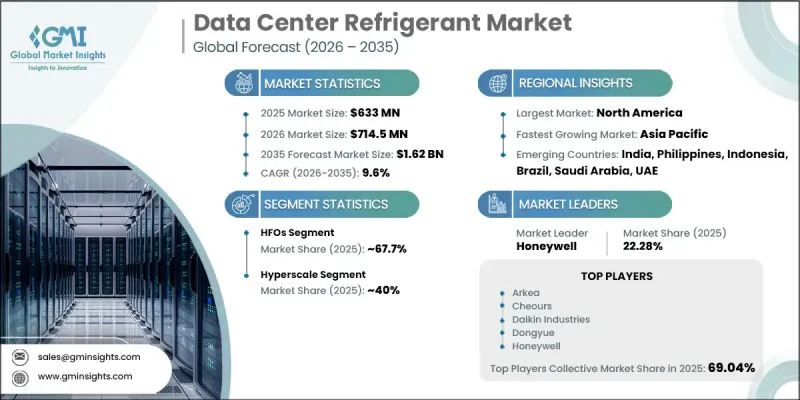
在包括超大規模資料中心和雲端平台在內的數位基礎設施快速擴張以及全球資料消費不斷成長的推動下,這個市場正經歷重大變革。人工智慧、巨量資料分析和高密度運算環境帶來的日益成長的運算工作負載,顯著提高了現代資料中心的溫度控管要求。因此,市場對能夠確保高效熱控制、運作穩定性和最佳化能源性能的先進冷媒的需求正在穩步成長。
| 市場範圍 | |
|---|---|
| 開始年份 | 2025 |
| 預測期 | 2026-2035 |
| 上市時的市場規模 | 6.33億美元 |
| 預測金額 | 16.2億美元 |
| 複合年成長率 | 9.6% |
此外,該產業正經歷著從高全球暖化潛值(GWP)的傳統冷媒向低排放、高能效替代冷媒的結構性轉變。全球氣候變遷協議和區域環境政策帶來的監管壓力正在加速下一代冷媒的採用。營運商日益重視減少排放、改善洩漏管理並加強生命週期管理實踐,以滿足不斷變化的永續發展要求。降低營運成本和提高大規模數位基礎設施的能源效率的日益成長的需求,也進一步推動了這一轉變。
預計到2025年,HFO(氫氟烯烴)冷媒的市佔率將達到67.7%,並在2035年之前以10.2%的複合年成長率成長。由於日益嚴格的環境法規和全球脫碳趨勢,HFO冷媒持續佔據市場主導地位。其極低的全球暖化潛勢(GWP)和高冷卻效率使其成為下一代資料中心冷卻系統的首選解決方案。高GWP冷媒的逐步淘汰進一步加速了HFO在整個產業的應用。
預計到2025年,超大規模資料中心將佔據40%的市場佔有率,並在2026年至2035年間以10.4%的複合年成長率成長。這一細分市場的成長主要得益於領先的雲端和技術供應商營運的超高運算密度和大規模的基礎設施。這些設施會因人工智慧(AI)工作負載、雲端運算和先進的數位服務而產生巨大的熱負荷,因此需要高效的冷媒冷卻系統來維持持續運作和系統穩定性。
預計到2025年,美國資料中心冷媒市場將佔據79%的全球佔有率,市場規模將達到1.763億美元。美國市場的這一成長主要得益於超大規模資料中心的快速擴張,而人工智慧、雲端運算和資料密集型應用的興起又推動了這一擴張。領先科技公司對新設施的持續投資,也增加了對先進冷卻系統的需求。高密度伺服器基礎設施的日益普及進一步增加了熱負荷,從而強化了對高效能冷媒的需求。此外,嚴格的能源效率法規和永續性要求也推動了向低全球暖化潛值(GWP)冷媒解決方案和先進溫度控管技術的轉變。
目錄
第1章:調查方法
第2章執行摘要
第3章業界考察
- 生態系分析
- 供應商情況
- 利潤率分析
- 成本結構
- 每個階段增加的價值
- 影響價值鏈的因素
- 中斷
- 影響產業的因素
- 促進因素
- 超大規模和雲端資料中心擴展
- 人工智慧、機器學習和高效能運算工作負載的激增
- 擴大節能環保永續解決方案的應用。
- 加強對低全球暖化潛勢冷媒監管的舉措
- 託管和邊緣資料中心部署的快速成長。
- 產業潛在風險與挑戰
- 新系統的初始成本很高。
- 與現有基礎設施的複雜整合
- 市場機遇
- 對HFO基冷媒和天然冷媒的需求增加
- 液冷和混合冷卻技術的應用正在迅速增加。
- 企業加大永續發展與減碳力度
- 加強傳統資料中心基礎設施的維修和升級
- 策略合作與先進冷卻解決方案研發活動激增。
- 促進因素
- 成長潛力分析
- 科技與創新趨勢
- 當前技術趨勢
- 新興技術
- 監管指南
- 北美洲
- 美國:《美國創新與製造法案》(AIM法案)
- 加拿大:《加拿大環境保護法》(CEPA)
- 歐洲
- 德國:歐盟關於氟氯化碳的法規(EU 2024/573)
- 英國:英國關於含氟溫室氣體的法規
- 法國:RE2020 環境法規(建築與冷凍效率)
- 義大利:國家能源效率指令的實施
- 亞太地區
- 中國:基加利修正案的實施框架
- 印度:分階段減少臭氧消耗物質和氫氟碳化合物排放的規定
- 日本:關於合理使用和管理氟化合物的法案
- 澳洲:《臭氧層保護與合成溫室氣體管理法》
- 拉丁美洲
- 巴西:國家固態廢棄物政策(PNRS - 冷卻設備納入)
- 墨西哥:氣候變遷總法
- 阿根廷:國家環境保護框架
- 中東和非洲(MEA)
- 阿拉伯聯合大公國:《聯邦環境保護法》第24號
- 沙烏地阿拉伯:沙烏地阿拉伯能源效率計畫(SEEP)
- 南非:國家環境管理:空氣品質法(NEMAQA)
- 北美洲
- 波特五力分析
- PESTEL 分析
- 專利分析(基於初步研究)
- 資料中心容量和基礎設施的現狀
- 各國裝置容量(兆瓦)
- 2025-2027年擴建計劃
- 運轉率及供需狀況
- 人工智慧和生成式人工智慧對市場的影響
- 利用人工智慧改造現有經營模式
- GenAI 各細分市場的應用案例與部署藍圖
- 風險、局限性和監管考量
- 服務交付能力和提供者基礎設施(基於初步調查)
- 區域醫療服務提供者網路密度和覆蓋範圍(基於初步調查)
- 生產能力缺口與現有需求不符(基於初步調查)
- 永續性和環境方面
- 永續計劃
- 減少廢棄物策略
- 生產中的能源效率
- 具有環保意識的舉措
- 關於碳足跡的考量
- 預測假設和情境分析(基於初步研究)
- 基本案例-驅動複合年成長率的關鍵宏觀經濟與產業變量
- 樂觀情境-宏觀經濟與產業的順風
- 悲觀情景-宏觀經濟放緩或產業逆風
第4章 競爭情勢
- 介紹
- 企業市佔率分析
- 主要市場公司的競爭分析
- 競爭定位矩陣
- 主要進展
- 併購
- 夥伴關係和聯盟
- 新產品發布
- 業務拓展計劃及資金籌措
- 企業級分層基準測試
- 層級分類標準與選擇標準
- 按銷售額、地區和創新能力分類的層級定位矩陣。
第5章 市場估算與預測:依冷媒類型分類,2022-2035年
- HFC
- R-134A
- R-404A
- HFO
- 其他
第6章 市場估計與預測:依資料中心分類,2022-2035年
- 公司
- 搭配
- 雲
- 超大規模
第7章 市場估價與預測:以冷卻方式分類,2022-2035年
- 空冷式
- 液冷
- 自然冷卻
第8章 市場估計與預測:依應用領域分類,2022-2035年
- IT冷卻系統
- 設施冷卻系統
第9章 市場估計與預測:依最終用途分類,2022-2035年
- BFSI
- 資訊科技和通訊
- 政府/國防
- 衛生保健
- 能源
- 製造業
- 零售
- 其他
第10章 市場估價與預測:依地區分類,2022-2035年
- 北美洲
- 美國
- 加拿大
- 歐洲
- 德國
- 英國
- 法國
- 義大利
- 西班牙
- 俄羅斯
- 荷蘭
- 比利時
- 亞太地區
- 中國
- 印度
- 日本
- 澳洲
- 韓國
- 菲律賓
- 印尼
- 拉丁美洲
- 巴西
- 墨西哥
- 阿根廷
- 中東和非洲(MEA)
- 南非
- 沙烏地阿拉伯
- 阿拉伯聯合大公國
第11章:公司簡介
- 世界公司
- AGC
- Arkema
- Chemours Company
- Daikin Industries
- Dongyue
- Linde plc
- Orbia Fluor &Energy Materials
- Sinochem
- Solstice Advanced Materials
- Zhejiang Juhua
- 當地公司
- Central Glass
- Changshu 3F Zhonghao New Chemical
- Gujarat Fluorochemicals(GFL)
- Halocarbon Products Corporation
- Kanto Denka Kogyo
- Navin Fluorine International
- Sanmei Chemical(Zhejiang Sanmei)
- Shandong Huaan New Material
- SRF Limited
- Zhejiang Yonghe Refrigerant
- 新興企業
- Sanmei Chemical
- Shandong Huaan New Material
- Tazzetti
- Zhejiang Yonghe Refrigerant
The Global Data Center Refrigerant Market was valued at USD 633 million in 2025 and is estimated to grow at a CAGR of 9.6% to reach USD 1.62 billion by 2035.
The market is undergoing a major transformation driven by the rapid expansion of digital infrastructure, including hyperscale facilities, cloud platforms, and accelerating global data consumption. Increasing computational workloads from artificial intelligence, big data analytics, and high-density computing environments are significantly raising thermal management requirements across modern data centers. As a result, demand for advanced refrigerants that ensure efficient heat control, operational stability, and optimized energy performance is increasing steadily.
| Market Scope | |
|---|---|
| Start Year | 2025 |
| Forecast Year | 2026-2035 |
| Start Value | $633 Million |
| Forecast Value | $1.62 Billion |
| CAGR | 9.6% |
The industry is also experiencing a structural shift away from traditional high-global-warming-potential refrigerants toward low-emission and energy-efficient alternatives. Regulatory pressure from global climate agreements and regional environmental policies is accelerating the adoption of next-generation refrigerants. Operators are increasingly focusing on reducing emissions, improving leakage control, and enhancing lifecycle management practices to comply with evolving sustainability requirements. This transition is further reinforced by rising emphasis on lowering operating costs and improving energy efficiency across large-scale digital infrastructure.
The HFOs segment held a 67.7% share in 2025 and is projected to grow at a CAGR of 10.2% through 2035. HFO refrigerants continue to dominate due to tightening environmental regulations and the global push toward decarbonization. Their significantly lower global warming potential, combined with strong cooling efficiency, makes them a preferred solution for next-generation data center cooling systems. The ongoing phase-out of high-GWP refrigerants is further accelerating their adoption across the industry.
The hyperscale segment accounted for 40% share in 2025 and is expected to grow at a CAGR of 10.4% from 2026 to 2035. This segment leads the market due to extremely high computing densities and large-scale infrastructure operated by major cloud and technology providers. These facilities generate substantial heat loads from artificial intelligence workloads, cloud computing, and advanced digital services, requiring highly efficient refrigerant-based cooling systems to maintain continuous operations and system stability.
U.S. Data Center Refrigerant Market held a 79% share in 2025, generating USD 176.3 million. Growth in the country is strongly supported by rapid hyperscale data center expansion driven by artificial intelligence, cloud computing, and data-intensive applications. Continuous investments in new facilities by leading technology firms are increasing demand for advanced cooling systems. Rising adoption of high-density server infrastructure is further intensifying thermal loads, strengthening the need for high-performance refrigerants. In addition, strict energy efficiency regulations and sustainability mandates are encouraging the shift toward low-GWP refrigerant solutions and modern thermal management technologies.
Key companies operating in the Global Data Center Refrigerant Market include Daikin Industries, Linde plc, Honeywell, Chemours, AGC, Dongyue, Zhejiang Juhua, Arkea and Sinochem. Companies in the Data Center Refrigerant Market are actively focusing on developing low-global warming potential refrigerants that align with tightening environmental regulations and sustainability targets. A major strategy involves increasing investment in research and development to enhance refrigerant efficiency, thermal stability, and compatibility with high-density computing environments. Market players are also strengthening partnerships with data center operators and cooling system manufacturers to integrate advanced refrigerant solutions into next-generation infrastructure. Expansion of production capabilities in high-demand regions is being prioritized to ensure supply chain stability and faster delivery. Additionally, firms are emphasizing compliance-driven innovation, improving leakage detection systems, and enhancing lifecycle management solutions.
Table of Contents
Chapter 1 Methodology
- 1.1 Research approach
- 1.2 Quality Commitments
- 1.2.1 GMI AI policy & data integrity commitment
- 1.2.1.1 Source consistency protocol
- 1.2.1 GMI AI policy & data integrity commitment
- 1.3 Research Trail & Confidence Scoring
- 1.3.1 Research Trail Components
- 1.3.2 Scoring Components
- 1.4 Data Collection
- 1.4.1 Partial list of primary sources
- 1.5 Data mining sources
- 1.5.1 Paid sources
- 1.5.1.1 Sources, by region
- 1.5.1 Paid sources
- 1.6 Base estimates and calculations
- 1.6.1 Base year calculation
- 1.7 Forecast Model
- 1.7.1 Quantified market impact analysis
- 1.7.1.1 Mathematical impact of growth parameters on forecast
- 1.7.1 Quantified market impact analysis
- 1.8 Research transparency addendum
- 1.8.1 Source attribution framework
- 1.8.2 Quality assurance metrics
- 1.8.3 Our commitment to trust
Chapter 2 Executive Summary
- 2.1 Industry 360° synopsis, 2022 - 2035
- 2.2 Key market trends
- 2.2.1 Regional
- 2.2.2 Refrigerant
- 2.2.3 Data Center
- 2.2.4 Cooling
- 2.2.5 Application
- 2.2.6 End-Use
- 2.3 TAM Analysis, 2026-2035
- 2.4 CXO perspectives: Strategic imperatives
Chapter 3 Industry Insights
- 3.1 Industry ecosystem analysis
- 3.1.1 Supplier landscape
- 3.1.2 Profit margin analysis
- 3.1.3 Cost structure
- 3.1.4 Value addition at each stage
- 3.1.5 Factor affecting the value chain
- 3.1.6 Disruptions
- 3.2 Industry impact forces
- 3.2.1 Growth drivers
- 3.2.1.1 Rise in hyperscale and cloud data center expansion
- 3.2.1.2 Surge in AI, machine learning, and high-performance computing workloads
- 3.2.1.3 Increase in adoption of energy-efficient and sustainable cooling solutions
- 3.2.1.4 Rise in regulatory push for low-GWP refrigerants
- 3.2.1.5 Surge in colocation and edge data center deployments
- 3.2.2 Industry pitfalls and challenges
- 3.2.2.1 High initial costs of new systems
- 3.2.2.2 Complex integration with existing infrastructure
- 3.2.3 Market opportunities
- 3.2.3.1 Rise in demand for HFO-based and natural refrigerants
- 3.2.3.2 Surge in adoption of liquid and hybrid cooling technologies
- 3.2.3.3 Increase in sustainability and carbon reduction initiatives by operators
- 3.2.3.4 Rise in retrofitting and upgrading of legacy data center infrastructure
- 3.2.3.5 Surge in strategic partnerships and R&D for advanced cooling solutions
- 3.2.1 Growth drivers
- 3.3 Growth potential analysis
- 3.4 Technology and Innovation landscape
- 3.4.1 Current technological trends
- 3.4.2 Emerging technologies
- 3.5 Regulatory guideline
- 3.5.1 North America
- 3.5.1.1 U.S.: American Innovation and Manufacturing (AIM) Act
- 3.5.1.2 Canada: Canadian Environmental Protection Act (CEPA)
- 3.5.2 Europe
- 3.5.2.1 Germany: EU F-Gas Regulation (EU 2024/573)
- 3.5.2.2 UK: UK Fluorinated Greenhouse Gases Regulations
- 3.5.2.3 France: RE2020 Environmental Regulation (Buildings & Cooling Efficiency)
- 3.5.2.4 Italy: National Energy Efficiency Directive Implementation
- 3.5.3 Asia Pacific
- 3.5.3.1 China: Kigali Amendment Implementation Framework
- 3.5.3.2 India: Ozone Depleting Substances and HFC Phase-down Rules
- 3.5.3.3 Japan: Act on Rational Use and Proper Management of Fluorocarbons
- 3.5.3.4 Australia: Ozone Protection and Synthetic Greenhouse Gas Management Act
- 3.5.4 Latin America
- 3.5.4.1 Brazil: National Solid Waste Policy (PNRS - Cooling Equipment Inclusion)
- 3.5.4.2 Mexico: General Law on Climate Change
- 3.5.4.3 Argentina: National Environmental Protection Framework
- 3.5.5 MEA
- 3.5.5.1 UAE: Federal Law No. 24 for Environmental Protection
- 3.5.5.2 Saudi Arabia: Saudi Energy Efficiency Program (SEEP)
- 3.5.5.3 South Africa: National Environmental Management: Air Quality Act (NEMAQA)
- 3.5.1 North America
- 3.6 Porter's analysis
- 3.7 PESTEL analysis
- 3.8 Patent analysis (Driven by Primary Research)
- 3.9 Data Center Capacity & Infrastructure Landscape
- 3.9.1 Installed capacity (MW) by country
- 3.9.2 Expansion pipeline 2025-2027
- 3.9.3 Utilization rates & supply demand
- 3.10 Impact of AI & generative AI on the market
- 3.10.1 AI-Driven Disruption of Existing Business Models
- 3.10.2 GenAI Use Cases & Adoption Roadmap by Segment
- 3.10.3 Risks, limitations & regulatory considerations
- 3.11 Service Delivery Capacity & Provider Infrastructure (Driven by Primary Research)
- 3.11.1 Provider Network Density & Coverage by Region (Driven by Primary Research)
- 3.11.2 Capacity Gaps & Addressable Demand Mismatch (Driven by Primary Research)
- 3.12 Sustainability and environmental aspects
- 3.12.1 Sustainable practices
- 3.12.2 Waste reduction strategies
- 3.12.3 Energy efficiency in production
- 3.12.4 Eco-friendly initiatives
- 3.12.5 Carbon footprint considerations
- 3.13 Forecast assumptions & scenario analysis (Driven by Primary Research)
- 3.13.1 Base Case - Key Macro & Industry Variables Driving CAGR
- 3.13.2 Optimistic Scenarios - Favourable macro and industry tailwinds
- 3.13.3 Pessimistic Scenario - Macroeconomic slowdown or industry headwinds
Chapter 4 Competitive Landscape, 2025
- 4.1 Introduction
- 4.2 Company market share analysis
- 4.2.1 North America
- 4.2.2 Europe
- 4.2.3 Asia Pacific
- 4.2.4 Latin America
- 4.2.5 MEA
- 4.3 Competitive analysis of major market players
- 4.4 Competitive positioning matrix
- 4.5 Key developments
- 4.5.1 Mergers & acquisitions
- 4.5.2 Partnerships & collaborations
- 4.5.3 New Product Launches
- 4.5.4 Expansion Plans and funding
- 4.6 Company Tier Benchmarking
- 4.6.1 Tier Classification Criteria & Qualifying Thresholds
- 4.6.2 Tier Positioning Matrix by Revenue, Geography & Innovation
Chapter 5 Market Estimates & Forecast, By Refrigerant, 2022 - 2035 ($Bn)
- 5.1 Key trends
- 5.2 HFCs
- 5.2.1 R-134A
- 5.2.2 R-404A
- 5.3 HFOs
- 5.4 Others
Chapter 6 Market Estimates & Forecast, By Data Center, 2022 - 2035 ($Bn)
- 6.1 Key trends
- 6.2 Enterprise
- 6.3 Colocation
- 6.4 Cloud
- 6.5 Hyperscale
Chapter 7 Market Estimates & Forecast, By Cooling, 2022 - 2035 ($Bn)
- 7.1 Key trends
- 7.2 Air cooling
- 7.3 Liquid cooling
- 7.4 Free cooling
Chapter 8 Market Estimates & Forecast, By Application, 2022 - 2035 ($Bn)
- 8.1 Key trends
- 8.2 IT cooling system
- 8.3 Facility cooling system
Chapter 9 Market Estimates & Forecast, By End Use, 2022 - 2035 ($Bn)
- 9.1 Key trends
- 9.2 BFSI
- 9.3 IT and Telecom
- 9.4 Government and Defense
- 9.5 Healthcare
- 9.6 Energy
- 9.7 Manufacturing
- 9.8 Retail
- 9.9 Others
Chapter 10 Market Estimates & Forecast, By Region, 2022 - 2035 ($Bn)
- 10.1 Key trends
- 10.2 North America
- 10.2.1 US
- 10.2.2 Canada
- 10.3 Europe
- 10.3.1 Germany
- 10.3.2 UK
- 10.3.3 France
- 10.3.4 Italy
- 10.3.5 Spain
- 10.3.6 Russia
- 10.3.7 Netherlands
- 10.3.8 Belgium
- 10.4 Asia Pacific
- 10.4.1 China
- 10.4.2 India
- 10.4.3 Japan
- 10.4.4 Australia
- 10.4.5 South Korea
- 10.4.6 Philippines
- 10.4.7 Indonesia
- 10.5 Latin America
- 10.5.1 Brazil
- 10.5.2 Mexico
- 10.5.3 Argentina
- 10.6 MEA
- 10.6.1 South Africa
- 10.6.2 Saudi Arabia
- 10.6.3 UAE
Chapter 11 Company Profiles
- 11.1 Global Players
- 11.1.1 AGC
- 11.1.2 Arkema
- 11.1.3 Chemours Company
- 11.1.4 Daikin Industries
- 11.1.5 Dongyue
- 11.1.6 Linde plc
- 11.1.7 Orbia Fluor & Energy Materials
- 11.1.8 Sinochem
- 11.1.9 Solstice Advanced Materials
- 11.1.10 Zhejiang Juhua
- 11.2 Regional Players
- 11.2.1 Central Glass
- 11.2.2 Changshu 3F Zhonghao New Chemical
- 11.2.3 Gujarat Fluorochemicals (GFL)
- 11.2.4 Halocarbon Products Corporation
- 11.2.5 Kanto Denka Kogyo
- 11.2.6 Navin Fluorine International
- 11.2.7 Sanmei Chemical (Zhejiang Sanmei)
- 11.2.8 Shandong Huaan New Material
- 11.2.9 SRF Limited
- 11.2.10 Zhejiang Yonghe Refrigerant
- 11.3 Emerging Players
- 11.3.1 Sanmei Chemical
- 11.3.2 Shandong Huaan New Material
- 11.3.3 Tazzetti
- 11.3.4 Zhejiang Yonghe Refrigerant

 資料中心冷卻市場-2026-2032年全球市場預測
 人工智慧資料中心暖通空調冷卻系統:2026-2032年全球市佔率及排名、總收入及需求預測
 2026-2030年全球資料中心冷卻解決方案市場
 全球資料中心冷卻CDU泵浦市場:按泵浦類型、冷卻方式、資料中心類型、CDU類型和地區分類-預測至2032年
 全球資料中心冷卻解決方案市場規模、佔有率、趨勢和成長分析報告(2026-2034年)
 資料中心溫度控管市場預測至2034年-按組件、冷卻技術、資料中心類型、冷卻方式、最終用戶和地區分類的全球分析
 全球資料中心直接晶片冷卻液市場(至2032年):依冷卻液類型、冷卻技術、資料中心類型及地區分類
 美國資料中心冷卻市場規模、佔有率和趨勢分析:按組件、類型、封閉方式、結構、應用、解決方案、服務和細分市場預測(2026-2033 年)
 資料中心冷卻市場-全球產業規模、佔有率、趨勢、機會和預測:按產品、資料中心類型、冷卻技術、地區和競爭格局分類,2021-2031年
 資料中心冷媒市場:按冷媒、應用、資料中心類型、冷卻方式、最終用戶、國家和地區分類-全球產業分析、市場規模及佔有率和未來預測(2026-2033)