


 |
市場調查報告書
商品編碼
2038346
2026-2035年惰性氣體市場機會、成長要素、產業趨勢分析及預測Rare Gas Market Opportunity, Growth Drivers, Industry Trend Analysis, and Forecast 2026 - 2035 |
||||||

預計到 2025 年,全球稀有氣體市場價值將達到 37 億美元,並預計以 4.4% 的複合年成長率成長,到 2035 年達到 58 億美元。
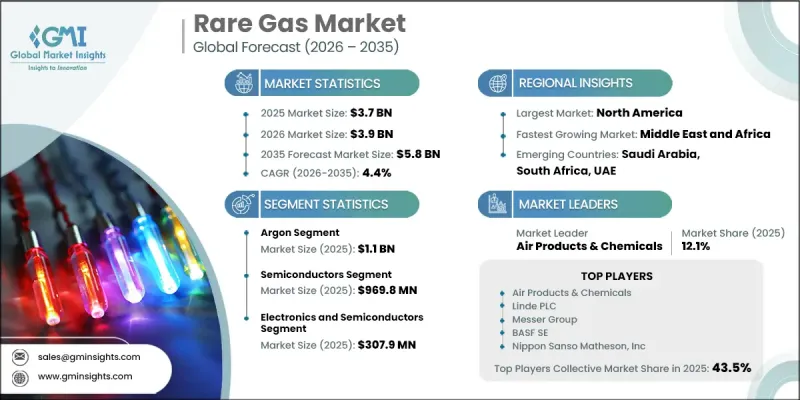
惰性氣體(也稱為稀有氣體)包括氦、氖、氬、氪、氙和氡,它們都具有極低的化學反應活性。其惰性使其能夠在對化學穩定性和惰性要求極高的環境中高效運作。這些氣體天然存在於大氣中,含量極低,主要透過空氣分離系統和天然氣處理技術提取。每種氣體都具有獨特的物理性質,例如沸點、密度和導熱係數,這些性質決定了其在各種工業應用中的適用性。氦氣因其低密度和冷卻性能而備受青睞,而氬氣則廣泛用作工業環境中的屏蔽和隔熱材料。總而言之,惰性氣體在維持各種技術和工業系統的製程穩定性和運作效率方面發揮著至關重要的作用。低溫工程和氣體純化技術的不斷進步顯著提高了萃取效率和純度。此外,氣體回收和循環利用系統的引入實現了更永續的利用,透過在工業循環中重複使用惰性氣體,緩解了供應緊張的局面。
| 市場範圍 | |
|---|---|
| 開始年份 | 2025 |
| 預測期 | 2026-2035 |
| 上市時的市場規模 | 37億美元 |
| 預測市場規模 | 58億美元 |
| 複合年成長率 | 4.4% |
預計到2025年,氬氣市場規模將達11億美元。氬氣優異的惰性使其非常適合受控制造環境、金屬加工製作流程以及各種需要防止氧化和製程穩定性的工業應用,從而推動了市場需求的持續成長。
預計到2025年,半導體市場規模將達到9.698億美元。該市場的成長主要得益於先進製造業和精密工業中對超高純度惰性氣體的需求不斷成長。這些氣體也用於需要惰性環境的受控醫療程序中。此外,半導體產業高度依賴高純度惰性氣體來確保其製造流程的精確度和一致性,從而支援先進電子元件和系統的生產。
預計北美稀有氣體市場規模將從2025年的11億美元成長到2035年的16億美元。由於醫療、航太、電子和科研等領域對高純度氣體有著廣泛的應用,且這些領域都需要可靠的供應和分銷網路,因此該地區的需求仍然強勁。美國仍然是主要的消費國,這主要得益於氦氣、氬氣和其他稀有氣體在半導體製造、醫學成像技術、太空探勘計劃和工業生產活動中的持續使用。
目錄
第1章:調查方法和範圍
第2章執行摘要
第3章業界考察
- 生態系分析
- 供應商情況
- 利潤率
- 每個階段增加的價值
- 影響價值鏈的因素
- 中斷
- 影響產業的因素
- 促進因素
- 不斷擴大的電子和半導體製造
- 醫療應用需求增加
- 工業焊接和製造的擴張
- 陷阱與挑戰
- 稀有氣體天然資源的供應是有限的。
- 高存儲和運輸要求
- 機會
- 氣體循環利用技術的發展
- 先進製造應用領域的成長
- 促進因素
- 成長潛力分析
- 監理情勢
- 北美洲
- 歐洲
- 亞太地區
- 拉丁美洲
- 中東和非洲
- 波特五力分析
- PESTEL 分析
- 科技與創新趨勢
- 當前技術趨勢
- 新興技術
- 價格趨勢
- 按地區
- 按類型
- 未來市場趨勢
- 專利趨勢
- 貿易統計(HS編碼)
- 主要進口國
- 主要出口國
- 永續性和環境方面
- 永續計劃
- 減少廢棄物策略
- 生產中的能源效率
- 具有環保意識的舉措
- 考慮碳足跡
第4章 競爭情勢
- 介紹
- 企業市佔率分析
- 按地區
- 北美洲
- 歐洲
- 亞太地區
- 拉丁美洲
- 中東和非洲(MEA)
- 按地區
- 企業矩陣分析
- 主要市場公司的競爭分析
- 競爭定位矩陣
- 主要進展
- 併購
- 夥伴關係和聯盟
- 新產品發布
- 業務拓展計劃
第5章 市場估計與預測:依類型分類,2022-2035年
- 氦
- 氖
- 氬氣
- 氪
- 氙
- 氡
第6章 市場估計與預測:依功能分類,2022-2035年
- 照明
- 絕緣
- 掃描
- 麻醉
- 半導體
- 衛星
第7章 市場估計與預測:依最終用途分類,2022-2035年
- 衛生保健
- 照明
- 電子設備和半導體
- 製造/加工
- 能源與電力
- 航太航太
- 其他
第8章 市場估計與預測:依地區分類,2022-2035年
- 北美洲
- 美國
- 加拿大
- 歐洲
- 德國
- 英國
- 法國
- 西班牙
- 義大利
- 其他歐洲地區
- 亞太地區
- 中國
- 印度
- 日本
- 澳洲
- 韓國
- 亞太其他地區
- 拉丁美洲
- 巴西
- 墨西哥
- 阿根廷
- 其他拉丁美洲地區
- 中東和非洲
- 沙烏地阿拉伯
- 南非
- 阿拉伯聯合大公國
- 其他中東和非洲地區
第9章:公司簡介
- Air Products &Chemicals
- American Gas Products
- Axcel Gases
- BASF SE
- Dakota Gasification Co.
- Ingas LLC
- Iwatani Corporation
- Nippon Sanso Matheson, Inc
- Messer Group
- Praxair
The Global Rare Gas Market was valued at USD 3.7 billion in 2025 and is estimated to grow at a CAGR of 4.4% to reach USD 5.8 billion by 2035.
Rare gases, also known as noble gases, include helium, neon, argon, krypton, xenon, and radon, all of which are characterized by extremely low chemical reactivity. Their inert behavior allows them to function effectively in environments where chemical stability and non-reactivity are essential. These gases are naturally present in the atmosphere in trace quantities and are primarily extracted through air separation units and natural gas processing techniques. Each gas has distinct physical properties such as boiling point, density, and thermal conductivity, which determine its industrial suitability across multiple applications. Helium is widely valued for its low density and cooling properties, while argon is extensively used for shielding and insulation in industrial environments. Overall, rare gases play a critical role in maintaining process stability and operational efficiency across a wide range of technical and industrial systems. Continuous advancements in cryogenic engineering and gas purification technologies have significantly improved extraction efficiency and purity levels. In addition, the integration of gas recovery and recycling systems has enabled more sustainable utilization, allowing rare gases to be reused within industrial cycles and reducing supply constraints.
| Market Scope | |
|---|---|
| Start Year | 2025 |
| Forecast Year | 2026-2035 |
| Start Value | $3.7 Billion |
| Forecast Value | $5.8 Billion |
| CAGR | 4.4% |
The argon segment accounted for USD 1.1 billion in 2025. Demand for argon continues to rise due to its excellent inert properties, which make it highly suitable for controlled manufacturing environments, metal processing operations, and various industrial applications where oxidation prevention and process stability are required.
The semiconductor segment generated USD 969.8 million in 2025. Growth in this segment is supported by increasing utilization of rare gases across advanced manufacturing and precision-driven industries, where ultra-high purity standards are essential. These gases are also used in healthcare applications for controlled medical procedures requiring inert environments. Additionally, the semiconductor industry relies heavily on high-purity rare gases to ensure accuracy and consistency during fabrication processes, supporting the production of advanced electronic components and systems.
North America Rare Gas Market is projected to grow from USD 1.1 billion in 2025 to USD 1.6 billion in 2035. Demand in the region remains strong due to widespread application across healthcare, aerospace, electronics, and scientific research sectors, all of which require high-purity gas supplies and reliable distribution networks. The United States continues to be a key consumer, driven by sustained usage of helium, argon, and other rare gases in semiconductor manufacturing, medical imaging technologies, space exploration programs, and industrial production activities.
Major players operating in the Global Rare Gas Industry include Iwatani Corporation, Messer Group, Air Products & Chemicals, Praxair, BASF SE, American Gas Products, Nippon Sanso Matheson, Inc, Axcel Gases, Ingas LLC, and Dakota Gasification Co. Companies operating in the Rare Gas Market are focusing on strengthening their market position through investments in advanced extraction technologies and high-efficiency air separation systems that improve yield and purity levels. Strategic emphasis is placed on expanding cryogenic processing capabilities and upgrading purification infrastructure to meet rising demand from high-precision industries. Many players are also prioritizing the development of sustainable gas recovery and recycling solutions to reduce waste and improve resource efficiency. Long-term supply agreements with semiconductor manufacturers, healthcare providers, and industrial clients are being used to ensure stable revenue streams. Additionally, firms are expanding global distribution networks and strengthening logistics capabilities to ensure uninterrupted supply.
Table of Contents
Chapter 1 Methodology & Scope
- 1.1 Market scope and definition
- 1.2 Research design
- 1.2.1 Research approach
- 1.2.2 Data collection methods
- 1.3 Data mining sources
- 1.3.1 Global
- 1.3.2 Regional/Country
- 1.4 Base estimates and calculations
- 1.4.1 Base year calculation
- 1.4.2 Key trends for market estimation
- 1.5 Primary research and validation
- 1.5.1 Primary sources
- 1.6 Forecast model
- 1.7 Research assumptions and limitations
Chapter 2 Executive Summary
- 2.1 Industry 360° synopsis
- 2.2 Key market trends
- 2.2.1 Type
- 2.2.2 Function
- 2.2.3 End Use
- 2.2.4 Regional
- 2.3 TAM Analysis, 2026-2035
- 2.4 CXO perspectives: Strategic imperatives
- 2.5 Future outlook and strategic recommendations
Chapter 3 Industry Insights
- 3.1 Industry ecosystem analysis
- 3.1.1 Supplier landscape
- 3.1.2 Profit margin
- 3.1.3 Value addition at each stage
- 3.1.4 Factor affecting the value chain
- 3.1.5 Disruptions
- 3.2 Industry impact forces
- 3.2.1 Growth drivers
- 3.2.1.1 Rising electronics and semiconductor manufacturing
- 3.2.1.2 Increasing demand from healthcare applications
- 3.2.1.3 Expanding industrial welding and fabrication
- 3.2.2 Pitfalls/challenge
- 3.2.2.1 Limited natural availability of rare gases
- 3.2.2.2 High storage and transportation requirements
- 3.2.3 Opportunities
- 3.2.3.1 Development of gas recycling technologies
- 3.2.3.2 Growth in advanced manufacturing applications
- 3.2.1 Growth drivers
- 3.3 Growth potential analysis
- 3.4 Regulatory landscape
- 3.4.1 North America
- 3.4.2 Europe
- 3.4.3 Asia Pacific
- 3.4.4 Latin America
- 3.4.5 Middle East & Africa
- 3.5 Porter's analysis
- 3.6 PESTEL analysis
- 3.7 Technology and innovation landscape
- 3.7.1 Current technological trends
- 3.7.2 Emerging technologies
- 3.8 Price trends
- 3.8.1 By region
- 3.8.2 By type
- 3.9 Future market trends
- 3.10 Patent landscape
- 3.11 Trade statistics (HS code)
- 3.11.1 Major importing countries
- 3.11.2 Major exporting countries
- 3.12 Sustainability and environmental aspects
- 3.12.1 Sustainable practices
- 3.12.2 Waste reduction strategies
- 3.12.3 Energy efficiency in production
- 3.12.4 Eco-friendly initiatives
- 3.13 Carbon footprint consideration
Chapter 4 Competitive Landscape, 2025
- 4.1 Introduction
- 4.2 Company market share analysis
- 4.2.1 By region
- 4.2.1.1 North America
- 4.2.1.2 Europe
- 4.2.1.3 Asia Pacific
- 4.2.1.4 LATAM
- 4.2.1.5 MEA
- 4.2.1 By region
- 4.3 Company matrix analysis
- 4.4 Competitive analysis of major market players
- 4.5 Competitive positioning matrix
- 4.6 Key developments
- 4.6.1 Mergers & acquisitions
- 4.6.2 Partnerships & collaborations
- 4.6.3 New product launches
- 4.6.4 Expansion plans
Chapter 5 Market Estimates and Forecast, By Type, 2022-2035 (USD Billion) (Kilo Tons)
- 5.1 Key trends
- 5.2 Helium
- 5.3 Neon
- 5.4 Argon
- 5.5 Krypton
- 5.6 Xenon
- 5.7 Radon
Chapter 6 Market Estimates and Forecast, By Function, 2022-2035 (USD Billion) (Kilo Tons)
- 6.1 Key trends
- 6.2 Illumination
- 6.3 Insulation
- 6.4 Scanning
- 6.5 Anaesthesia
- 6.6 Semiconductors
- 6.7 Satellites
Chapter 7 Market Estimates and Forecast, By End Use, 2022-2035 (USD Billion) (Kilo Tons)
- 7.1 Key trends
- 7.2 Healthcare
- 7.3 Lighting
- 7.4 Electronics and semiconductors
- 7.5 Manufacturing and fabrication
- 7.6 Energy and power
- 7.7 Aerospace and aviation
- 7.8 Others
Chapter 8 Market Estimates and Forecast, By Region, 2022-2035 (USD Billion) (Kilo Tons)
- 8.1 Key trends
- 8.2 North America
- 8.2.1 U.S.
- 8.2.2 Canada
- 8.3 Europe
- 8.3.1 Germany
- 8.3.2 UK
- 8.3.3 France
- 8.3.4 Spain
- 8.3.5 Italy
- 8.3.6 Rest of Europe
- 8.4 Asia Pacific
- 8.4.1 China
- 8.4.2 India
- 8.4.3 Japan
- 8.4.4 Australia
- 8.4.5 South Korea
- 8.4.6 Rest of Asia Pacific
- 8.5 Latin America
- 8.5.1 Brazil
- 8.5.2 Mexico
- 8.5.3 Argentina
- 8.5.4 Rest of Latin America
- 8.6 Middle East and Africa
- 8.6.1 Saudi Arabia
- 8.6.2 South Africa
- 8.6.3 UAE
- 8.6.4 Rest of Middle East and Africa
Chapter 9 Company Profiles
- 9.1 Air Products & Chemicals
- 9.2 American Gas Products
- 9.3 Axcel Gases
- 9.4 BASF SE
- 9.5 Dakota Gasification Co.
- 9.6 Ingas LLC
- 9.7 Iwatani Corporation
- 9.8 Nippon Sanso Matheson, Inc
- 9.9 Messer Group
- 9.10 Praxair

 惰性氣體市場-2026-2032年全球市場預測
 稀有氣體:市場佔有率分析、行業趨勢和統計數據、成長預測(2026-2031)
 稀有氣體質譜儀市場規模、佔有率和成長分析:按產品類型、技術、應用、最終用戶和地區分類-2026-2033年產業預測
 全球稀有氣體市場規模、佔有率、趨勢和成長分析報告(2026-2034年)
 稀有氣體市場 - 全球產業規模、佔有率、趨勢、機會及預測(按類型、應用、運輸方式、地區和競爭格局分類,2021-2031年)
 氪氣市場規模、佔有率及成長分析(按應用、純度、最終用途和地區分類)-2026-2033年產業預測
 全球氪氣市場按類型、功能、最終用戶和地區分類的惰性氣體市場:未來預測(2026-2032 年)