


 |
市場調查報告書
商品編碼
2073438
稀有氣體:市場佔有率分析、行業趨勢和統計數據、成長預測(2026-2031)Noble Gas - Market Share Analysis, Industry Trends & Statistics, Growth Forecasts (2026 - 2031) |
||||||

※ 本網頁內容可能與最新版本有所差異。詳細情況請與我們聯繫。
據 Mordor Intelligence 稱,2026 年稀有氣體市場規模估計為 62.4 億立方米,預計在預測期(2026-2031 年)內將以 4.03% 的複合年成長率成長,到 2031 年達到 76 億立方米。
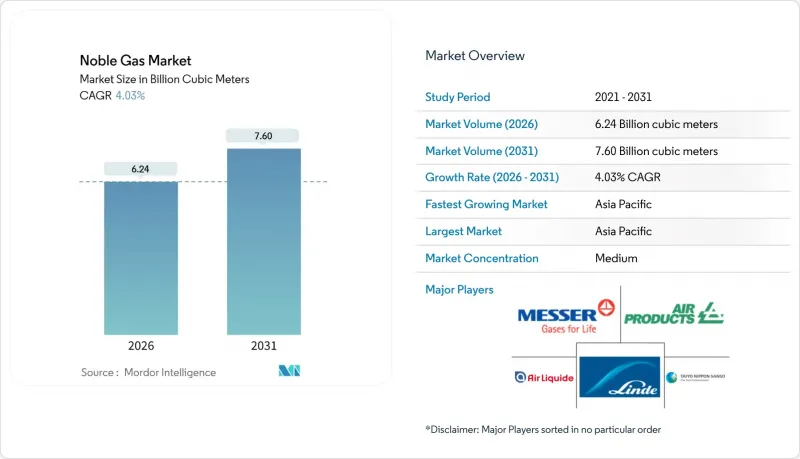
本報告按類型(氦、氪、氬、氖、氙、氡)和地區(亞太地區、北美、歐洲、南美、中東和非洲)進行細分。市場預測以體積(立方米)為基礎。
全球稀有氣體市場趨勢及洞察
醫療領域對超高純度氦氣的需求日益成長
由於人口老化導致影像檢查需求不斷成長,全球磁振造影(MRI)系統的安裝數量持續增加。這些系統仍需大量氦氣來維持超導性磁體在4.2開爾文的極低溫下運作。儘管飛利浦的「BlueSeal」磁鐵已成功大幅降低了氦氣消耗,但大多數已安裝的設備仍然老舊,預計對氦氣的需求仍將十分旺盛。美國和德國的醫院已延長氦氣補充合約期限,以應對現貨價格上漲並穩定成本。同時,在日本,攜帶式已開始臨床試驗,顯示需求正在轉變。然而,由於不使用低溫冷卻劑的設計仍處於早期階段,醫療領域仍然是稀有氣體市場中氦氣需求的重要基礎。
鋼鐵和汽車業焊接活動的復甦
2024年,中國粗鋼產量大幅成長,恢復到疫情前水平,並加速了氬氣在屏蔽焊接的應用。電動車電池組的製造需要純度超過99.996%的氬氣,光是特斯拉上海工廠就消耗了中國市場的部分供應。歐洲汽車製造商正轉向雷射-電弧混合焊接,這種焊接方式結合使用氦氣來加深焊縫,2024年德國、法國和西班牙的氦氣消耗量均成長。為了因應歐洲飆升的電價,製造商選擇簽訂與電價掛鉤的多年合約。因此,焊接市場的強勁發展趨勢進一步鞏固了氬氣在稀有氣體市場的主導地位。
氦氣和氖氣價格波動
2024年至2025年間,由於克利夫賽德倉儲設施關閉以及俄羅斯出口下降,美國氦氣現貨價格出現波動。烏克蘭停止生產後,氖氣價格飆升。中國供應商進入市場,價格居高不下,直到2025年新的產能投入運作。儘管大型半導體製造商透過數量保證合約降低了風險,但規模較小的原始設備製造商(OEM)面臨利潤率壓力,導致資本投資放緩。這種波動性的加劇不僅抑制了非必需消費,也增加了對營運資金的需求,從而減緩了稀有氣體市場的短期成長。
細分市場分析
2025年,氬氣佔惰性氣體市場出貨量的56.12%。這反映了氬氣在全球鋼鐵和汽車工廠的金屬惰性氣體保護焊(MIG焊)和鎢極惰性氣體保護焊(TIG焊)的廣泛應用。中國電動車產量和電池組製造的激增推動了氬氣需求,而印度生產連結獎勵計畫計劃(PLI)下產能的提升也使2025年全年氬氣需求保持高位。儘管氬氣驅動的惰性氣體市場規模預計將繼續擴大,但隨著氖氣的成長速度超過氬氣,其市場佔有率預計將逐漸下降。
預計到2031年,氖氣將以7.12%的複合年成長率成長,成為稀有氣體中成長最快的。這主要是因為極紫外線(EUV)微影技術每片晶圓消耗的氣體量是深紫外線(DUV)設備的3倍。由於北美礦床枯竭和價格波動,終端用戶傾向於回收,因此氦氣的需求成長較為溫和。氪氣的需求因多層玻璃標準的實施而逐步成長,氙氣則受益於衛星發射的強勁勢頭。儘管有這些變化,氬氣仍然是稀有氣體市場的基石,而氖氣則是推動整體市場結構重新平衡的主要成長要素。
區域分析
預計到2025年,亞太地區將佔全球稀有氣體市場規模的51.12%,並在2031年之前以5.64%的複合年成長率成長,這主要得益於半導體晶圓廠的建設、鋼鐵產能的擴張以及電動車生產的加速發展。 2025年,晶片製造商將轉向3奈米製程,將帶動台灣和韓國氖氣消費量的成長。同時,隨著液化空氣集團在古吉拉突邦新建的空氣分離裝置運作,印度在2024年的氖氣消費量將顯著成長。中國作為市場領導者,在全球氬氣消費中佔有較大佔有率。
2025年,北美地區的氦氣儲存保持穩定,但隨著堪薩斯州和德克薩斯州傳統氦氣儲量的枯竭,該地區正從國內氦氣盈餘轉向依賴進口。同時,亞伯達和薩斯喀徹爾溫省的探勘公司正競相填補供應缺口。值得注意的是,空氣產品公司(Air Products)正在路易斯安那州投資5億美元,專注於從墨西哥灣沿岸的天然氣流中回收氦氣。歐洲正面臨高昂的電力成本和老化的低溫基礎設施的雙重挑戰。這些挑戰限制了供應的柔軟性,因此產業巨頭林德集團(Linde)和梅塞爾公司(Messer)優先考慮對現有設施維修,而不是新建設施。南美和中東地區則受惠於巴西的鋼鐵生產和沙烏地阿拉伯的石化業務。海灣低溫公司(Gulf Cryo)涵蓋整個海灣合作理事會(GCC)的網路進一步推動了該地區獨特的氦氣需求。
其他好處
- Excel格式的市場預測(ME)表
- 3個月的分析師支持
目錄
第1章:引言
- 研究假設和市場定義
- 調查範圍
第2章:調查方法
第3章執行摘要
第4章 市場狀況
- 市場概覽
- 市場促進因素
- 醫療領域對超高純度氦氣的需求不斷成長
- 鋼鐵和汽車業焊接活動的復甦
- 亞太地區半導體製造廠的擴張
- 積層製造防護罩周圍環境的快速擴散
- 在非洲和加拿大探勘低碳原生氦礦床
- 市場限制因素
- 氦氣和氖氣價格波動
- 能源密集低溫分離成本
- 加強對關鍵氣體的出口限制
- 價值鏈分析
- 波特五力模型
第5章 市場規模與成長預測
- 按類型
- 氦
- 衛生保健
- 電子設備
- 焊接塗層氣體
- 提升氣體
- 控制周圍環境
- 洩漏檢測
- 呼吸氣體混合物
- 分析氣體
- 其他用途/最終用戶產業
- 氪
- 建築(雙層玻璃窗)
- 照明
- 準分子雷射
- 其他用途/最終用戶產業
- 氬氣
- 焊接保護氣體
- 電子和半導體
- 照明
- 其他用途/最終用戶產業
- 氖
- 電子設備(雷射)
- 顯示組件
- 照明
- 其他用途/最終用戶產業
- 氙
- 照明
- 衛星
- 醫療(麻醉劑)
- 電子學(光刻)
- 電子設備(雷射)
- 等離子/AMOLED螢幕
- 其他用途/最終用戶產業
- 氡
- 氦
- 按地區
- 亞太地區
- 中國
- 印度
- 日本
- 韓國
- ASEAN
- 其他亞太國家
- 北美洲
- 美國
- 加拿大
- 墨西哥
- 歐洲
- 德國
- 比利時
- 英國
- 義大利
- 法國
- 西班牙
- 俄羅斯
- 荷蘭
- 其他歐洲國家
- 南美洲
- 巴西
- 阿根廷
- 其他南美國家
- 中東和非洲
- 沙烏地阿拉伯
- 南非
- 其他中東和非洲國家
- 亞太地區
第6章 競爭情勢
- 市場集中度
- 策略趨勢
- 市佔率和排名分析
- 公司簡介
- Air Liquide
- Air Products and Chemicals Inc.
- Airgas Inc.
- American Gas
- BASF SE
- Buzwair Industrial Gases Factories
- First Helium
- Gulf Cryo
- ITM Power
- Iwatani Corporation
- Linde plc
- MATHESON TRI-GAS INC.
- Messer North America, Inc.
- Praxair Technology, Inc.
- Ras Gas Company Limited
- Royal Dutch Shell PLC
- TAIYO NIPPON SANSO CORPORATION
第7章 市場機會與未來展望
According to Mordor Intelligence, the noble gas market size is estimated at 6.24 billion cubic meters in 2026, and is expected to reach 7.60 billion cubic meters by 2031, at a CAGR of 4.03% during the forecast period (2026-2031).
This report is Segmented by Type (Helium, Krypton, Argon, Neon, Xenon, and Radon), and Geography (Asia-Pacific, North America, Europe, South America, and Middle-East and Africa). Market Forecasts are Provided in Terms of Volume (Cubic Meters).
Global Noble Gas Market Trends and Insights
Rising Healthcare Demand for Ultra-High-Purity Helium
Global installations of MRI systems, which still rely on substantial helium volumes to maintain superconducting magnets at a chilly 4.2 Kelvin, have been growing, driven by an aging population's increasing need for imaging procedures. While Philips' BlueSeal magnet has successfully slashed helium consumption, a significant portion of the installed base still comprises legacy equipment, ensuring a meaningful helium demand persists. Hospitals in the United States and Germany, reacting to rising spot quotes, extended their replenishment contracts to longer terms, aiming for price stability. Meanwhile, Japan's portable MRI prototypes embarked on clinical trials, hinting at a potential demand shift. Yet, with cryogen-free designs still in their infancy, the healthcare sector remains a cornerstone for helium industry demand within the noble gas market.
Resurgence of Steel and Automotive Welding Activity
In 2024, China produced a high quantity of crude steel, restoring pre-pandemic throughput and accelerating argon uptake for shielded welding. Electric-vehicle battery-pack fabrication needs argon purities above 99.996%, and Tesla's Shanghai plant alone consumed a portion of China's merchant supply. European automakers have shifted to laser-arc hybrid welding that co-uses helium to deepen weld penetration, adding to consumption across Germany, France, and Spain in 2024. Fabricators favored multi-year agreements indexed to power costs to mitigate European electricity price spikes. Robust welding dynamics therefore reinforce argon's dominant role within the noble gas market.
Helium and Neon Price Volatility
In 2024-2025, the United States' helium spot prices fluctuated due to outages at the Cliffside storage site and reduced exports from Russia. Neon prices experienced sharper spikes when Ukraine halted production. Chinese suppliers stepped in, commanding premium prices until new capacity became operational in 2025. While major semiconductor companies shielded themselves through volume-commitment contracts, smaller OEMs faced margin pressures, leading to a slowdown in capital expenditures. This heightened volatility not only dampens discretionary consumption but also increases working-capital requirements, moderating short-term growth in the noble gas market.
Other drivers and restraints analyzed in the detailed report include:
- Expansion of Semiconductor Fabs in Asia-Pacific
- Rapid Uptake of Additive-Manufacturing Shielding Atmospheres
- Energy-Intensive Cryogenic Separation Costs
For complete list of drivers and restraints, kindly check the Table Of Contents.
Segment Analysis
Argon held 56.12% of the noble gas market volume in 2025, reflecting entrenched use in metal-inert-gas and tungsten-inert-gas welding across global steel and automotive plants. China's surge in electric-vehicle output and battery-pack fabrication lifted argon demand, and India's capacity expansions under the Production-Linked Incentive scheme sustained elevated off-take through 2025. The noble gas market size attributed to argon is forecast to continue expanding in absolute terms, although its share erodes gradually as neon growth outpaces it.
Neon is projected to grow at a 7.12% CAGR through 2031, the fastest among noble gases, as extreme ultraviolet lithography triples gas consumption per wafer compared with deep ultraviolet tools. Helium demand rose modestly, constrained by North American field depletion and price swings that pushed end users toward recycling. Krypton enjoyed incremental pull from insulating-glass standards, while xenon benefited from a robust satellite launch cadence. Despite these shifts, argon remains the anchor of the noble gas market, whereas neon represents the principal growth lever driving rebalancing across the portfolio.
Complete Report Scope:
- By Type
- Helium
- Healthcare
- Electronics
- Welding Cover Gas
- Lifting Gas
- Controlled Atmospheres
- Leak Detection
- Breathing Mixtures
- Analytical Gas
- Other Applications/End-user Industries
- Krypton
- Construction (Insulating Glass)
- Lighting
- Excimer Lasers
- Other Applications/End-user Industries
- Argon
- Protective Gas for Welding
- Electronics and Semiconductor
- Lighting
- Other Applications/End-user Industries
- Neon
- Electronics (Lasers)
- Display Components
- Lighting
- Other Applications/End-user Industries
- Xenon
- Lighting
- Satellites
- Healthcare (Anesthetics)
- Electronics (Photolithiography)
- Electronics (Lasers)
- Plasma/AMOLED Screens
- Other Applications/End-user Industries
- Radon
- Helium
- By Geography
- Asia-Pacific
- China
- India
- Japan
- South Korea
- ASEAN Countries
- Rest of Asia-Pacific
- North America
- United States
- Canada
- Mexico
- Europe
- Germany
- Belgium
- United Kingdom
- Italy
- France
- Spain
- Russia
- Netherlands
- Rest of Europe
- South America
- Brazil
- Argentina
- Rest of South America
- Middle-East and Africa
- Saudi Arabia
- South Africa
- Rest of Middle-East and Africa
- Asia-Pacific
Geography Analysis
Asia-Pacific accounted for 51.12% of the noble gas market volume in 2025 and is tracking a 5.64% CAGR to 2031, bolstered by semiconductor fab build-outs, steel capacity expansions, and accelerating electric-vehicle production. In 2025, chipmakers advanced to 3 nm nodes, leading Taiwan and South Korea to increase neon consumption. Meanwhile, in 2024, India witnessed significant volume growth, thanks to new air-separation units launched by Air Liquide in Gujarat. Dominating the scene, China accounted for a substantial share of global argon consumption.
In 2025, North America maintained a steady share but is shifting from a domestic helium surplus to a reliance on imports, as traditional reservoirs in Kansas and Texas dwindle. Meanwhile, exploration companies in Alberta and Saskatchewan are racing to bridge the gap. In a significant move, Air Products has committed USD 500 million in Louisiana, focusing on helium recovery from Gulf Coast gas streams. Europe grapples with high power costs and an aging cryogenic infrastructure. These challenges limit supply flexibility, leading industry giants Linde and Messer to prioritize retrofitting existing facilities over establishing new ones. South America and the Middle East are buoyed by Brazil's steel production and Saudi Arabia's petrochemical initiatives. This localized demand is further bolstered by Gulf Cryo's expanded network across the GCC.
- Air Liquide
- Air Products and Chemicals Inc.
- Airgas Inc.
- American Gas
- BASF SE
- Buzwair Industrial Gases Factories
- First Helium
- Gulf Cryo
- ITM Power
- Iwatani Corporation.
- Linde plc
- MATHESON TRI-GAS INC.
- Messer North America, Inc.
- Praxair Technology, Inc.
- Ras Gas Company Limited
- Royal Dutch Shell PLC
- TAIYO NIPPON SANSO CORPORATION
Additional Benefits:
- The market estimate (ME) sheet in Excel format
- 3 months of analyst support
TABLE OF CONTENTS
1 Introduction
- 1.1 Study Assumptions and Market Definition
- 1.2 Scope of the Study
2 Research Methodology
3 Executive Summary
4 Market Landscape
- 4.1 Market Overview
- 4.2 Market Drivers
- 4.2.1 Rising healthcare demand for ultra-high-purity helium
- 4.2.2 Resurgence of steel and automotive welding activity
- 4.2.3 Expansion of semiconductor fabs in Asia-Pacific
- 4.2.4 Rapid uptake of additive-manufacturing shielding atmospheres
- 4.2.5 Exploration of low-carbon, primary-helium fields in Africa and Canada
- 4.3 Market Restraints
- 4.3.1 Helium and neon price volatility
- 4.3.2 Energy-intensive cryogenic separation costs
- 4.3.3 Tightening export controls on critical gases
- 4.4 Value Chain Analysis
- 4.5 Porter's Five Forces
- 4.5.1 Bargaining Power of Suppliers
- 4.5.2 Bargaining Power of Consumers
- 4.5.3 Threat of New Entrants
- 4.5.4 Threat of Substitute Products and Services
- 4.5.5 Degree of Competition
5 Market Size and Growth Forecasts (Volume)
- 5.1 By Type
- 5.1.1 Helium
- 5.1.1.1 Healthcare
- 5.1.1.2 Electronics
- 5.1.1.3 Welding Cover Gas
- 5.1.1.4 Lifting Gas
- 5.1.1.5 Controlled Atmospheres
- 5.1.1.6 Leak Detection
- 5.1.1.7 Breathing Mixtures
- 5.1.1.8 Analytical Gas
- 5.1.1.9 Other Applications/End-user Industries
- 5.1.2 Krypton
- 5.1.2.1 Construction (Insulating Glass)
- 5.1.2.2 Lighting
- 5.1.2.3 Excimer Lasers
- 5.1.2.4 Other Applications/End-user Industries
- 5.1.3 Argon
- 5.1.3.1 Protective Gas for Welding
- 5.1.3.2 Electronics and Semiconductor
- 5.1.3.3 Lighting
- 5.1.3.4 Other Applications/End-user Industries
- 5.1.4 Neon
- 5.1.4.1 Electronics (Lasers)
- 5.1.4.2 Display Components
- 5.1.4.3 Lighting
- 5.1.4.4 Other Applications/End-user Industries
- 5.1.5 Xenon
- 5.1.5.1 Lighting
- 5.1.5.2 Satellites
- 5.1.5.3 Healthcare (Anesthetics)
- 5.1.5.4 Electronics (Photolithiography)
- 5.1.5.5 Electronics (Lasers)
- 5.1.5.6 Plasma/AMOLED Screens
- 5.1.5.7 Other Applications/End-user Industries
- 5.1.6 Radon
- 5.1.1 Helium
- 5.2 By Geography
- 5.2.1 Asia-Pacific
- 5.2.1.1 China
- 5.2.1.2 India
- 5.2.1.3 Japan
- 5.2.1.4 South Korea
- 5.2.1.5 ASEAN Countries
- 5.2.1.6 Rest of Asia-Pacific
- 5.2.2 North America
- 5.2.2.1 United States
- 5.2.2.2 Canada
- 5.2.2.3 Mexico
- 5.2.3 Europe
- 5.2.3.1 Germany
- 5.2.3.2 Belgium
- 5.2.3.3 United Kingdom
- 5.2.3.4 Italy
- 5.2.3.5 France
- 5.2.3.6 Spain
- 5.2.3.7 Russia
- 5.2.3.8 Netherlands
- 5.2.3.9 Rest of Europe
- 5.2.4 South America
- 5.2.4.1 Brazil
- 5.2.4.2 Argentina
- 5.2.4.3 Rest of South America
- 5.2.5 Middle-East and Africa
- 5.2.5.1 Saudi Arabia
- 5.2.5.2 South Africa
- 5.2.5.3 Rest of Middle-East and Africa
- 5.2.1 Asia-Pacific
6 Competitive Landscape
- 6.1 Market Concentration
- 6.2 Strategic Moves
- 6.3 Market Share/Ranking Analysis
- 6.4 Company Profiles (includes Global-level Overview, Market-level Overview, Core Segments, Financials, Strategic Information, Market Rank/Share, Products and Services, Recent Developments)
- 6.4.1 Air Liquide
- 6.4.2 Air Products and Chemicals Inc.
- 6.4.3 Airgas Inc.
- 6.4.4 American Gas
- 6.4.5 BASF SE
- 6.4.6 Buzwair Industrial Gases Factories
- 6.4.7 First Helium
- 6.4.8 Gulf Cryo
- 6.4.9 ITM Power
- 6.4.10 Iwatani Corporation.
- 6.4.11 Linde plc
- 6.4.12 MATHESON TRI-GAS INC.
- 6.4.13 Messer North America, Inc.
- 6.4.14 Praxair Technology, Inc.
- 6.4.15 Ras Gas Company Limited
- 6.4.16 Royal Dutch Shell PLC
- 6.4.17 TAIYO NIPPON SANSO CORPORATION
7 Market Opportunities and Future Outlook
- 7.1 White-space and Unmet-Need Assessment

 惰性氣體市場-2026-2032年全球市場預測
 2026-2035年惰性氣體市場機會、成長要素、產業趨勢分析及預測
 稀有氣體質譜儀市場規模、佔有率和成長分析:按產品類型、技術、應用、最終用戶和地區分類-2026-2033年產業預測
 全球稀有氣體市場規模、佔有率、趨勢和成長分析報告(2026-2034年)
 稀有氣體市場 - 全球產業規模、佔有率、趨勢、機會及預測(按類型、應用、運輸方式、地區和競爭格局分類,2021-2031年)
 氪氣市場規模、佔有率及成長分析(按應用、純度、最終用途和地區分類)-2026-2033年產業預測
 全球氪氣市場按類型、功能、最終用戶和地區分類的惰性氣體市場:未來預測(2026-2032 年)