

 |
市場調查報告書
商品編碼
2027603
2026 年至 2035 年草本個人保健產品的市場機會、成長要素、產業趨勢和預測。Herbal Personal Care Products Market Opportunity, Growth Drivers, Industry Trend Analysis, and Forecast 2026 - 2035 |
||||||

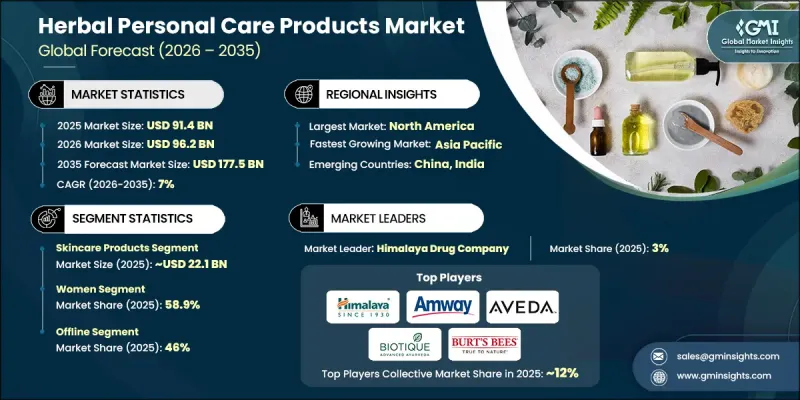
2025年全球草本個人保健產品市場價值為914億美元,預計到2035年將以7%的複合年成長率成長至1775億美元。
消費者越來越意識到對羥基苯甲酸酯、硫酸鹽、鄰苯二甲酸酯和人工香料等合成化學物質的有害影響,這正在改變他們的購買行為。許多消費者現在會仔細查看標籤,在線上搜尋成分,優先考慮透明度,並傾向於選擇標榜「不含」配方的品牌。這種轉變促使老牌企業和新興企業重新評估其產品配方,以滿足消費者對更清潔、更安全的個人保健產品日益成長的需求。數位內容、皮膚科醫生的推薦以及網紅主導的宣傳活動正在推動這一趨勢。社群媒體使複雜的化學訊息變得易於理解,並教育消費者了解風險和更安全的替代方案。溫和親膚、不含害物質且宣稱天然成分的產品正在獲得市場認可,而強調植物來源配方的品牌正在建立信任,並在不斷發展的個人護理市場中獲得競爭優勢。
| 市場規模 | |
|---|---|
| 開始年份 | 2025 |
| 預測期 | 2026-2035 |
| 初始市場規模 | 914億美元 |
| 預測金額 | 1775億美元 |
| 複合年成長率 | 7% |
預計到2025年,護膚市場規模將達到2,21億美元,並在2035年之前以7.2%的複合年成長率成長。受痤瘡、敏感肌膚、老化和環境損害等問題日益關注的推動,草本護膚護膚市場蓬勃發展。消費者更傾向於選擇草本、無化學成分的產品,因為他們認為這些產品更安全、更有效。植物萃取技術和活性成分研究的創新進一步提升了草本護膚品的吸引力和信譽度。
預計到2025年,女性消費市場將佔據58.9%的市場佔有率,並在2035年之前以7.3%的複合年成長率成長。女性消費者是護膚個人保健產品(尤其是偏好和護髮產品)的主要需求驅動力,這主要受她們對「潔淨標示」的偏好、注重健康的生活方式以及積極參與日常美容護理的影響。社群媒體、網紅以及個人化的護理習慣進一步放大了女性對市場成長的影響力,使她們產生收入的核心力量。
美國草本個人保健產品市場預計到2025年將達到226億美元,並在2026年至2035年間以7.5%的複合年成長率成長。消費者對「清潔美容」和成分安全性的日益關注,推動了美國消費者對草本個人保健產品的接受度。高品質的植物來源配方、強大的零售網路和穩健的線上銷售管道,鞏固了草本產品在美國市場的領先地位。尤其值得一提的是,女性消費者正積極將草本產品融入日常生活中,從而支撐了市場的持續需求。
目錄
第1章:調查方法和範圍
第2章執行摘要
第3章業界考察
- 生態系分析
- 供應商情況
- 利潤率
- 每個階段增加的價值
- 影響價值鏈的因素
- 影響產業的因素
- 促進因素
- 消費者對有害合成化學物質的認知不斷提高
- 健康養生趨勢推動了對天然產品的需求
- 影響者行銷和社群媒體的影響
- 陷阱與挑戰
- 市場飽和以及誤導性產品的氾濫
- 消費者對功效宣傳持懷疑態度。
- 機會
- 數位優先品牌和D2C模式的崛起
- 阿育吠陀與傳統醫學的融合
- 促進因素
- 成長潛力分析
- 未來市場趨勢
- 科技與創新趨勢
- 當前技術趨勢
- 新興技術
- 價格趨勢
- 按地區
- 依產品
- 監理情勢
- 北美洲
- 美國:消費品安全委員會(CPSC)聯邦法規(CFR)第16篇第1512節
- 加拿大:國際標準化組織(ISO)4210
- 歐洲
- 德國:德國標準化協會 (DIN)、歐洲標準 (EN)、ISO 4210
- 英國:歐洲標準 (EN) ISO 4210 /英國合格評定 (UKCA)
- 法國:歐洲標準 (EN) ISO 4210
- 亞太地區
- 中國:國家標準(GB)3565
- 印度:印度標準 (IS) 10613
- 日本:日本工業標準(JIS)D 9110
- 拉丁美洲
- 巴西:巴西技術標準協會 (ABNT)、巴西標準局 (NBR)、ISO 4210
- 墨西哥:國際標準化組織(ISO)4210
- 中東和非洲
- 南非:南非國家標準 (SANS) 311
- 沙烏地阿拉伯:沙烏地阿拉伯標準、計量和品質組織 (SASO)、海灣標準化組織 (GSO)、ISO 4210
- 北美洲
- 貿易資料分析(HS編碼 - 30049011)
- 進出口量及進口額趨勢
- 主要貿易走廊及關稅的影響
- 人工智慧和生成式人工智慧對市場的影響
- 利用人工智慧改造現有經營模式
- Genai 各細分市場的應用案例與實施藍圖
- 風險、限制和監管考量
- 波特五力分析
- PESTEL 分析
第4章 競爭情勢
- 介紹
- 企業市佔率分析
- 按地區
- 企業矩陣分析
- 主要市場公司的競爭分析
- 競爭定位矩陣
- 主要進展
- 併購
- 夥伴關係與合作
- 新產品發布
- 業務拓展計劃
第5章 市場估算與預測:依產品類型分類,2022-2035年
- 護膚品
- 乳霜和乳液
- 身體乳/潤膚霜
- 保濕霜
- 洗面乳
- 防曬油
- 抗衰老產品
- 美容精華液
- 其他產品(磨砂膏、眼霜、潤唇膏等)
- 口腔護理產品
- 牙膏
- 漱口水
- 牙膏
- 其他(例如,口氣清新劑)
- 化妝品和彩妝
- 基礎
- 口紅
- 眼線
- 粉末
- 其他物品(卸妝、腮紅、打亮)
- 淋浴設備產品
- 肥皂
- 沐浴凝膠
- 沐浴油
- 浴鹽
- 其他物品(泡澡球、磨砂膏等)
- 香味
- 香水
- 除臭劑
- 身體噴霧
- 其他(滾珠香水、固體香水)
- 嬰兒護理產品
- 洗髮精
- 洗劑
- 油
- 濕紙巾
- 粉末
- 其他(尿布霜等)
- 個人護理產品
- 鬍鬚油
- 鬍後水
- 刮鬍膏
- 其他物品(除毛蠟紙/套裝、刮鬍刀/修剪器等)
- 護髮產品
- 洗髮精
- 護髮素
- 髮油
- 髮膜
- 護髮精華液
- 其他產品(護髮素、髮膠噴霧、染髮劑等)
- 其他(例如,私人部位護理、指甲護理)
第6章 市場估算與預測:依膚質分類 2022-2035 年
- 正常皮膚
- 乾性皮膚
- 油性肌膚
- 混合性肌膚
- 敏感肌膚
第7章 市場估計與預測:依原料類型分類,2022-2035年
- 植物來源成分
- 蘆薈
- 苦楝樹
- 薑黃
- 聖羅勒(印度羅勒)
- 檀香木
- 其他
- 精油
- 茶樹油
- 薰衣草油
- 尤加利油
- 迷迭香油
- 薄荷油
- 其他
- 天然萃取物
- 水果萃取物
- 花卉萃取物
- 種子萃取物
- 根萃取物
- 其他草本成分
- 其他草藥成分(活性碳、死海礦物質)
第8章 市場估算與預測:依類型分類,2022-2035年
- 奶油
- 洗劑
- 液體
- 固態
- 凝膠
- 油
- 其他(泡沫、噴霧、粉末、氣霧劑)
第9章 市場估計與預測:依價格區間分類,2022-2035年
- 低價位
- 中價位
- 高的
第10章 市場估計與預測:依消費者區隔市場分類,2022-2035年
- 男性
- 女士
- 孩子
第11章 市場估價與預測:依通路分類,2022-2035年
- 線上
- 電子商務
- 企業網站
- 離線
- 超級市場/大賣場
- 專賣店
- 藥局/藥局
- 百貨公司
第12章 市場估計與預測:依地區分類,2022-2035年
- 北美洲
- 美國
- 加拿大
- 歐洲
- 德國
- 英國
- 法國
- 義大利
- 西班牙
- 亞太地區
- 中國
- 印度
- 日本
- 韓國
- 澳洲
- 拉丁美洲
- 巴西
- 墨西哥
- 阿根廷
- 中東和非洲(MEA)
- 沙烏地阿拉伯
- 阿拉伯聯合大公國
- 南非
第13章:公司簡介
- Amway Corporation
- Aveda Corporation
- Biotique
- Burt's Bees
- Dabur India Ltd.
- Forest Essentials
- Himalaya Drug Company
- Kama Ayurveda
- Khadi Natural
- Lotus Herbals
- Lush Fresh Handmade Cosmetics
- Oriflame Cosmetics
- Patanjali Ayurved Ltd.
- The Body Shop International Limited
- Weleda AG
The Global Herbal Personal Care Products Market was valued at USD 91.4 billion in 2025 and is estimated to grow at a CAGR of 7% to reach USD 177.5 billion by 2035.
Consumers are increasingly conscious of the harmful effects of synthetic chemicals like parabens, sulfates, phthalates, and artificial fragrances, which have reshaped purchasing behavior. Many shoppers now scrutinize labels, research ingredients online, and gravitate toward brands emphasizing transparency and "free-from" formulations. This shift has prompted both established and emerging companies to reformulate products to meet rising demand for cleaner, safer personal care solutions. Digital content, dermatologist recommendations, and influencer-led awareness campaigns are fueling this movement. Social media simplifies complex chemical information, educating consumers on risks and safer alternatives. The market favors products marketed as gentle, toxin-free, and naturally derived, and brands that highlight plant-based formulations are building trust while gaining a competitive edge in the evolving personal care landscape.
| Market Scope | |
|---|---|
| Start Year | 2025 |
| Forecast Year | 2026-2035 |
| Start Value | $91.4 Billion |
| Forecast Value | $177.5 Billion |
| CAGR | 7% |
The skincare segment generated USD 22.1 billion in 2025 and is expected to grow at a CAGR of 7.2% through 2035. Skincare leads the herbal personal care sector, driven by increasing concerns about acne, sensitivity, aging, and environmental damage. Consumers prefer herbal, chemical-free solutions, which are perceived as safer and more effective. Innovations in botanical extraction and active ingredient research have strengthened the appeal and credibility of herbal skincare products.
The women segment accounted for 58.9% share in 2025 and is anticipated to grow at a CAGR of 7.3% through 2035. Female consumers dominate demand for herbal personal care items, particularly skincare and haircare, influenced by clean-label preferences, wellness-focused lifestyles, and engagement with beauty routines. Social media, influencers, and personalized care regimens have further amplified women's impact on market growth, making them central to revenue generation.
U.S. Herbal Personal Care Products Market reached USD 22.6 billion in 2025 and is expected to grow at a CAGR of 7.5% from 2026 to 2035. Rising awareness of clean beauty and ingredient safety drives U.S. consumer adoption of herbal personal care products. Premium botanical formulations, strong retail networks, and digital presence have reinforced the country's market leadership. Women are particularly active in adopting herbal solutions, which supports sustained demand.
Major players in the Global Herbal Personal Care Products Market include Forest Essentials, Aveda Corporation, Dabur India Ltd., Lotus Herbals, Burt's Bees, Lush Fresh Handmade Cosmetics, Patanjali Ayurved Ltd., Weleda AG, Khadi Natural, Biotique, The Body Shop International Limited, Amway Corporation, Ecobee, Kama Ayurveda, and Oriflame Cosmetics. Companies in the Global Herbal Personal Care Products Market are strengthening their presence by investing heavily in research and development to enhance product efficacy and safety. They are expanding their portfolios to include premium and niche herbal offerings to cater to diverse consumer segments. Strategic collaborations with retailers, wellness brands, and digital platforms improve accessibility and brand visibility. Firms are leveraging influencer marketing and social media campaigns to educate consumers and build trust. Additionally, they are focusing on sustainable sourcing, eco-friendly packaging, and certifications to align with clean-label trends, while expanding into emerging markets to increase their global footprint and market share.
Table of Contents
Chapter 1 Methodology & Scope
- 1.1 Market scope & definitions
- 1.2 Research design
- 1.2.1 Research approach
- 1.2.2 Data collection methods
- 1.3 Base estimates and calculations
- 1.3.1 Base year calculation
- 1.3.2 Market estimates & forecasts parameters
- 1.4 Forecast Model
- 1.4.1 Key trends for market estimates
- 1.4.2 Quantified market impact analysis
- 1.4.2.1 Mathematical impact of growth parameters on forecast
- 1.4.3 Scenario analysis framework
- 1.5 Primary research and validation
- 1.5.1 Some of the primary sources (but not limited to)
- 1.6 Data mining sources
- 1.6.1 Paid Sources
- 1.7 Primary research and validation
- 1.7.1 Primary sources
- 1.8 Research Trail & confidence scoring
- 1.8.1 Research trail components
- 1.8.2 Scoring components
- 1.9 Research transparency addendum
- 1.9.1 Source attribution framework
- 1.9.2 Quality assurance metrics
- 1.9.3 Our commitment to trust
- 1.10 Market Definitions
Chapter 2 Executive Summary
- 2.1 Industry 360° synopsis
- 2.2 Key market trends
- 2.2.1 Regional
- 2.2.2 Product type
- 2.2.3 Skin type
- 2.2.4 Ingredient type
- 2.2.5 Form
- 2.2.6 Price
- 2.2.7 Consumer Group
- 2.2.8 Distribution channel
- 2.3 CXO perspectives: Strategic imperatives
- 2.3.1 Key decision points for industry executives
- 2.3.2 Critical success factors for market players
- 2.4 Future outlook and strategic recommendations
Chapter 3 Industry Insights
- 3.1 Industry ecosystem analysis
- 3.1.1 Supplier landscape
- 3.1.2 Profit margin
- 3.1.3 Value addition at each stage
- 3.1.4 Factor affecting the value chain
- 3.2 Industry impact forces
- 3.2.1 Growth drivers
- 3.2.1.1 Rising consumer awareness of harmful synthetic chemicals
- 3.2.1.2 Health & wellness trends driving natural product demand
- 3.2.1.3 Influencer marketing & social media impact
- 3.2.2 Pitfalls & Challenges
- 3.2.2.1 Market saturation & proliferation of misleading products
- 3.2.2.2 Consumer skepticism on efficacy claims
- 3.2.3 Opportunities
- 3.2.3.1 Digital-first brand emergence & D2C models
- 3.2.3.2 Ayurveda & traditional medicine integration
- 3.2.1 Growth drivers
- 3.3 Growth potential analysis
- 3.4 Future market trends
- 3.5 Technology and innovation landscape
- 3.5.1 Current technological trends
- 3.5.2 Emerging technologies
- 3.6 Price trends
- 3.6.1 By region
- 3.6.2 By product
- 3.7 Regulatory landscape
- 3.7.1 North America
- 3.7.1.1 US: Consumer Product Safety Commission (CPSC) 16 Code of Federal Regulations (CFR) part 1512
- 3.7.1.2 Canada: International Organization for Standardization (ISO) 4210
- 3.7.2 Europe
- 3.7.2.1 Germany: Deutsches Institut fur Normung (DIN) European Norm (EN) ISO 4210
- 3.7.2.2 UK: European Norm (EN) ISO 4210 / United Kingdom Conformity Assessed (UKCA)
- 3.7.2.3 France: European Norm (EN) ISO 4210
- 3.7.3 Asia Pacific
- 3.7.3.1 China: Guobiao (GB) 3565
- 3.7.3.2 India: Indian Standard (IS) 10613
- 3.7.3.3 Japan: Japanese Industrial Standard (JIS) D 9110
- 3.7.4 Latin America
- 3.7.4.1 Brazil: Associacao Brasileira de Normas Tecnicas (ABNT) Norma Brasileira (NBR) ISO 4210
- 3.7.4.2 Mexico: International Organization for Standardization (ISO) 4210
- 3.7.5 Middle East & Africa
- 3.7.5.1 South Africa: South African National Standard (SANS) 311
- 3.7.5.2 Saudi Arabia: Saudi Standards, Metrology and Quality Organization (SASO) Gulf Standardization Organization (GSO) ISO 4210
- 3.7.1 North America
- 3.8 Trade data analysis (HS Code - 30049011)
- 3.8.1 Import/export volume & value trends
- 3.8.2 Key trade corridors & tariff impact
- 3.9 Impact of ai & generative ai on the market
- 3.9.1 AI-driven disruption of existing business models
- 3.9.2 Genai use cases & adoption roadmap by segment
- 3.9.3 Risks, limitations & regulatory considerations
- 3.10 Porter's analysis
- 3.11 PESTEL analysis
Chapter 4 Competitive Landscape, 2025
- 4.1 Introduction
- 4.2 Company market share analysis
- 4.2.1 By Region
- 4.2.1.1 North America
- 4.2.1.2 Europe
- 4.2.1.3 Asia Pacific
- 4.2.1.4 Latin America
- 4.2.1.5 Middle East & Africa
- 4.2.1 By Region
- 4.3 Company matrix analysis
- 4.4 Competitive analysis of major market players
- 4.5 Competitive positioning matrix
- 4.6 Key developments
- 4.6.1 Mergers & acquisitions
- 4.6.2 Partnerships & collaborations
- 4.6.3 New product launches
- 4.6.4 Expansion plans
Chapter 5 Market Estimates & Forecast, By Type, 2022 - 2035, (USD Billion) (Million Units)
- 5.1 Key trends
- 5.2 Skin care products
- 5.2.1 Face creams & lotions
- 5.2.2 Body creams & lotions
- 5.2.3 Moisturizers
- 5.2.4 Cleansers
- 5.2.5 Sunscreens
- 5.2.6 Anti-aging products
- 5.2.7 Serums
- 5.2.8 Other (exfoliators, eye creams, lip care etc.)
- 5.3 Oral care products
- 5.3.1 Toothpaste
- 5.3.2 Mouthwash
- 5.3.3 Tooth powder
- 5.3.4 Other (breath fresheners etc.)
- 5.4 Makeup and color cosmetics
- 5.4.1 Foundation
- 5.4.2 Lipsticks
- 5.4.3 Eyeliners
- 5.4.4 Powders
- 5.4.5 Others (makeup removers, blushes and highlighters)
- 5.5 Bath & Shower Products
- 5.5.1 Soaps
- 5.5.2 Shower gels
- 5.5.3 Bath oils
- 5.5.4 Bath salts
- 5.5.5 Others (bath bombs, scrubs etc.)
- 5.6 Fragrances
- 5.6.1 Perfumes
- 5.6.2 Deodorants
- 5.6.3 Body mists
- 5.6.4 Others (roll-ons, solid perfumes)
- 5.7 Baby care products
- 5.7.1 Shampoos
- 5.7.2 Lotions
- 5.7.3 Oils
- 5.7.4 Wipes
- 5.7.5 Powder
- 5.7.6 Others (diaper creams, etc.)
- 5.8 Grooming products
- 5.8.1 Beard oils
- 5.8.2 Aftershave lotions
- 5.8.3 Shaving creams
- 5.8.4 Others (waxing strips and kits, razors and trimmers etc.)
- 5.9 Hair care products
- 5.9.1 Shampoos
- 5.9.2 Conditioners
- 5.9.3 Hair oils
- 5.9.4 Hair masks
- 5.9.5 Hair serums
- 5.9.6 Other (hair tonics, hair sprays, hair dyes and colors etc.)
- 5.10 Others (intimate care, nail care etc.)
Chapter 6 Market Estimates & Forecast, By Skin Type 2022 - 2035, (USD Billion) (Million Units)
- 6.1 Key trends
- 6.2 Normal skin
- 6.3 Dry skin
- 6.4 Oily skin
- 6.5 Combination skin
- 6.6 Sensitive skin
Chapter 7 Market Estimates & Forecast, By Ingredient Type, 2022 - 2035, (USD Billion) (Million Units)
- 7.1 Key trends
- 7.2 Plant-based ingredients
- 7.2.1 Aloe vera
- 7.2.2 Neem
- 7.2.3 Turmeric
- 7.2.4 Tulsi (Holy Basil)
- 7.2.5 Sandalwood
- 7.2.6 Others
- 7.3 Essential oils
- 7.3.1 Tea tree oil
- 7.3.2 Lavender oil
- 7.3.3 Eucalyptus oil
- 7.3.4 Rosemary oil
- 7.3.5 Peppermint oil
- 7.3.6 Others
- 7.4 Natural extracts
- 7.4.1 Fruit extracts
- 7.4.2 Flower extracts
- 7.4.3 Seed extracts
- 7.4.4 Root extracts
- 7.4.5 Other herbal ingredients
- 7.5 Other herbal ingredients (activated charcoal, dead sea minerals)
Chapter 8 Market Estimates & Forecast, By Form, 2022 - 2035, (USD Billion) (Million Units)
- 8.1 Key trends
- 8.2 Creams
- 8.3 Lotions
- 8.4 Liquids
- 8.5 Bars
- 8.6 Gels
- 8.7 Oils
- 8.8 Others (foams, sprays, powders, aerosols)
Chapter 9 Market Estimates & Forecast, By Price Range, 2022 - 2035, (USD Billion) (Million Units)
- 9.1 Key trends
- 9.2 Low
- 9.3 Medium
- 9.4 High
Chapter 10 Market Estimates & Forecast, By Consumer Group, 2022 - 2035, (USD Billion) (Million Units)
- 10.1 Key trends
- 10.2 Men
- 10.3 Women
- 10.4 Children
Chapter 11 Market Estimates & Forecast, By Distribution Channel, 2022 - 2035, (USD Billion) (Million Units)
- 11.1 Key trends
- 11.2 Online
- 11.2.1 E-commerce
- 11.2.2 Company websites
- 11.3 Offline
- 11.3.1 Supermarkets/hypermarkets
- 11.3.2 Specialty stores
- 11.3.3 Pharmacies & drugstores
- 11.3.4 Department stores
Chapter 12 Market Estimates & Forecast, By Region, 2022 - 2035, (USD Billion) (Million Units)
- 12.1 Key trends
- 12.2 North America
- 12.2.1 U.S.
- 12.2.2 Canada
- 12.3 Europe
- 12.3.1 Germany
- 12.3.2 UK
- 12.3.3 France
- 12.3.4 Italy
- 12.3.5 Spain
- 12.4 Asia Pacific
- 12.4.1 China
- 12.4.2 India
- 12.4.3 Japan
- 12.4.4 South Korea
- 12.4.5 Australia
- 12.5 Latin America
- 12.5.1 Brazil
- 12.5.2 Mexico
- 12.5.3 Argentina
- 12.6 MEA
- 12.6.1 Saudi Arabia
- 12.6.2 UAE
- 12.6.3 South Africa
Chapter 13 Company Profiles
- 13.1 Amway Corporation
- 13.2 Aveda Corporation
- 13.3 Biotique
- 13.4 Burt's Bees
- 13.5 Dabur India Ltd.
- 13.6 Forest Essentials
- 13.7 Himalaya Drug Company
- 13.8 Kama Ayurveda
- 13.9 Khadi Natural
- 13.10 Lotus Herbals
- 13.11 Lush Fresh Handmade Cosmetics
- 13.12 Oriflame Cosmetics
- 13.13 Patanjali Ayurved Ltd.
- 13.14 The Body Shop International Limited
- 13.15 Weleda AG

 草本美容產品市場:2026-2032年全球市場預測(按產品類型、成分類型、包裝類型、分銷管道和最終用戶分類)
 草本美容產品市場報告:趨勢、預測及競爭分析(至2035年)
 全球草本油市場規模、佔有率、趨勢和成長分析報告(2026-2034年)
 草本美容產品市場規模、佔有率及成長分析(依產品、最終用途、通路及地區分類)-2026-2033年產業預測
 全球草本美容產品市場全球草本油市場
 草本美容產品市場:按產品、按最終用戶、按分銷管道和按地區
 草本油市場機會、成長動力、產業趨勢分析和 2025 - 2034 年預測
 藥草美容產品的全球市場:產業分析·規模·佔有率·成長·趨勢·預測 (2024-2031年)
 草本美容產品市場 - 全球產業規模、佔有率、趨勢、機會和預測,按類型、銷售管道、地區和競爭細分,2019-2029F