


 |
市場調查報告書
商品編碼
2027580
天然冷媒市場:商業機會、成長要素、產業趨勢分析及2026-2035年預測Natural Refrigerants Market Opportunity, Growth Drivers, Industry Trend Analysis, and Forecast 2026 - 2035 |
||||||

全球天然冷媒市場預計到 2025 年將價值 19 億美元,預計到 2035 年將以 3.3% 的複合年成長率成長至 27 億美元。
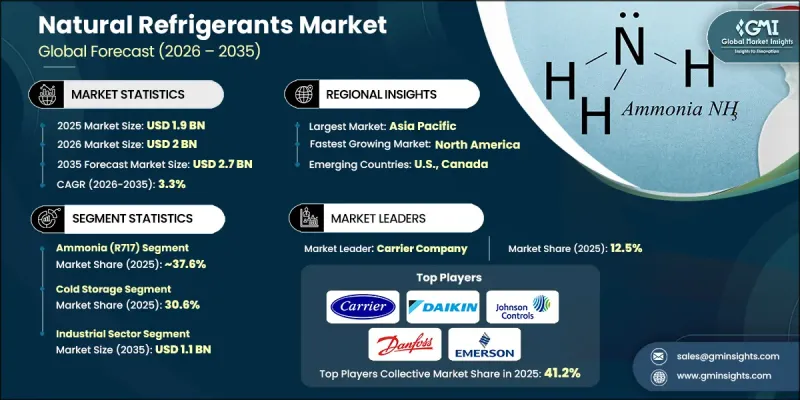
全球天然冷媒產業正穩步從以合規為導向的產業轉型為現代冷凍系統設計的核心要素。這項轉變的驅動力來自更清晰的法規結構、對節能技術日益成長的需求以及對永續性目標的日益重視。隨著各組織將長期環境相容性和營運效率置於優先地位,天然冷媒正從系統設計的初始階段就被納入考慮。系統工程的持續改進提高了可靠性,降低了運作風險,並促進了其在各個終端應用領域的廣泛應用。系統配置和監控技術的進步有助於實現更安全、更有效率的運行,並有助於解決初期部署階段的擔憂。隨著各行業向環保實踐轉型,天然冷媒正成為下一代冷凍解決方案的首選,從而推動了其在全球市場的穩步擴張。
| 市場範圍 | |
|---|---|
| 開始年份 | 2025 |
| 預測期 | 2026-2035 |
| 上市時的市場規模 | 19億美元 |
| 預測金額 | 27億美元 |
| 複合年成長率 | 3.3% |
技術進步顯著提升了天然冷媒在冷凍冷卻系統中的實用性。改進的系統設計、增強的安全機制和先進的監測能力,提高了運作性能並降低了潛在風險。這些進步簡化了安裝流程,縮小了系統面積,並簡化了對不斷更新的安全標準的遵守,從而進一步加速了天然冷媒在商業和工業應用中的普及。
預計到 2025 年,氨(R717)冷媒市場佔有率將達到 37.6%,到 2035 年將以 2.5% 的複合年成長率成長。該冷媒領域之所以能夠繼續主導地位,是因為其在大規模製冷應用中的成熟地位,以及各行業對可靠高效製冷解決方案的穩定需求。
預計到2026年,暖通空調(HVAC)市場規模將達到3.089億美元,但其整體市佔率預計將會下降。市場擴張日益受到新興和專業應用領域的驅動,這些領域需要客製化的系統設計和基礎設施投資。這些領域的成長仍然較為緩慢,並且很大程度上依賴於每個專案的可行性和技術適應性。
預計2026年至2035年,北美天然冷媒市場將以3.7%的複合年成長率成長。該地區市場環境成熟且穩定發展,其促進因素包括監管機構為減少高全球暖化潛勢(GWP)冷媒的使用而採取的措施,以及對替代解決方案日益成長的需求。商業和工業領域的廣泛應用,以及小規模應用領域滲透率的不斷提高,都支撐了市場需求。此外,能源效率標準和環境因素也持續影響消費者的購買決策。
目錄
第1章:調查方法和範圍
第2章執行摘要
第3章業界考察
- 生態系分析
- 供應商情況
- 利潤率
- 每個階段增加的價值
- 影響價值鏈的因素
- 中斷
- 影響產業的因素
- 促進因素
- 全球向低全球暖化潛勢冷媒轉型
- 降低整個生命週期的能源成本
- ESG與品牌差異化
- 產業潛在風險與挑戰
- 初始資本投資和維修的複雜性
- 安全、標準和培訓差距
- 供應鍊和零件供應情況
- 市場機遇
- 低灌裝量系統和包裝系統
- 數位控制和熱回收
- 擴大低溫運輸和資料中心
- 促進因素
- 成長潛力分析
- 監理情勢
- 北美洲
- 歐洲
- 亞太地區
- 拉丁美洲
- 中東和非洲
- 波特的分析
- PESTEL 分析
- 價格趨勢
- 按地區
- 依冷媒類型
- 未來市場趨勢
- 科技與創新趨勢
- 當前技術趨勢
- 新興技術
- 專利趨勢
- 貿易統計(HS編碼)
- 主要進口國
- 主要出口國
- 永續性和環境方面
- 永續計劃
- 減少廢棄物策略
- 生產中的能源效率
- 環保意識的舉措
第4章 競爭情勢
- 介紹
- 企業市佔率分析
- 按地區
- 北美洲
- 歐洲
- 亞太地區
- 拉丁美洲
- 中東和非洲
- 按地區
- 企業矩陣分析
- 主要市場公司的競爭分析
- 競爭定位矩陣
- 主要進展
- 併購
- 夥伴關係與合作
- 新產品發布
- 業務拓展計劃
第5章 市場估算與預測:依冷媒類型分類,2022-2035年
- 二氧化碳(CO2/R744)
- 氨(R717)
- 碳氫化合物
- 水(R718)
- 航空(R729)
第6章 市場估計與預測:依應用領域分類,2022-2035年
- 冷藏倉庫
- 冷凍庫
- 食品加工
- 空調
- 其他
第7章 市場估計與預測:依最終用途分類,2022-2035年
- 工業部門
- 商業領域
- 住宅部門
- 公共產業和基礎設施部門
第8章 市場估計與預測:依地區分類,2022-2035年
- 北美洲
- 美國
- 加拿大
- 歐洲
- 德國
- 英國
- 法國
- 西班牙
- 義大利
- 其他歐洲地區
- 亞太地區
- 中國
- 印度
- 日本
- 澳洲
- 韓國
- 亞太其他地區
- 拉丁美洲
- 巴西
- 墨西哥
- 阿根廷
- 其他拉丁美洲地區
- 中東和非洲
- 沙烏地阿拉伯
- 南非
- 阿拉伯聯合大公國
- 其他中東和非洲地區
第9章:公司簡介
- Carrier Corporation
- Daikin Industries
- Johnson Controls
- Danfoss
- Emerson
- Gree
- Midea
- LG
- Samsung
- A-Gas International
- Linde plc
- Air Liquide
- Honeywell
The Global Natural Refrigerants Market was valued at USD 1.9 billion in 2025 and is estimated to grow at a CAGR of 3.3% to reach USD 2.7 billion by 2035.
The global natural refrigerants industry is steadily transitioning from a compliance-driven segment into a core component of modern cooling and refrigeration system design. This shift is being supported by clear regulatory frameworks, rising demand for energy-efficient technologies, and increasing emphasis on sustainability objectives. Natural refrigerants are now being incorporated at the initial design stage of systems as organizations prioritize long-term environmental alignment and operational efficiency. Continuous improvements in system engineering are enhancing reliability, reducing operational risks, and enabling broader adoption across various end-use sectors. Advancements in system configurations and monitoring technologies are contributing to safer, more efficient operations, helping address earlier implementation-related concerns. As industries move toward environmentally responsible practices, natural refrigerants are becoming a preferred choice for next-generation cooling solutions, supporting consistent market expansion across global regions.
| Market Scope | |
|---|---|
| Start Year | 2025 |
| Forecast Year | 2026-2035 |
| Start Value | $1.9 Billion |
| Forecast Value | $2.7 Billion |
| CAGR | 3.3% |
Technological progress has significantly improved the practicality of natural refrigerants in refrigeration and cooling systems. Enhanced system designs, improved safety mechanisms, and advanced monitoring capabilities have strengthened operational performance and reduced perceived risks. These developments have streamlined installation processes, minimized system footprint, and simplified compliance with evolving safety standards, further accelerating adoption across commercial and industrial applications.
The ammonia (R717) segment accounted for 37.6% share in 2025 and is expected to grow at a CAGR of 2.5% through 2035. This segment continues to lead due to its established role in large-scale refrigeration applications and its consistent demand across industries that require reliable and efficient cooling solutions.
The air conditioning segment is projected to reach USD 308.9 million in 2026, although its overall share is expected to decline over time. Market expansion is increasingly being supported by emerging and specialized applications that require tailored system designs and infrastructure investments. Growth in these areas remains gradual and highly dependent on project-specific feasibility and technological adaptability.
North America Natural Refrigerants Market is anticipated to grow at a CAGR of 3.7% during 2026 to 2035. The region reflects a mature yet steadily advancing market environment, driven by regulatory efforts to reduce high global warming potential refrigerants and a growing need for replacement solutions. Demand is supported by widespread adoption across commercial and industrial sectors, along with increasing penetration in smaller-scale applications as efficiency standards and environmental considerations continue to influence purchasing decisions.
Key companies operating in the Global Natural Refrigerants Market include Daikin Industries, Carrier Corporation, Emerson, Danfoss, Johnson Controls, LG, Samsung, Midea, Gree, Honeywell, Linde plc, Air Liquide, and A-Gas International. Companies in the Natural Refrigerants Market are adopting strategic measures to strengthen their market presence and enhance competitive advantage. A strong emphasis is being placed on research and development to improve system efficiency, safety, and compatibility with evolving regulatory standards. Organizations are investing in advanced technologies to optimize product performance and reduce environmental impact. Strategic collaborations and partnerships are being pursued to expand technological capabilities and global reach. Companies are also focusing on expanding production capacities and strengthening distribution networks to meet rising demand across regions. Additionally, efforts are being directed toward product innovation and portfolio diversification to address a wider range of applications. Mergers and acquisitions are further enabling firms to gain market access, improve operational efficiency, and reinforce their long-term growth strategies.
Table of Contents
Chapter 1 Methodology & Scope
- 1.1 Research approach
- 1.2 Quality Commitments
- 1.2.1 GMI AI policy & data integrity commitment
- 1.2.1.1 Source consistency protocol
- 1.2.1 GMI AI policy & data integrity commitment
- 1.3 Research Trail & Confidence Scoring
- 1.3.1 Research Trail Components
- 1.3.2 Scoring Components
- 1.4 Data Collection
- 1.4.1 Partial list of primary sources
- 1.5 Data mining sources
- 1.5.1 Paid sources
- 1.5.1.1 Sources, by region
- 1.5.1 Paid sources
- 1.6 Base estimates and calculations
- 1.6.1 Base year calculation for any one approach
- 1.7 Forecast model
- 1.7.1 Quantified market impact analysis
- 1.7.1.1 Mathematical impact of growth parameters on forecast
- 1.7.1 Quantified market impact analysis
- 1.8 Research transparency addendum
- 1.8.1 Source attribution framework
- 1.8.2 Quality assurance metrics
- 1.8.3 Our commitment to trust
Chapter 2 Executive Summary
- 2.1 Industry 360° synopsis
- 2.2 Key market trends
- 2.2.1 Regional
- 2.2.2 Refrigerant Type
- 2.2.3 Application
- 2.2.4 End Use
- 2.3 TAM Analysis, 2025-2034
- 2.4 CXO perspectives: Strategic imperatives
Chapter 3 Industry Insights
- 3.1 Industry ecosystem analysis
- 3.1.1 Supplier landscape
- 3.1.2 Profit margin
- 3.1.3 Value addition at each stage
- 3.1.4 Factor affecting the value chain
- 3.1.5 Disruptions
- 3.2 Industry impact forces
- 3.2.1 Growth drivers
- 3.2.1.1 Global shift to low-GWP refrigeration
- 3.2.1.2 Lifecycle energy-cost reductions
- 3.2.1.3 ESG and brand differentiation
- 3.2.2 Industry pitfalls and challenges
- 3.2.2.1 Upfront capex and retrofit complexity
- 3.2.2.2 Safety, codes, and training gaps
- 3.2.2.3 Supply chain and parts availability
- 3.2.3 Market opportunities
- 3.2.3.1 Low-charge and packaged systems
- 3.2.3.2 Digital controls and heat recovery
- 3.2.3.3 Expanding cold-chain and data centers
- 3.2.1 Growth drivers
- 3.3 Growth potential analysis
- 3.4 Regulatory landscape
- 3.4.1 North America
- 3.4.2 Europe
- 3.4.3 Asia Pacific
- 3.4.4 Latin America
- 3.4.5 Middle East & Africa
- 3.5 Porter’s analysis
- 3.6 PESTEL analysis
- 3.7 Price trends
- 3.7.1 By region
- 3.7.2 By refrigerant type
- 3.8 Future market trends
- 3.9 Technology and Innovation landscape
- 3.9.1 Current technological trends
- 3.9.2 Emerging technologies
- 3.10 Patent Landscape
- 3.11 Trade statistics (HS code)
- 3.11.1 Major importing countries
- 3.11.2 Major exporting countries
- 3.12 Sustainability and environmental aspects
- 3.12.1 Sustainable practices
- 3.12.2 Waste reduction strategies
- 3.12.3 Energy efficiency in production
- 3.12.4 Eco-friendly initiatives
Chapter 4 Competitive Landscape, 2025
- 4.1 Introduction
- 4.2 Company market share analysis
- 4.2.1 By region
- 4.2.1.1 North America
- 4.2.1.2 Europe
- 4.2.1.3 Asia Pacific
- 4.2.1.4 LATAM
- 4.2.1.5 MEA
- 4.2.1 By region
- 4.3 Company matrix analysis
- 4.4 Competitive analysis of major market players
- 4.5 Competitive positioning matrix
- 4.6 Key developments
- 4.6.1 Mergers & acquisitions
- 4.6.2 Partnerships & collaborations
- 4.6.3 New Product Launches
- 4.6.4 Expansion Plans
Chapter 5 Market Estimates and Forecast, By Refrigerant Type, 2022-2035 (USD Million) (Kilo Tons)
- 5.1 Key trends
- 5.2 Carbon Dioxide (CO2/R744)
- 5.3 Ammonia (R717)
- 5.4 Hydrocarbons
- 5.5 Water (R718)
- 5.6 Air (R729)
Chapter 6 Market Estimates and Forecast, By Application, 2022-2035 (USD Million) (Kilo Tons)
- 6.1 Key trends
- 6.2 Cold storage
- 6.3 Freezers
- 6.4 Food processing
- 6.5 Air conditioners
- 6.6 Others
Chapter 7 Market Estimates and Forecast, By End Use, 2022-2035 (USD Million) (Kilo Tons)
- 7.1 Key trends
- 7.2 Industrial Sector
- 7.3 Commercial Sector
- 7.4 Residential Sector
- 7.5 Utility and Infrastructure Sector
Chapter 8 Market Estimates and Forecast, By Region, 2022-2035 (USD Million) (Kilo Tons)
- 8.1 Key trends
- 8.2 North America
- 8.2.1 U.S.
- 8.2.2 Canada
- 8.3 Europe
- 8.3.1 Germany
- 8.3.2 UK
- 8.3.3 France
- 8.3.4 Spain
- 8.3.5 Italy
- 8.3.6 Rest of Europe
- 8.4 Asia Pacific
- 8.4.1 China
- 8.4.2 India
- 8.4.3 Japan
- 8.4.4 Australia
- 8.4.5 South Korea
- 8.4.6 Rest of Asia Pacific
- 8.5 Latin America
- 8.5.1 Brazil
- 8.5.2 Mexico
- 8.5.3 Argentina
- 8.5.4 Rest of Latin America
- 8.6 Middle East and Africa
- 8.6.1 Saudi Arabia
- 8.6.2 South Africa
- 8.6.3 UAE
- 8.6.4 Rest of Middle East and Africa
Chapter 9 Company Profiles
- 9.1 Carrier Corporation
- 9.2 Daikin Industries
- 9.3 Johnson Controls
- 9.4 Danfoss
- 9.5 Emerson
- 9.6 Gree
- 9.7 Midea
- 9.8 LG
- 9.9 Samsung
- 9.10 A-Gas International
- 9.11 Linde plc
- 9.12 Air Liquide
- 9.13 Honeywell

 天然冷媒市場:按類型、應用和地區分類-全球預測至2031年
 全球天然冷媒市場規模、佔有率、趨勢和成長分析報告(2026-2034年)
 天然冷媒全球市場報告(2026 年)
 天然冷媒市場-全球產業規模、佔有率、趨勢、機會、預測:按氣體類型、應用、地區和競爭對手分類,2021-2031年
 天然冷媒市場規模、佔有率及成長分析(按類型、應用、最終用途和地區分類)-產業預測,2026-2033年
 不含 PFAS 的冷媒:全球市場佔有率和排名、總收入和需求預測(2025-2031 年)
 2033 年天然冷媒市場分析及預測:依類型、產品、應用、最終用戶、技術、組件、安裝類型、設備
 天然冷媒市場:成長、未來展望與競爭分析(2025-2033)