


 |
市場調查報告書
商品編碼
2027542
大豆分離蛋白市場機會、成長促進因素、產業趨勢分析及預測(2026-2035年)Soy Protein Isolate Market Opportunity, Growth Drivers, Industry Trend Analysis, and Forecast 2026 - 2035 |
||||||

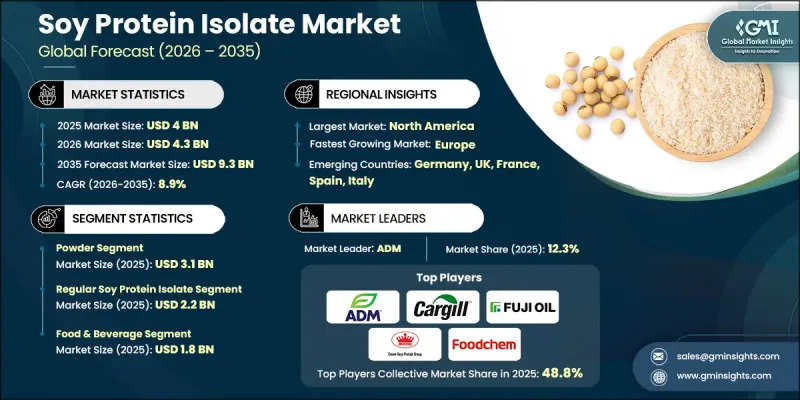
預計到 2025 年,全球大豆分離蛋白市場價值將達到 40 億美元,並預計以 8.9% 的複合年成長率成長,到 2035 年達到 93 億美元。
大豆分離蛋白採用先進的純化工藝,以脫脂大豆片為原料生產,是一種高濃度、低脂肪和低碳水化合物的蛋白質來源。其風味中性,功能特性優異,可廣泛應用於各種產品中,且不會顯著影響產品的口感或質地。本產品主要用作生產過程中的功能性配料,不直接銷售給終端消費者。市場動態受產業相關人員之間的大量採購、技術規範和長期供應合約的影響。加工技術的不斷進步,包括萃取、純化和乾燥技術的改進,提高了產品的品質、穩定性和溶解度。這些創新也有助於減少不良風味特徵,同時提升其在各種應用中的表現。因此,由於其用途廣泛且能夠支持產品創新,大豆分離蛋白正被擴大應用於各個領域。
| 市場範圍 | |
|---|---|
| 開始年份 | 2025 |
| 預測期 | 2026-2035 |
| 起始金額 | 40億美元 |
| 預測金額 | 93億美元 |
| 複合年成長率 | 8.9% |
預計2025年,粉狀大豆分離蛋白市場規模將達到31億美元,成為大豆分離蛋白市場的主導形式。其廣泛應用得益於諸多優勢,例如易於儲存、保存期限長以及與乾混製程的兼容性。製造商更青睞粉狀產品,因為其配方柔軟性、便於運輸,並且能夠在各種生產環境中實現精準施用。
預計到2025年,食品飲料產業將創造18億美元的市場規模,成為最大的應用領域。大豆分離蛋白因其能夠提升營養價值並改善各種加工食品和強化產品的功能性,而被廣泛應用於該領域。
預計北美大豆分離蛋白市場規模將從2025年的14億美元成長到2035年的34億美元。該地區的成長主要得益於成熟的食品生產系統和對營養產品的穩定需求。美國憑藉著穩定的消費模式和成熟的供應鏈基礎設施(支持產品開發和大規模生產),繼續發揮核心作用。
目錄
第1章:調查方法和範圍
第2章執行摘要
第3章業界考察
- 產業生態系分析
- 供應商情況
- 利潤率
- 每個階段增加的價值
- 影響價值鏈的因素
- 中斷
- 影響產業的因素
- 成長促進因素
- 水產品需求的不斷成長帶動了大豆分離蛋白的消費。
- 現代水產養殖技術可提高生長速度和抗病能力。
- 支持長期生產的永續農業
- 潛在風險和挑戰
- 水污染對貝類健康有負面影響
- 過度捕撈導致野生族群數量減少。
- 機會
- 生態旅遊和貝類節
- 利用生物技術提高產量和品質
- 成長促進因素
- 成長潛力分析
- 監理情勢
- 北美洲
- 歐洲
- 亞太地區
- 拉丁美洲
- 中東和非洲
- 波特的分析
- PESTEL 分析
- 科技與創新趨勢
- 當前技術趨勢
- 新興技術
- 價格趨勢
- 按地區
- 依產品類型
- 未來市場趨勢
- 科技與創新趨勢
- 當前技術趨勢
- 新興技術
- 專利趨勢
- 貿易統計(HS編碼)
- 主要進口國
- 主要出口國
- 永續性和環境方面
- 永續計劃
- 減少廢棄物策略
- 生產中的能源效率
- 環保意識的舉措
- 考慮碳足跡
第4章 競爭情勢
- 介紹
- 企業市佔率分析
- 按地區
- 北美洲
- 歐洲
- 亞太地區
- 拉丁美洲
- 中東和非洲
- 按地區
- 企業矩陣分析
- 主要市場公司的競爭分析
- 競爭定位矩陣
- 主要進展
- 併購
- 夥伴關係與合作
- 新產品發布
- 業務拓展計劃
第5章 市場估計與預測:依類型分類,2022-2035年
- 粉末
- 液體
第6章 市場估算與預測:依產品類型分類,2022-2035年
- 普通大豆分離蛋白
- 有機大豆分離蛋白
- 組織化大豆分離蛋白
- 大豆蛋白水解物
第7章 市場估計與預測:依應用領域分類,2022-2035年
- 食品/飲料
- 營養補充品
- 製藥
- 化妝品和個人保健產品
- 動物飼料
- 其他
第8章 市場估計與預測:依地區分類,2022-2035年
- 北美洲
- 美國
- 加拿大
- 歐洲
- 德國
- 英國
- 法國
- 西班牙
- 義大利
- 其他歐洲地區
- 亞太地區
- 中國
- 印度
- 日本
- 澳洲
- 韓國
- 亞太其他地區
- 拉丁美洲
- 巴西
- 墨西哥
- 阿根廷
- 其他拉丁美洲地區
- 中東和非洲
- 沙烏地阿拉伯
- 南非
- 阿拉伯聯合大公國
- 其他中東和非洲地區
第9章:公司簡介
- ADM
- Cargill
- Crown Soya Protein Group Company
- ETChem的
- Farbest Brands
- Foodchem International Corporation
- FUJI OIL HOLDINGS INC
- Taj Agro International(Taj Pharma Group)
- Titan Biotech Limited
- Xi'an Healthful Biotechnology Co.,Ltd
The Global Soy Protein Isolate Market was valued at USD 4 billion in 2025 and is estimated to grow at a CAGR of 8.9% to reach USD 9.3 billion by 2035.
Soy protein isolate is produced through an advanced refining process using defatted soybean flakes, resulting in a highly concentrated protein ingredient with minimal fat and carbohydrate content. Its neutral flavor profile and strong functional characteristics make it widely suitable for incorporation into a broad range of formulations without significantly altering taste or texture. The product is primarily utilized as a functional ingredient within manufacturing processes rather than being directly marketed to end consumers. Market dynamics are shaped by bulk purchasing practices, technical specifications, and long-term supply agreements among industry participants. Continuous advancements in processing technologies, including improvements in extraction, purification, and drying techniques, have enhanced product quality, stability, and solubility. These innovations also help reduce undesirable flavor characteristics while improving performance across applications. As a result, soy protein isolate is increasingly being adopted in various sectors due to its versatility and ability to support product innovation.
| Market Scope | |
|---|---|
| Start Year | 2025 |
| Forecast Year | 2026-2035 |
| Start Value | $4 Billion |
| Forecast Value | $9.3 Billion |
| CAGR | 8.9% |
The powder segment accounted for USD 3.1 billion in 2025, making it the leading form in the soy protein isolate market. Its widespread use is driven by advantages such as convenient storage, longer shelf life, and compatibility with dry blending processes. Manufacturers prefer powdered formats due to their flexibility in formulation, ease of transportation, and ability to support precise application across different production environments.
The food & beverage segment generated USD 1.8 billion in 2025, representing the largest application area. Soy protein isolate is extensively utilized in this segment for its ability to enhance nutritional profiles and improve functional performance in a variety of processed and fortified products.
North America Soy Protein Isolate Market is projected to grow from USD 1.4 billion in 2025 to USD 3.4 billion by 2035. Growth in the region is supported by well-established food manufacturing systems and consistent demand for nutrition-focused products. The United States continues to play a central role, driven by steady consumption patterns and mature supply chain infrastructure that supports product development and large-scale production.
Key companies operating in the Soy Protein Isolate Market include Cargill, ADM, FUJI OIL HOLDINGS INC, Crown Soya Protein Group Company, Farbest Brands, Foodchem International Corporation, Taj Agro International, Titan Biotech Limited, Xi'an Healthful Biotechnology Co., Ltd, and ETChem. Companies in the Soy Protein Isolate Market are strengthening their competitive position by investing in advanced processing technologies and expanding their product portfolios. Many players are focusing on improving protein quality, solubility, and functionality to meet evolving industry requirements. Strategic partnerships and long-term supply agreements are being leveraged to secure consistent demand and enhance market reach. Firms are also expanding into emerging markets to capture new growth opportunities while optimizing their distribution networks. Additionally, increasing emphasis on research and development is enabling companies to create customized solutions for diverse applications, helping them build strong customer relationships and maintain a competitive edge in the market.
Table of Contents
Chapter 1 Methodology & Scope
- 1.1 Market scope and definition
- 1.2 Research design
- 1.2.1 Research approach
- 1.2.2 Data collection methods
- 1.3 Data mining sources
- 1.3.1 Global
- 1.3.2 Regional/Country
- 1.4 Base estimates and calculations
- 1.4.1 Base year calculation
- 1.4.2 Key trends for market estimation
- 1.5 Primary research and validation
- 1.5.1 Primary sources
- 1.6 Forecast model
- 1.7 Research assumptions and limitations
Chapter 2 Executive Summary
- 2.1 Industry 360° synopsis
- 2.2 Key market trends
- 2.2.1 Form
- 2.2.2 Product Type
- 2.2.3 Application
- 2.2.4 Regional
- 2.3 TAM Analysis, 2026-2035
- 2.4 CXO perspectives: Strategic imperatives
- 2.5 Future outlook and strategic recommendations
Chapter 3 Industry Insights
- 3.1 Industry ecosystem analysis
- 3.1.1 Supplier landscape
- 3.1.2 Profit margin
- 3.1.3 Value addition at each stage
- 3.1.4 Factor affecting the value chain
- 3.1.5 Disruptions
- 3.2 Industry impact forces
- 3.2.1 Growth drivers
- 3.2.1.1 Rising demand for seafood boosts soy protein isolate consumption
- 3.2.1.2 Modern aquaculture improves growth and disease resistance
- 3.2.1.3 Sustainable farming supports long-term production
- 3.2.2 Pitfalls/challenge
- 3.2.2.1 Water pollution harms shellfish health
- 3.2.2.2 Overharvesting reduces wild populations
- 3.2.3 Opportunities
- 3.2.3.1 Eco-tourism and shellfish festivals
- 3.2.3.2 Biotechnology enhances yield and quality
- 3.2.1 Growth drivers
- 3.3 Growth potential analysis
- 3.4 Regulatory landscape
- 3.4.1 North America
- 3.4.2 Europe
- 3.4.3 Asia Pacific
- 3.4.4 Latin America
- 3.4.5 Middle East & Africa
- 3.5 Porter’s analysis
- 3.6 PESTEL analysis
- 3.7 Technology and innovation landscape
- 3.7.1 Current technological trends
- 3.7.2 Emerging technologies
- 3.8 Price trends
- 3.8.1 By region
- 3.8.2 By product type
- 3.9 Future market trends
- 3.10 Technology and innovation landscape
- 3.10.1 Current technological trends
- 3.10.2 Emerging technologies
- 3.11 Patent landscape
- 3.12 Trade statistics (HS code)
- 3.12.1 Major importing countries
- 3.12.2 Major exporting countries
- 3.13 Sustainability and environmental aspects
- 3.13.1 Sustainable practices
- 3.13.2 Waste reduction strategies
- 3.13.3 Energy efficiency in production
- 3.13.4 Eco-friendly initiatives
- 3.14 Carbon footprint consideration
Chapter 4 Competitive Landscape, 2025
- 4.1 Introduction
- 4.2 Company market share analysis
- 4.2.1 By region
- 4.2.1.1 North America
- 4.2.1.2 Europe
- 4.2.1.3 Asia Pacific
- 4.2.1.4 LATAM
- 4.2.1.5 MEA
- 4.2.1 By region
- 4.3 Company matrix analysis
- 4.4 Competitive analysis of major market players
- 4.5 Competitive positioning matrix
- 4.6 Key developments
- 4.6.1 Mergers & acquisitions
- 4.6.2 Partnerships & collaborations
- 4.6.3 New product launches
- 4.6.4 Expansion plans
Chapter 5 Market Estimates and Forecast, By Form, 2022-2035 (USD Billion) (Kilo Tons)
- 5.1 Key trends
- 5.2 Powder
- 5.3 Liquid
Chapter 6 Market Estimates and Forecast, By Product Type, 2022-2035 (USD Billion) (Kilo Tons)
- 6.1 Key trends
- 6.2 Regular soy protein isolate
- 6.3 Organic soy protein isolate
- 6.4 Textured soy protein isolate
- 6.5 Soy protein hydrolysate
Chapter 7 Market Estimates and Forecast, By Application, 2022-2035 (USD Billion) (Kilo Tons)
- 7.1 Key trends
- 7.2 Food & beverage
- 7.3 Nutritional supplements
- 7.4 Pharmaceuticals
- 7.5 Cosmetics & personal care products
- 7.6 Animal feed
- 7.7 Others
Chapter 8 Market Estimates and Forecast, By Region, 2022-2035 (USD Billion) (Kilo Tons)
- 8.1 Key trends
- 8.2 North America
- 8.2.1 U.S.
- 8.2.2 Canada
- 8.3 Europe
- 8.3.1 Germany
- 8.3.2 UK
- 8.3.3 France
- 8.3.4 Spain
- 8.3.5 Italy
- 8.3.6 Rest of Europe
- 8.4 Asia Pacific
- 8.4.1 China
- 8.4.2 India
- 8.4.3 Japan
- 8.4.4 Australia
- 8.4.5 South Korea
- 8.4.6 Rest of Asia Pacific
- 8.5 Latin America
- 8.5.1 Brazil
- 8.5.2 Mexico
- 8.5.3 Argentina
- 8.5.4 Rest of Latin America
- 8.6 Middle East and Africa
- 8.6.1 Saudi Arabia
- 8.6.2 South Africa
- 8.6.3 UAE
- 8.6.4 Rest of Middle East and Africa
Chapter 9 Company Profiles
- 9.1 ADM
- 9.2 Cargill
- 9.3 Crown Soya Protein Group Company
- 9.4 ETChem’s
- 9.5 Farbest Brands
- 9.6 Foodchem International Corporation
- 9.7 FUJI OIL HOLDINGS INC
- 9.8 Taj Agro International (Taj Pharma Group)
- 9.9 Titan Biotech Limited
- 9.10 Xi'an Healthful Biotechnology Co.,Ltd


