

 |
市場調查報告書
商品編碼
2027528
古董和收藏品市場機會、成長促進因素、產業趨勢分析與預測(2026-2035年)Antiques and Collectibles Market Opportunity, Growth Drivers, Industry Trend Analysis, and Forecast 2026 - 2035 |
||||||

據估計,到 2025 年,全球古董和收藏品市場價值將達到 1,502 億美元,並以 4.4% 的複合年成長率成長,到 2035 年將達到 2,297 億美元。
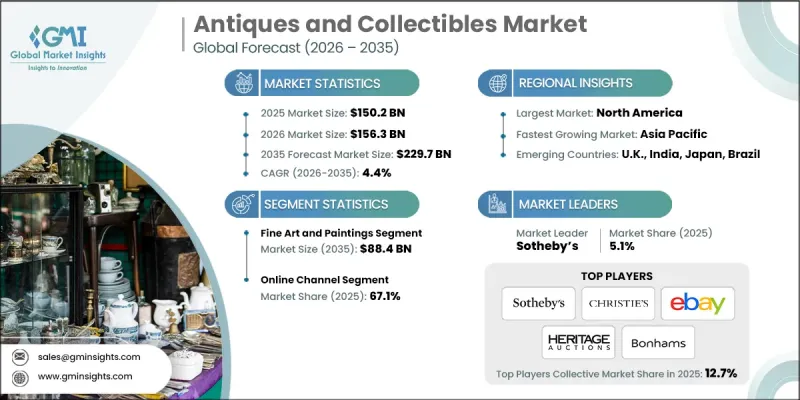
這一成長是由投資策略的結構性轉變所驅動的。高價值有形資產作為多元化投資組合的一部分,正日益受到關注。投資人積極尋求能夠抵禦市場波動和通貨膨脹的另類資產,而收藏品被視為一種穩定的價值儲存手段。資產支持型投資日益成長的吸引力也得益於其稀缺性和獲取難度,這增強了其長期增值的潛力。此外,人們日益增強的所有權意識,尤其是對傳承的重視,推動了對能夠體現個人身分和文化意義的物品的收藏。同時,由於經認證的高價值物品供應有限,而全球需求持續成長,供應限制進一步影響市場動態。這種供需失衡是維持價格上漲並強化收藏品作為全球金融生態系統中高階投資工具的認知的重要因素。
| 市場範圍 | |
|---|---|
| 開始年份 | 2025 |
| 預測期 | 2026-2035 |
| 起始金額 | 1502億美元 |
| 預測金額 | 2297億美元 |
| 複合年成長率 | 4.4% |
基於興趣的投資方式日益盛行,對古董和收藏品市場產生了重大影響。買家越來越重視稀有物品的歷史、文化和情感價值,這往往導致價格形成超出傳統估值框架。收藏家們越來越注重建構能夠體現個人聲望和長期傳承的投資組合,在投資決策中融入了非貨幣因素。同時,隨著檢驗的高品質收藏日益稀缺,買家之間的競爭也愈發激烈。隨著更多珍貴藏品成為機構的永久資產,私人藏品的數量持續減少,進一步推高了價格,並增強了全球市場的需求。
預計2025年,美術及繪畫品類市場規模將達599億美元,2035年將達884億美元。憑藉其強勁的歷史表現和作為高價值資產類別的全球認可度,該品類仍然是古董和收藏品市場中最具影響力的類別。美術品價格長期穩定上漲,被廣泛認為是可靠的長期資產轉移方式。其普世魅力超越了地理和文化界限,使其成為尋求經濟回報和文化意義的收藏家和投資者的首選。市場的深度和對高品質作品的持續需求進一步鞏固了美術品作為收藏品產業基石的地位。
預計到2025年,線上通路將佔據全球古董和收藏品市場67.1%的佔有率,凸顯了該產業數位轉型的快速步伐。數位平台透過讓買賣雙方能夠更便捷、透明地跨越地域界限進行交易,從而拓展了市場准入。先進技術的整合提升了交易效率、鑑定流程和價格發現機制。因此,線上管道吸引了更廣泛的客戶群,包括新舊收藏家,同時也促進了交易量和市場流動性的成長。
預計到2025年,美國古董和收藏品市場將佔據79.7%的市場佔有率,這得益於其龐大的收藏群體、強大的購買力以及人們對具有歷史意義的資產的長期重視。高度發展的市場基礎設施,加上透明的定價和評估標準,增強了買家的信心,並推動了市場的持續活躍。數位平台的日益普及進一步擴大了市場參與度,使更多類型的買家能夠參與其中。人們對替代投資的興趣日益濃厚,以及世代資產轉移和精通數位技術的消費者參與度的提高,持續推動全部區域的市場成長。
目錄
第1章:調查方法和範圍
第2章執行摘要
第3章業界考察
- 產業生態系分析
- 供應商情況
- 利潤率
- 每個階段增加的價值
- 影響價值鏈的因素
- 影響產業的因素
- 成長促進因素
- 人們對藝術和歷史的興趣日益濃厚。
- 文化和歷史吸引力
- 古董和收藏品的潛在投資機會
- 產業潛在風險與挑戰
- 關於真實性和來源的問題
- 監管和法律挑戰
- 機會
- 線上市場的擴張
- 促進文化旅遊和遺產
- 成長促進因素
- 成長潛力分析
- 未來市場趨勢
- 科技與創新趨勢
- 當前技術趨勢
- 新興技術
- 監理情勢
- 標準和合規要求
- 區域法規結構
- 認證標準
- 貿易數據分析
- 進出口量及進口額趨勢
- 主要貿易走廊及關稅的影響
- 人工智慧和生成式人工智慧對市場的影響
- 利用人工智慧改造現有經營模式
- 針對特定領域的生成式人工智慧應用案例和實施藍圖
- 風險、限制和監管考量
- 波特五力分析
- PESTEL 分析
- 消費行為分析
- 購買模式
- 偏好分析
- 不同地區的消費行為差異
- 電子商務對購買決策的影響
第4章 競爭情勢
- 介紹
- 企業市佔率分析
- 按地區
- 企業矩陣分析
- 主要市場公司的競爭分析
- 競爭定位矩陣
- 主要進展
- 併購
- 夥伴關係與合作
- 新產品發布
- 業務拓展計劃
第5章 市場估算與預測:依產品類型,2022-2035年
- 美術和繪畫
- 古董家具和裝飾藝術品
- 金屬製品及雕塑
- 珠寶和手錶
- 收藏玩具和遊戲
- 書籍、手稿和紙本原始資料
- 硬幣、紙幣、錢幣學
- 體育紀念品和交易卡
- 樂器及音響設備
- 其他(與汽車和交通運輸相關的收藏品)
第6章 市場估計與預測:依價格分類,2022-2035年
- 價格低廉(低於 1000 美元)
- 中價位(1,000 美元至 50,000 美元)
- 高價位(超過 50,000 美元)
第7章 市場估計與預測:依最終用途分類,2022-2035年
- 個人
- 商業的
- 博物館
- 設施
- 其他
第8章 市場估算與預測:依通路分類,2022-2035年
- 線上
- 電子商務
- 企業網站
- 離線
- 超級市場/大賣場
- 專賣店
- 其他(個體店、百貨公司等)
第9章 市場估計與預測:依地區分類,2022-2035年
- 北美洲
- 美國
- 加拿大
- 歐洲
- 德國
- 法國
- 英國
- 義大利
- 西班牙
- 亞太地區
- 中國
- 印度
- 日本
- 韓國
- 澳洲
- 拉丁美洲
- 巴西
- 墨西哥
- 阿根廷
- 中東和非洲(MEA)
- 南非
- 沙烏地阿拉伯
- 阿拉伯聯合大公國
第10章:公司簡介
- Bonhams
- Christie's International
- ComicLink
- eBay
- Goldin Auctions
- Hake's Americana & Collectibles
- Heritage Auctions
- Invaluable
- Julien's Auctions
- Lelands
- LiveAuctioneers
- PWCC Marketplace
- RR Auction
- Sotheby's
- Stanley Gibbons Group
The Global Antiques and Collectibles Market was valued at USD 150.2 billion in 2025 and is estimated to grow at a CAGR of 4.4% to reach USD 229.7 billion by 2035.
The growth is driven by a structural transition in investment strategies, where high-value physical assets are gaining prominence as part of diversified portfolios. Investors are actively seeking alternatives that offer resilience against market volatility and inflation, positioning collectibles as a stable store of value. The rising appeal of asset-backed investments is also supported by their exclusivity and limited availability, which enhances their long-term appreciation potential. In addition, the growing influence of legacy-driven ownership is encouraging individuals to acquire items that reflect personal identity and cultural significance. Market dynamics are further shaped by constrained supply, as the availability of authenticated, high-value items remains limited while global demand continues to rise. This imbalance is contributing to sustained price growth and reinforcing the perception of collectibles as premium investment instruments within the global financial ecosystem.
| Market Scope | |
|---|---|
| Start Year | 2025 |
| Forecast Year | 2026-2035 |
| Start Value | $150.2 Billion |
| Forecast Value | $229.7 Billion |
| CAGR | 4.4% |
The increasing popularity of passion-driven investments is playing a critical role in shaping the antiques and collectibles market. Buyers are placing greater importance on the historical, cultural, and emotional value associated with rare items, which often drives pricing beyond conventional valuation frameworks. Collectors are increasingly focused on curating portfolios that reflect personal prestige and long-term legacy, adding a non-financial dimension to investment decisions. At the same time, the scarcity of verified, high-quality assets is intensifying competition among buyers. As more valuable pieces become part of permanent institutional holdings, the availability of privately owned items continues to decline, further supporting price appreciation and strengthening demand across global markets.
The fine art and paintings segment generated USD 59.9 billion in 2025 and is expected to reach USD 88.4 billion by 2035. This segment remains the most influential category within the antiques and collectibles market due to its strong historical performance and global recognition as a high-value asset class. Fine art is widely regarded as a reliable medium for long-term wealth transfer, supported by its proven track record of appreciation over time. Its universal appeal allows it to transcend geographic and cultural boundaries, making it a preferred choice among collectors and investors seeking both financial returns and cultural significance. The depth of the market and consistent demand for premium works further reinforce its position as a cornerstone of the collectibles industry.
The online distribution channel accounted for 67.1% of the global antiques and collectibles market share in 2025, highlighting the rapid digital transformation within the industry. Digital platforms are expanding market accessibility by enabling buyers and sellers to connect across regions with greater convenience and transparency. The integration of advanced technologies is improving transaction efficiency, authentication processes, and price discovery mechanisms. As a result, online channels are attracting a broader audience, including new and experienced collectors, while supporting higher transaction volumes and market liquidity.
United States Antiques and Collectibles Market held a 79.7% share in 2025 supported by a well-established collector base, strong purchasing power, and a long-standing appreciation for historically significant assets. A highly developed marketplace infrastructure, combined with transparent pricing and authentication standards, is reinforcing buyer confidence and driving sustained activity. The growing adoption of digital platforms is further expanding participation, allowing a wider range of buyers to engage with the market. Increasing interest in alternative investments, along with intergenerational wealth transfer and rising engagement from digitally connected consumers, continues to strengthen market growth across the region.
Key companies operating in the Global Antiques and Collectibles Market include Sotheby's, Christie's International, Heritage Auctions, Bonhams, eBay, Invaluable, LiveAuctioneers, Goldin Auctions, RR Auction, Lelands, PWCC Marketplace, ComicLink, Julien's Auctions, Hake's Americana & Collectibles, and Stanley Gibbons Group. Companies in the antiques and collectibles market are strengthening their competitive position through digital innovation, strategic partnerships, and enhanced customer engagement. Many firms are investing in advanced online platforms to improve accessibility, streamline transactions, and provide real-time market insights. Auction houses and marketplaces are expanding their global reach by leveraging technology-driven solutions such as virtual bidding and secure authentication systems. Strategic collaborations with collectors, institutions, and private sellers are helping companies access exclusive inventory and diversify their offerings. Additionally, businesses are focusing on building brand credibility through transparent pricing, provenance verification, and expert advisory services. Marketing strategies centered on storytelling and asset uniqueness are further enhancing customer interest.
Table of Contents
Chapter 1 Methodology & Scope
- 1.1 Research approach
- 1.2 Quality Commitments
- 1.3 GMI AI policy & data integrity commitment
- 1.3.1 Source consistency protocol
- 1.4 Research Trail & Confidence Scoring
- 1.4.1 Research Trail Components
- 1.4.2 Scoring Components
- 1.5 Data Collection
- 1.5.1 Partial list of primary sources
- 1.6 Data mining sources
- 1.7 Paid sources
- 1.7.1 Sources, by region
- 1.8 Base estimates and calculations
- 1.8.1 Base year calculation for any one approach
- 1.9 Forecast model
- 1.9.1 Quantified market impact analysis
- 1.9.1.1 Mathematical impact of growth parameters on forecast
- 1.9.1 Quantified market impact analysis
- 1.10 Research transparency addendum
- 1.10.1 Source attribution framework
- 1.10.2 Quality assurance metrics
- 1.10.3 Our commitment to trust
Chapter 2 Executive Summary
- 2.1 Industry 360° synopsis
- 2.2 Key market trends
- 2.2.1 Regional
- 2.2.2 Product Category
- 2.2.3 Price
- 2.2.4 End Use
- 2.2.5 Distribution Channel
Chapter 3 Industry Insights
- 3.1 Industry ecosystem analysis
- 3.1.1 Supplier landscape
- 3.1.2 Profit margin
- 3.1.3 Value addition at each stage
- 3.1.4 Factor affecting the value chain
- 3.2 Industry impact forces
- 3.2.1 Growth drivers
- 3.2.1.1 Growing interest in art and history
- 3.2.1.2 Cultural and historical appeal
- 3.2.1.3 Investment in potential antiques and collectibles
- 3.2.2 Industry pitfalls & challenges
- 3.2.2.1 Authentication and provenance issues
- 3.2.2.2 Regulatory and legal challenges
- 3.2.3 Opportunities
- 3.2.3.1 Expansion of online marketplaces
- 3.2.3.2 Cultural tourism and heritage promotion
- 3.2.1 Growth drivers
- 3.3 Growth potential analysis
- 3.4 Future market trends
- 3.5 Technology and innovation landscape
- 3.5.1 Current technological trends
- 3.5.2 Emerging technologies
- 3.6 Regulatory landscape
- 3.6.1 Standards and compliance requirements
- 3.6.2 Regional regulatory frameworks
- 3.6.3 Certification standards
- 3.7 Trade data analysis
- 3.7.1 Import/export volume & value trends
- 3.7.2 Key trade corridors & tariff impact
- 3.8 Impact of AI & generative AI on the market
- 3.8.1 AI-driven disruption of existing business models
- 3.8.2 Gen AI use cases & adoption roadmap by segment
- 3.8.3 Risks, limitations & regulatory considerations
- 3.9 Porter's analysis
- 3.10 PESTEL analysis
- 3.11 Consumer behaviour analysis
- 3.11.1 Purchasing patterns
- 3.11.2 Preference analysis
- 3.11.3 Regional variations in consumer behaviour
- 3.11.4 Impact of e-commerce on buying decisions
Chapter 4 Competitive Landscape, 2025
- 4.1 Introduction
- 4.2 Company market share analysis
- 4.2.1 By region
- 4.2.1.1 North America
- 4.2.1.2 Europe
- 4.2.1.3 Asia Pacific
- 4.2.1.4 Latin America
- 4.2.1.5 Middle East and Africa
- 4.2.1 By region
- 4.3 Company matrix analysis
- 4.4 Competitive analysis of major market players
- 4.5 Competitive positioning matrix
- 4.6 Key developments
- 4.6.1 Mergers & acquisitions
- 4.6.2 Partnerships & collaborations
- 4.6.3 New product launches
- 4.6.4 Expansion plans
Chapter 5 Market Estimates & Forecast, By Product Category, 2022 - 2035, (USD Billion) (Thousand Units)
- 5.1 Key trends
- 5.2 Fine art and paintings
- 5.3 Antique furniture and decorative arts
- 5.4 Metalwork and sculpture
- 5.5 Jewelry and watches
- 5.6 Collectible toys and games
- 5.7 Books, manuscripts, and paper ephemeral
- 5.8 Coins, currency, and numismatics
- 5.9 Sports memorabilia and trading cards
- 5.10 Musical instruments and audio equipment
- 5.11 Others (automotive and transportation collectibles)
Chapter 6 Market Estimates & Forecast, By Price, 2022 - 2035, (USD Billion) (Thousand Units)
- 6.1 Key trends
- 6.2 Low (Under $1,000)
- 6.3 Medium ($1,000 - $50,000)
- 6.4 High (Above $50,000)
Chapter 7 Market Estimates & Forecast, By End Use, 2022 - 2035, (USD Billion) (Thousand Units)
- 7.1 Key trends
- 7.2 Individual
- 7.3 Commercial
- 7.3.1 Museum
- 7.3.2 Institutions
- 7.3.3 Others
Chapter 8 Market Estimates & Forecast, By Distribution Channel, 2022-2035 (USD Billion) (Million Units)
- 8.1 Key trends
- 8.2 Online
- 8.2.1 E-Commerce
- 8.2.2 Company website
- 8.3 Offline
- 8.3.1 Supermarkets/Hypermarkets
- 8.3.2 Specialty Stores
- 8.3.3 Others (Individual stores, Departmental stores, etc.)
Chapter 9 Market Estimates & Forecast, By Region, 2022-2035 (USD Billion) (Million Units)
- 9.1 Key trends
- 9.2 North America
- 9.2.1 U.S.
- 9.2.2 Canada
- 9.3 Europe
- 9.3.1 Germany
- 9.3.2 France
- 9.3.3 UK
- 9.3.4 Italy
- 9.3.5 Spain
- 9.4 Asia Pacific
- 9.4.1 China
- 9.4.2 India
- 9.4.3 Japan
- 9.4.4 South Korea
- 9.4.5 Australia
- 9.5 Latin America
- 9.5.1 Brazil
- 9.5.2 Mexico
- 9.5.3 Argentina
- 9.6 MEA
- 9.6.1 South Africa
- 9.6.2 Saudi Arabia
- 9.6.3 UAE
Chapter 10 Company Profiles
- 10.1 Bonhams
- 10.2 Christie's International
- 10.3 ComicLink
- 10.4 eBay
- 10.5 Goldin Auctions
- 10.6 Hake's Americana & Collectibles
- 10.7 Heritage Auctions
- 10.8 Invaluable
- 10.9 Julien's Auctions
- 10.10 Lelands
- 10.11 LiveAuctioneers
- 10.12 PWCC Marketplace
- 10.13 RR Auction
- 10.14 Sotheby's
- 10.15 Stanley Gibbons Group

 零浪費消費品市場預測至2034年:按產品類型、廢棄物減量方法、材料類型、分銷通路和最終用戶分類的全球分析
 宗教和精神產品的市場機會、成長要素、產業趨勢以及 2026-2035 年的預測。
 古董和收藏品市場規模、佔有率和成長分析:按產品類型、分銷通路、價格範圍、最終用戶細分市場、銷售管道和地區分類-2026-2033年產業預測
 2026-2030年全球永續消費品市場消費品市場環境評估系統預測(至 2032 年):按評估類型、部署模型、技術、應用、最終用戶和地區進行的全球分析
 如何在印度消費品市場中獲勝(全面實用的行銷指南)進軍印度快速消費品市場的第一步