

 |
市場調查報告書
商品編碼
2027505
冰淇淋機市場機會、成長要素、產業趨勢分析及2026-2035年預測。Ice Cream Maker Market Opportunity, Growth Drivers, Industry Trend Analysis, and Forecast 2026 - 2035 |
||||||

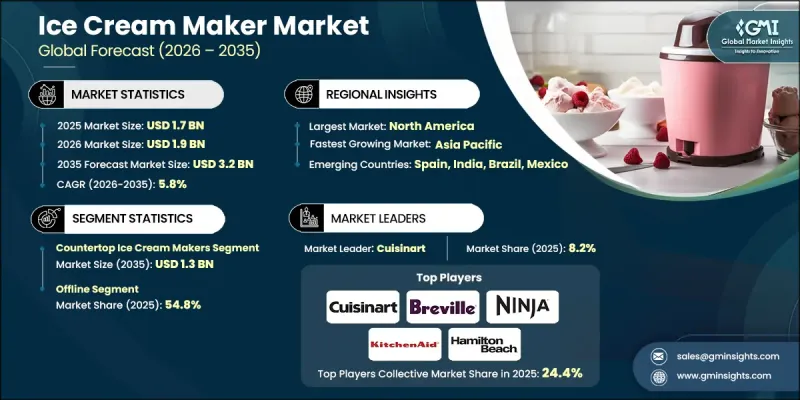
預計到 2025 年,全球冰淇淋機市場價值將達到 17 億美元,並預計以 5.8% 的複合年成長率成長,到 2035 年達到 32 億美元。
市場成長的驅動力在於消費者偏好發生了顯著轉變,他們開始追求更健康、更個人化的冷凍甜點。現代消費者越來越警惕市售冰淇淋中常見的添加劑,例如人工穩定劑、乳化劑和高果糖玉米糖漿。家用冰淇淋機曾經被視為小眾電器,如今卻已成為家庭廚房的必備工具,方便消費者掌控食材、營養和口味。可支配收入的成長使消費者能夠投資高階「專業級」廚房電器,這反映了家庭烹飪的優質化。此外,DIY、健康飲食和注重便利的社會趨勢也在推動市場需求,使用戶能夠有效率地製作營養豐富、富含蛋白質或適合特定飲食的冷凍甜點。功能性、個人化訂製和精緻的用餐體驗相結合,正使冰淇淋機成為現代廚房的必備品。
| 市場規模 | |
|---|---|
| 開始年份 | 2025 |
| 預測期 | 2026-2035 |
| 上市時的市場規模 | 17億美元 |
| 預測金額 | 32億美元 |
| 複合年成長率 | 5.8% |
預計到2025年,桌上型冰淇淋機市場規模將達7億美元,到2035年將達到13億美元。這些機型之所以受歡迎,是因為它們兼具專業級的性能和家用便利性。桌上型冰淇淋機通常內建壓縮機,無需預先冷凍冰淇淋桶即可立即使用。這種快速製作功能使其深受追求高效能、高品質甜點製作的消費者的青睞。
截至2025年,線下銷售通路將佔54.8%的市佔率。儘管線上零售發展迅速,消費者仍然傾向於在實體店購買冰淇淋機,因為他們重視在購買前檢查產品的做工、重量和易用性。高階廚房電器由於線下通路供貨迅速且運輸過程中損壞風險較低,仍主要透過線下通路銷售。
到2025年,美國冰淇淋機市佔率將達到54.9%。消費者對優質、健康、手工製作的冷凍甜點的強勁需求是推動市場成長的主要動力。自動壓縮機和智慧控制等技術創新深受注重便利性的消費者歡迎。較高的可支配收入、較高的廚房電器普及率以及成熟的廚具市場進一步鞏固了美國市場的主導地位。季節性促銷活動以及在零售和電商領域的強大影響力正在加速產品更換,而餐飲業的發展趨勢也激發了人們在家嘗試烹飪的熱情。
目錄
第1章:調查方法和範圍
第2章執行摘要
第3章業界考察
- 生態系分析
- 供應商情況
- 利潤率
- 每個階段增加的價值
- 影響價值鏈的因素
- 影響產業的因素
- 促進因素
- 消費者對自製甜點的需求日益成長
- 開發一種先進的冰淇淋機
- 可支配收入增加,以及對高級產品的偏好日益成長
- 產業潛在風險與挑戰
- 冰淇淋機的高成本
- 操作複雜且需要頻繁維護。
- 機會
- 產品創新方面尚未開發的領域
- 電子商務和D2C(直接面對消費者)的成長
- 促進因素
- 成長潛力分析
- 未來市場趨勢
- 科技與創新趨勢
- 當前技術趨勢
- 新興技術
- 監理情勢
- 標準和合規要求
- 區域法規結構
- 認證標準
- 貿易數據分析
- 進出口量及進口額趨勢
- 主要貿易路線及關稅的影響
- 人工智慧和生成式人工智慧對市場的影響
- 利用人工智慧改造現有經營模式
- 按細分市場分類的生成式人工智慧用例和部署藍圖
- 風險、限制和監管考量
- 定價分析(基於初步研究)
- 對過去價格趨勢的分析(基於初步研究)
- 不同經營者的定價策略(溢價/價值/成本加成)(基於初步調查)
- 各地區價格波動
- 原物料成本對定價的影響
- 波特五力分析
- PESTEL 分析
- 消費行為分析
- 購買模式
- 偏好分析
- 不同地區的消費行為差異
- 電子商務對購買決策的影響
第4章 競爭情勢
- 介紹
- 企業市佔率分析
- 按地區
- 企業矩陣分析
- 主要市場公司的競爭分析
- 競爭定位矩陣
- 主要進展
- 併購
- 夥伴關係與合作
- 新產品發布
- 業務拓展計劃
第5章 市場估計與預測:依類型分類,2022-2035年
- 桌上型冰淇淋機
- 碗式冷凍型
- 壓縮機型
- 可攜式冰淇淋機
- 手搖冰淇淋機
- 霜凍優格機
- 其他(冰沙機、義式霜淇淋機等)
第6章 市場估計與預測:依材料分類,2022-2035年
- 金屬
- 不銹鋼
- 鋁
- 銅及其合金
- 其他
- 非金屬
第7章 市場估計與預測:依營運方式分類 2022-2035 年
- 自動的
- 手動的
第8章 市場估計與預測:依產能分類 2022-2035 年
- 小瓶裝(1-2公升)
- 中型(3-5升)
- 大容量(5公升或以上)
第9章 市場估算與預測:2022-2035年價格區間
- 低價位
- 中價位
- 高的
第10章 市場估計與預測:依應用領域分類 2022-2035 年
- 家用
- 商用
- 冰淇淋店
- HoReCa
- 速食連鎖店
- 其他(餐飲服務等)
第11章 市場估價與預測:依通路分類,2022-2035年
- 線上
- 電子商務
- 企業網站
- 離線
- 超級市場/大賣場
- 專賣店
- 其他(個體店、百貨公司等)
第12章 市場估計與預測:依地區分類,2022-2035年
- 北美洲
- 美國
- 加拿大
- 歐洲
- 德國
- 法國
- 英國
- 義大利
- 西班牙
- 亞太地區
- 中國
- 印度
- 日本
- 韓國
- 澳洲
- 拉丁美洲
- 巴西
- 墨西哥
- 阿根廷
- 中東和非洲(MEA)
- 南非
- 沙烏地阿拉伯
- 阿拉伯聯合大公國
第13章:公司簡介
- Breville Group
- Carpigiani
- Cuisinart
- Dash
- Electro Freeze
- Euro Cuisine
- Hamilton Beach
- KitchenAid
- Musso
- Ninja
- Nostalgia Products
- Stoelting
- Taylor Company
- VonShef
- Whynter
The Global Ice Cream Maker Market was valued at USD 1.7 billion in 2025 and is estimated to grow at a CAGR of 5.8% to reach USD 3.2 billion by 2035.
Market growth is driven by a noticeable shift in consumer preferences toward healthier, more customizable frozen desserts. Modern buyers are increasingly wary of artificial stabilizers, emulsifiers, and high-fructose corn syrup present in pre-packaged ice cream. Home ice cream makers, once considered niche appliances, are now regarded as essential kitchen tools for households seeking control over ingredients, nutritional content, and flavor profiles. Rising discretionary income is enabling consumers to invest in high-end, "prosumer" kitchen gadgets, reflecting the premiumization of home dining. Social trends emphasizing DIY, health-conscious eating, and convenience are also fueling demand, as users can prepare nutrient-dense, protein-rich, or specialty-diet frozen desserts efficiently. The combination of functionality, customization, and elevated culinary experiences is positioning ice cream makers as a staple in modern kitchens.
| Market Scope | |
|---|---|
| Start Year | 2025 |
| Forecast Year | 2026-2035 |
| Start Value | $1.7 Billion |
| Forecast Value | $3.2 Billion |
| CAGR | 5.8% |
The countertop ice cream makers segment generated USD 700 million in 2025 and is expected to reach USD 1.3 billion by 2035. These models are favored for their combination of professional-grade performance and home convenience. Countertop ice cream makers often feature built-in compressors, allowing for immediate use without pre-freezing bowls. This rapid preparation capability has boosted adoption among consumers seeking efficient, high-quality dessert preparation.
The offline segment held a 54.8% share in 2025. Despite the growth of online retail, consumers still prefer to purchase ice cream makers in physical stores, as they value evaluating the appliance's build quality, weight, and interface before buying. High-end kitchen appliances continue to sell primarily through offline channels due to immediate ownership and reduced risk of shipping damage.
U.S. Ice Cream Maker Market held a 54.9% share in 2025. Strong household demand for premium, health-focused, and artisanal frozen desserts is driving market adoption. Technological innovations, including automated compressors and smart controls, appeal to convenience-oriented consumers. High disposable incomes, widespread ownership of kitchen appliances, and a mature culinary gadget market further reinforce U.S. dominance. Seasonal promotions and a robust retail and e-commerce presence accelerate replacement cycles, while foodservice trends inspire at-home culinary experimentation.
Key players operating in the Global Ice Cream Maker Market include KitchenAid, Breville Group, Cuisinart, Ninja, Musso, Nostalgia Products, Hamilton Beach, Dash, VonShef, Taylor Company, Carpigiani, Whynter, Electro Freeze, Euro Cuisine, and Stoelting. Companies in the Global Ice Cream Maker Industry are adopting multiple strategies to strengthen their market foothold. They are investing in R&D to develop user-friendly, high-performance, and multifunctional models, including countertop and compressor-based machines. Expanding digital and offline distribution networks ensures broader market reach, while collaborations with retailers and e-commerce platforms enhance visibility. Product differentiation through smart technology, customization options, and nutritional-focused designs attracts health-conscious buyers. Seasonal promotions, influencer campaigns, and targeted marketing initiatives improve brand engagement, while strategic pricing and bundling reinforce competitive advantage.
Table of Contents
Chapter 1 Methodology & Scope
- 1.1 Research approach
- 1.2 Quality Commitments
- 1.3 GMI AI policy & data integrity commitment
- 1.3.1 Source consistency protocol
- 1.4 Research Trail & Confidence Scoring
- 1.4.1 Research Trail Components
- 1.4.2 Scoring Components
- 1.5 Data Collection
- 1.5.1 Partial list of primary sources
- 1.6 Data mining sources
- 1.7 Paid sources
- 1.7.1 Sources, by region
- 1.8 Base estimates and calculations
- 1.8.1 Base year calculation for any one approach
- 1.9 Forecast model
- 1.9.1 Quantified market impact analysis
- 1.9.1.1 Mathematical impact of growth parameters on forecast
- 1.9.1 Quantified market impact analysis
- 1.10 Research transparency addendum
- 1.10.1 Source attribution framework
- 1.10.2 Quality assurance metrics
- 1.10.3 Our commitment to trust
Chapter 2 Executive Summary
- 2.1 Industry 360° synopsis
- 2.2 Key market trends
- 2.2.1 Regional
- 2.2.2 Type
- 2.2.3 Material
- 2.2.4 Price
- 2.2.5 Operation
- 2.2.6 Capacity
- 2.2.7 End-use
- 2.2.8 Distribution Channel
Chapter 3 Industry Insights
- 3.1 Industry ecosystem analysis
- 3.1.1 Supplier landscape
- 3.1.2 Profit margin
- 3.1.3 Value addition at each stage
- 3.1.4 Factor affecting the value chain
- 3.2 Industry impact forces
- 3.2.1 Growth drivers
- 3.2.1.1 Rising consumer demand for homemade desserts
- 3.2.1.2 Development of advanced ice cream makers
- 3.2.1.3 Rising disposable incomes and an increasing preference for premium products
- 3.2.2 Industry pitfalls & challenges
- 3.2.2.1 High cost associated with the ice cream makers
- 3.2.2.2 Complexity in handling and the need of frequent maintenance
- 3.2.3 Opportunities
- 3.2.3.1 Untapped product innovation space
- 3.2.3.2 E-commerce and direct-to-consumer growth
- 3.2.1 Growth drivers
- 3.3 Growth potential analysis
- 3.4 Future market trends
- 3.5 Technology and innovation landscape
- 3.5.1 Current technological trends
- 3.5.2 Emerging technologies
- 3.6 Regulatory landscape
- 3.6.1 Standards and compliance requirements
- 3.6.2 Regional regulatory frameworks
- 3.6.3 Certification standards
- 3.7 Trade data analysis
- 3.7.1 Import/export volume & value trends
- 3.7.2 Key trade corridors & tariff impact
- 3.8 Impact of AI & generative AI on the market
- 3.8.1 AI-driven disruption of existing business models
- 3.8.2 Gen AI use cases & adoption roadmap by segment
- 3.8.3 Risks, limitations & regulatory considerations
- 3.9 Pricing analysis (driven by primary research)
- 3.9.1 Historical price trend analysis (driven by primary research)
- 3.9.2 Pricing strategy by player Material (premium / value / cost-plus) (driven by primary research)
- 3.9.3 Regional price variations
- 3.9.4 Impact of raw material costs on pricing
- 3.10 Porter's analysis
- 3.11 PESTEL analysis
- 3.12 Consumer behaviour analysis
- 3.12.1 Purchasing patterns
- 3.12.2 Preference analysis
- 3.12.3 Regional variations in consumer behaviour
- 3.12.4 Impact of e-commerce on buying decisions
Chapter 4 Competitive Landscape, 2025
- 4.1 Introduction
- 4.2 Company market share analysis
- 4.2.1 By region
- 4.2.1.1 North America
- 4.2.1.2 Europe
- 4.2.1.3 Asia Pacific
- 4.2.1.4 Latin America
- 4.2.1.5 Middle East and Africa
- 4.2.1 By region
- 4.3 Company matrix analysis
- 4.4 Competitive analysis of major market players
- 4.5 Competitive positioning matrix
- 4.6 Key developments
- 4.6.1 Mergers & acquisitions
- 4.6.2 Partnerships & collaborations
- 4.6.3 New product launches
- 4.6.4 Expansion plans
Chapter 5 Market Estimates & Forecast, By Type, 2022-2035 (USD Billion) (Thousand Units)
- 5.1 Key trends
- 5.2 Countertop ice cream makers
- 5.2.1 Bowl-freezer type
- 5.2.2 Compressor type
- 5.3 Portable ice cream makers
- 5.4 Hand-cranked ice cream makers
- 5.5 Frozen yogurt makers
- 5.6 Others (slushie machines, gelato makers, etc.)
Chapter 6 Market Estimates & Forecast, By Material, 2022-2035 (USD Billion) (Thousand Units)
- 6.1 Key trends
- 6.2 Metallic
- 6.2.1 Stainless Steel
- 6.2.2 Aluminum
- 6.2.3 Copper & Alloy
- 6.2.4 Others
- 6.3 Non-Metallic
Chapter 7 Market Estimates & Forecast, By Operation 2022-2035 (USD Billion) (Thousand Units)
- 7.1 Key trends
- 7.2 Automatic
- 7.3 Manual
Chapter 8 Market Estimates & Forecast, By Capacity 2022-2035 (USD Billion) (Thousand Units)
- 8.1 Key trends
- 8.2 Small (1-2 liters)
- 8.3 Medium (3-5 liters)
- 8.4 Large (5+ liters)
Chapter 9 Market Estimates & Forecast, By Price 2022-2035 (USD Billion) (Thousand Units)
- 9.1 Key trends
- 9.2 Low
- 9.3 Medium
- 9.4 High
Chapter 10 Market Estimates & Forecast, By End Use 2022-2035 (USD Billion) (Thousand Units)
- 10.1 Key trends
- 10.2 Household use
- 10.3 Commercial use
- 10.3.1 Ice cream parlors
- 10.3.2 HoReCa
- 10.3.3 Fast food chains
- 10.3.4 Others (catering services, etc.)
Chapter 11 Market Estimates & Forecast, By Distribution Channel, 2022-2035 (USD Billion) (Million Units)
- 11.1 Key trends
- 11.2 Online
- 11.2.1 E-Commerce
- 11.2.2 Company website
- 11.3 Offline
- 11.3.1 Supermarkets/Hypermarkets
- 11.3.2 Specialty Stores
- 11.3.3 Others (Individual stores, Departmental stores, etc.)
Chapter 12 Market Estimates & Forecast, By Region, 2022-2035 (USD Billion) (Million Units)
- 12.1 Key trends
- 12.2 North America
- 12.2.1 U.S.
- 12.2.2 Canada
- 12.3 Europe
- 12.3.1 Germany
- 12.3.2 France
- 12.3.3 UK
- 12.3.4 Italy
- 12.3.5 Spain
- 12.4 Asia Pacific
- 12.4.1 China
- 12.4.2 India
- 12.4.3 Japan
- 12.4.4 South Korea
- 12.4.5 Australia
- 12.5 Latin America
- 12.5.1 Brazil
- 12.5.2 Mexico
- 12.5.3 Argentina
- 12.6 MEA
- 12.6.1 South Africa
- 12.6.2 Saudi Arabia
- 12.6.3 UAE
Chapter 13 Company Profiles
- 13.1 Breville Group
- 13.2 Carpigiani
- 13.3 Cuisinart
- 13.4 Dash
- 13.5 Electro Freeze
- 13.6 Euro Cuisine
- 13.7 Hamilton Beach
- 13.8 KitchenAid
- 13.9 Musso
- 13.10 Ninja
- 13.11 Nostalgia Products
- 13.12 Stoelting
- 13.13 Taylor Company
- 13.14 VonShef
- 13.15 Whynter


