


 |
市場調查報告書
商品編碼
2019244
丙酮市場機會、成長要素、產業趨勢分析及2026-2035年預測。Acetone Market Opportunity, Growth Drivers, Industry Trend Analysis, and Forecast 2026 - 2035 |
||||||

2025年全球丙酮市場價值為69億美元,預計2035年將以5.8%的複合年成長率成長至122億美元。
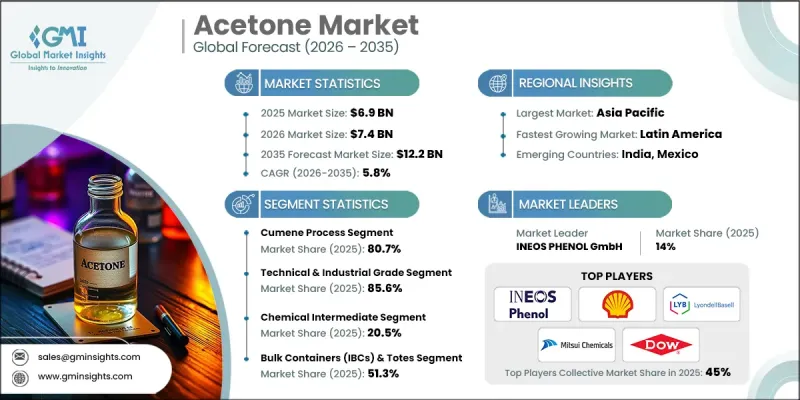
丙酮已超越其作為傳統基礎溶劑的角色,成為全球現代製造業、化學品生產和材料開發過程中不可或缺的組成部分。其多功能性、卓越的溶解能力以及作為高價值化學反應價值鏈前體的作用,使得丙酮成為那些尋求最佳化營運效率和永續性的行業的必備之選。企業越來越注重採用能夠最大限度減少環境影響、利用生物基原料並融入循環化學實踐的生產方法,以滿足全球環境標準。這些變化正在影響塑膠、塗料、製藥和個人護理等領域的產品開發、採購和下游夥伴關係策略。苯酚生產、先進的廢棄物減量系統和環境控制技術的整合正在重塑供應鏈運營,為全球丙酮生產商創造新的競爭優勢和成本效益。
| 市場範圍 | |
|---|---|
| 開始年份 | 2025 |
| 預測期 | 2026-2035 |
| 上市時的市場規模 | 69億美元 |
| 預測金額 | 122億美元 |
| 複合年成長率 | 5.8% |
異丙苯製程佔80.7%的市場佔有率,預計到2035年將以6.8%的複合年成長率成長。該工藝與苯酚生產無縫銜接,並能實現大規模、高品質的生產,因此在業界仍佔據核心地位。異丙醇脫氫、丙烯氧化和丁烷氧化等替代方法為生產商提供了操作柔軟性和原料多樣化,同時也滿足了對高純度下游產品的需求。
到2025年,技術級和工業級丙酮將佔據85.6%的市場佔有率,預計2026年至2035年將以5.8%的複合年成長率成長。這些等級的丙酮對於油漆、塑膠和化學中間體的大規模生產至關重要,它們具有穩定的溶解能力和可靠的加工性能。高純度的ACS級和試劑級丙酮適用於實驗室和分析應用,而USP級和藥用級丙酮則符合藥物開發和萃取過程中嚴格的安全和品質要求。 FCC級和食品級丙酮對於涉及食品接觸、香料和受管制物質處理的應用至關重要。
預計到2025年,北美將佔據丙酮市場22.7%的佔有率。該地區受益於強大的工業基礎、高產運轉率、先進的生產技術以及以下游應用需求為主導的客戶群。憑藉對創新和永續生產實踐的重視,北美正逐步成為全球丙酮供應鏈的重要貢獻者。
目錄
第1章:調查方法和範圍
第2章執行摘要
第3章業界考察
- 生態系分析
- 供應商情況
- 利潤率
- 每個階段增加的價值
- 影響價值鏈的因素
- 中斷
- 影響產業的因素
- 促進因素
- 油漆和塗料行業需求增加
- 製藥業的擴張
- 汽車產業活性化。
- 產業潛在風險與挑戰
- 原物料價格波動
- 嚴格的環境法規和合規成本
- 市場機遇
- 氣體發酵產生的負碳丙酮
- 用於先進半導體的超高純度電子級材料
- 促進因素
- 成長潛力分析
- 監理情勢
- 波特五力分析
- PESTEL 分析
- 價格趨勢
- 按地區
- 透過製造技術
- 未來市場趨勢
- 科技與創新趨勢
- 當前技術趨勢
- 新興技術
- 專利趨勢
- 貿易統計(HS編碼)
- 主要進口國
- 主要出口國
- 永續性和環境方面
- 永續計劃
- 減少廢棄物策略
- 生產中的能源效率
- 具有環保意識的舉措
- 考慮碳足跡
第4章 競爭情勢
- 介紹
- 企業市佔率分析
- 按地區
- 北美洲
- 歐洲
- 亞太地區
- 拉丁美洲
- 中東和非洲
- 按地區
- 企業矩陣分析
- 主要市場公司的競爭分析
- 競爭定位矩陣
- 主要進展
- 併購
- 夥伴關係與合作
- 新產品發布
- 業務拓展計劃
第5章 市場估算與預測:依製造技術分類,2022-2035年
- 異丙苯法
- 異丙醇(IPA)的脫氫裝置和氧化
- 丙烯和丁烷的氧化
- 生物衍生發酵
- 氣體發酵
第6章 市場估算與預測:依等級分類,2022-2035年
- 工業技術級
- ACS級和試劑級
- USP 和藥用級
- FCC 和食品級
- 電子和半導體級
- 其他
第7章 市場估計與預測:依應用領域分類,2022-2035年
- 化學中間體
- 甲基丙烯酸甲酯(MMA)的生產
- 雙酚A(BPA)的生產
- 甲基異丁基酮(MIBK)
- 溶劑 - 工業應用
- 溶劑在油漆和塗料中的應用
- 黏合劑和密封劑
- 印刷油墨
- 清洗和除油
- 醫藥溶劑及加工助劑
- API合成和藥物生產
- 結晶/純化應用
- 設備清潔和消毒準備
- 電子設備和半導體的清洗
- 晶圓清洗和光阻劑去除
- PCB製造和精密清洗
- 化妝品和個人護理
- 實驗室和分析化學
- 樣品製備和萃取
- 層析法和光譜分析的應用
- 3D列印與積層製造
- 食品加工/風味提取
- 其他
第8章 市場估算與預測:依通路分類,2022-2035年
- 從製造商到經銷商再到最終用戶
- 線上和電子商務平台
第9章 市場估價與預測:依包裝類型分類,2022-2035年
- 中型散貨箱(IBC)和噸桶
- 桶(55加侖,360磅)
- 小容器(1-5公升)
第10章 市場估價與預測:依地區分類,2022-2035年
- 北美洲
- 美國
- 加拿大
- 歐洲
- 德國
- 英國
- 法國
- 西班牙
- 義大利
- 其他歐洲地區
- 亞太地區
- 中國
- 印度
- 日本
- 澳洲
- 韓國
- 亞太其他地區
- 拉丁美洲
- 巴西
- 墨西哥
- 阿根廷
- 其他拉丁美洲地區
- 中東和非洲
- 沙烏地阿拉伯
- 南非
- 阿拉伯聯合大公國
- 其他中東和非洲地區
第11章:公司簡介
- INEOS Phenol GmbH
- Royal Dutch Shell plc
- Mitsui Chemicals, Inc.
- LyondellBasell Industries Holdings BV
- The Dow Chemical Company
- BASF SE
- Formosa Chemicals & Fibre Corporation
- Sumitomo Chemical Co., Ltd.
- LG Chem Ltd.
- Reliance Industries Limited
- PTT Global Chemical Public Company Limited
- Celanese Corporation
- LanzaTech, Inc.
- Honeywell International Inc.
The Global Acetone Market was valued at USD 6.9 billion in 2025 and is estimated to grow at a CAGR of 5.8% to reach USD 12.2 billion by 2035.
Acetone has evolved beyond its traditional role as a basic solvent to become a vital component in modern manufacturing, chemical production, and material development processes across the globe. Its versatility, excellent solvency, and ability to act as a precursor in high-value chemical chains make it indispensable for industries aiming to optimize operational efficiency and sustainability. Companies are increasingly focusing on production methods that minimize environmental impact, leverage bio-derived raw materials, and adopt circular chemistry practices to meet global ecological standards. These shifts are influencing product development, procurement, and downstream partnership strategies across sectors such as plastics, coatings, pharmaceuticals, and personal care. Integration of phenol production, advanced waste minimization systems, and environmental control technologies is reshaping supply chain operations, creating new competitive advantages and cost efficiencies for acetone producers worldwide.
| Market Scope | |
|---|---|
| Start Year | 2025 |
| Forecast Year | 2026-2035 |
| Start Value | $6.9 Billion |
| Forecast Value | $12.2 Billion |
| CAGR | 5.8% |
The cumene process segment held an 80.7% share and is projected to grow at a CAGR of 6.8% through 2035. This process remains central to the industry due to its seamless integration with phenol production and its ability to deliver large-scale quality output. Alternative methods such as IPA dehydrogenation, propylene oxidation, and butane oxidation provide producers with operational flexibility and the ability to diversify feedstock while meeting the demand for high-purity downstream products.
The technical and industrial grade acetone held an 85.6% share in 2025 and is expected to grow at a CAGR of 5.8% from 2026 to 2035. These grades are essential for large-scale production in coatings, plastics, and chemical intermediates, offering stable solvency and reliable processing characteristics. High-purity ACS and reagent grades support laboratory and analytical applications, while USP and pharmaceutical grade acetone meet stringent safety and quality requirements for drug development and extraction processes. FCC and food-grade acetone are critical for applications involving food contact, flavoring, and regulated material handling.
North America Acetone Market accounted for 22.7% share in 2025. The region benefits from a strong industrial base operating at high capacity, advanced production techniques, and a customer landscape that drives demand for downstream applications. North America's focus on innovation and sustainable manufacturing practices positions it as a key contributor to the global acetone supply chain.
Leading companies in the Global Acetone Industry include INEOS Phenol GmbH, LyondellBasell Industries Holdings B.V., Royal Dutch Shell plc, BASF SE, Sumitomo Chemical Co., Ltd., Formosa Chemicals & Fibre Corporation, Reliance Industries Limited, The Dow Chemical Company, LG Chem Ltd., Celanese Corporation, Mitsui Chemicals, Inc., PTT Global Chemical Public Company Limited, LanzaTech, Inc., and Honeywell International Inc. Companies in the acetone market are strengthening their market foothold by investing in sustainable production technologies, expanding capacity, and diversifying feedstock sources. Key strategies include developing bio-based and environmentally friendly acetone to meet regulatory requirements, optimizing phenol integration for cost efficiency, and establishing partnerships with downstream industries. Firms are also focusing on innovation in production processes to improve yield, reduce energy consumption, and enhance product quality. Strategic acquisitions, expansion into emerging markets, and portfolio diversification are helping companies capture new applications in pharmaceuticals, coatings, and plastics, while maintaining a competitive advantage in both industrial and high-purity segments.
Table of Contents
Chapter 1 Methodology & Scope
- 1.1 Market scope and definition
- 1.2 Research design
- 1.2.1 Research approach
- 1.2.2 Data collection methods
- 1.3 Data mining sources
- 1.3.1 Global
- 1.3.2 Regional/Country
- 1.4 Base estimates and calculations
- 1.4.1 Base year calculation
- 1.4.2 Key trends for market estimation
- 1.5 Primary research and validation
- 1.5.1 Primary sources
- 1.6 Forecast model
- 1.7 Research assumptions and limitations
Chapter 2 Executive Summary
- 2.1 Industry 360° synopsis
- 2.2 Key market trends
- 2.2.1 Regional
- 2.2.2 Production Technology
- 2.2.3 Grade
- 2.2.4 Application
- 2.2.5 Distribution Channel
- 2.2.6 Packaging
- 2.3 TAM Analysis, 2026-2035
- 2.4 CXO perspectives: Strategic imperatives
- 2.4.1 Executive decision points
- 2.4.2 Critical success factors
- 2.5 Future Outlook and Strategic Recommendations
Chapter 3 Industry Insights
- 3.1 Industry ecosystem analysis
- 3.1.1 Supplier landscape
- 3.1.2 Profit margin
- 3.1.3 Value addition at each stage
- 3.1.4 Factor affecting the value chain
- 3.1.5 Disruptions
- 3.2 Industry impact forces
- 3.2.1 Growth drivers
- 3.2.1.1 Increasing demand in paints and coatings
- 3.2.1.2 Expansion of the pharmaceutical sector
- 3.2.1.3 Rising automotive industry activities
- 3.2.2 Industry pitfalls and challenges
- 3.2.2.1 Volatility in raw material prices
- 3.2.2.2 Stringent environmental regulations & compliance costs
- 3.2.3 Market opportunities
- 3.2.3.1 Carbon-negative acetone via gas fermentation
- 3.2.3.2 Ultra-high-purity electronic-grade for advanced semiconductors
- 3.2.1 Growth drivers
- 3.3 Growth potential analysis
- 3.4 Regulatory landscape
- 3.4.1 North America
- 3.4.2 Europe
- 3.4.3 Asia Pacific
- 3.4.4 Latin America
- 3.4.5 Middle East & Africa
- 3.5 Porter's analysis
- 3.6 PESTEL analysis
- 3.7 Price trends
- 3.7.1 By region
- 3.7.2 By production technology
- 3.8 Future market trends
- 3.9 Technology and Innovation landscape
- 3.9.1 Current technological trends
- 3.9.2 Emerging technologies
- 3.10 Patent Landscape
- 3.11 Trade statistics (HS code)
- 3.11.1 Major importing countries
- 3.11.2 Major exporting countries
- 3.12 Sustainability and environmental aspects
- 3.12.1 Sustainable practices
- 3.12.2 Waste reduction strategies
- 3.12.3 Energy efficiency in production
- 3.12.4 Eco-friendly initiatives
- 3.13 Carbon footprint consideration
Chapter 4 Competitive Landscape, 2025
- 4.1 Introduction
- 4.2 Company market share analysis
- 4.2.1 By region
- 4.2.1.1 North America
- 4.2.1.2 Europe
- 4.2.1.3 Asia Pacific
- 4.2.1.4 LATAM
- 4.2.1.5 MEA
- 4.2.1 By region
- 4.3 Company matrix analysis
- 4.4 Competitive analysis of major market players
- 4.5 Competitive positioning matrix
- 4.6 Key developments
- 4.6.1 Mergers & acquisitions
- 4.6.2 Partnerships & collaborations
- 4.6.3 New Product Launches
- 4.6.4 Expansion Plans
Chapter 5 Market Estimates and Forecast, By Production Technology, 2022-2035 (USD Billion) (Kilo Tons)
- 5.1 Key trends
- 5.2 Cumene process
- 5.3 Isopropyl alcohol (IPA) dehydrogenation & oxidation
- 5.4 Propylene & butane oxidation
- 5.5 Bio-based fermentation
- 5.6 Gas fermentation
Chapter 6 Market Estimates and Forecast, By Grade, 2022-2035 (USD Billion) (Kilo Tons)
- 6.1 Key trends
- 6.2 Technical & Industrial Grade
- 6.3 ACS & Reagent Grade
- 6.4 USP & Pharmaceutical Grade
- 6.5 FCC & Food Grade
- 6.6 Electronic & Semiconductor Grade
- 6.7 Others
Chapter 7 Market Estimates and Forecast, By Application, 2022-2035 (USD Billion) (Kilo Tons)
- 7.1 Key trends
- 7.2 Chemical Intermediate
- 7.2.1 Methyl Methacrylate (MMA) Production
- 7.2.2 Bisphenol A (BPA) Production
- 7.2.3 Methyl Isobutyl Ketone (MIBK)
- 7.3 Solvent - Industrial Applications
- 7.3.1 Paints & Coatings Solvent Applications
- 7.3.2 Adhesives & Sealants
- 7.3.3 Printing Inks
- 7.3.4 Cleaning & Degreasing
- 7.4 Pharmaceutical Solvent & Processing Aid
- 7.4.1 API Synthesis & Drug Manufacturing
- 7.4.2 Crystallization & Purification Applications
- 7.4.3 Equipment Cleaning & Sterilization Preparation
- 7.5 Electronics & Semiconductor Cleaning
- 7.5.1 Wafer Cleaning & Photoresist Removal
- 7.5.2 PCB Fabrication & Precision Cleaning
- 7.6 Cosmetics & Personal Care
- 7.7 Laboratory & Analytical Chemistry
- 7.7.1 Sample Preparation & Extraction
- 7.7.2 Chromatography & Spectroscopy Applications
- 7.8 3D Printing & Additive Manufacturing
- 7.9 Food Processing & Flavor Extraction
- 7.10 Others
Chapter 8 Market Estimates and Forecast, By Distribution Channel, 2022-2035 (USD Billion) (Kilo Tons)
- 8.1 Key trends
- 8.2 Manufacturer-to-Distributor-to-End-User
- 8.3 Online & E-Commerce Platforms
Chapter 9 Market Estimates and Forecast, By Packaging, 2022-2035 (USD Billion) (Kilo Tons)
- 9.1 Key trends
- 9.2 Intermediate Bulk Containers (IBCs) & Totes
- 9.3 Drums (55-Gallon & 360 lb)
- 9.4 Small Containers (1-5 Liters)
Chapter 10 Market Estimates and Forecast, By Region, 2022-2035 (USD Billion) (Kilo Tons)
- 10.1 Key trends
- 10.2 North America
- 10.2.1 U.S.
- 10.2.2 Canada
- 10.3 Europe
- 10.3.1 Germany
- 10.3.2 UK
- 10.3.3 France
- 10.3.4 Spain
- 10.3.5 Italy
- 10.3.6 Rest of Europe
- 10.4 Asia Pacific
- 10.4.1 China
- 10.4.2 India
- 10.4.3 Japan
- 10.4.4 Australia
- 10.4.5 South Korea
- 10.4.6 Rest of Asia Pacific
- 10.5 Latin America
- 10.5.1 Brazil
- 10.5.2 Mexico
- 10.5.3 Argentina
- 10.5.4 Rest of Latin America
- 10.6 Middle East and Africa
- 10.6.1 Saudi Arabia
- 10.6.2 South Africa
- 10.6.3 UAE
- 10.6.4 Rest of Middle East and Africa
Chapter 11 Company Profiles
- 11.1 INEOS Phenol GmbH
- 11.2 Royal Dutch Shell plc
- 11.3 Mitsui Chemicals, Inc.
- 11.4 LyondellBasell Industries Holdings B.V.
- 11.5 The Dow Chemical Company
- 11.6 BASF SE
- 11.7 Formosa Chemicals & Fibre Corporation
- 11.8 Sumitomo Chemical Co., Ltd.
- 11.9 LG Chem Ltd.
- 11.10 Reliance Industries Limited
- 11.11 PTT Global Chemical Public Company Limited
- 11.12 Celanese Corporation
- 11.13 LanzaTech, Inc.
- 11.14 Honeywell International Inc.

 丙酮市場:2026-2032年全球市場預測(依等級、形態、來源、應用及通路分類)
 丙酮市場:按應用、等級、分銷管道、終端用戶行業和地區分類(2026-2034 年)
 丙酮市場規模、佔有率和成長分析(按等級、製造流程、應用、最終用途產業、分銷通路和地區分類)-2026-2033年產業預測日本丙酮市場規模、佔有率、趨勢和預測:按生產流程、應用、最終用途和地區分類,2026-2034年
 2026年全球丙酮市場報告異氟酮市場依劑型、純度、應用及通路分類,全球預測(2026-2032年)
 丙酮:市場佔有率分析、產業趨勢、統計數據、成長預測(2025-2030)
 異佛爾酮市場:全球2025-2029
 2030 年丙酮市場預測:按產品類型、生產流程、應用、最終用戶和地區進行的全球分析
 丙酮市場規模、佔有率、趨勢分析報告:按等級、應用、分銷管道、地區、細分市場預測,2025-2030 年