

 |
市場調查報告書
商品編碼
2019193
光纖通訊與網路市場機會、成長要素、產業趨勢分析及2026-2035年預測Optical Communication and Networking Market Opportunity, Growth Drivers, Industry Trend Analysis, and Forecast 2026 - 2035 |
||||||

全球光纖通訊和網路市場預計到 2025 年將價值 356 億美元,預計到 2035 年將以 8.3% 的複合年成長率成長至 775 億美元。
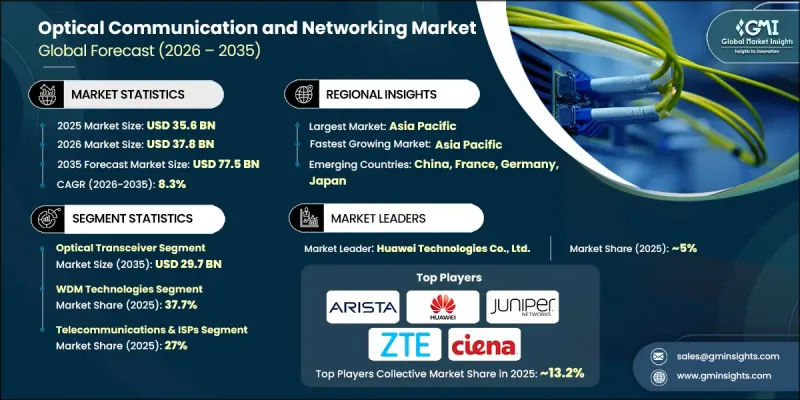
隨著全球數位化進程的加速和5G技術的普及,市場正迅速擴張。通訊業者正日益整合高密度分波多工(DWDM)和連貫光技術,以建構用於回程傳輸和去程傳輸雙向傳輸的高容量光纖網路。這一趨勢對於支援智慧城市、工業自動化和物聯網生態系統的可靠連接至關重要,並將光纖網路定位為現代數位基礎設施的基礎。超大規模資料中心的成長和對雲端服務日益成長的需求也是主要促進因素。先進的光纖傳輸解決方案和高速收發器能夠實現高速、高容量的資料傳輸,從而支援人工智慧、雲端運算和企業應用。包括800G解決方案在內的光連貫技術的持續創新,正在推動功耗降低和容量提升,進而刺激對路由光纖網路的持續投資,以提升其性能和可擴展性。
| 市場範圍 | |
|---|---|
| 開始年份 | 2025 |
| 預測期 | 2026-2035 |
| 上市時的市場規模 | 356億美元 |
| 預測金額 | 775億美元 |
| 複合年成長率 | 8.3% |
預計到2025年,光放大器市場規模將達到55億美元,並在2026年至2035年間以8.1%的複合年成長率成長。這一成長主要受全球數據流量不斷成長以及長途、城域和資料中心網路對訊號放大需求的推動。多核心放大器等創新技術在顯著降低能耗的同時,還能提高吞吐量;而新興的低功耗晶片級放大器則能夠高效整合到下一代光子網路中,從而提升網路效能和能源效率。
預計2026年至2035年,光纖傳輸網路(OTN)市場將以9.5%的複合年成長率成長。 OTN提供標準化、穩健的傳輸解決方案,能夠管理光纖骨幹網路上的各種用戶端流量。其支援復用、路由和流量管理的能力,使其成為5G回程傳輸、雲端互連和安全的企業間通訊的關鍵,從而增強了全球高容量網路的可靠性和擴充性。
美國光纖通訊和網路市場預計到2025年將達到84億美元,並隨著通訊業者擴大光纖網路和回程傳輸以滿足5G、雲端運算和人工智慧驅動下日益成長的數據需求而持續擴張。營運商正投資於骨幹網路升級、網路擴展和策略性收購,以提高寬頻容量並整合高速服務。主要企業正在獲得數十億美元的光纖部署和資料中心基礎設施契約,這反映出對通訊和企業生態系統的持續投資。
目錄
第1章:調查方法和範圍
第2章執行摘要
第3章業界考察
- 生態系分析
- 供應商情況
- 利潤率分析
- 成本結構
- 每個階段增加的價值
- 影響價值鏈的因素
- 中斷
- 影響產業的因素
- 促進因素
- 5G及未來行動網路的擴展與部署
- 超大規模資料中心的快速成長
- 全球網路使用量和數據流量都在成長。
- 雲端服務和虛擬化的廣泛應用
- 物聯網在各領域的成長與數位轉型
- 產業潛在風險與挑戰
- 實施和升級需要大量的初始資本投入。
- 將光學技術與舊有系統整合的複雜性
- 市場機遇
- 邊緣運算和混合網路的發展
- 在企業和資料中心網路中引入先進的光纖技術
- 促進因素
- 監理情勢
- 北美洲
- 歐洲
- 亞太地區
- 拉丁美洲
- 中東和非洲
- 波特五力分析
- PESTEL 分析
- 科技與創新趨勢
- 當前技術趨勢
- 新興技術
- 新興經營模式
- 合規要求
- 專利和智慧財產權分析
- 地緣政治和貿易趨勢
第4章 競爭情勢
- 介紹
- 企業市佔率分析
- 按地區
- 北美洲
- 歐洲
- 亞太地區
- 拉丁美洲
- 中東和非洲
- 按地區
- 主要企業的競爭標竿分析
- 財務績效比較
- 銷售量
- 利潤率
- 研究與開發
- 產品系列比較
- 產品線寬度
- 科技
- 創新
- 區域擴張比較
- 全球擴張分析
- 服務網路覆蓋
- 按地區分類的市場滲透率
- 競爭定位矩陣
- 領導者
- 挑戰者
- 追蹤者
- 小眾玩家
- 財務績效比較
- 2022-2025 年重大發展
- 併購
- 夥伴關係和聯盟
- 技術進步
- 業務拓展與投資策略
- 數位轉型計劃
- 新興/Start-Ups競爭對手的發展趨勢
第5章 市場估計與預測:依組件分類,2022-2035年
- 光纖
- 光收發器
- 光開關
- 光放大器
- 輕型循環器
- 其他
第6章 市場估計與預測:依技術分類,2022-2035年
- WDM技術
- SONET/SDH
- 光纖通道
- 光分封傳輸(OTN)
- 其他
第7章 市場估計與預測:依資料傳輸速度分類,2022-2035年
- 10 Gbps 或更低
- 10~40 Gbps
- 40~100 Gbps
- 超過 100 Gbps
第8章 市場估算與預測:依產業分類,2022-2035年
- 通訊和網際網路服務供應商
- 資料中心和雲端服務供應商
- 政府/公共部門
- 國防/航太
- 能源與公共產業
- 工業和製造業
- 銀行、金融服務、保險業 (BFSI)
- 醫療保健和生命科學
- 媒體、廣播、娛樂
- 零售和商業公司
- 其他
第9章 市場估計與預測:依地區分類,2022-2035年
- 北美洲
- 美國
- 加拿大
- 歐洲
- 德國
- 英國
- 法國
- 西班牙
- 義大利
- 荷蘭
- 亞太地區
- 中國
- 印度
- 日本
- 澳洲
- 韓國
- 拉丁美洲
- 巴西
- 墨西哥
- 阿根廷
- 中東和非洲
- 南非
- 沙烏地阿拉伯
- 阿拉伯聯合大公國
第10章:公司簡介
- Adtran
- Arista Networks, Inc.
- Ciena Corporation.
- Cisco Systems, Inc.
- FiberHome
- FUJITSU
- General Atomics
- Huawei Technologies Co., Ltd.
- Juniper Networks, Inc.
- Mitsubishi Electric Corporation
- NEC Corporation
- Nokia
- Space Photonics Inc.
- Telefonaktiebolaget LM Ericsson
- ZTE Corporation
The Global Optical Communication and Networking Market was valued at USD 35.6 billion in 2025 and is estimated to grow at a CAGR of 8.3% to reach USD 77.5 billion by 2035.
The market is expanding rapidly as digitalization accelerates globally and 5G technology becomes widely deployed. Telecommunications providers are increasingly building out high-capacity fiber optic networks for both backhaul and fronthaul, integrating Dense Wavelength Division Multiplexing (DWDM) and Coherent Optical technologies. These developments are critical for supporting reliable connectivity in smart cities, industrial automation, and IoT ecosystems, positioning optical networks as a cornerstone of modern digital infrastructure. The growth of hyperscale data centers and the rising demand for cloud services are also major drivers. Advanced optical transport solutions and high-speed transceivers enable fast, large-volume data transfer, supporting AI, cloud computing, and enterprise applications. Ongoing innovations in optical coherent technologies, including 800G solutions, reduce power consumption while increasing capacity, encouraging continued investment in routed optical networks to enhance performance and scalability.
| Market Scope | |
|---|---|
| Start Year | 2025 |
| Forecast Year | 2026-2035 |
| Start Value | $35.6 Billion |
| Forecast Value | $77.5 Billion |
| CAGR | 8.3% |
The optical amplifiers segment generated USD 5.5 billion in 2025 and is expected to grow at a CAGR of 8.1% during 2026-2035. The expansion is fueled by increasing global data traffic and the need for signal boosting across long-haul, metro, and data center networks. Innovations such as multi-core amplifiers significantly reduce energy usage while expanding throughput, and emerging low-power, chip-scale amplifiers offer efficient integration in next-generation photonic networks, enhancing network performance and energy efficiency.
The optical transport network (OTN) segment is projected to grow at a CAGR of 9.5% between 2026 and 2035. OTN provides standardized, robust transport solutions capable of managing diverse client traffic over optical backbones. Its ability to support multiplexing, routing, and traffic management makes it essential for 5G backhaul, cloud interconnects, and secure enterprise communication, reinforcing the reliability and scalability of global high-capacity networks.
U.S. Optical Communication and Networking Market accounted for USD 8.4 billion in 2025 and continues to expand as operators scale fiber networks and optical backhaul to meet growing 5G, cloud, and AI-driven data demands. Telecommunications companies are investing in backbone upgrades, network expansion, and strategic acquisitions to enhance broadband capacity and integrate high-speed services. Leading suppliers are securing multi-billion-dollar contracts for fiber deployment and data center infrastructure, reflecting sustained investment in telecommunications and enterprise ecosystems.
Key players in the Global Optical Communication and Networking Market include Adtran, Arista Networks, Inc., Ciena Corporation, Cisco Systems, Inc., FiberHome, FUJITSU, General Atomics, Huawei Technologies Co., Ltd., Juniper Networks, Inc., Mitsubishi Electric Corporation, NEC Corporation, Nokia, Space Photonics Inc., Telefonaktiebolaget LM Ericsson, and ZTE Corporation. Companies in the Optical Communication and Networking Market are implementing several strategies to strengthen their presence and market foothold. They are investing heavily in research and development to create high-speed, energy-efficient, and scalable optical solutions. Strategic partnerships with telecommunications operators, hyperscale data center providers, and enterprise clients expand deployment opportunities. Firms are also pursuing mergers and acquisitions to enhance network coverage, secure intellectual property, and increase market share. Additionally, companies are focusing on developing software-defined networking (SDN) and automated optical solutions to provide flexible, cost-effective services. Participation in global standardization initiatives, customer-centric innovation, and regional expansion into emerging markets further solidifies their competitive position, ensuring long-term growth and industry leadership.
Table of Contents
Chapter 1 Methodology and Scope
- 1.1 Market scope and definition
- 1.2 Research design
- 1.2.1 Research approach
- 1.2.2 Data collection methods
- 1.3 Data mining sources
- 1.3.1 Global
- 1.3.2 Regional/Country
- 1.4 Base estimates and calculations
- 1.4.1 Base year calculation
- 1.4.2 Key trends for market estimation
- 1.5 Primary research and validation
- 1.5.1 Primary sources
- 1.6 Forecast model
- 1.7 Research assumptions and limitations
Chapter 2 Executive Summary
- 2.1 Industry 360° synopsis, 2022 - 2035
- 2.2 Key market trends
- 2.2.1 System type trends
- 2.2.2 Deployment model trends
- 2.2.3 End-user industry trends
- 2.2.4 Regional trends
- 2.3 TAM analysis, 2025-2035
- 2.4 CXO perspectives: Strategic imperatives
- 2.4.1 Executive decision points
- 2.4.2 Critical success factors
- 2.5 Future outlook and strategic recommendations
Chapter 3 Industry Insights
- 3.1 Industry ecosystem analysis
- 3.1.1 Supplier landscape
- 3.1.2 Profit margin analysis
- 3.1.3 Cost structure
- 3.1.4 Value addition at each stage
- 3.1.5 Factor affecting the value chain
- 3.1.6 Disruptions
- 3.2 Industry impact forces
- 3.2.1 Growth drivers
- 3.2.1.1 Expansion and rollout of 5G and future mobile networks
- 3.2.1.2 Rapid growth of hyperscale data centers
- 3.2.1.3 Rising global internet usage and data traffic volumes
- 3.2.1.4 Rising adoption of cloud based services and virtualization
- 3.2.1.5 Growth of IoT and digital transformation across sectors
- 3.2.2 Industry pitfalls and challenges
- 3.2.2.1 High initial capital expenditure on deployment and upgrades
- 3.2.2.2 Complexity in integrating optical technology with legacy systems
- 3.2.3 Market opportunities
- 3.2.3.1 Growth in edge computing and hybrid networks
- 3.2.3.2 Adoption of advanced optical technologies in enterprise/data center networks
- 3.2.1 Growth drivers
- 3.3 Regulatory landscape
- 3.3.1 North America
- 3.3.2 Europe
- 3.3.3 Asia Pacific
- 3.3.4 Latin America
- 3.3.5 Middle East & Africa
- 3.4 Porter's analysis
- 3.5 PESTEL analysis
- 3.6 Technology and innovation landscape
- 3.6.1 Current technological trends
- 3.6.2 Emerging technologies
- 3.7 Emerging business models
- 3.8 Compliance requirements
- 3.9 Patent and IP analysis
- 3.10 Geopolitical and trade dynamics
Chapter 4 Competitive Landscape, 2025
- 4.1 Introduction
- 4.2 Company market share analysis
- 4.2.1 By region
- 4.2.1.1 North America
- 4.2.1.2 Europe
- 4.2.1.3 Asia Pacific
- 4.2.1.4 Latin America
- 4.2.1.5 Middle East & Africa
- 4.2.1 By region
- 4.3 Competitive benchmarking of key players
- 4.3.1 Financial performance comparison
- 4.3.1.1 Revenue
- 4.3.1.2 Profit margin
- 4.3.1.3 R&D
- 4.3.2 Product portfolio comparison
- 4.3.2.1 Product range breadth
- 4.3.2.2 Technology
- 4.3.2.3 Innovation
- 4.3.3 Geographic presence comparison
- 4.3.3.1 Global footprint analysis
- 4.3.3.2 Service network coverage
- 4.3.3.3 Market penetration by region
- 4.3.4 Competitive positioning matrix
- 4.3.4.1 Leaders
- 4.3.4.2 Challengers
- 4.3.4.3 Followers
- 4.3.4.4 Niche players
- 4.3.1 Financial performance comparison
- 4.4 Key developments, 2022-2025
- 4.4.1 Mergers and acquisitions
- 4.4.2 Partnerships and collaborations
- 4.4.3 Technological advancements
- 4.4.4 Expansion and investment strategies
- 4.4.5 Digital transformation initiatives
- 4.5 Emerging/ startup competitors’ landscape
Chapter 5 Market Estimates and Forecast, By Component, 2022 - 2035 (USD Billion)
- 5.1 Key trends
- 5.2 Optical Fiber
- 5.3 Optical Transceiver
- 5.4 Optical Switch
- 5.5 Optical Amplifiers
- 5.6 Optical Circulators
- 5.7 Others
Chapter 6 Market Estimates and Forecast, By Technology, 2022 - 2035 (USD Billion)
- 6.1 Key trends
- 6.2 WDM Technologies
- 6.3 SONET/SDH
- 6.4 Fibre Channel
- 6.5 Optical Packet Transport (OTN)
- 6.6 Others
Chapter 7 Market Estimates and Forecast, By Data Rate, 2022 - 2035 (USD Billion)
- 7.1 Key trends
- 7.2 ≤ 10 Gbps
- 7.3 10-40 Gbps
- 7.4 40-100 Gbps
- 7.5 above 100 Gbps
Chapter 8 Market Estimates and Forecast, By Vertical, 2022 - 2035 (USD Billion)
- 8.1 Key trends
- 8.2 Telecommunications & ISPs
- 8.3 Data Centers & Cloud Providers
- 8.4 Government & Public Sector
- 8.5 Defense & Aerospace
- 8.6 Energy & Utilities
- 8.7 Industrial & Manufacturing
- 8.8 BFSI (Banking, Financial Services & Insurance)
- 8.9 Healthcare & Life Sciences
- 8.10 Media, Broadcasting & Entertainment
- 8.11 Retail & Commercial Enterprises
- 8.12 Others
Chapter 9 Market Estimates and Forecast, By Region, 2022 - 2035 (USD Billion)
- 9.1 Key trends
- 9.2 North America
- 9.2.1 U.S.
- 9.2.2 Canada
- 9.3 Europe
- 9.3.1 Germany
- 9.3.2 UK
- 9.3.3 France
- 9.3.4 Spain
- 9.3.5 Italy
- 9.3.6 Netherlands
- 9.4 Asia Pacific
- 9.4.1 China
- 9.4.2 India
- 9.4.3 Japan
- 9.4.4 Australia
- 9.4.5 South Korea
- 9.5 Latin America
- 9.5.1 Brazil
- 9.5.2 Mexico
- 9.5.3 Argentina
- 9.6 Middle East and Africa
- 9.6.1 South Africa
- 9.6.2 Saudi Arabia
- 9.6.3 UAE
Chapter 10 Company Profiles
- 10.1 Adtran
- 10.2 Arista Networks, Inc.
- 10.3 Ciena Corporation.
- 10.4 Cisco Systems, Inc.
- 10.5 FiberHome
- 10.6 FUJITSU
- 10.7 General Atomics
- 10.8 Huawei Technologies Co., Ltd.
- 10.9 Juniper Networks, Inc.
- 10.10 Mitsubishi Electric Corporation
- 10.11 NEC Corporation
- 10.12 Nokia
- 10.13 Space Photonics Inc.
- 10.14 Telefonaktiebolaget LM Ericsson
- 10.15 ZTE Corporation


