


 |
市場調查報告書
商品編碼
2019128
靜態量熱儀市場機會、成長要素、產業趨勢分析及2026-2035年預測Static Heat Meters Market Opportunity, Growth Drivers, Industry Trend Analysis, and Forecast 2026 - 2035 |
||||||

全球靜態量熱儀市場預計到 2025 年將價值 26 億美元,預計到 2035 年將以 6.4% 的複合年成長率成長至 47 億美元。
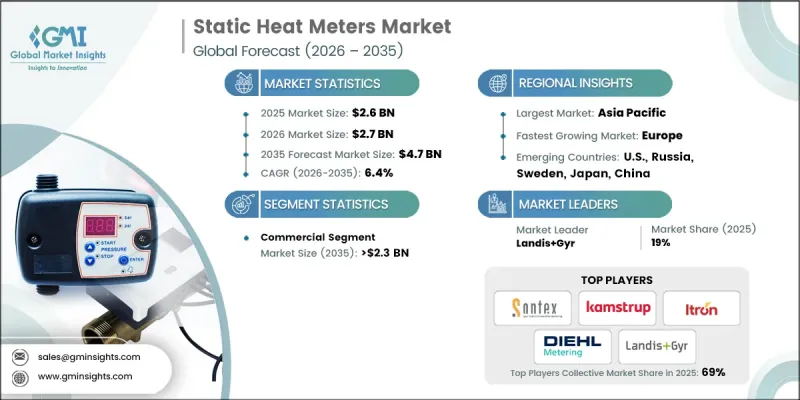
靜態量熱計是一種固態設備,無需任何移動部件即可測量加熱系統中熱能的消耗和傳遞,從而確保了高耐久性、高精度和長期可靠性。節能措施、電子帳單技術的進步以及對穩定、精確測量系統的需求,推動了智慧電錶解決方案需求的成長,進而促進了此類產品的普及。對即時監測的永續溫度控管日益重視,以及精確數據採集技術的創新,正在推動市場滲透。政府對碳排放的更嚴格監管、對節能解決方案的獎勵以及對區域供熱系統中經濟高效計量的推動,共同營造了有利的市場環境。同時,隨著對永續性和精確計費的重視程度不斷提高,全球需求持續強勁成長。
| 市場範圍 | |
|---|---|
| 開始年份 | 2025 |
| 預測期 | 2026-2035 |
| 上市時的市場規模 | 26億美元 |
| 預測金額 | 47億美元 |
| 複合年成長率 | 6.4% |
預計到2035年,商業應用領域市場規模將達到23億美元,主要得益於強制性節能措施、區域供熱網路的擴展以及智慧建築技術的整合。經濟高效的設計、耐用性和精準的測量能力支撐了這一需求,這些優勢能夠實現精確的熱監測和客製化的收費解決方案。
受永續發展措施、監管趨勢和智慧基礎設施普及的推動,預計到2035年,美國靜態量熱儀市場規模將達到3億美元。將靜態量熱儀與暖通空調系統、溫控器和能源監控平台整合,可實現高效的能源追蹤,從而減少浪費、降低成本並提高居住者舒適度,所有這些都將推動市場成長。
目錄
第1章:調查方法和範圍
第2章執行摘要
第3章業界考察
- 產業生態系統
- 監理情勢
- 影響產業的因素
- 促進因素
- 產業潛在風險與挑戰
- 成長潛力分析
- 波特五力分析
- PESTEL 分析
- 成本結構分析
- 價格趨勢分析,2022-2035年
- 透過使用
- 按地區
- 新機會和趨勢
- 數位化和物聯網整合
- 投資分析及未來展望
第4章 競爭情勢
- 介紹
- 企業市佔率分析:按地區分類
- 北美洲
- 歐洲
- 亞太地區
- 競爭定位矩陣
- 主要進展
- 併購
- 夥伴關係與合作
- 新產品發布
- 業務拓展計劃及資金籌措
第5章 市場規模及預測:依應用領域分類,2022-2035年
- 住宅
- 商業的
- 學院和高等教育機構
- 辦公大樓
- 政府大樓
- 其他
- 工業的
第6章 市場規模及預測:依地區分類,2022-2035年
- 北美洲
- 美國
- 加拿大
- 歐洲
- 德國
- 波蘭
- 瑞典
- 丹麥
- 芬蘭
- 義大利
- 英國
- 亞太地區
- 中國
- 日本
- 韓國
第7章:公司簡介
- ABB
- Apator SA
- Axioma Metering UAB
- BMETERS
- Danfoss
- Diehl Stiftung & Co. KG
- Engelmann Sensor GmbH
- Huizhong Instrumentation
- Itron
- Kamstrup
- Landis+Gyr AG
- Metrix Polska
- Micronics
- QUNDIS
- Schneider Electric
- Siemens
- Sensus
- Sontex
- Techem
- ZENNER International
The Global Static Heat Meters Market was valued at USD 2.6 billion in 2025 and is estimated to grow at a CAGR of 6.4% to reach USD 4.7 billion by 2035.
Static heat meters are solid-state devices designed to measure thermal energy consumption or transfer in heating systems without any moving components, ensuring high durability, precision, and long-term reliability. The rising demand for smart metering solutions is driving widespread adoption, fueled by energy-saving initiatives, electronic billing advancements, and the need for stable, accurate measurement systems. Increasing focus on sustainable heat management with real-time monitoring, coupled with technological innovations in precision data collection, is enhancing product penetration. Stricter government regulations on carbon emissions, incentives for energy-efficient solutions, and the push for cost-effective metering in district heating systems are creating a favorable market environment, while the growing emphasis on sustainability and accurate billing continues to strengthen demand globally.
| Market Scope | |
|---|---|
| Start Year | 2025 |
| Forecast Year | 2026-2035 |
| Start Value | $2.6 Billion |
| Forecast Value | $4.7 Billion |
| CAGR | 6.4% |
The commercial applications segment is expected to reach USD 2.3 billion by 2035 due to mandates for energy efficiency, expansion of district heating networks, and the integration of smart building technologies. The demand is supported by cost-effective designs, durability, and accurate measurement capabilities, enabling precise heat monitoring and customized billing solutions.
U.S. Static Heat Meters Market is forecast to reach USD 0.3 billion by 2035, driven by sustainability initiatives, regulatory developments, and the adoption of smart infrastructure. Integration of static heat meters with HVAC systems, thermostats, and energy monitoring platforms allows efficient energy tracking, reduces waste, lowers costs, and enhances occupant comfort, which collectively drives growth.
Prominent players in the Global Static Heat Meters Market include ABB, Apator S.A., Axioma Metering UAB, BMETERS, Danfoss, Diehl Stiftung & Co. KG, Engelmann Sensor GmbH, Huizhong Instrumentation, Itron, Kamstrup, Landis+Gyr AG, Metrix Polska, Micronics, QUNDIS, Schneider Electric, Siemens, Sensus, Sontex, Techem, and ZENNER International. Companies in the static heat meters market strengthen their position by investing in R&D to develop more accurate, durable, and energy-efficient devices, expanding their smart metering solutions, and offering integration with digital energy management platforms. Strategic collaborations and partnerships with utility providers and technology companies accelerate innovation and adoption. Firms also target emerging markets by customizing products for local heating systems and regulatory requirements. Offering comprehensive after-sales services, remote monitoring, and training programs builds customer trust. Focus on sustainable manufacturing, cost optimization, and scalable production further enhances market foothold while ensuring compliance with global energy standards.
Table of Contents
Chapter 1 Methodology & Scope
- 1.1 Research design
- 1.2 Quality commitment
- 1.2.1 GMI AI policy & data integrity commitment
- 1.2.1.1 Source consistency protocol
- 1.2.1 GMI AI policy & data integrity commitment
- 1.3 Research trail & Confidence Scoring
- 1.3.1 Research trail components
- 1.3.2 Scoring components
- 1.4 Data Collection
- 1.4.1 Partial list of primary sources
- 1.5 Data mining sources
- 1.5.1 Paid sources
- 1.5.1.1 Sources, by region
- 1.5.1 Paid sources
- 1.6 Base estimates and calculations
- 1.6.1 Base year calculation for any one approach
- 1.7 Forecast model
- 1.8 Research transparency addendum
- 1.8.1 Source attribution framework
- 1.8.2 Quality assurance metrics
- 1.8.3 Our commitment to trust
- 1.9 Market definitions
Chapter 2 Executive Summary
- 2.1 Industry 360-degree synopsis, 2022 - 2035
- 2.2 Business trends
- 2.3 Product trends
- 2.4 Application trends
- 2.5 Regional trends
Chapter 3 Industry Insights
- 3.1 Industry ecosystem
- 3.2 Regulatory landscape
- 3.3 Industry impact forces
- 3.3.1 Growth drivers
- 3.3.2 Industry pitfalls & challenges
- 3.4 Growth potential analysis
- 3.5 Porter's analysis
- 3.5.1 Bargaining power of suppliers
- 3.5.2 Bargaining power of buyers
- 3.5.3 Threat of new entrants
- 3.5.4 Threat of substitutes
- 3.6 PESTEL analysis
- 3.6.1 Political factors
- 3.6.2 Economic factors
- 3.6.3 Social factors
- 3.6.4 Technological factors
- 3.6.5 Legal factors
- 3.6.6 Environmental factors
- 3.7 Cost structure analysis
- 3.8 Price trend analysis, 2022-2035
- 3.8.1 By Application
- 3.8.2 By Region
- 3.9 Emerging opportunities & trends
- 3.9.1 Digitalization & IoT integration
- 3.10 Investment analysis & future outlook
Chapter 4 Competitive landscape, 2026
- 4.1 Introduction
- 4.2 Company market share analysis, by region, 2025
- 4.2.1 North America
- 4.2.2 Europe
- 4.2.3 Asia Pacific
- 4.3 Competitive positioning matrix
- 4.4 Key developments
- 4.4.1 Mergers & acquisitions
- 4.4.2 Partnerships & collaborations
- 4.4.3 New product launches
- 4.4.4 Expansion plans & funding
Chapter 5 Market Size and Forecast, By Application, 2022 - 2035 (USD Million & '000 Units)
- 5.1 Key trends
- 5.2 Residential
- 5.3 Commercial
- 5.3.1 College/University
- 5.3.2 Office Building
- 5.3.3 Government Building
- 5.3.4 Others
- 5.4 Industrial
Chapter 6 Market Size and Forecast, By Region, 2022 - 2035 (USD Million & '000 Units)
- 6.1 Key trends
- 6.2 North America
- 6.2.1 U.S.
- 6.2.2 Canada
- 6.3 Europe
- 6.3.1 Germany
- 6.3.2 Poland
- 6.3.3 Sweden
- 6.3.4 Denmark
- 6.3.5 Finland
- 6.3.6 Italy
- 6.3.7 UK
- 6.4 Asia Pacific
- 6.4.1 China
- 6.4.2 Japan
- 6.4.3 South Korea
Chapter 7 Company Profiles
- 7.1 ABB
- 7.2 Apator S.A.
- 7.3 Axioma Metering UAB
- 7.4 BMETERS
- 7.5 Danfoss
- 7.6 Diehl Stiftung & Co. KG
- 7.7 Engelmann Sensor GmbH
- 7.8 Huizhong Instrumentation
- 7.9 Itron
- 7.10 Kamstrup
- 7.11 Landis+Gyr AG
- 7.12 Metrix Polska
- 7.13 Micronics
- 7.14 QUNDIS
- 7.15 Schneider Electric
- 7.16 Siemens
- 7.17 Sensus
- 7.18 Sontex
- 7.19 Techem
- 7.20 ZENNER International

 量熱儀市場:按類型、連接方式、安裝方式、應用、分銷管道和最終用戶分類-2026-2032年全球市場預測
 熱測量儀器市場 - 全球產業規模、佔有率、趨勢、機會、預測:按類型、連接方式、最終用戶、地區和競爭格局分類,2021-2031年
 量熱儀市場:按類型、應用、組件、通訊方式、安裝方式和地區分類
 渦街量熱儀市場機會、成長要素、產業趨勢分析及2026-2035年預測超音波熱儀市場機會、成長要素、產業趨勢分析及2026-2035年預測
 量熱儀市場分析及預測(至2035年):依類型、產品、服務、技術、組件、應用、部署、最終用戶及功能分類超音波流量感測器市場按產品類型、通訊介面、精度等級、安裝類型、流量範圍、材料、感測器類型、應用類型和最終用戶分類-全球預測,2026-2032年
 熱量表市場規模、佔有率和成長分析(按類型、管道尺寸、功能、技術、應用和地區分類)-2026-2033年產業預測熱量表市場機會、成長動力、產業趨勢分析及 2025 - 2034 年預測
 超音波熱量表的全球市場