


 |
市場調查報告書
商品編碼
2019078
渦街量熱儀市場機會、成長要素、產業趨勢分析及2026-2035年預測Vortex Heat Meters Market Opportunity, Growth Drivers, Industry Trend Analysis, and Forecast 2026 - 2035 |
||||||

預計到 2025 年,全球渦式流量計市場價值將達到 6.968 億美元,年複合成長率為 7.2%,到 2035 年將達到 13 億美元。
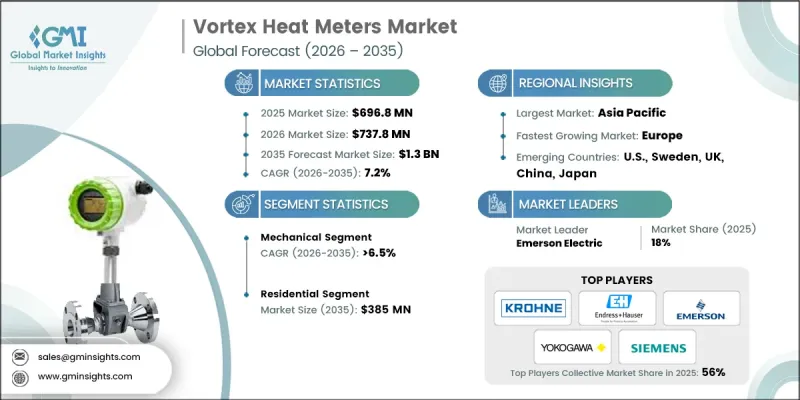
這種成長是由對能夠提供精確穩定性能的先進流量測量技術的需求不斷成長所驅動的。這些流量計基於渦流原理運行,能夠可靠地監測各種系統中的熱能消耗。除了對節能解決方案日益成長的需求外,都市區現代供熱網路的擴張也顯著影響市場動態。與智慧電錶平台和建築管理系統的整合進一步提升了其功能性和普及性。感測器設計、材料品質和數位化整合方面的持續改進,確保了更高的精度和長期可靠性。此外,監管機構對能源效率和透明收費方式的重視,也推動了渦流熱儀的更廣泛應用,從而增強了其在現代能源管理系統中的重要性。
| 市場範圍 | |
|---|---|
| 開始年份 | 2025 |
| 預測期 | 2026-2035 |
| 上市時的市場規模 | 6.968億美元 |
| 預測金額 | 13億美元 |
| 複合年成長率 | 7.2% |
基礎設施建設投資的增加以及永續供熱技術的日益普及,進一步推動了市場需求的成長。各行業對精準能源監測和高效能熱能利用的日益關注,正在影響他們的採購決策。隨著企業採用先進的能源管理策略,對精準耐用的測量解決方案的需求持續成長。技術進步使得產品在各種運作條件下都能保持優異的性能,而向環保系統的轉變也增強了整體市場潛力。這些因素共同推動了渦流式量熱儀產業的穩定擴張。
機械式測量系統預計到2035年將以6.5%的複合年成長率成長,這主要得益於其簡單的設計和極低的維護需求。這些系統因其成本效益和可靠性而廣受讚譽,適用於各種應用。校準方法和感測技術的不斷改進正在提升測量精度和可靠性。與現有測量基礎設施的兼容性也促進了其應用範圍的擴大,而製造流程的最佳化則有助於降低整體成本,從而進一步推動該領域的成長。
預計到2035年,住宅市場規模將達到3.85億美元,主要得益於現代住宅開發中節能解決方案的日益普及。住宅和開發商越來越重視永續建築實踐和先進的能源監控系統。包括物聯網設備在內的智慧技術的整合,能夠更好地即時追蹤和控制能源消耗。兼具功能性和易用性的改良系統設計也促進了節能解決方案的普及。隨著消費者節能意識的不斷提高,住宅市場預計將持續成長。
受能源成本上漲和人們對高效節能日益成長的需求推動,預計到2035年,美國渦街量熱儀市場規模將達到1.3億美元。自動化技術的廣泛應用和對嚴格能源法規的遵守是市場成長的關鍵促進因素。這些量熱儀具有耐用、維護成本低、在惡劣條件下性能可靠等優點,使其適用於廣泛的應用領域。此外,能源最佳化和環保意識的提升,以及對現代基礎設施和永續建築項目的持續投資,也進一步促進了渦街量熱儀的普及。
目錄
第1章:調查方法和範圍
第2章執行摘要
第3章業界考察
- 產業生態系統
- 監理情勢
- 影響產業的因素
- 促進因素
- 產業潛在風險與挑戰
- 成長潛力分析
- 波特五力分析
- PESTEL 分析
- 成本結構分析
- 價格趨勢分析,2022-2035年
- 透過使用
- 按地區
- 新機會和趨勢
- 數位化和物聯網整合
- 投資分析及未來展望
第4章 競爭情勢
- 介紹
- 企業市佔率分析:按地區分類
- 北美洲
- 歐洲
- 亞太地區
- 競爭定位矩陣
- 主要進展
- 併購
- 夥伴關係與合作
- 新產品發布
- 業務拓展計劃及資金籌措
第5章 市場規模及預測:依技術分類,2022-2035年
- 機械的
- 靜止的
第6章 市場規模與預測:依應用領域分類,2022-2035年
- 住宅
- 商業的
- 學院和高等教育機構
- 辦公大樓
- 政府大樓
- 其他
- 工業的
第7章 市場規模及預測:依地區分類,2022-2035年
- 北美洲
- 美國
- 加拿大
- 歐洲
- 德國
- 波蘭
- 瑞典
- 丹麥
- 芬蘭
- 義大利
- 英國
- 亞太地區
- 中國
- 日本
- 韓國
第8章:公司簡介
- ABB
- Apure
- Arrow Electronics
- Badger Meter
- Emerson Electric
- Endress+Hauser
- Grainger
- Honeywell International
- KROHNE
- KOBOLD Instruments, Inc.
- Schneider Electric
- Siemens
- Spirax Sarco
- Sino-Inst
- TLV Co., Ltd.
- WPG Holdings
- Yokogawa Electric Corporation
The Global Vortex Heat Meters Market was valued at USD 696.8 million in 2025 and is estimated to grow at a CAGR of 7.2% to reach USD 1.3 billion by 2035.
Growth is driven by the rising need for advanced flow measurement technologies capable of delivering precise and consistent performance. These meters operate based on vortex flow principles, enabling reliable monitoring of thermal energy consumption in various systems. Increasing demand for energy-efficient solutions, along with the expansion of modern heating networks in urban environments, is significantly shaping market dynamics. Integration with smart metering platforms and building management systems is further enhancing their functionality and adoption. Continuous improvements in sensor design, material quality, and digital integration are supporting higher accuracy and long-term reliability. Additionally, regulatory focus on energy efficiency and transparent billing practices is encouraging wider deployment, reinforcing the importance of vortex heat meters in modern energy management systems.
| Market Scope | |
|---|---|
| Start Year | 2025 |
| Forecast Year | 2026-2035 |
| Start Value | $696.8 Million |
| Forecast Value | $1.3 Billion |
| CAGR | 7.2% |
Rising investments in infrastructure development and the growing adoption of sustainable heating technologies are further accelerating market demand. The increasing emphasis on precise energy monitoring and efficient heat utilization is influencing purchasing decisions across industries. As organizations adopt advanced energy management strategies, the need for accurate and durable metering solutions continues to grow. Technological advancements are enabling better performance under varying operational conditions, while the shift toward environmentally responsible systems is strengthening overall market potential. These factors collectively contribute to the steady expansion of the vortex heat meters industry.
The mechanical segment is expected to grow at a CAGR of 6.5% through 2035, supported by its straightforward design and minimal maintenance requirements. These systems are widely preferred for their cost-effectiveness and dependable operation, making them suitable for a variety of applications. Ongoing enhancements in calibration methods and sensing technologies are improving measurement accuracy and reliability. Their compatibility with existing metering infrastructure also supports continued adoption, while efforts to optimize manufacturing processes are helping reduce overall costs, further strengthening segment growth.
The residential segment is projected to reach USD 385 million by 2035, driven by increasing adoption of energy-efficient solutions in modern housing developments. Homeowners and developers are placing greater emphasis on sustainable construction practices and advanced energy monitoring systems. The integration of smart technologies, including IoT-enabled devices, is enabling real-time tracking and improved control over energy consumption. Enhanced system designs that combine functionality with user-friendly features are also contributing to increased adoption. As consumer awareness around energy efficiency continues to rise, the residential segment is expected to experience sustained growth.
U.S. Vortex Heat Meters Market is anticipated to reach USD 130 million by 2035, supported by rising energy costs and a growing focus on efficient energy utilization. Increased adoption of automation and compliance with stringent energy regulations are key factors influencing market expansion. These meters offer advantages such as durability, low maintenance, and reliable performance under demanding conditions, making them well-suited for a wide range of applications. The push toward energy optimization and environmentally conscious practices is further driving adoption, alongside continued investments in modern infrastructure and sustainable building initiatives.
Major companies operating in the Global Vortex Heat Meters Market include Siemens, ABB, Honeywell International, Schneider Electric, Emerson Electric, Endress+Hauser, Yokogawa Electric Corporation, KROHNE, Badger Meter, Spirax Sarco, TLV, KOBOLD Instruments, Apure, Sino-Inst, Grainger, Arrow Electronics, and WPG Holdings. Companies in the Global Vortex Heat Meters Market are focusing on strengthening their market position through innovation, strategic partnerships, and expanded product offerings. Investments in advanced sensor technologies and digital integration are enabling the development of more accurate and efficient metering solutions. Many players are enhancing their portfolios with smart and connected devices that support real-time monitoring and data analytics. Collaborations with infrastructure developers and energy service providers are helping companies expand their reach and secure long-term contracts. Additionally, firms are prioritizing compliance with global energy efficiency standards while optimizing production processes to reduce costs. Expanding distribution networks and improving after-sales services further support customer retention and long-term growth.
Table of Contents
Chapter 1 Methodology & Scope
- 1.1 Research design
- 1.2 Quality commitment
- 1.2.1 GMI AI policy & data integrity commitment
- 1.2.1.1 Source consistency protocol
- 1.2.1 GMI AI policy & data integrity commitment
- 1.3 Research trail & Confidence Scoring
- 1.3.1 Research trail components
- 1.3.2 Scoring components
- 1.4 Data Collection
- 1.4.1 Partial list of primary sources
- 1.5 Data mining sources
- 1.5.1 Paid sources
- 1.5.1.1 Sources, by region
- 1.5.1 Paid sources
- 1.6 Base estimates and calculations
- 1.6.1 Base year calculation for any one approach
- 1.7 Forecast model
- 1.8 Research transparency addendum
- 1.8.1 Source attribution framework
- 1.8.2 Quality assurance metrics
- 1.8.3 Our commitment to trust
- 1.9 Market definitions
Chapter 2 Executive Summary
- 2.1 Industry 3600 synopsis, 2022 - 2035
- 2.2 Business trends
- 2.3 Technology trends
- 2.4 Application trends
- 2.5 Regional trends
Chapter 3 Industry Insights
- 3.1 Industry ecosystem
- 3.2 Regulatory landscape
- 3.3 Industry impact forces
- 3.3.1 Growth drivers
- 3.3.2 Industry pitfalls & challenges
- 3.4 Growth potential analysis
- 3.5 Porter's analysis
- 3.5.1 Bargaining power of suppliers
- 3.5.2 Bargaining power of buyers
- 3.5.3 Threat of new entrants
- 3.5.4 Threat of substitutes
- 3.6 PESTEL analysis
- 3.6.1 Political factors
- 3.6.2 Economic factors
- 3.6.3 Social factors
- 3.6.4 Technological factors
- 3.6.5 Legal factors
- 3.6.6 Environmental factors
- 3.7 Cost structure analysis
- 3.8 Price trend analysis, 2022-2035
- 3.8.1 By Application
- 3.8.2 By Region
- 3.9 Emerging opportunities & trends
- 3.9.1 Digitalization & IoT integration
- 3.10 Investment analysis & future outlook
Chapter 4 Competitive landscape, 2026
- 4.1 Introduction
- 4.2 Company market share analysis, by region, 2025
- 4.2.1 North America
- 4.2.2 Europe
- 4.2.3 Asia Pacific
- 4.3 Competitive positioning matrix
- 4.4 Key developments
- 4.4.1 Mergers & acquisitions
- 4.4.2 Partnerships & collaborations
- 4.4.3 New product launches
- 4.4.4 Expansion plans & funding
Chapter 5 Market Size and Forecast, By Technology, 2022 - 2035 (USD Million & ‘000 Units)
- 5.1 Key trends
- 5.2 Mechanical
- 5.3 Static
Chapter 6 Market Size and Forecast, By Application, 2022 - 2035 (USD Million & ‘000 Units)
- 6.1 Key trends
- 6.2 Residential
- 6.3 Commercial
- 6.3.1 College/University
- 6.3.2 Office Building
- 6.3.3 Government Building
- 6.3.4 Others
- 6.4 Industrial
Chapter 7 Market Size and Forecast, By Region, 2022 - 2035 (USD Million & ‘000 Units)
- 7.1 Key trends
- 7.2 North America
- 7.2.1 U.S.
- 7.2.2 Canada
- 7.3 Europe
- 7.3.1 Germany
- 7.3.2 Poland
- 7.3.3 Sweden
- 7.3.4 Denmark
- 7.3.5 Finland
- 7.3.6 Italy
- 7.3.7 UK
- 7.4 Asia Pacific
- 7.4.1 China
- 7.4.2 Japan
- 7.4.3 South Korea
Chapter 8 Company Profiles
- 8.1 ABB
- 8.2 Apure
- 8.3 Arrow Electronics
- 8.4 Badger Meter
- 8.5 Emerson Electric
- 8.6 Endress+Hauser
- 8.7 Grainger
- 8.8 Honeywell International
- 8.9 KROHNE
- 8.10 KOBOLD Instruments, Inc.
- 8.11 Schneider Electric
- 8.12 Siemens
- 8.13 Spirax Sarco
- 8.14 Sino-Inst
- 8.15 TLV Co., Ltd.
- 8.16 WPG Holdings
- 8.17 Yokogawa Electric Corporation

 量熱儀市場:按類型、連接方式、安裝方式、應用、分銷管道和最終用戶分類-2026-2032年全球市場預測
 熱測量儀器市場 - 全球產業規模、佔有率、趨勢、機會、預測:按類型、連接方式、最終用戶、地區和競爭格局分類,2021-2031年
 量熱儀市場:按類型、應用、組件、通訊方式、安裝方式和地區分類
 超音波熱儀市場機會、成長要素、產業趨勢分析及2026-2035年預測靜態量熱儀市場機會、成長要素、產業趨勢分析及2026-2035年預測
 量熱儀市場分析及預測(至2035年):依類型、產品、服務、技術、組件、應用、部署、最終用戶及功能分類超音波流量感測器市場按產品類型、通訊介面、精度等級、安裝類型、流量範圍、材料、感測器類型、應用類型和最終用戶分類-全球預測,2026-2032年
 熱量表市場規模、佔有率和成長分析(按類型、管道尺寸、功能、技術、應用和地區分類)-2026-2033年產業預測熱量表市場機會、成長動力、產業趨勢分析及 2025 - 2034 年預測
 超音波熱量表的全球市場