


 |
市場調查報告書
商品編碼
1998849
毛氈纖維市場機會、成長要素、產業趨勢分析及2026-2035年預測Tackifier Market Opportunity, Growth Drivers, Industry Trend Analysis, and Forecast 2026 - 2035 |
||||||

預計到 2025 年,全球黏性纖維市場價值將達到 73 億美元,並有望以 5.2% 的複合年成長率成長,到 2035 年達到 122 億美元。
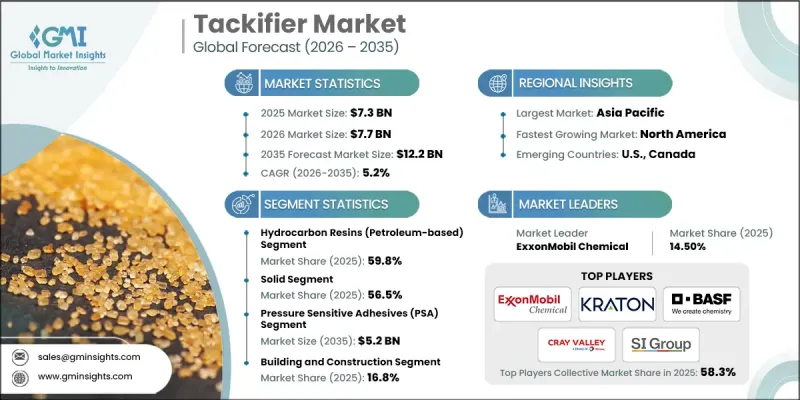
黏性纖維市場的成長主要得益於多個工業領域對黏合技術的需求不斷成長,這些領域依賴黏合技術來提升產品性能和耐久性。黏性纖維在提升各種黏合劑配方(貫穿整個製造環境)的黏合強度、柔軟性和長期穩定性方面發揮著至關重要的作用。在終端用戶領域中,包裝產業佔據最大的消費佔有率,其次是建築施工、汽車製造、不織布以及木工和家具製造。隨著人們對環境永續性和法規遵循的日益關注,製造商正在開發能夠減少排放並提升環境性能的樹脂。隨著環境法規日趨嚴格,為了滿足不斷變化的標準,業界正擴大採用低揮發性有機化合物(VOC)和生物基黏性材料。從區域來看,亞太地區憑藉其完善的製造基礎設施、強大的工業生產能力以及對研發活動的持續投入,佔據了全球最大的銷售佔有率。同時,歐洲黏性纖維市場正透過開發環保高性能樹脂技術而蓬勃發展。北美市場成長最快,這主要得益於工業活動的擴張、城市發展的推進以及包裝和不織布用黏合劑產品消費量的成長。拉丁美洲和中東及非洲在全球市場中所佔佔有率相對較小,但預計這兩個地區在預測期內都將保持穩定溫和的成長。
| 市場範圍 | |
|---|---|
| 開始年份 | 2025 |
| 預測期 | 2026-2035 |
| 上市時的市場規模 | 73億美元 |
| 預計金額 | 122億美元 |
| 複合年成長率 | 5.2% |
預計到2025年,松香樹脂市場規模將達到27億美元,仍將是黏合劑配方中最重要的天然樹脂類別之一。松香基材料因其優異的黏合性能和對眾多工業應用的適應性而被廣泛應用。多種加工技術已被應用於改善這些材料的性能,包括透過化學改質來增強其穩定性和抗氧化性。此外,還開發了多種衍生配方,以提高其與各種聚合物系統和黏合劑組合物的相容性,使製造商能夠在廣泛的工業領域中獲得更佳的黏合性能和配方柔軟性。
預計到2025年,固體黏性纖維的市佔率將達到56.5%,並在2026年至2035年間以4.9%的複合年成長率成長。固體黏性纖維因其在儲存和處理過程中具有高穩定性,並在整個黏合劑生產過程中保持性能穩定,而備受青睞。其物理特性使製造商能夠更有效地控制熱處理過程中的黏度和軟化特性。因此,這些材料廣泛應用於需要可靠黏合強度和可預測加工性能的黏合劑系統中。其耐久性和與工業生產方法的兼容性持續推動其在多個製造領域的廣泛應用。
預計到2025年,北美黏性纖維市場規模將達到18億美元。該地區強大的工業基礎設施以及主要化工企業持續的研發投入,正推動著產業的創新發展。各公司日益專注於開發特殊樹脂技術,例如氫化樹脂和高性能混煉技術,旨在提升產品的穩定性和耐久性。然而,該地區市場仍易受價格波動的影響,尤其是樹脂生產中使用的石油衍生原料的價格波動。原料成本的波動會影響製造成本,並最終影響全部區域的市場動態。
目錄
第1章:調查方法和範圍
第2章執行摘要
第3章業界考察
- 生態系分析
- 供應商情況
- 利潤率
- 每個階段增加的價值
- 影響價值鏈的因素
- 中斷
- 影響產業的因素
- 促進因素
- 對壓敏黏著劑(PSA)的需求增加
- 包裝和電子商務行業的成長
- 建築業和汽車業的擴張
- 產業潛在風險與挑戰
- 原油和原料價格波動
- 嚴格的環境法規和揮發性有機化合物(VOC)法規
- 替代黏合技術的可用性
- 市場機遇
- 對生物基和永續樹脂的需求日益成長
- 亞太地區的快速工業化
- 氫化樹脂和特殊樹脂的最新進展
- 促進因素
- 成長潛力分析
- 監理情勢
- 北美洲
- 歐洲
- 亞太地區
- 拉丁美洲
- 中東和非洲
- 波特五力分析
- PESTEL 分析
- 價格趨勢
- 按地區
- 依化學類型
- 未來市場趨勢
- 科技與創新趨勢
- 當前技術趨勢
- 新興技術
- 專利趨勢
- 貿易統計(HS編碼)
- 主要進口國
- 主要出口國
- 永續性和環境方面
- 永續計劃
- 減少廢棄物策略
- 生產中的能源效率
- 環保意識的舉措
- 考慮碳足跡
第4章 競爭情勢
- 介紹
- 企業市佔率分析
- 按地區
- 北美洲
- 歐洲
- 亞太地區
- 拉丁美洲
- 中東和非洲
- 按地區
- 企業矩陣分析
- 主要市場公司的競爭分析
- 競爭定位矩陣
- 主要進展
- 併購
- 夥伴關係與合作
- 新產品發布
- 業務拓展計劃
第5章 市場估算與預測:依化學性質分類,2022-2035年
- 烴類樹脂(石油基)
- C5脂肪族樹脂
- C9芳香樹脂
- C5/C9混合脂肪族/芳香族樹脂
- DCPD(二環戊二烯)樹脂
- 氫化烴類樹脂
- 松香樹脂(天然)
- 松香酸
- 松香酯
- 萜烯樹脂
- 聚萜烯樹脂
- 氫化萜烯樹脂
- 苯乙烯改質萜烯樹脂
- 萜烯酚樹脂
第6章 市場估計與預測:依類型分類,2022-2035年
- 固體的
- 液體
- 樹脂分散體
第7章 市場估計與預測:依應用領域分類,2022-2035年
- 壓敏黏著劑(PSA)
- 黏合劑(HMA)
- 組裝黏合劑
- 裝訂黏合劑
- 鞋類、皮革和橡膠黏合劑
- 其他
第8章 市場估算與預測:依最終使用者分類,2022-2035年
- 包裝
- 建築/施工
- 車
- 不織布
- 木工和家具
- 鞋類
- 其他
第9章 市場估計與預測:依地區分類,2022-2035年
- 北美洲
- 美國
- 加拿大
- 歐洲
- 德國
- 英國
- 法國
- 西班牙
- 義大利
- 其他歐洲地區
- 亞太地區
- 中國
- 印度
- 日本
- 澳洲
- 韓國
- 亞太其他地區
- 拉丁美洲
- 巴西
- 墨西哥
- 阿根廷
- 其他拉丁美洲地區
- 中東和非洲
- 沙烏地阿拉伯
- 南非
- 阿拉伯聯合大公國
- 其他中東和非洲地區
第10章:公司簡介
- Arakawa Chemical Industries Ltd.
- BASF SE
- Cray Valley
- DRT(Derives Resiniques et Terpeniques)
- Eastman Chemical Company
- ExxonMobil Chemical
- Foreverest Resources Ltd.
- Kolon Industries Inc.
- Kraton Corporation
- Lawter Inc.
- Neville Chemical Company
- Resin Solutions LLC
- SI Group Inc.
- Yasuhara Chemical Co. Ltd.
- ZEON Corporation
The Global Tackifier Market was valued at USD 7.3 billion in 2025 and is estimated to grow at a CAGR of 5.2% to reach USD 12.2 billion by 2035.
Growth in the tackifier market is driven by rising demand from multiple industrial sectors that rely on adhesive technologies to enhance product performance and durability. Tackifiers play an important role in improving adhesion strength, flexibility, and long-term stability within various adhesive formulations used across manufacturing environments. Among end-use sectors, packaging represents the largest share of consumption, followed by building and construction, automotive production, non-woven materials, and woodworking or furniture manufacturing. Increasing focus on environmental sustainability and regulatory compliance is encouraging manufacturers to develop resins with reduced emissions and improved ecological profiles. As environmental regulations become stricter, industries are increasingly adopting low-VOC and bio-based tackifying materials to meet evolving standards. Regionally, Asia Pacific generates the largest share of global revenue due to its extensive manufacturing infrastructure, strong industrial production capacity, and continuous investment in research and development activities. Meanwhile, the European tackifier market is advancing through the development of environmentally responsible high-performance resin technologies. North America is witnessing the fastest growth, supported by expanding industrial activities, increasing urban development, and rising consumption of adhesive products used in packaging and non-woven materials. Although Latin America and the Middle East & Africa represent comparatively smaller portions of the global market, both regions are anticipated to demonstrate consistent and gradual growth over the forecast period.
| Market Scope | |
|---|---|
| Start Year | 2025 |
| Forecast Year | 2026-2035 |
| Start Value | $7.3 Billion |
| Forecast Value | $12.2 Billion |
| CAGR | 5.2% |
The rosin resins segment generated USD 2.7 billion in 2025 and remains one of the most important natural resin categories used in adhesive formulations. Rosin-based materials are widely utilized due to their effective bonding properties and adaptability in numerous industrial applications. Several processing techniques are applied to improve the performance characteristics of these materials, including chemical modifications that enhance stability and resistance to oxidation. In addition, various derivative formulations are developed to improve compatibility with different polymer systems and adhesive compositions, allowing manufacturers to achieve improved bonding performance and formulation flexibility across multiple industries.
The solid tackifier segment accounted for 56.5% share in 2025 and is projected to grow at a CAGR of 4.9% between 2026 and 2035. Solid-form tackifiers remain widely preferred because they offer greater stability during storage and handling while maintaining consistent performance during adhesive production. Their physical properties allow manufacturers to control viscosity levels and softening characteristics more effectively during thermal processing. As a result, these materials are commonly incorporated into hot-melt adhesive systems that require dependable bonding strength and predictable processing behavior. Their durability and compatibility with industrial production methods continue to support widespread adoption across multiple manufacturing sectors.
North America Tackifier Market generated USD 1.8 billion in 2025. Strong industrial infrastructure and consistent investment in research and development by major chemical manufacturers support ongoing innovation within the region. Companies are increasingly focusing on developing specialized resin technologies, including hydrogenated and advanced performance formulations designed to improve product stability and durability. However, the regional market remains sensitive to fluctuations in raw material pricing, particularly those associated with petroleum-derived inputs used in resin production. Variability in feedstock costs can influence manufacturing expenses and ultimately affect market dynamics across the region.
Major companies operating in the Global Tackifier Market include BASF SE, Eastman Chemical Company, ExxonMobil Chemical, Kraton Corporation, SI Group Inc., Kolon Industries Inc., ZEON Corporation, Arakawa Chemical Industries Ltd., Yasuhara Chemical Co. Ltd., Lawter Inc., Neville Chemical Company, DRT (Derives Resiniques et Terpeniques), Cray Valley, Foreverest Resources Ltd., and Resin Solutions LLC. Companies competing in the Tackifier Market are strengthening their market presence through continuous innovation, strategic partnerships, and capacity expansion initiatives. Many manufacturers are investing in research and development to create advanced tackifying resins that offer improved bonding performance while meeting evolving environmental standards. The development of bio-based and low-VOC resin technologies has become a key strategic priority as industries shift toward sustainable production practices. Firms are also expanding production facilities and strengthening supply chain networks to support growing global demand for adhesive materials. Strategic collaborations with adhesive manufacturers enable companies to develop customized resin solutions tailored to specific industrial applications.
Table of Contents
Chapter 1 Methodology & Scope
- 1.1 Research approach
- 1.2 Quality Commitments
- 1.2.1 GMI AI policy & data integrity commitment
- 1.2.1.1 Source consistency protocol
- 1.2.1 GMI AI policy & data integrity commitment
- 1.3 Research Trail & Confidence Scoring
- 1.3.1 Research Trail Components
- 1.3.2 Scoring Components
- 1.4 Data Collection
- 1.4.1 Partial list of primary sources
- 1.5 Data mining sources
- 1.5.1 Paid sources
- 1.5.1.1 Sources, by region
- 1.5.1 Paid sources
- 1.6 Base estimates and calculations
- 1.6.1 Base year calculation for any one approach
- 1.7 Forecast model
- 1.7.1 Quantified market impact analysis
- 1.7.1.1 Mathematical impact of growth parameters on forecast
- 1.7.1 Quantified market impact analysis
- 1.8 Research transparency addendum
- 1.8.1 Source attribution framework
- 1.8.2 Quality assurance metrics
- 1.8.3 Our commitment to trust
Chapter 2 Executive Summary
- 2.1 Industry 360° synopsis
- 2.2 Key market trends
- 2.2.1 Regional
- 2.2.2 Chemistry Type
- 2.2.3 Form
- 2.2.4 Application
- 2.2.5 End User
- 2.3 TAM Analysis, 2025-2034
- 2.4 CXO perspectives: Strategic imperatives
Chapter 3 Industry Insights
- 3.1 Industry ecosystem analysis
- 3.1.1 Supplier landscape
- 3.1.2 Profit margin
- 3.1.3 Value addition at each stage
- 3.1.4 Factor affecting the value chain
- 3.1.5 Disruptions
- 3.2 Industry impact forces
- 3.2.1 Growth drivers
- 3.2.1.1 Rising Demand for Pressure Sensitive Adhesives (PSA)
- 3.2.1.2 Growth in Packaging & E-commerce Industries
- 3.2.1.3 Expansion of Construction & Automotive Sectors
- 3.2.2 Industry pitfalls and challenges
- 3.2.2.1 Volatility in Crude Oil & Raw Material Prices
- 3.2.2.2 Stringent Environmental & VOC Regulations
- 3.2.2.3 Availability of Alternative Adhesive Technologies
- 3.2.3 Market opportunities
- 3.2.3.1 Increasing Demand for Bio-Based & Sustainable Resins
- 3.2.3.2 Rapid Industrialization in Asia Pacific
- 3.2.3.3 Advancements in Hydrogenated & Specialty Resins
- 3.2.1 Growth drivers
- 3.3 Growth potential analysis
- 3.4 Regulatory landscape
- 3.4.1 North America
- 3.4.2 Europe
- 3.4.3 Asia Pacific
- 3.4.4 Latin America
- 3.4.5 Middle East & Africa
- 3.5 Porter's analysis
- 3.6 PESTEL analysis
- 3.7 Price trends
- 3.7.1 By region
- 3.7.2 By chemistry type
- 3.8 Future market trends
- 3.9 Technology and Innovation landscape
- 3.9.1 Current technological trends
- 3.9.2 Emerging technologies
- 3.10 Patent Landscape
- 3.11 Trade statistics (HS code)
- 3.11.1 Major importing countries
- 3.11.2 Major exporting countries
- 3.12 Sustainability and environmental aspects
- 3.12.1 Sustainable practices
- 3.12.2 Waste reduction strategies
- 3.12.3 Energy efficiency in production
- 3.12.4 Eco-friendly initiatives
- 3.13 Carbon footprint consideration
Chapter 4 Competitive Landscape, 2025
- 4.1 Introduction
- 4.2 Company market share analysis
- 4.2.1 By region
- 4.2.1.1 North America
- 4.2.1.2 Europe
- 4.2.1.3 Asia Pacific
- 4.2.1.4 Latin America
- 4.2.1.5 Middle East & Africa
- 4.2.1 By region
- 4.3 Company matrix analysis
- 4.4 Competitive analysis of major market players
- 4.5 Competitive positioning matrix
- 4.6 Key developments
- 4.6.1 Mergers & acquisitions
- 4.6.2 Partnerships & collaborations
- 4.6.3 New Product Launches
- 4.6.4 Expansion Plans
Chapter 5 Market Estimates and Forecast, By Chemistry Type, 2022-2035 (USD Million) (Kilo Tons)
- 5.1 Key trends
- 5.2 Hydrocarbon Resins (Petroleum-Based)
- 5.2.1 C5 Aliphatic Resins
- 5.2.2 C9 Aromatic Resins
- 5.2.3 C5/C9 Mixed Aliphatic/Aromatic Resins
- 5.2.4 DCPD (Dicyclopentadiene) Resins
- 5.2.5 Hydrogenated Hydrocarbon Resins
- 5.3 Rosin Resins (Natural)
- 5.3.1 Rosin Acids
- 5.3.2 Rosin Esters
- 5.4 Terpene Resins
- 5.4.1 Polyterpene Resins
- 5.4.2 Hydrogenated Terpene Resins
- 5.4.3 Styrenated Terpene Resins
- 5.4.4 Terpene Phenolic Resins
Chapter 6 Market Estimates and Forecast, By Form, 2022-2035 (USD Million) (Kilo Tons)
- 6.1 Key trends
- 6.2 Solid
- 6.3 Liquid
- 6.4 Resin Dispersion
Chapter 7 Market Estimates and Forecast, By Application, 2022-2035 (USD Million) (Kilo Tons)
- 7.1 Key trends
- 7.2 Pressure Sensitive Adhesives (PSA)
- 7.3 Hot Melt Adhesives (HMA)
- 7.4 Assembly Adhesives
- 7.5 Bookbinding Adhesives
- 7.6 Footwear, Leather & Rubber Adhesives
- 7.7 Others
Chapter 8 Market Estimates and Forecast, By End User, 2022-2035 (USD Million) (Kilo Tons)
- 8.1 Key trends
- 8.2 Packaging
- 8.3 Building & Construction
- 8.4 Automotive
- 8.5 Non-Wovens
- 8.6 Woodworking & Furniture
- 8.7 Footwear
- 8.8 Others
Chapter 9 Market Estimates and Forecast, By Region, 2022-2035 (USD Million) (Kilo Tons)
- 9.1 Key trends
- 9.2 North America
- 9.2.1 U.S.
- 9.2.2 Canada
- 9.3 Europe
- 9.3.1 Germany
- 9.3.2 UK
- 9.3.3 France
- 9.3.4 Spain
- 9.3.5 Italy
- 9.3.6 Rest of Europe
- 9.4 Asia Pacific
- 9.4.1 China
- 9.4.2 India
- 9.4.3 Japan
- 9.4.4 Australia
- 9.4.5 South Korea
- 9.4.6 Rest of Asia Pacific
- 9.5 Latin America
- 9.5.1 Brazil
- 9.5.2 Mexico
- 9.5.3 Argentina
- 9.5.4 Rest of Latin America
- 9.6 Middle East and Africa
- 9.6.1 Saudi Arabia
- 9.6.2 South Africa
- 9.6.3 UAE
- 9.6.4 Rest of Middle East and Africa
Chapter 10 Company Profiles
- 10.1 Arakawa Chemical Industries Ltd.
- 10.2 BASF SE
- 10.3 Cray Valley
- 10.4 DRT (Derives Resiniques et Terpeniques)
- 10.5 Eastman Chemical Company
- 10.6 ExxonMobil Chemical
- 10.7 Foreverest Resources Ltd.
- 10.8 Kolon Industries Inc.
- 10.9 Kraton Corporation
- 10.10 Lawter Inc.
- 10.11 Neville Chemical Company
- 10.12 Resin Solutions LLC
- 10.13 SI Group Inc.
- 10.14 Yasuhara Chemical Co. Ltd.
- 10.15 ZEON Corporation

 全球增稠劑市場規模、佔有率、趨勢和成長分析報告(2026-2034年)
 PTOP橡膠增粘劑市場按類型、形態、等級和應用分類,全球預測(2026-2032年)生物基 Tacklyzer 市場按原料來源、產品類型、應用、終端用戶產業和分銷管道分類,全球預測(2026-2032 年)增黏劑市場 - 全球預測 2025-2030
 增黏劑市場-全球產業規模、佔有率、趨勢、機會與預測,依產品、形式、應用、地區及競爭細分,2020-2030 年預測
 增稠劑:市佔率分析、產業趨勢、統計、成長預測(2025-2030)
 增黏劑市場報告:2031 年趨勢、預測與競爭分析
 增粘劑市場規模、佔有率、趨勢分析報告:按產品、形式、應用、地區、細分市場預測,2024-2030