


 |
市場調查報告書
商品編碼
1998803
菌絲體市場機會、成長要素、產業趨勢分析及2026-2035年預測Mycelium Market Opportunity, Growth Drivers, Industry Trend Analysis, and Forecast 2026 - 2035 |
||||||

預計到 2025 年,全球菌絲市場價值將達到 36 億美元,並預計以 8.3% 的複合年成長率成長,到 2035 年達到 79 億美元。
隨著永續材料和循環經濟實踐在各行各業日益重要,全球菌絲體產業正經歷穩定成長。菌絲體形成類似真菌根狀的網狀結構,正逐漸被認可為一種可再生且可生物分解的資源,能夠取代許多傳統的石化燃料衍生材料。企業和消費者日益增強的環保意識正在推動生物基替代品的普及,從而減少碳排放和環境影響。世界各國政府和監管機構也正在透過更嚴格的環境法規和廢棄物減量政策來促進永續材料的使用。因此,各產業正積極探索以菌絲體為基礎的解決方案,以應用於工業生產、消費品和先進材料領域。在包裝和建築行業,菌絲體材料因其輕質、天然絕緣以及能夠自然分解且不留有害殘留物等優點而備受關注。同時,醫療和製藥業也在探索菌絲體衍生化合物的潛力,因為它們含有生物活性成分,並有望用於多種治療應用。此外,在時尚和紡織業,隨著永續性成為行業重點,人們擴大嘗試用菌絲體取代傳統的動物性材料。這些新的應用,加上生物製造和培養技術的進步,正在穩步提升全球菌絲體市場的商業性潛力。
| 市場範圍 | |
|---|---|
| 開始年份 | 2025 |
| 預測期 | 2026-2035 |
| 上市時的市場規模 | 36億美元 |
| 預測金額 | 79億美元 |
| 複合年成長率 | 8.3% |
預計到2025年,加工菌絲體市佔率將達到87%,並在2035年之前以8.4%的複合年成長率成長。此細分市場的主導地位源自於加工菌絲體易於應用於各種工業和商業領域。透過專門的加工和製造程序,活性菌絲體轉化為高性能材料,滿足各行業對功能性和耐久性的要求。加工技術能夠改善機械強度、結構穩定性和均勻紋理等性能,使製造商能夠生產出可靠的材料,用於大規模生產。因此,加工菌絲體對那些在其生產過程中尋求永續原料的公司來說越來越有吸引力。其「即用型」特性使公司能夠直接將該材料整合到其生產流程中,而無需進行重大更改,從而提高營運效率和擴充性。
預計到2025年,粉末狀菌絲體產品將佔據45%的市場佔有率,並在2035年以9%的複合年成長率成長。菌絲體粉末因其用途廣泛且易於融入各種配方,成為應用最廣泛的產品形式之一。粉狀產品具有優異的儲存穩定性,使製造商能夠在運輸和儲存過程中最大限度地降低產品品質。其成分包含濃縮的生物活性化合物、蛋白質和天然多醣,使其非常適合各種商業應用。此外,粉狀產品便於精確稱量和劑量控制,這在需要嚴格配方標準的行業中尤其重要。另外,菌絲體粉末在生產過程中可與其他原料混合,提高了其在大規模生產環境中的實用性。隨著人們對天然原料和功能性配方的興趣持續成長,預計粉末狀產品將在多個應用領域保持強勁成長。
預計到2025年,北美菌絲體市場將佔據13.9%的佔有率。北美菌絲體產業受益於高度活躍的生物技術創新生態系統以及不斷成長的永續材料研發資金。研究機構、技術開發商和私人企業之間的緊密合作正在加速菌絲體技術的進步。該地區還受益於完善的研究基礎設施以及越來越多專注於生物基材料和替代製造解決方案的Start-Ups。消費者和企業對環保產品的日益關注,進一步增強了各行各業的需求。在北美營運的公司也將永續供應鏈和低環境影響材料作為其長期環境承諾的一部分。
目錄
第1章:調查方法和範圍
第2章執行摘要
第3章業界考察
- 生態系分析
- 供應商情況
- 利潤率
- 每個階段增加的價值
- 影響價值鏈的因素
- 中斷
- 影響產業的因素
- 促進因素
- 產業潛在風險與挑戰
- 市場機遇
- 成長潛力分析
- 監理情勢
- 波特五力分析
- PESTEL 分析
- 價格趨勢
- 按地區
- 依產品類型
- 未來市場趨勢
- 科技與創新趨勢
- 當前技術趨勢
- 新興技術
- 專利趨勢
- 貿易統計(HS編碼)
- 主要進口國
- 主要出口國
- 永續性和環境方面
- 永續計劃
- 減少廢棄物策略
- 生產中的能源效率
- 環保意識的舉措
第4章 競爭情勢
- 介紹
- 企業市佔率分析
- 按地區
- 北美洲
- 歐洲
- 亞太地區
- 拉丁美洲
- 中東和非洲
- 按地區
- 主要市場公司的競爭分析
- 競爭定位矩陣
- 主要進展
- 併購
- 夥伴關係與合作
- 新產品發布
- 業務拓展計劃
第5章 市場估算與預測:依原料分類,2022-2035年
- 活菌絲體
- 處理過的菌絲體
第6章 市場估算與預測:依產品類型分類,2022-2035年
- 粉末
- 材料
- 藥片
- 其他
第7章 市場估計與預測:依最終用途產業分類,2022-2035年
- 包裝
- 建造
- 製藥和醫療保健
- 服飾和服飾
- 車
- 飲食
- 其他
第8章 市場估計與預測:依地區分類,2022-2035年
- 北美洲
- 美國
- 加拿大
- 歐洲
- 德國
- 英國
- 法國
- 西班牙
- 義大利
- 其他歐洲地區
- 亞太地區
- 中國
- 印度
- 日本
- 澳洲
- 韓國
- 亞太其他地區
- 拉丁美洲
- 巴西
- 墨西哥
- 阿根廷
- 其他拉丁美洲地區
- 中東和非洲
- 沙烏地阿拉伯
- 南非
- 阿拉伯聯合大公國
- 其他中東和非洲地區
第9章:公司簡介
- Bolt Projects Holdings Inc.
- Ecovative LLC
- Magical Mushroom Company
- Mycelia NV
- Mycotech Lab
- MycoTechnology, Inc.
- Citribel
- MycoWorks
- Infinite Roots
- SQIM
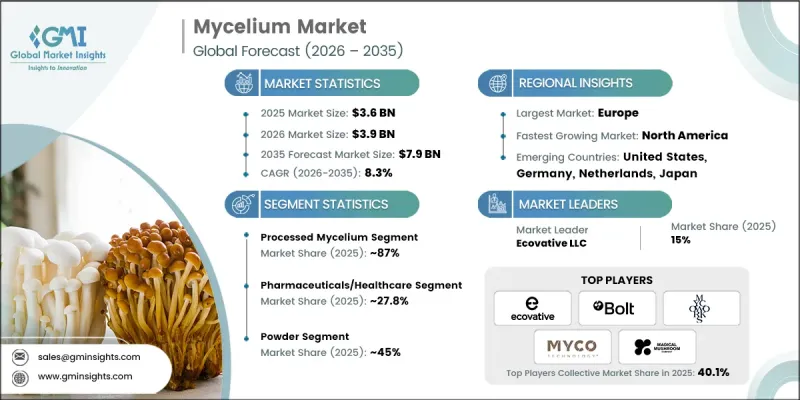
The Global Mycelium Market was valued at USD 3.6 billion in 2025 and is estimated to grow at a CAGR of 8.3% to reach USD 7.9 billion by 2035.
The mycelium industry worldwide is witnessing consistent expansion as industries increasingly prioritize sustainable materials and circular economy practices. Mycelium, which forms the root-like network of fungi, is gaining recognition as a renewable and biodegradable resource capable of replacing several traditional materials derived from fossil fuels. Rising environmental awareness among businesses and consumers is encouraging the adoption of bio-based alternatives that support lower carbon emissions and reduced environmental impact. Governments and regulatory authorities across multiple regions are also promoting sustainable material adoption through stricter environmental regulations and waste reduction policies. As a result, industries are actively exploring mycelium-based solutions for industrial manufacturing, consumer products, and advanced material applications. The packaging and building sectors are showing significant interest in mycelium materials due to their lightweight composition, natural insulation characteristics, and ability to decompose naturally without leaving harmful residues. At the same time, the healthcare and pharmaceutical industries are exploring the potential of mycelium-derived compounds due to their bioactive components that may support various therapeutic applications. In addition, the fashion and textile sectors are increasingly experimenting with mycelium-based alternatives to traditional animal-derived materials as sustainability becomes a key industry priority. These emerging applications, combined with technological advancements in biofabrication and cultivation methods, are steadily strengthening the commercial potential of the global mycelium market.
| Market Scope | |
|---|---|
| Start Year | 2025 |
| Forecast Year | 2026-2035 |
| Start Value | $3.6 Billion |
| Forecast Value | $7.9 Billion |
| CAGR | 8.3% |
The processed mycelium segment accounted for 87% share in 2025 and is anticipated to grow at a CAGR of 8.4% through 2035. This segment holds a leading position because processed mycelium can be easily integrated into a wide range of industrial and commercial applications. Through specialized treatment and manufacturing processes, raw mycelium is transformed into high-performance materials that meet the functional and durability requirements of various industries. Processing techniques enhance properties such as mechanical strength, structural stability, and uniform texture, allowing manufacturers to produce reliable materials for large-scale production. As a result, processed mycelium has become increasingly attractive for businesses seeking sustainable inputs for manufacturing processes. Its ready-to-use characteristics allow companies to incorporate the material directly into production workflows without significant modification, which improves operational efficiency and scalability.
The powder segment held a 45% share in 2025 and is expected to grow at a CAGR of 9% by 2035. Mycelium powder has become one of the most widely utilized product forms because of its versatility and ease of integration into various formulations. The powdered format provides extended shelf stability and allows manufacturers to transport and store the product without significant degradation. Its composition contains concentrated bioactive compounds, proteins, and naturally occurring polysaccharides, which make it highly suitable for multiple commercial applications. The powder form also enables precise measurement and controlled dosing, which is particularly valuable for industries that require consistent formulation standards. Additionally, the ability to blend mycelium powder with other ingredients during production processes increases its practicality for large-scale manufacturing environments. As interest in natural ingredients and functional formulations continues to expand, the powder segment is expected to maintain strong growth across several application areas.
North America Mycelium Market held a 13.9% share in 2025. The North America mycelium industry is benefiting from a highly active biotechnology innovation ecosystem and growing financial support for sustainable material development. Strong collaboration between research institutions, technology developers, and commercial enterprises is accelerating advancements in mycelium-based technologies. The region also benefits from a well-developed research infrastructure and an increasing number of startups focused on bio-based materials and alternative manufacturing solutions. Rising awareness among consumers and corporations regarding environmentally responsible products is further strengthening demand across multiple industries. Businesses operating in North America are also prioritizing sustainable supply chains and low-impact materials as part of their long-term environmental commitments.
Major companies operating in the Global Mycelium Market include Bolt Projects Holdings Inc., Ecovative LLC, Magical Mushroom Company, Mycelia NV, Mycotech Lab, MycoTechnology, Inc., Citribel, MycoWorks, Infinite Roots, and SQIM. Companies participating in the Global Mycelium Market are implementing several strategic initiatives to strengthen their market presence and expand their technological capabilities. A key strategy involves investing heavily in research and development to improve cultivation techniques, material performance, and large-scale production efficiency. Many companies are also forming strategic partnerships with manufacturers, consumer brands, and research institutions to accelerate the commercialization of mycelium-based products. Expanding production facilities and scaling fermentation technologies are additional priorities aimed at meeting growing market demand. Firms are also focusing on product diversification by developing mycelium materials for multiple industries, including packaging, food ingredients, advanced biomaterials, and textiles.
Table of Contents
Chapter 1 Methodology & Scope
- 1.1 Market scope and definition
- 1.2 Research design
- 1.2.1 Research approach
- 1.2.2 Data collection methods
- 1.3 Data mining sources
- 1.3.1 Global
- 1.3.2 Regional/Country
- 1.4 Base estimates and calculations
- 1.4.1 Base year calculation
- 1.4.2 Key trends for market estimation
- 1.5 Primary research and validation
- 1.5.1 Primary sources
- 1.6 Forecast model
- 1.7 Research assumptions and limitations
Chapter 2 Executive Summary
- 2.1 Industry 360° synopsis
- 2.2 Key market trends
- 2.2.1 Nature
- 2.2.2 Product type
- 2.2.3 End Use Industry
- 2.2.4 Regional
- 2.3 TAM Analysis, 2026-2035
- 2.4 CXO perspectives: Strategic imperatives
Chapter 3 Industry Insights
- 3.1 Industry ecosystem analysis
- 3.1.1 Supplier landscape
- 3.1.2 Profit margin
- 3.1.3 Value addition at each stage
- 3.1.4 Factor affecting the value chain
- 3.1.5 Disruptions
- 3.2 Industry impact forces
- 3.2.1 Growth drivers
- 3.2.2 Industry pitfalls and challenges
- 3.2.3 Market opportunities
- 3.3 Growth potential analysis
- 3.4 Regulatory landscape
- 3.4.1 North America
- 3.4.2 Europe
- 3.4.3 Asia Pacific
- 3.4.4 Latin America
- 3.4.5 Middle East & Africa
- 3.5 Porter's analysis
- 3.6 PESTEL analysis
- 3.7 Price trends
- 3.7.1 By region
- 3.7.2 By product type
- 3.8 Future market trends
- 3.9 Technology and Innovation landscape
- 3.9.1 Current technological trends
- 3.9.2 Emerging technologies
- 3.10 Patent Landscape
- 3.11 Trade statistics (HS code)
- 3.11.1 Major importing countries
- 3.11.2 Major exporting countries
- 3.12 Sustainability and environmental aspects
- 3.12.1 Sustainable practices
- 3.12.2 Waste reduction strategies
- 3.12.3 Energy efficiency in production
- 3.12.4 Eco-friendly initiatives
Chapter 4 Competitive Landscape, 2025
- 4.1 Introduction
- 4.2 Company market share analysis
- 4.2.1 By region
- 4.2.1.1 North America
- 4.2.1.2 Europe
- 4.2.1.3 Asia Pacific
- 4.2.1.4 LATAM
- 4.2.1.5 MEA
- 4.2.1 By region
- 4.3 Competitive analysis of major market players
- 4.4 Competitive positioning matrix
- 4.5 Key developments
- 4.5.1 Mergers & acquisitions
- 4.5.2 Partnerships & collaborations
- 4.5.3 New Product Launches
- 4.5.4 Expansion Plans
Chapter 5 Market Estimates and Forecast, By Nature, 2022-2035 (USD Billion) (Kilo Tons)
- 5.1 Key trends
- 5.2 Raw Mycelium
- 5.3 Processed Mycelium
Chapter 6 Market Estimates and Forecast, By Product Type, 2022-2035 (USD Billion) (Kilo Tons)
- 6.1 Key trends
- 6.2 Powder
- 6.3 Dough
- 6.4 Tablets
- 6.5 Others
Chapter 7 Market Estimates and Forecast, By End Use Industry, 2022-2035 (USD Billion) (Kilo Tons)
- 7.1 Key trends
- 7.2 Packaging
- 7.3 Construction
- 7.4 Pharmaceuticals/Healthcare
- 7.5 Clothing and apparel
- 7.6 Automotive
- 7.7 Food and beverage
- 7.8 Others
Chapter 8 Market Estimates and Forecast, By Region, 2022-2035 (USD Billion) (Kilo Tons)
- 8.1 Key trends
- 8.2 North America
- 8.2.1 U.S.
- 8.2.2 Canada
- 8.3 Europe
- 8.3.1 Germany
- 8.3.2 UK
- 8.3.3 France
- 8.3.4 Spain
- 8.3.5 Italy
- 8.3.6 Rest of Europe
- 8.4 Asia Pacific
- 8.4.1 China
- 8.4.2 India
- 8.4.3 Japan
- 8.4.4 Australia
- 8.4.5 South Korea
- 8.4.6 Rest of Asia Pacific
- 8.5 Latin America
- 8.5.1 Brazil
- 8.5.2 Mexico
- 8.5.3 Argentina
- 8.5.4 Rest of Latin America
- 8.6 Middle East and Africa
- 8.6.1 Saudi Arabia
- 8.6.2 South Africa
- 8.6.3 UAE
- 8.6.4 Rest of Middle East and Africa
Chapter 9 Company Profiles
- 9.1 Bolt Projects Holdings Inc.
- 9.2 Ecovative LLC
- 9.3 Magical Mushroom Company
- 9.4 Mycelia NV
- 9.5 Mycotech Lab
- 9.6 MycoTechnology, Inc.
- 9.7 Citribel
- 9.8 MycoWorks
- 9.9 Infinite Roots
- 9.10 SQIM


